
SLIDE 1
We value your feedback on this webinar. Please visit:
https://www.surveymonkey.com/r/NCMM_NIMH_Webinar
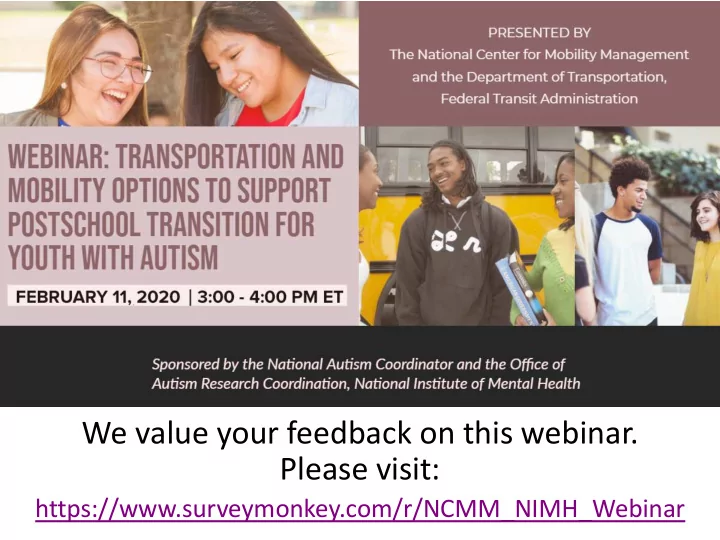
We value your feedback on this webinar. Please visit: - - PowerPoint PPT Presentation
We value your feedback on this webinar. Please visit: https://www.surveymonkey.com/r/NCMM_NIMH_Webinar CCAM Coordinating Council on Access and Mobility Coordinating Council on Access and Mobility (CCAM): Encouraging Partnerships to Improve
https://www.surveymonkey.com/r/NCMM_NIMH_Webinar
Coordinating Council on Access and Mobility (CCAM): Encouraging Partnerships to Improve Transportation Options for Youth with Autism
February 11, 2019 Danielle Nelson, Office of Program Management, Rural and Targeted Programs Danielle.Nelson@dot.gov (202) 366-2160
Coordinating Council on Access and Mobility
Coordinating Council on Access and Mobility
3
HHS Secretary ED Secretary DOL Secretary VA Secretary USDA Secretary HUD Secretary DOI Secretary Attorney General SSA Comm’r NCD Chair DOT Secretary
Mission
The CCAM issues policy recommendations and implements activities that improve the availability, accessibility, and efficiency of transportation for the following targeted populations:
Individuals with Disabilities Older Adults Individuals of Low Income
Organization
Coordinating Council on Access and Mobility
CCAM Mission and Organization CCAM Overview
History
The CCAM is an interagency partnership established in 2004 by Executive Order 13330 to coordinate the efforts
targeted populations.
Public Transportation
Transit Passengers
The Federal Transit Administration (FTA) provides funding that delivers over 10 billion trips to public transportation customers, supporting access to jobs, education, health care and other important activities. Transit Agencies & Assets
Ø 4,000 public transit providers
– 900 FTA grantees (States, transit agencies & Tribes) – 3,000+ Recipients of FTA funds through the States
Ø 130,000 transit vehicles
Section 5310 Requires a Coordinated Transportation Plan
Enhanced Mobility for Seniors & Individuals with Disabilities Program (Section 5310) requires a locally developed, coordinated transportation plan:
https://nationalcenterformobilitymanagement.org/states-at-a-glance/
people with low incomes
Section 5310 Project: Ypsilanti, Michigan
Programs To Educate All Cyclists (PEAC) Ø PEAC is a 501(c)3 non-profit organization Ø Mission: empower individuals with disabilities through cycling, active transportation, and self-advocacy education. Biking and alternative modes of transportation play a critical role in increasing community access, fostering social involvement & self-esteem, and promoting healthy lifestyles among individuals with disabilities. So everyone can ride. https://www.bikeprogram.org/ Active Transportation Program Ø Teaches young adults with developmental disabilities how to more independently walk, bike, and use transit in their communities. Teaches young people how to be advocates for more equitable transportation options in Michigan and beyond.
7
Coordinating Council on Access and Mobility
7
On October 29, 2019, during the USDOT Access and Mobility for All Summit, Transportation Secretary Elaine L. Chao announced a Notice of Funding Opportunity for the Access and Mobility for All Grant Program, which seeks to improve mobility options through strategies to enhance mobility and access to community services for older adults, individuals with disabilities, and people with low incomes. The $3.5-million program will fund projects that enable transportation connections to jobs, education and health services.
CCAM Pilot Program Access and Mobility for All Grant Program
Goal 4: Demonstrate Innovative Coordinated Transportation Objective 1: Implement and evaluate CCAM pilot programs Objective 2: Incorporate the use of innovative technologies in coordinated transportation
The CCAM directed the development of an Advancing Mobility Management Co Course
coordination between transit and non-traditional stakeholders. The interactive course highlights community partnerships that improve coordination and helps participants identify new partners to expand networks and resources. The course is free for public transit and government agencies. 2020 Co Courses: Se September 25-26, 26, 2019 2019 – St
Fe February 5-6, 6, 2020 2020 -Ph Phoenix, AZ Fe February 24-25, 25, 2020 2020 – Na Nashville, e, TN N March ch 25-26, 26, 2020 2020 – Sp Springfield, MA Ma May 5 5-6, 6, 2020 2020 – Den Denver er, C CO Ju June e 16 16-17, 17, 2020 2020 – It Ithaca, NY NY The course is designed to build the capacity of community professionals to implement and scale up mobility management strategies and initiatives, and expose participants to promising practices in the field. Re Register: www www.ntionline.com/advanci cing-mo mobility-ma manageme ment
Coordinating Council on Access and Mobility
Rural Transit Assistance Program website: www.nationalrtap.org 1-888-589-6821 email: info@nationalrtap.org National Aging and Disability Transportation Center website: www.nadtc.org phone: 1-866-983-3222 email: contact@nadtc.org Annual Community Grants National Center for Mobility Management website: www.nc4mm.org phone: 1-866-846-6400 email: info@nc4mm.org Annual Community Grants
Free Transportation Resources
Judy L. Shanley, Ph.D.
Easterseals Director, National Center for Mobility Management
Office of National Autism Coordination Office of Autism Research Coordination National Institute for Mental Health Webinar, February 11, 2020
§ Challenges and opportunities Related to Transportation and Mobility Options for Youth § Strategies to focus on transportation in schools and adult service programs
– Learn about a peer to peer mentoring program to teach transportation advocacy
§ Mobility Management Resources and Systems § Discussion: What are you doing in your community?
Judy Shanley, Easterseals, NCMM Genelle Thomas, PYD Austin Carr
§ Least Restrictive Environment § Inclusion § IDEA § Access to the General Education Curriculum § Home & Community Based Services § Americans with Disabilities Act § Higher Education Opportunity Act § State Employment First Initiatives § Olmstead Act § Workforce Innovation and Opportunity Act
15
§ Students lack knowledge and skills § Students are fearful § Families are fearful § Teachers are fearful § Lack of connections with public transportation § Lack of transportation options - rural § Inconvenience of transportation options § Cost of transportation
I feel like I am independent. I don’t need to depend on my mom and dad to take me places. Now I can ride the bus to get to my job and to the movies with my friends Spontaneous Choice
17
Ideas to Focus on Transportation Education…
§ Engage families, students, human services, and colleagues – Hold a transportation summit – Invite students who use transit, businesses, Voc Rehab § Conduct resource mapping of transportation resources & travel training services – shared services (church, school, business) – student projects § Include mobility & transportation in IEP, service plan, and pre-ets goals § Invite transit professionals into events § Enable students to do transportation-related projects & service learning § Look for grant opportunities to focus on accessible transportation (CCAM) § Integrate transportation content into professional development for educators and adult service providers § Simulate bus using classroom or non-bus setting § Establish travel buddy or peer to peer mentoring programs
– Volunteer driver programs – Demand response systems – Engage employers, health care – non-traditional service providers – “Ruber” service – organic ride share
19
21
Mobility management is an approach to designing and delivering transportation services that starts and ends with the customer. It begins with a community vision in which the entire transportation network—public transit, private operators, cycling and walking, volunteer drivers, and others—works together with customers, planners, and stakeholders to deliver the transportation options that best meet the community’s needs.
23
The mission of the National Center for Mobility Management (NCMM) is to facilitate communities to adopt transportation strategies and mobility options that empower people to live independently and advance health, economic vitality, self- sufficiency, and community. www.nationalcenterformobilitymanagement.org
§ National Technical Assistance Center § Launched in early 2013 § Jointly operated by three national organizations:
– Easterseals – American Public Transportation Association – Community Transportation Association of America
§ Through a cooperative agreement with the Federal Transit Administration (FTA), U.S. DOT
26
§ Judy Shanley – jshanley@easterseals.com – 312-551-7227
February 15, 2018
Transportation Advocacy Mentoring Initiative 1. Demonstration project paired young adults with disabilities from Massachusetts with young advocates with disabilities in Michigan, who already had experience and success advocating for inclusive transportation options. 2. Series of interactive mentoring and educational sessions, young adults from Massachusetts prepared to engage in their own advocacy project. 3. Funded by the Department of Health & Human Services, Administration for Community Living, through an agreement with the Community Transportation Association of America (CTAA). 4. Collaborators were Easterseals, Partners for Youth with Disabilities (PYD), and PEAC.
Why is this project important?
1. Help youth think about inclusive mobility options 2. Assist transit providers to consider the voices of youth with disabilities in service planning 3. Improve range of accessible transportation options 4. Highlight the viability of careers in transportation careers
advocates
know each other
Project Implementation
leadership training.
Keys to Success
Advocate Perspective
transportation advocate?
peer mentors in Michigan?
team's advocacy project?
participating?
you learned? Austin Carr