
SLIDE 1
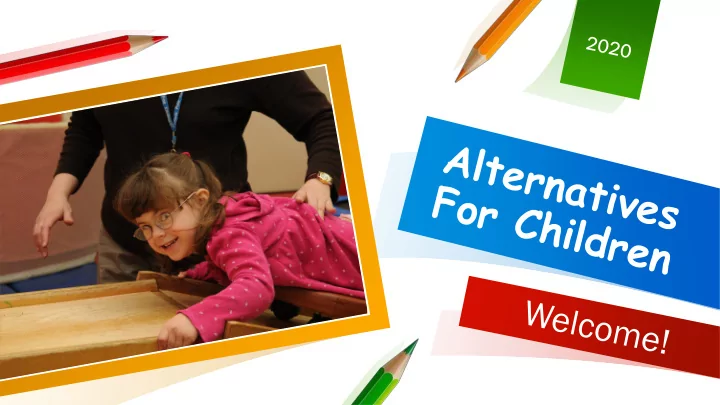
We are so pleased that you are considering placing your trust and - - PowerPoint PPT Presentation
We are so pleased that you are considering placing your trust and your child with us. Since 1988, Alternatives For Children has been at the forefront in providing educational experiences to a broad spectrum of children from across Long Island.
2
We are so pleased that you are considering placing your trust and your child with us. Since 1988, Alternatives For Children has been at the forefront in providing educational experiences to a broad spectrum of children from across Long Island. Alternatives For Children collaborates with most of the school districts across Long Island. For over thirty years, Alternatives For Children has been a well-respected organization, and a known leader in providing quality care to all children, but especially to those who need it most, at the most critical time in their development.
3
Alternatives For Children works to create family- school partnerships to expand learning beyond the classroom and therapeutic environment and share the responsibility and privilege of educating our students along with their parents. As parents, you are an important part of your child’s educational program. Here at Alternatives for Children we welcome and encourage parents to actively participate in all aspects of their child’s program. Working with families and giving them the tools they need to become life-long advocates for their child goes hand-in-hand with our mission of providing the highest quality special and regular education programs and services to children with disabilities and their typically developing peers. Altern ternati tives es Fo For Children en recogn
izes that t acti tive e enga gagemen gement and open commu munica cati tion
betwee een parents ents and school
ports s student ent attain tainme ment t of individ ividualiz ized goals s and ove
rall achie ievem ement ent.
OCFS - Office of Children and Family Services
SOUTHAMPTON
5
background checks are done on all staff
requirements for ongoing training for staff
with all health and safety regulations DIX HILLS EAST SETAUKET AQUEBOGUE The agency that oversees regulation compliance and inspections for our school’s physical facilities is the NYS Office of Children and Family Services.
6
All classes at Alternatives For Children are taught by New York State dually certified special education/early childhood teachers working in collaboration with certified teaching assistants. Therapeutic services are provided by specially trained, licensed and certified therapists experienced in working with young children. Counseling and social work services are provided by licensed and certified psychologists and social workers. Therapeutic and educational staff integrate a child’s related services with their educational program using a whole child team model, creating experiences where the individual needs of each child are met. Our early childhood professionals use developmentally appropriate holistic approaches in the delivery of services to assure that a child’s IEP goals can be achieved.
7
The CPSE recommends programs for you to choose from and the services to meet your child’s individual needs and where they will be provided. That is what has brought you to Alternatives For
and Nassau Counties that offer a center-based educational and therapeutic preschool special education program designed to meet the varied needs of children. If it has been determined that your child has a disability that may be affecting their learning, your local school district’s Committee on Preschool Special Education (CPSE) will find your child to be an eligible "preschool student with a disability.” CPSE – Committee on Preschool Special Education
You
and th the CPS PSE have writt ritten en an an Indivi ividualized ized Educa cati tion Pr Progr
EP) for
chil ild th that lists ists th the recommend ecommended services vices to to be be pro rovi vided
eaks abou
eir:
ength ths s and needs s and how those needs can be met in the least st restrict trictiv ive e envir iron
ment
sent t lev evel els s of performa mance ce
ique e learn rning ing chara ract cteristi eristics cs and educational needs
commodati tion
s and modification ications s needed for your child to achieve their goals The IEP creates a roadmap and an
school administrators, related services personnel to work together to improve educational results for children with special needs. IEP - Individualized Education Program
9
You
IEP Coord
inator
is avail ilable for
shou
qu question stions about yo your child’s progr gram or
ices.
inator
s are familiar with all the components of your child’s IEP.
ent t Conferen erences es to review IEP
Review w Paren ent t Conferen erences ces are held prior to your child’s annual review meeting in the late Winter or Spring to discuss assessments and progress towards goals.
trict CPSE E meeti etings gs and work with your child’s teachers and therapists to coordinate the Annual Revie Review w pro roces cess s for Presch school
. To assist you and help you through the process, your child will be assigned to one of our IEP Coordinators. Your IEP Coordinator is your connection between Alternatives For Children and your School District CPSE. IEP Coordinators also work closely with your child’s team of teacher, therapists, and support staff. IEP Coordinator AFC to Parent to School District Connection
The programs and/or services your child will receive will be outlined in their IEP. The IEP lists the service, how many times a week the service will take place, the duration, and where the service will take place. The programs and/or services your child will receive will be outlined in their IEP
Each child has an assigned treatment
teacher assistants, and therapists. It may also include social workers psychologists, BCBA, behavior aides or 1:1 aides. Your child’s team communicates frequently with each other, evaluates your child’s progress, and meets on a regular basis. As the person who knows your child best, we welcome your input. You are a vital team member and can provide us with important information about your child.
e Techno hnology/ gy/Alter erna native e and Augm gment entative e Commun unication n - Communication Assistive Technology (AT) is used
by children with special needs in order to perform functions that might otherwise be difficult or impossible for them. Assistive Technology device refers to any item, piece of equipment, or product system that is used to increase, maintain, or improve functional
and wheelchairs, as well as hardware and peripherals to help access computers or other information technologies.
erapy - Music Therapy is a well-established, research-
based profession in which music is used to accomplish therapeutic and educational goals. Music Therapy helps to improve cognitive, social, physical, psychological, and communication functioning. The Music Therapists at Alternatives For Children design and implement music sessions for individuals and groups based on the specific needs of the children.
upational Ther erapy y - Occupational Therapy is a developmental
intervention that enhances a child’s ability to successfully function within their environment, both at home and at school. Occupational Therapists work with children facing physical delays, educational delays, cognitive delays, self-care delays or sensory processing disorders that may affect their developmental performance.
hysical Ther erapy y - Physical Therapy as part of a child’s IEP are
therapeutic interventions aimed at maximizing a child’s ability to participate in daily activities in school and at home. The goal of Physical Therapy is to promote independence and age-appropriate gross motor development, improve strength and flexibility, and enhance learning
udent Coun unsel eling ng - Student Counseling builds on the natural way
that children learn about themselves and their relationships in the world around them. Through this therapy, children learn to communicate with others, express feelings, modify behavior, develop problem-solving skills, and learn a variety of ways of relating to
expression of thoughts and feelings appropriate to their development.
ycho hological/Social Work Services es - Psychological and Social
Work Services are integral components of the multidisciplinary team approach in early childhood education. Psychologists and Social Workers collaborate to assure that all students and their families have access to the support and assistance they might need. A variety
families including: social skills groups, parent training, support groups, and parent education workshops.
eech h & Langua guage ge Ther erapy y - Speech-Language Therapy focuses
you, and expressive language, or the ability to use words to express
sounds or words, such as articulation, pitch, fluency, and volume. For children, Speech Therapy generally involves pursuing language milestones that have been delayed. Speech-Language Pathologists work to find fun activities to strengthen a child’s abilities while working on their areas of weakness.
n Services s - The Teacher for the Blind and Visually Impaired
compensatory skill practice, and communication skill practice, which may involve the use of modified materials and equipment such as large print or Braille, slant boards or light boxes.
d Certifi fied ed Behavior
yst, BCBA, may be added as
part of your child’s team. A BCBA studies the behavior of children and can help teachers and parents identify learning challenges that a child may be experiencing, and respond by implementing strategies and differentiating instruction to help them access the curriculum with more independence.
gister ered d Behavior
hnician RBT BTs, assist in delivering
behavior analysis services in the classroom in conjunction with the RBT Supervisor, BCBA, and the child’s team.
es,
, under the direction of the teacher and BCBA, work with individual children on implementation of classroom wide rules and individualized behavior plans.
1 Aides, es, are assigned to individual children who have this
service identified in their IEP. 1:1 Aides, under the direction of the teacher, assist children with independent dressing skills, structured activities, and other educational and therapeutic goals set forth by the IEP.
Your child’s recommended class ratio is listed on their IEP
15
6:1:1 5 hour classes 12:1:2 5 hour classes (Integrated) 15:1:2 2½ hour classes (Integrated)
6:1:1 3, 4 and 5 hour classes 6:1:2 4 hour classes 12:1:1 2½, 3, and 4 hour classes 15:1:2 2½ hour classes (Integrated)
Class Ratio The student-to-teacher-to- teaching assistant ratio For example a 6:1:1 class ratio refers to a maximum of 6 students 1 special education teacher and 1 teaching assistant
6:1:1 5 hour classes 12:1:1 2½ and 5 hour classes 12:1:2 5 hour classes (Integrated) 15:1:2 2½ and 5 hour classes (Integrated)
6:1:1 5 hour classes 6:1:2 5 hour class 12:2:1 3 hour classes (Integrated) 12:1:1 5 hour classes 18:2:1 3 and 5 hour classes (Integrated)
16
17
The physical environment of a classroom has a profound effect
group, teachers, assistants and support staff. A classroom that is safe, attractive, comfortable and well- designed helps children engage in learning activities.
It is evident how much children enjoy running, jumping, climbing, and playing
to their learning as the time they spend in the classrooms. All our playgrounds have accessible and age-appropriate equipment that is checked daily for safety. Outside play is an extension of the classroom and is often structured by the classroom staff to target specific goals of the children.
19
that are used for large and small group instruction, music and movement, and gross motor activities.
use in small groups to support fine-motor skill and literacy development.
for students to listen to stories being read aloud as they follow along in a book. Listening Centers are used to help children in developing critical listening and comprehension skills.
Educational Technology Teachers.
teachers with resources for Smart Board, iPad, Listening Centers, and for use in the classroom that enhance and enrich the materials presented for the Creative Curriculum study the class is working on.
Each of our classes are able to participate in at least one music class a week provided by our Music Therapists. Some classes have the opportunity to meet with a Music Therapist for Music class two times a week. Music therapists use music, much of which is written by them especially for our children, that works on the development of listening, cognitive, academic, motor, social, and emotional skills. Musical experiences can include instrument play, singing, listening, music relaxation, and movement to music.
21
Each of our locations have areas that are dedicated as a natural learning environment. Our “Garden Areas” that include planters, planting tables, trees, shrubs, and flowerpots provide opportunities for teachers and the children to explore the important role of the garden as a place for play, exploration, inquiry, sensory integration, and building cooperative relationships. Plus, the added bonus of simply watching plants grow that we can eat, and the beauty that flowers provide.
free to explore and learn
Alternatives For Children uses the Creative Curriculum for Preschool, which is aligned with the New York State Common Core Learning Standards (CCLS), and ensures continuity with the Common Core State Standards in ELA and Math. The Creative Curriculum is based on research and theory of child development. It is designed to foster children’s social/emotional, physical, cognitive and language development, as well as enhance learning in literacy, math, social studies, the arts and technology. Additionally, social and emotional skills are a focus of the curriculum, giving children the opportunity to learn about sharing, turn taking and self-help skills. A Day in the Life at Alternatives For Children
that encourages all children to discover and learn.
they provide children with opportunities to gain information through direct observation and experimentation and then link new ideas to what they already know.
child’s individual needs, as well as incorporating a balance of child centered versus teacher directed instruction presented in a range of environments, large and small groups, and one-to-one teaching.
child receives appropriate support to ensure success in achieving their IEP goals.
All About Me Throughout the school year, children explore a variety of studies through first-hand exploration and discovery. Investigative studies may include Trees, Clothes, Buildings, Balls, Wheels, Water, Exercise, Boxes and Getting Ready for Kindergarten. Buildings Flowers Clothes Balls
Designing an effective learning environment is foundational to helping children explore, discover, and learn Classrooms are divided into Interest Areas Separate interest areas with a variety of materials
Interest Areas contain specific materials and activities that support learning opportunities.
s Center er - When children construct, create and represent their
experiences with blocks, they progress in many areas of development and learning.
er - When children engage in dramatic play, they
deepen their understanding of the world and develop skills that will serve them throughout their lives.
ys, games, es, puzzles, es, manipulatives ves – These materials offer
children quiet activities that they can do alone, with another child, with a teacher or other adult, or with a small group. Children strengthen skills in all areas of development as they play with toys and games.
r is a place filled with materials that children can enjoy on a
purely sensory level. Here children can create and represent their ideas in a visual form. Children draw, paint, knead, cut, glue, and make things of their own choosing. Creative art is another language children use to express what they know and what they feel.
d and Water er Tabl bles es - While sand and water play can delight the
senses, it also can challenge children’s minds and promote all areas
rary y Litera eracy Book
day, look through books on their own, listen to recorded stories, retell familiar stories, and make up their own stories, children strengthen skills in all areas of development.
ery y ST STEM - In the Discovery area, children use their senses to
touch, feel, taste, smell, and see. They act on objects and observe what happens.
ent - Music and movement experiences help
develop both sides of the brain and contribute to children’s social- emotional, physical, language, and cognitive development and learning..
hnol
y - Computer/ er/sm smartboa board d iPad d - Children use
technology devices like computers and tablets to investigate questions, solve problems, and explore and manipulate objects on a screen.
Because the classroom belongs to everyone, taking care of it is a shared responsibility. Everyone helps with daily jobs; putting things away, throwing away trash after snack and lunch. Centers and all the materials in them are labelled. Labels serve to show children that everything has a place. Pictures and words in lowercase letters are used for labels so that children can easily identify what things are and where they belong. .
Routines and Schedules are important because they influence a child's emotional, cognitive, and social development. They help children feel secure. They help children understand expectations.
happen today, what is different. Children can share topics that are important to them (like a new pair of shoes). The class may engage in songs and finger-plays.
happened during the day. Short - Large Group Meetings, or a group activity takes place at the beginning of the class day, and then one at the end of the day.
every day. Small group experiences are designed to meet a child’s particular goals.
to introduce a new concept or new materials to children teach a specific skill encourage conversations and the sharing of ideas extend children’s thinking by asking questions and posing new challenges focus observations on individual children and document what children know and can do and the collection of data
What does a day in the life look like?
29
When time is blocked out in an orderly and consistent fashion, children tend to feel secure and become increasingly independent. A good balance of active and quiet times, as well as a range
are scheduled throughout the day. A daily schedule helps children begin to understand time concepts as they anticipate what comes first in the day, second, next, and last. Sufficient time is allowed in interest areas so children can become deeply involved in their play. Times for teaching literacy, math and the intentional teaching of social/emotional skills are included in lesson plans for every day.
Individual visual schedules, for those children who need one, are based on each child’s developmental level and specific needs. Teachers set up the To Do - and when an activity or interest area is completed the child moves the icon to - All Done. An Individual Schedule works very much like a classroom Visual Schedule in that it helps children begin to understand time concepts as they anticipate what comes first in the day, second, next, and last. Children move the activity icon from To Do to All Done once an activity is completed
One Step Command Rings
Staff present appropriate picture
be transitioning to as they are verbally stating the command or transition place.
children to be able to achieve success in transitioning.
for one more puzzle.”
children to do.
keep the same routine each day so children learn what to do and how to do it without a lot of adult guidance.
transitions throughout the day. Mighty Minutes
From the Creative Curriculum are songs, chants, rhymes, games and short activities used during transition
classroom.
First/Then Boards
Some children may need to use a first/then board to help with transitions. “First puzzle, then playground
A 1-2 minute announcement is made before an activity is about to end so children know what to expect and that the activity time is almost over.
Safely prepared, nutritious snacks are provided for our preschoolers. Because each child’s physical development is as important as his social, emotional, or intellectual development, we are committed to providing healthy snacks for young children who are just beginning to acquire food preferences.
32
Snack and Lunch time is a learning time. Good experiences at mealtimes help children to develop positive attitudes toward food and nutrition. Children participate in setting up, serving, and cleanup at meals and snacks. Snacks and lunch are served “family style.” Children and teachers eat together and share conversation just as a family would. Mealtime is a time where children are exposed to and encouraged to try new foods.
Each snack consists of a variety of food choices - all healthy. Snacks and fruits are not sweetened, little
Sugared candies, cookies, chips, chocolate, and sweets are not part of our regular meal/snacks.
Mond nday Tuesday Wednes nesday Thursday Friday
Chicken ken Nugget ets Rice Gravy vy Broccoli Applesauce Milk Meatl tloaf on Whole Grain Bun Golden en Corn rn Peach Cup Milk Macaroni & Chee eese Carrot t Circles es Apple Slices es Milk Hamburger er Whole Grain Bun Ketc tchup Baked ed Beans Cut t Melon Milk Whole Grain Pizza Cucumber ers Pear Cup Milk
SAMPLE E Lunch Menu
Mond nday Tuesday Wednes nesday Thursday Friday
Apple juice Pineap eapples es Milk Mandarin Oranges es Applesauce Corn Chex ex low fat vanilla yogurt Chee eerios Kix Goldfish wate ter wate ter wate ter
SAMPLE Snack k Menu
Children en with document mented ed food allerg ergie ies s or dieta tary y restricti triction
ided ed with altern ernati tive e food choices. ices. Paren rents ts may choose
to suppl plem ement ent the e daily y menu as medica cally y need eded ed. .
Alternatives For Children is a NUT FREE E envir iron
students who have a severe, life-threatening allergy to specific foods or other conditions (such as a bee sting) will be kept in the clear case inside a specified red backpack within each classroom. The EpiPen will travel with the student wherever they go throughout the day. Alternatives For Children participates in the Child Obesity Prevention programs “Let’s Move” and the Cornell Cooperative Extension Food Program.
Eve very member r of a student’s educati tion
team is familiar r with the EpiPen and the doctor’s orders.
Fo Food preferen erences es and physica ysical acti tivit ity habit its s develop evelop during ing early y childhood
tinue e into adulth thood
Remember - even 5 year olds have only been using a toilet for a couple of years! Toilet training can be a challenging and frustrating time for children and parents. Toilet training is treated by staff in a positive and respectful manner. Parents and caregivers working together will ensure the success of the toilet training experience.
All the classrooms at Alternatives For Children utilize some form of a Daily Visual Schedule. The children are very used to moving through their day by following the schedule with adults giving indications of when it is time to transition. Visual Schedules are used so that the children know what to expect and what is expected of them. Positive language and neutral talk is used by all staff. Negative statements are avoided. Behaviors are anticipated and pre-correction is used. Children are acknowledged regularly and appropriately for positive behaviors, and NEVER criticized for negative behaviors! Criticizing doesn’t decrease negative behaviors. It
and creates an unpleasant interaction.
As part of PBIS practices, Alternatives For Children has developed organization- wide procedures to support implementation of the Pyramid Model. We believe that through the implementation of PBIS systems and the Pyramid Model strategies we will increase academic performance, increase safety, decrease problem behavior and establish a positive school climate The main focus of the Pyramid Model is to provide a clear system for all expected behaviors at Alternatives For Children. Through PBIS and the Pyramid Model we work together to create and maintain a productive and safe environment in which all community members clearly understand the shared expectations for behavior. Through positive recognition and continual teaching of expectations students will experience academic and social growth. One of the key components of PBIS and the Pyramid Model is the focus on prevention. Children are taught clearly defined behavioral expectations for all aspects of the school environment. They are provided with predictable responses to their behavior, in a positive way. A small number of behavioral expectations are positively stated and clearly defined. Behavioral expectations are taught to all students.
At the beginning of each school year every classroom will work together to develop the expectations for their
will define what it looks like when We Are Safe, Kind and Ready in the classroom. Large display posters of the behavioral expectations are placed throughout the buildings as visual learning tools and reminders for the children.
The SCERTS Model is implemented by the child’s multidisciplinary team in collaboration with the family. SCERTS concen centra trates es on three ree key ey areas eas: social ial commu mmunica icati tion
relationships and communication skills emoti
gulati tion
emotional ups and downs transa sact ction
ppor
t – providing helpful aids to communication and learning. The SCERTS Model is a model of service provision, rather than a specific program. It combines several techniques to create individualized programs for children with autism spectrum disorders. SCERTS aims to help families, teachers and therapists work cooperatively to support individual children with ASD. The acronym stands for Social Communication (SC), Emotional Regulation (ER) and Transactional Support (TS). SCERTS was developed specifically for preschool-age and primary school-age children with ASD. SCERTS is used to teach children with ASD how to regulate their emotions and communicate with others.
da book
with families about what their child is doing in the classroom and therapy sessions. Speech therapists use a marble notebook to communicate with families.
ssroom new ewsl slet etters ers are sent home weekly. Newsletters review what has happened in the class that week and preview the following week. The newsletter contains lists of book, songs, activities and recipes to carry over things learned in the classroom to the home.
rogres gress s reports s are provided quarterly for IEP students and present the child's strengths and weakness; they explain the specific level of needs within the classroom; discuss cueing and how the goal is to fade out prompting; give examples of tasks the child can do independently or has mastered.
ent t Conferen ences ces are held in the Fall. The purpose of the conference is to review IEP goals.
eview w Paren ent t Conferen ences ces are held prior to the child’s annual review meeting to discuss assessments and progress towards goals
How do I reach my teacher or therapists? It’s always a good idea to speak directly to the person that you might have a question for. If your question is about something going on in the classroom or one of your child’s therapies – you can always write a note in your child’s blue agenda book and the teacher or therapist will get back to you. Speech Therapists use a marble notebook for communication. You may also call the main office and leave a message for a teacher or therapist to call you. Return phone calls will be made during a teacher or therapists prep time or at the end of the school day. Phone calls are not put through to classrooms or therapy rooms during class time.
How
rd or easy y is it to get et in and out of the e buildi ding? g? All exterior doors at all our schools are
locked, and are visible by a closed-circuit camera in the receptionist’s or main office. Families that are known to the receptionist are buzzed in at the door. Photo ID of people unfamiliar to the receptionist must be shown before they are buzzed in.
A child d is NEVE VER R relea eased sed from rom the e schoo
ess the e person son picking g them em up is known to the e staff f mem ember
and verification of the individual by photo ID, preferably a driver’s license is made. If the person is NOT listed on the Emergency Contact/ Release form, the child will be retained at the school and the parent will be called.
Can my y child d run out of classr sroo
? The safety of every child in our program is our first priority.
Classroom doors are closed while the children are in the room. Classrooms are equipped with wind chimes or bells placed over the door that “ring” every time the door is opened. Children are never left without direct, competent supervision
When en leaving g a classr sroo
her areas s of the e buildi ding g or outsi side de, staff position
themselves in designated areas with one staff member close to the entrance or exit to allow for monitoring of the gate or door. Staff communicate frequently with one another by making eye contact and expressing their needs. Walkie-Talkies are used when the class is outside to maintain communication with the main office and the nurse’s office.
Staff use our Name e to to Face e Log procedures required by OCFS, to keep an accurate daily log
various learning environments throughout the day. The Name to Face Log is taken with staff everywhere they go! Staff MUST match the child’s name on the paper er to to seeing ing thei eir face.
the child is present upon leaving the classroom, upon arriving at their destination, leaving their destination, and arriving back at the classroom. A child’s day is filled with many activities, outdoor play, gym, music, computers as well as therapeutic treatment sessions. The Name to Face Logs are used to keep track of where the child is at ALL TIMES throughout their day.
Alternatives For Children is required by OCFS to maintain a Health care plan that is reviewed, approved, and renewed every two years. Our Health Care Plan includes:
injury and including notifying a child’s parents
cleaning, sanitizing and disinfecting
medications
Hand Washin ing Must t Occur:
touching a runny nose or sneezing
Hand Washing is a frequent occurrence at Alternatives For Children
Large equipment that is frequently used or touched by children on a daily basis must be cleaned and then sanitized or disinfected using an EPA-registered product. Diapering surfaces must be disinfected after each use. Countertops, tables, hard surfaces, and food preparation surfaces must be cleaned and sanitized before and after food preparation and eating, and any other time they are soiled – for example after a craft activity. At Alternatives For Children the health and safety of our students, families and staff is as important as the educational and therapeutic programs we provide. Disinfecting a surface will “kill” the microscopic
particular product. Alternatives For Children, in compliance with OCFS guidelines, follows manufacturer specific instructions when utilizing one step cleaners and sanitizers to ensure effectiveness in fighting germs. Spray bleach solutions require 2 minutes surface contact time to be effective
The School Nurse is an integral part of the team ensuring the health and safety of all Students – Teachers – Therapists - Staff In accordance with OCFS requirements, Alternatives For Children must submit an annual medical form for each child that indicates current immunization status and general state of health. Preschoolers, ages 3-5, are required to have vision and hearing screenings, as well as a dental exam.
In order to protect the health of everyone at Alternatives For Children, no child may be in attendance when they have a contagious illness
keep your child at home if they are ill. What t happe pens s with chil ildren ren
If yo your chil ild becomes
jured ed during ing the day Children who appear ill or are injured are taken to the nurse’s
condition, and with staff decide whether or not it is appropriate for the child to remain at school. If yo your chil ild will need to to be sent t home, they will be made as comfortable as possible until you arrive. If you cannot be reached we will call your emergency contact/pickup telephone numbers. If yo your r chil ild falls s ill or gets s injur jured ed during ing the day you will be called if it is a significant incident. In addition, a note will be sent home from the nurse in your child’s backpack about any visit to the nurse’s office, other than for medication. Please se make e sure re that t yo your r emerg rgen ency cy conta tact/p ct/pick ickup p te telep ephon
e numb mber ers s are kept t curren ent. t.
Please make sure that your emergency contact/pickup telephone numbers are kept current Medica cati tion
If your child is on medi dication
y basis, or for an illness, a note must be sent to the attention of the nurse, with instructions from your child’s doctor. In the event of a medical emergency it is important that we know if and what medications your child is taking.
If Medica cati tion
to be dispen ensed at Schoo
A MEDICA CATION N CONS NSENT FO FORM for prescription medications must be completed by a Licen ensed sed Au Authori horized ed Presc scri riber ber. Medication Consent Forms must be reauthorized every 6 months for children under 5 years of age. The presc escri ription
bottle must be clearly labeled with the child’s full name, the name e of the medi dication,
e dosage ge to be given ven, and the met ethod hod by by which h the e medi dication
stered.
pharmacy label MUST be intact. Medication is only given by the nurse, or an administrator who is MAT certified. The e schoo
se must st recei eive e a new ew Medication
sent Fo Form rm if any changes ges in medi dication
sage ge occurs. rs.
Shel elter er-in in-Place Place is a response to an emergency that creates a situation in which it is safer to remain in the building rather than to evacuate. Lock ck Down
an intruder or an emergency situation outside the school that prevents the evacuation of students from the building. Paren ent t not
ices will be sent home prior to Shelter-in- Place and Lock Down drills. Two Shelter-in-Place and two Lock Down drills are conducted each school year. Fire drills in both morning and afternoon sessions are conducted twice a month.
The Safe e School
s Against st Violen ence ce in Educa cation
Ac Act Projec ect t SAVE E wa was s signed ed into to law w in July 2000, to to imp mprove e school
ety in our schools.
Altern ernatives es Fo For r Childr dren en has in place e procedu rocedures res to address ress respo sponses ses to a va variet ety of emergenc ergencies es in
Each Alternatives For Children location has a School Emergency Team that is responsible for overseeing & implementing Project SAVE procedures.
Drop
en from m school
Families who choose to drive their children each day might be reimbursed from Suffolk/Nassau County through the Parental Mileage Reimbursement Program (PMR). Mileage reimbursement must be authorized prior to actual services through the school district CPSE meeting. If someone other than you will picking the child up from school, the parent or legal guardian must notify us in writing. We maintain a list of who is authorized to pick up your child from school, and any change must be submitted in writing. Bus transpor sporta tati tion
through the school district CPSE meeting. Bus drop off and pick up information must be kept up to date. It is your responsibility to inform us of any changes. If someone other than you will be taking the child off of the bus, the parent or legal guardian must notify us in writing. We maintain a list of who is authorized to pick up your child from school or take them off the bus, and any change must be submitted in writing. Under direction and guidance from OCFS, and with the added requirement of social distancing, the drop off and pick up of children from the school building is under review. We will notify you once new procedures are put in place.
1116 Main Street Aquebogue, N.Y. 11931 Phone: (631) 722-2170 Fax: (631) 722-2177
600 South Service Road Dix Hills, New York 11746 Phone: (631) 271-0777 Fax: (631) 271-0999
14 Research Way East Setauket, N.Y. 11733 Phone: (631) 331-6400 Fax: (631) 331-6865
168 Hill Street Southampton, N.Y. 11968 Phone: (631) 283-3272 Fax: (631) 283-3356