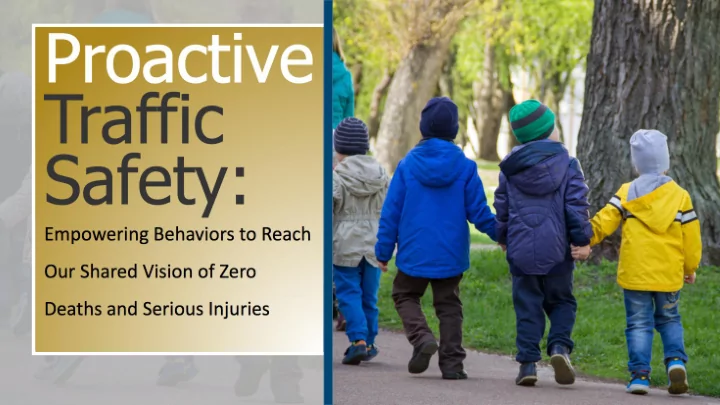
SLIDE 1
SLIDE 2
- We Are in This Together
- Proactive Traffic Safety – What You Need to Know
- Where We Go from Here
AGENDA
PROACTIVE TRAFFIC SAFETY
SLIDE 3 The only acceptable traffic safety goal is to reduce fatalities and serious injuries to zero.
We Are in This Together
National Highway Traffic Safety Administration (NHTSA). Fatal Analysis Reporting System (FARS). Washington, DC: US Department of Transportation.
- 2017. https://cdan.nhtsa.gov/STSI.htm
SLIDE 4
- Driver behavior is a significant factor contributing to
motor vehicle crashes.1
- To improve traffic safety, we must focus on
strategies that influence risky driver behaviors.
- Risky driver behaviors include deliberate behaviors
like
- speeding,
- texting while driving,
- impaired driving, and
- not wearing a seat belt.
We Are in This Together
- 1. National Highway Traffic Safety Administration (NHTSA). Critical Reasons for Crashes Investigated in the
National Motor Vehicle Crash Causation Survey. (DOT HS 812 115). Washington, DC: US Department of
- Transportation. 2015. https://crashstats.nhtsa.dot.gov/Api/Public/ViewPublication/812115.
SLIDE 5 The majority of road users already engage in safe behaviors.
- Most people (90%) wear a seat belt.1
- Most people (92%) do not drive within two hours of drinking alcohol.2
- Most people (95%) do not drive within two hours of using cannabis.2
- Most people (81%) do not speed (in excess of 10 mph over the posted
speed).3
We Are in This Together
- 1. National Highway Traffic Safety Administration (NHTSA). Traffic Safety Facts: Seat Belt Use in 2017—Overall Results. (DOT-HS-812-465).
Washington, DC: US Department of Transportation. 2018. https://crashstats.nhtsa.dot.gov/Api/Public/ViewPublication/812465.
- 2. Center for Behavioral Health Statistics and Quality. Results from the 2017 National Survey on Drug Use and Health: Detailed Tables. Washington, DC:
Substance Abuse and Mental Health Services Administration, U.S. Department of Health and Human Services. 2018. https://www.samhsa.gov/data/sites/default/files/cbhsq-reports/NSDUHDetailedTabs2017/NSDUHDetailedTabs2017.htm#tab6-84B
- 3. De Leonardis, D., R. Huey, and J. Green. National Traffic Speeds Survey III: 2015. (DOT HS 812 485) (March, 2018). Washington, DC: National
Highway Traffic Safety Administration. 2018.
SLIDE 6
- How do we leverage the large group
- f people already engaging in safe
road user behaviors to influence the smaller group engaging in risky road user behaviors?
QUESTION
We Are in This Together
ANSWER
SLIDE 7
- The roadway transportation system is a shared community.
- Each of us is a member of the community because we depend on this
shared system to connect us with people, places, goods, and services.
- For this system to meet everyone’s needs and be sustained, we have
an obligation to one another to act in ways that support the system.
- Compliance… AND SOMETHING MORE!
PROACTIVE TRAFFIC SAFETY – What You Need to Know
SLIDE 8
- To achieve higher levels of safety,
individuals need to go beyond compliance to commitment – a commitment to safety for themselves and others.
- A commitment to safety means committing
to avoiding risk as well as committing to taking actions to keep safe.
COMMITMENT
PROACTIVE TRAFFIC SAFETY – What You Need to Know
SLIDE 9
- Proactive behaviors demonstrating commitment to a safe roadway
transportation system.
- “Proactive”
- “acting in anticipation of future problems, needs, or changes”1
- “serving to prepare for, intervene in, or control an expected
- ccurrence or situation, especially a negative or difficult one”2
PROACTIVE TRAFFIC SAFETY IS…
PROACTIVE TRAFFIC SAFETY – What You Need to Know
- 1. Merriam-Webster Dictionary. “Proactive” Accessed April, 2019, https://www.merriam-webster.com/dictionary/proactive.
- 2. Dictionary.com. “Proactive” Accessed April, 2019. https://www.dictionary.com/browse/proactive.
SLIDE 10
- Supporting existing traffic safety efforts
- Staying informed of safety-related issues
- Planning a safe way to get home before drinking alcohol
PROACTIVE TRAFFIC SAFETY INCLUDES PROACTIVE BEHAVIORS LIKE:
PROACTIVE TRAFFIC SAFETY – What You Need to Know
SLIDE 11
- Speaking up about unsafe behaviors like not wearing a seat
belt or driving distracted
- Establishing family rules about safety like never texting while
driving or never riding with someone who has been drinking alcohol
- Establishing a workplace policy like always wearing a seat
belt in a company vehicle
PROACTIVE TRAFFIC SAFETY INCLUDES PROACTIVE BEHAVIORS LIKE:
PROACTIVE TRAFFIC SAFETY – What You Need to Know
SLIDE 12
- Creates a shared commitment to safety
- Encourages proactive behaviors that support safety efforts
- Encourages proactive behaviors that extend beyond one’s own
safety to support the safety of others
- Expands the focus to include the large group of safe road users as
a way to influence the small group engaging in risky behaviors
- Enhances existing Strategic Highway Safety Plan efforts
GROWING PROACTIVE TRAFFIC SAFETY
PROACTIVE TRAFFIC SAFETY – What You Need to Know
SLIDE 13 Growing proactive traffic safety is an
- pportunity for traffic safety
professionals and stakeholders to create lasting and sustainable improvements in traffic safety behaviors.
PROACTIVE TRAFFIC SAFETY – What You Need to Know
SLIDE 14
- Proactive traffic safety is a new opportunity to
improve traffic safety.
- It’s an approach that leverages our existing positive
traffic safety culture and, once established, is likely to be sustained.
- Action is needed to move this approach forward.
- Tools
- Tips
- Reflection Questions
PROACTIVE TRAFFIC SAFETY – Where We Go from Here
SLIDE 15
- A Proactive Traffic Safety Primer
- A Proactive Traffic Safety PowerPoint
Presentation
- A Conversation Guide
- A Proactive Traffic Safety Poster
PROACTIVE TRAFFIC SAFETY – Where We Go from Here
TOOLS
SLIDE 16
- Tip #1. Think in Terms of Allies and Partners
- Tip #2. Engage Others about Proactive Traffic Safety
- Tip #3. Grow a Shared Understanding of Proactive Traffic Safety
- Tip #4. Think about Hosting a Meeting, Providing a Presentation,
and/or Facilitating a Conversation about Proactive Traffic Safety
- Tip #5. Use the Available Communication Tools
- Tip #6. Integrate Proactive Traffic Safety into Existing Strategic
Highway Safety Plans
TIPS
PROACTIVE TRAFFIC SAFETY – Where We Go from Here
SLIDE 17
- How could growing proactive traffic safety help you
achieve your desired traffic safety outcomes?
- What are the opportunities for applying proactive
traffic safety to your current efforts right now?
REFLECTION QUESTIONS
PROACTIVE TRAFFIC SAFETY – Where We Go from Here
SLIDE 18 PROACTIVE TRAFFIC SAFETY
- Traffic safety professionals and stakeholders must
continue to evolve and seek innovative ways to reduce risky driver behaviors and increase safer behaviors.
- Growing proactive traffic safety cultivates a traffic safety
culture where people commit to a safer transportation system.
- Growing proactive traffic safety behaviors is a new
- pportunity to strategically address risky traffic
behaviors and ultimately achieve and sustain our Towards Zero Deaths goals.
CONCLUSION
SLIDE 19
PROACTIVE TRAFFIC SAFETY
Traffic Safety Culture Pooled Fund The transportation Pooled Fund (TPF) Program allows federal, state, and local agencies and other organizations to combine resources to support transportation research studies. Current participating States: CA, CT, ID, IL, IN, IA, LA, MS, MT, NV, TX, UT, VT, and WA. Managed by: Sue Sillick, Research Programs Manager Montana Department of Transportation 2701 Prospect Avenue, PO Box 201001 Helena, MT 59620-1001 Office: 406.444.7693 E-mail: ssillick@mt.gov www.mdt.mt.gov/research/
RESEARCH SPONSOR
SLIDE 20
PROACTIVE TRAFFIC SAFETY
CONTACT US EMAIL: MAIL@CHSCULTURE.ORG PHONE: (406) 994-7873
#CHSCulture www.chsculture.org