SLIDE 1
Water Travels on Gradients
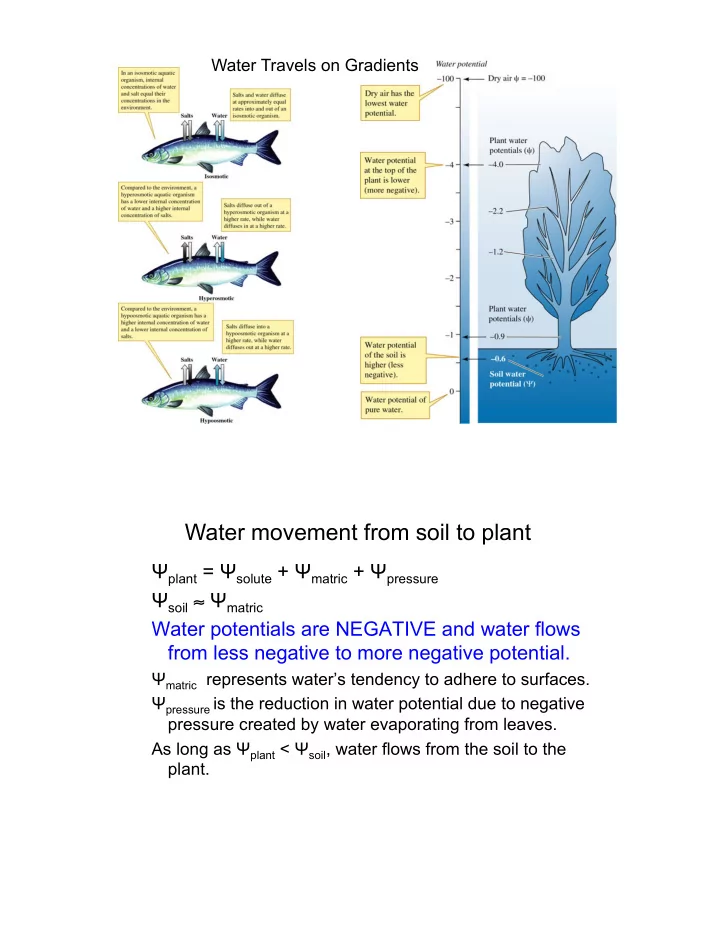
plant = solute + matric + pressure soil matric Water potentials are NEGATIVE and water flows from less negative to more negative potential.
matric represents water’s tendency to adhere to surfaces. pressure is the reduction in water potential due to negative pressure created by water evaporating from leaves. As long as plant < soil, water flows from the soil to the plant.
Water movement from soil to plant
SLIDE 2
In plants, water flows in a continuous stream from root to leaf
Plant Wip= Wr + Wa - Wt - Ws Wip= Internal water Wr =Root uptake Wa = Absorbed (air) Wt = Transpiration Ws = Secretions Animal Wia= Wd + Wf + Wa - We - Ws Wia= Internal water Wd = Drinking Wf = Food (as source) Wa = Absorbed (air) We = Evaporation Ws = Secretion / Excretion
Water budgets in plants and animals.
SLIDE 3
Plant and animal water balance A. A. B. B. C. C. D. D. E. 7.
SLIDE 4
Ecological transactions with multiple currencies Heat budget: Energy balance HS = Hm ± Hcd ± Hcv ± Hr - He Water budget: Water balance Wip= Wr + Wa - Wt - Ws Coupled budgets and trade-offs: Carbon gain vs. Water loss Light interception vs. Heat stress sunlight
SLIDE 5 Joseph Grinnell Charles Elton (w/ Aldo Leopold)
Niche pioneers
And NUH is the letter I use to spell Nutches, Who live in small caves, known as Niches, for hutches. These Nutches have troubles, the biggest of which is The fact there are many more Nutches than Niches. Each Nutch in a Nich knows that some other Nutch Would like to move into his Nich very much. So each Nutch in a Nich has to watch that small Nich Or Nutches who haven't got Niches will snitch.
SLIDE 6 Niche: Questions
Are niches properties of species or habitats? Do they describe roles (professions) or conditions (addresses)? How do you measure them or quantify them? Are there “empty niches?” Can two species share the same niche?
Niche axis 1 (e.g., Temperature) Niche axis 2 (e.g., moisture)
Niche as “N-dimensional hypervolume” the set of all conditions under which a species can exist
Fundamental niche
SLIDE 7
Niche axis 1 (e.g., Temperature) Niche axis 2 (e.g., moisture)
Niche as “N-dimensional hypervolume” the set of all conditions under which a species can exist
Fundamental niche Realized niche
Iverson and Prasad 1998, Distributions of 80 sp. of trees Fundamental or realized niche?
SLIDE 8
What limits the distribution of barnacles? Is there a trade-off? Spatial patterns within populations What is the role of scale?
SLIDE 9 Spatial pattern is scale dependent Metapopulations - Populations of populations scale
random competitive
adversity
clumped environmental regular
Weiher and Keddy 1999 – Conceptual Model
SLIDE 10 Abundance Varies in Space Clumped at Broad Scales scale
random competitive
adversity
clumped environmental regular
Tolerance and distribution in Encelia species They are all closely related, how are they different?