WAQUOIT BAY STREAM RESTORATION MASTER PLAN Falmouth and Mashpee, - - PowerPoint PPT Presentation

waquoit bay stream restoration master plan
SMART_READER_LITE
LIVE PREVIEW

WAQUOIT BAY STREAM RESTORATION MASTER PLAN Falmouth and Mashpee, - - PowerPoint PPT Presentation

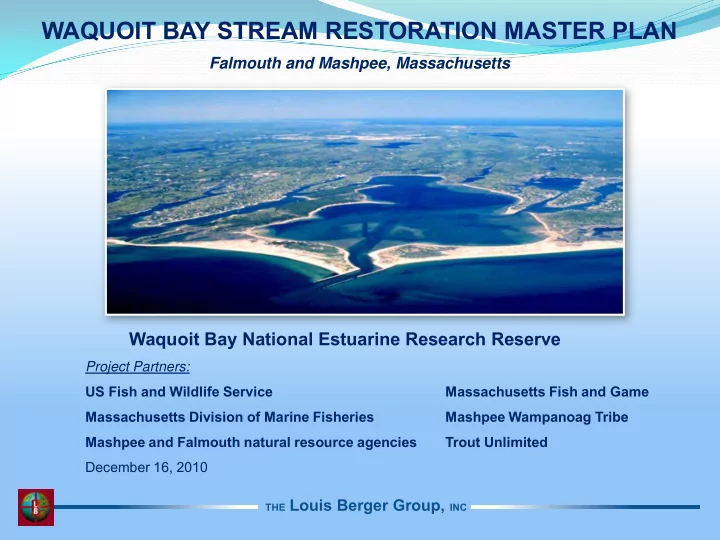
WAQUOIT BAY STREAM RESTORATION MASTER PLAN Falmouth and Mashpee, Massachusetts Waquoit Bay National Estuarine Research Reserve Project Partners: US Fish and Wildlife Service Massachusetts Fish and Game Massachusetts Division of Marine


slide-1
SLIDE 1

THE Louis Berger Group, INC
Project Partners: US Fish and Wildlife Service Massachusetts Fish and Game Massachusetts Division of Marine Fisheries Mashpee Wampanoag Tribe Mashpee and Falmouth natural resource agencies Trout Unlimited December 16, 2010

WAQUOIT BAY STREAM RESTORATION MASTER PLAN

Falmouth and Mashpee, Massachusetts

Waquoit Bay National Estuarine Research Reserve

slide-2
SLIDE 2

THE Louis Berger Group, INC

Hingham Bay

Stream Systems:

  • Childs River
  • Bourne Pond
  • Quashnet River
  • Red Brook
  • Dutchman’s Creek
  • Abigails Brook
  • Flat Pond
slide-3
SLIDE 3

THE Louis Berger Group, INC

Restoration Opportunities:

  • Diadromous Fish Habitat
  • Cold Water Fish Habitat
  • Freshwater Wetland
  • Tidal Wetland
  • Watershed Approach
slide-4
SLIDE 4

THE Louis Berger Group, INC

Spring Sapping Valleys

(from: Schwarzman 2002 and Finch-Cape Cod)

slide-5
SLIDE 5

THE Louis Berger Group, INC

Cranberry Production

slide-6
SLIDE 6

THE Louis Berger Group, INC

Cranberry Production Watershed Impacts

  • Channel straightening
  • Disconnected floodplains
  • Loss of woody material/riparian forest
  • Elevated water temperatures
  • Impounded conditions
  • Lack of flow regime diversity
  • Obstructions/loss of connectivity

Quashnet Bogs

slide-7
SLIDE 7

THE Louis Berger Group, INC

Components

Data Gathering/Site Visits

  • Historical mapping/photos
  • Previous studies
  • On-going research
  • Personal communications
  • Field reconnaissance

Restoration Master Plan

  • Data inventory/compilation
  • Prioritization
  • Recommendations

Public Meeting Conceptual Design of Priority Sites

slide-8
SLIDE 8

THE Louis Berger Group, INC

Hingham Bay

Inventory of Potential Sites

Childs River 12 Bourne Pond 2 Quashnet River 16 Red Brook 5 Dutchman’s Creek 2 Abigails Brook 4 Flat Pond 1

slide-9
SLIDE 9

THE Louis Berger Group, INC

Restoration Priority Criterion

Ecological Feasibility

Obstructions/loss of connectivity Local support Restoration area (fish/wildlife) Ownership Existing populations Complexity (construction/regs) Stream flow/hydrology Cost/Funding sources Water quality Multiple environmental benefits

Education/Recreation

Public access Proximity to schools On-going research

slide-10
SLIDE 10

THE Louis Berger Group, INC

  • Lower Childs

River-Carriage Shop Dam

  • Middle Quashnet

River- Abandoned Bogs

  • Upper Quashnet

River-Bog Complex

  • Abigails Brook
slide-11
SLIDE 11

THE Louis Berger Group, INC

Current issues:

  • Existing fishway in poor condition
  • Falmouth Rod & Gun Club ponds very shallow with extensive

aquatic vegetation growth and sediment accumulation

  • Impoundment acts to increase water temperatures in brook trout

stream with most trout occurring below dam

Riverways study (Milone & MacBroom 2008) recommended full dam removal at cost of up to $575,000

Other options include:

  • Replacement of existing fishway with new “technical” fishway

(such as Denil, but upstream herring passage not a major objective for river)

  • Partial dam removal with conversion of existing fishway channel to

nature-like fishway, lower pond level, create new stream channel, wetland restoration (preferred)

slide-12
SLIDE 12

THE Louis Berger Group, INC

  • Creates stream habitat in new

stream channel in former pond, and in nature-like fishway

  • Provides for fish passage at the

site for river herring, trout, and

  • ther species
  • Allows for restoration of scrub-

shrub and forested wetland in former pond

  • Lower cost than full dam

removal

slide-13
SLIDE 13

THE Louis Berger Group, INC

Nature-like fishway:

  • Estimated head – 4 feet
  • Slope – 20:1 to 30:1 depending on topography and head
  • Length – 80 to 120 feet, drop per pool approx. 6 inches
  • Width – 15 to 20 feet
  • Rock/boulder weirs with interspersed instream boulders

and cobble/gravel substrate in pools

  • Design flow – 15 to 20 cfs -based on average monthly

flows on the Quashnet River – max. annual flows on Quashnet typically 30 to 40 cfs. (Design flows to be prorating by drainage area)

  • Current outlet from pond to be replaced and stabilized
slide-14
SLIDE 14

THE Louis Berger Group, INC

Nature-Like Fishway

POOL SECTION B-B’

slide-15
SLIDE 15

THE Louis Berger Group, INC

Current issues:

  • Several water control structures

remain from past cranberry

  • perations
  • Open for fish passage
  • Potential for structural failures
  • Impediments to river

connectivity and wildlife passage in river corridor

  • Potential for flow

restriction/impounding of flows

  • Channel location/spring seeps

Lower Quashnet River bogs abandoned and purchased by Division of Fisheries and Game – 1956 (picture of David Leonowicz near Martin Rd., 1953)

slide-16
SLIDE 16

THE Louis Berger Group, INC

1950’s Aerials

slide-17
SLIDE 17

THE Louis Berger Group, INC

Restoration Opportunities

slide-18
SLIDE 18

THE Louis Berger Group, INC

Potential Restoration Measures:

  • Regular inspection & maintenance program to

ensure structures are open

  • Removal of failing concrete structures, leave

associated berms in place

  • Removal of concrete structures and berms,

river corridor restoration

  • Those to remain subject to regular inspections
  • In-stream habitat enhancement
  • Restore natural stream process, function and

values (self-sustaining)

slide-19
SLIDE 19

THE Louis Berger Group, INC

slide-20
SLIDE 20

THE Louis Berger Group, INC

Impairments:

  • Cutting of white cedars, shingle mill

dam, cranberry cultivation (mid-1900’s)

  • Ethylene Di-bromide (EDB) Treatment
  • Channel straightening
  • Disconnected floodplains
  • Loss of woody material/riparian forest
  • Elevated water temperatures
  • Loss of wetland habitat
  • Lack of flow regime diversity
  • Obstructions/loss of connectivity

Quashnet Bogs

slide-21
SLIDE 21

THE Louis Berger Group, INC

Atlantic White Cedar Swamp Red Maple Swamp

Reference Wetlands

slide-22
SLIDE 22

THE Louis Berger Group, INC

Restoration components

  • Restore natural stream alignment, width,

depth, slope, and substrate (sand/gravel with upwelling cool water)

  • Stream flow regime/diversity
  • Bank stability
  • Establish forested wetland/riparian

forest/shading

  • Logs and root wads
  • Restore wetland hydrology (elevate

groundwater-grade controls/plug ditches)

  • Modify bog surface
  • Atlantic white cedar/red maple plantings
  • Planting/Deer exclusion fencing
slide-23
SLIDE 23

THE Louis Berger Group, INC

slide-24
SLIDE 24

THE Louis Berger Group, INC

slide-25
SLIDE 25

THE Louis Berger Group, INC

Photos Courtesy of Alex Hackman, MA DER

slide-26
SLIDE 26

THE Louis Berger Group, INC

Photos Courtesy of Alex Hackman, MA DER

slide-27
SLIDE 27

THE Louis Berger Group, INC

slide-28
SLIDE 28

THE Louis Berger Group, INC

Impairments:

  • Tidal Restriction
  • Obstructions/loss of connectivity
  • Invasive species
  • Channel straightening
  • Disconnected floodplains
  • Fish run potential (Fells Pond)
slide-29
SLIDE 29

THE Louis Berger Group, INC

Next Steps:

  • Finalize Master Plan
  • Complete Conceptual Design of Priority Projects
  • Public outreach-build support
  • Seek funding opportunities to advance design and implementation

WAQUOIT BAY STREAM RESTORATION MASTER PLAN

Falmouth and Mashpee, Massachusetts