Lee Walston lwalston@anl.gov Environmental Science Division, - - PowerPoint PPT Presentation

lee walston
SMART_READER_LITE
LIVE PREVIEW

Lee Walston lwalston@anl.gov Environmental Science Division, - - PowerPoint PPT Presentation

Lee Walston lwalston@anl.gov Environmental Science Division, Argonne National Laboratory Walston et al. In Prep . Examining the Potential Agricultural Benefits of Pollinator Habitat at Utility- Scale Solar Facilities in the U.S. Utility-Scale


slide-1
SLIDE 1

Lee Walston lwalston@anl.gov Environmental Science Division, Argonne National Laboratory

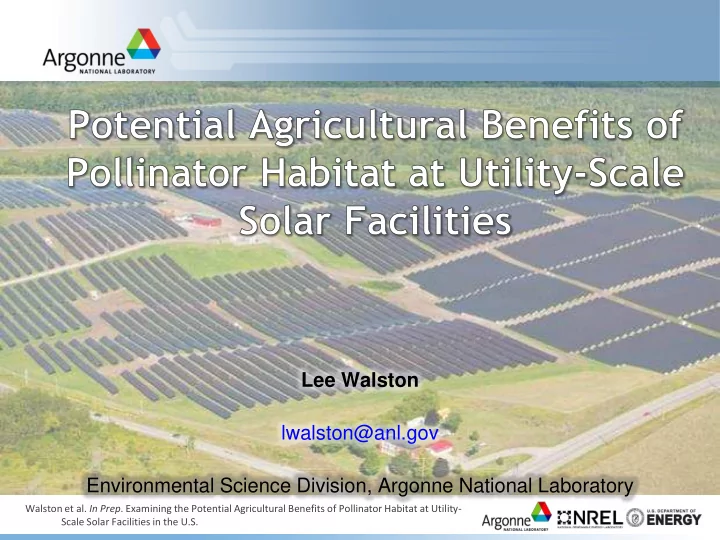
Walston et al. In Prep. Examining the Potential Agricultural Benefits of Pollinator Habitat at Utility- Scale Solar Facilities in the U.S.
slide-2
SLIDE 2

Utility-Scale Solar Development in the U.S.

  • >1 MW ground-mounted installations that feed into the electricity grid
  • Large spatial footprints: ~8 acres per MW
  • Currently about 70 GW* (existing and planned): ~875 mi2

2

Agricultural Benefits of Solar-Pollinator Habitat

Groveland Solar Farm (Groveland, MA) 3.6 MW 30 acres Desert Sunlight Solar Farm (San Bernardino County, CA) 550 MW ~4,000 acres (6.2 mi2)

*SEIA Major Solar Projects: https://www.seia.org/research-resources/major-solar-projects-list

slide-3
SLIDE 3

3

Agricultural Benefits of Solar-Pollinator Habitat

Utility-Scale Solar Development in the U.S.

  • Over 2,200 existing projects (>600 planned)
  • Average size: 12 MW
  • Over 80% <25 MW
slide-4
SLIDE 4

4

Agricultural Benefits of Solar-Pollinator Habitat

Utility-Scale Solar Development in the U.S.

  • Over 2,200 existing projects (>600 planned)
  • Average size: 12 MW
  • Over 80% <25 MW
slide-5
SLIDE 5

InSPIRE: Innovative Site Preparation and Impact Reductions on the Environment

  • NREL-led effort to improve the landscape compatibility of large-scale solar

projects through innovative siting practices

– Focus on contaminated and previously disturbed lands – Co-locating solar projects on agricultural lands

5

Agricultural Benefits of Solar-Pollinator Habitat

Evaluating vegetation performance under PV arrays Co-location of solar and agriculture

slide-6
SLIDE 6

InSPIRE: Innovative Site Preparation and Impact Reductions on the Environment

  • Interest in restoration of ecosystem services of solar sites
  • What about pollinator services through maintenance of solar-pollinator habitat?

6

Agricultural Benefits of Solar-Pollinator Habitat

The establishment of regional flowering plants such as milkweed and other wildflowers, and soil preparation methods, either within the solar facility footprint area (e.g., beneath PV panels) and/or in offsite areas adjacent to the solar facility, that attract and support insect pollinators by providing nesting areas and a source of food.

A B C D

No Vegetation Turf Grass Onsite Pollinator Offsite Pollinator

slide-7
SLIDE 7

7

Agricultural Benefits of Solar-Pollinator Habitat

What is Solar-Pollinator Habitat?

Pollinator Value

No vegetation “Turf grass” “Pollinator friendly” seed mixes Pollinator habitat diversity, Habitat management, Soil management

Something is better than nothing

slide-8
SLIDE 8

8

Agricultural Benefits of Solar-Pollinator Habitat

  • Business case

– Potential reductions in O&M costs with pollinator habitat (e.g., less mowing, risks)

  • Ecosystem benefits

– Increased biodiversity – Storm water & erosion control – Carbon storage – Agricultural benefits (e.g., pollination services)

Despite the potential ecosystem service benefits of solar-pollinator habitat, little has been done to quantify these benefits. The first step towards quantifying the pollination service benefits of solar-pollinator habitat is to identify the areas of co-location where solar-pollinator habitat may be most beneficial to crop production.

Making the Case for Solar-Pollinator Habitat

slide-9
SLIDE 9

9

Agricultural Benefits of Solar-Pollinator Habitat

Quantifying Potential Solar-Pollinator Agricultural Interactions

What if something was done at solar facilities?

Cropland Data Layer, USDA National Agricultural Statistics Service

slide-10
SLIDE 10

10

Agricultural Benefits of Solar-Pollinator Habitat

Quantifying Potential Solar-Pollinator Agricultural Interactions

Ten States with the greatest area within 1.5 km of existing and planned solar facilities.

State Name Total Number of USSE Projects Total USSE Electric Capacity (MW) Total Area within 1.5 km of USSE Facilities (km2)

California

776 14,562 8,059

North Carolina

591 4,027 7,572

Massachusetts

220 569 2,238

New Jersey

218 666 2,031

Arizona

111 2,528 1,647

Texas

42 2,701 1,456

Nevada

61 2,458 1,301

Florida

40 1,105 1,070

Minnesota

168 489 1,059

Georgia

39 1,030 965

Total 2,266 30,135 27,298

(6.7 million acres)

slide-11
SLIDE 11

11

Agricultural Benefits of Solar-Pollinator Habitat

Quantifying Potential Solar-Pollinator Agricultural Interactions

Total Amount of Pollinator-Dependent Agriculture Near Solar Facilities

>0% dependence (Aizen et al. 2009)

Over 850,000 acres

12 states with at least 1,200 acres

slide-12
SLIDE 12

12

Agricultural Benefits of Solar-Pollinator Habitat

Quantifying Potential Solar-Pollinator Agricultural Interactions

Total Amount of Highly Pollinator-Dependent Agriculture Near Solar Facilities

>40% dependence (e.g., Aizen et al. 2009)

Nearly 90,000 acres

slide-13
SLIDE 13

13

Agricultural Benefits of Solar-Pollinator Habitat

Quantifying Potential Solar-Pollinator Agricultural Interactions

Summary of Low & Moderately-Dependent Crop Types Near Solar Facilities

These crop types near solar facilities have 1%-40% benefit from insect pollination (e.g., Aizen et al. 2009)

Over 775,000 acres of these 10 crop types near solar facilities

slide-14
SLIDE 14

14

Agricultural Benefits of Solar-Pollinator Habitat

Quantifying Potential Solar-Pollinator Agricultural Interactions

Summary of Highly- Dependent Crop Types Near Solar Facilities

These crop types near solar facilities have >40% benefit from insect pollination (e.g., Aizen et al. 2009)

slide-15
SLIDE 15

15

Agricultural Benefits of Solar-Pollinator Habitat

Quantifying Potential Pollination Service Benefits

Examples…

  • 1. California Almonds

The 29,718 ha (73,434 acres) of almond orchards near solar facilities in California represents nearly 8% of the total almond production in California, which is an industry valued at over $5 billion USD.

Honey bees pollinating almonds. (Photo by UC-Davis, Kathy Keatley Garvey)

Almond orchards are largely dependent upon managed honeybees for pollination. However, improved pollinator habitat near almond orchards may increase pollination by wild insects and improve the pollination efficiency of both managed and wild pollinators.

Therefore, a 1% yield increase resulting from improved insect pollination efficiency associated with the maintenance of solar-pollinator habitat could be valued at over $4 million. Possible additional economic tradeoffs in relation to reduced honeybee rental fees ($300-$400 per acre).

slide-16
SLIDE 16

16

Agricultural Benefits of Solar-Pollinator Habitat

Quantifying Potential Pollination Service Benefits

Examples…

  • 2. Massachusetts Cranberries

The 1,904 ha (4,705 acres) of cranberry bogs near solar facilities in Massachusetts represents approximately one-third of the total cranberry production in the state, which is valued at about $80 million USD (farm production value).

Bumblebee pollinating cranberry. (Photo credit: University of Maine – Cooperative Research Extension)

Therefore, a 1% yield increase resulting from improved insect pollination efficiency associated with the maintenance of solar-pollinator habitat could be valued at over $266,000. Possible additional economic tradeoffs in relation to reduced honeybee rental fees ($200-$300 per acre).

slide-17
SLIDE 17

17

Agricultural Benefits of Solar-Pollinator Habitat

Quantifying Potential Pollination Service Benefits

Economic analysis of solar-pollinator habitat benefits to agricultural production:

  • Biophysical characteristics
  • Pollinator communities
  • Crop value

Next Steps… Field work to collect baseline data and measure pollinator service response to solar-pollinator habitat

slide-18
SLIDE 18

18

Agricultural Benefits of Solar-Pollinator Habitat

Questions?