SLIDE 1
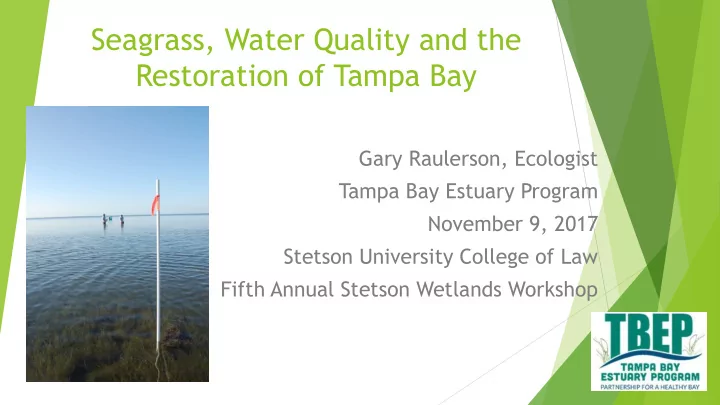
Seagrass, Water Quality and the Restoration of Tampa Bay
Gary Raulerson, Ecologist Tampa Bay Estuary Program November 9, 2017 Stetson University College of Law Fifth Annual Stetson Wetlands Workshop
SLIDE 2
What’s the story??
uTampa Bay
environmental history
uWhy seagrass uScience,
management and policy links
uFuture issues
SLIDE 3
Tampa Bay Fast Facts
u Urbanized, 3 million people u Open water – 400 sq. mi. u Watershed – 2200 sq. mi. u Avg Depth – 11 feet u Max Depth – 43 feet u Salinity – 1-35 ppt u Economic driver - $22 Billion
SLIDE 4
Tampa Bay in the 1970s-Early 1980s
u Phytoplankton and macroalgae
dominated
u 50% loss of seagrass coverage between
1950 and 1980
u Newspapers and TV declared Tampa
Bay “dead”
u Poorly-treated domestic point sources u Untreated industrial point sources u Stormwater u Dredge & fill activities
SLIDE 5 Citizens Demanded Action
u Hillsborough County
Environmental Prot. Comm. (1967)
u Grizzle-Figg Act for Southwest
Florida (1978) – WWTP reduction
u Aquatic Preserves - FDEP (1968-
1984)
u SWIM Water Body - SWFWMD
(1987)
u National Estuary Program (1991) u Tampa Bay Watch (1993) u TMDLs, BMAPs, and other
Stormwater regulations
SLIDE 6
TBEP’s Role
u Facilitate scientific and technical
work, discussions and evaluations
u Provide public education and
communication
u Develop and convene
partnerships to restore and protect Tampa Bay
u Link science to management
SLIDE 7
Key Indicator - Seagrass
u Habitat and economic value u Straightforward indicator u Science-based numeric goals & targets u Long-term monitoring u Ongoing assessment & adjustment
SLIDE 8
Seagrass Species
Halodule wrightii Shoal grass Syringodium filiforme Manatee grass Thalassia testudinum Turtle grass Ruppia maritima Widgeon grass Halophila engelmanii Star grass
SLIDE 9
Setting Seagrass Restoration Goals – ca. 1950
Approximately 40,400 acres, however…
SLIDE 10
Setting Seagrass Goals – Dredge and Fill
Adjusted From 40,400 to 38,000 acres
SLIDE 11 Nitrogen Management Paradigm
Reduce Nitrogen Loads Reduce Chloro- phyll Increase Sea- grass Cover Increase Water Clarity
Seagrass Goal: Preserve 25,000 acres (1999 coverage), while restoring 13,000 more acres = 38,000 acres (15,385 ha)
SLIDE 12
Water Quality Assessment
u Rely on long-term ambient
water quality stations sampled by EPCHC
u 45 fixed stations have been
monitored since 1974
u Annual averages developed
from chlorophyll-a & secchi disk depth measurements
SLIDE 13
Site Specific Thresholds for Chlorophyll-a
uHillsborough Bay: 15.0 ug/L uOld Tampa Bay: 9.3 ug/L uMiddle Tampa Bay: 8.5 ug/L uLower Tampa Bay: 5.1 ug/L
Nitrogen Management Goal: “Hold the line” on nitrogen loading at 1992-1994 average level. To compensate for expected increase in load with population growth, reduce or preclude an additional 17 tons per year.
SLIDE 14 Public Partners:
- Hillsborough County
- Manatee County
- Pinellas County
- Pasco County
- Polk County
- Sarasota County
- City of Tampa
- City of St. Petersburg
- City of Clearwater
- City of Palmetto
- City of Bradenton
- City of Largo
- City of Lakeland
- City of Oldsmar
- City of Gulfport
- City of Mulberry
- City of Plant City
- City of Safety Harbor
- SWFWMD
- US EPA
- FDEP
- FDACS
- FDOH
- FDOT
- MacDill AFB
- TBRPC
- Tampa Bay Water
- Tampa Port Authority
- EPC of Hillsborough County
- AEDC of Hills. County
Private Partners:
- Eastern Terminals
- Mosaic
- CSX Transportation
- Florida Power & Light
- CF Industries
- Tampa Electric Co.
- Kinder Morgan Bulk T., Inc.
- Progress Energy
- Tropicana Products, Inc.
- Kerry I&F
- Trademark Nitrogen
- Yara N.A.
- Alafiia Preserve, LLC
- Eagle Ridge, LLC
- LDC Donaldson Knoll
Investments, LLC
Tampa Bay Nitrogen Management Consortium
u Formed in 1998, now includes 40+ public/private partners u Members include TBEP government and regulatory agency
participants, local phosphate companies, agricultural interests and electric utilities
u Mid-1990s, collectively accepted responsibility for meeting
nitrogen load reduction goals
u Consortium members may choose to implement any
combination of projects to maintain loads to Tampa Bay at 1992-1994 levels
SLIDE 15 Voluntary Actions Become Regulatory Requirements
u Clean Water Act and Total Maximum Daily Loads u Goal to “hold the line” on TN loadings to the bay &
preclude 17 tons TN / yr (offset growth)
u 1998 – TMDL for TN first established by EPA (based on
1992-1994 TN loads to Tampa Bay)
u 2002 – NMC and TBEP granted “Reasonable Assurance”
that TB will meet State WQ Criteria for Nutrients
u 2007 – FDEP and EPA require allocations to be
developed to meet federal TMDL and continue State “Reasonable Assurance” determination
u 2009 – NMC voluntarily developed TN load allocations
to 189+ sources in the bay; Effectively capping TN loads
SLIDE 16 TN Loads Capped & Reductions Documented
http://apdb.tbeptech.org
- All TN Loads Apportioned to Sources
- Future loads will require offsets/transfers
- Calculations and BMP efficiencies used based on land use, subbasin, and treatment method
- User-defined efficiencies & reductions can also be entered
- TBEP collates and reports to FDEP/EPA on a 5-yr basis by major bay segment
SLIDE 17
Reducing TN Loads to Tampa Bay
SLIDE 18
Chlorophyll-a
Light Attenuation
SLIDE 19 Water Quality Assessment / Management Framework
u Bay segment observed values compared
to established bay segment targets for chlorophyll-a and light attenuation
u Results of each comparison placed into
a decision matrix framework
u Overall management response
determined for each bay segment in a clear, “policy-level” format
u 2-year exceedence results in additional
actions
Green “Stay the course;” partners continue with planned projects to implement the CCMP. Data summary and reporting via the Baywide Environmental Monitoring Report and annual assessment and progress reports. Yellow TAC and Management Board on caution alert; review monitoring data and loading estimates; attempt to identify causes of target exceedences; TAC report to Management Board on findings and recommended responses needed. Red TAC, Management and Policy Boards on alert; review and report by TAC to Management Board on recommended types of responses. Management and Policy Boards take appropriate actions to get the program back on track.
SLIDE 20 Water Quality Has Improved
Stormwater Regulations Enacted 85/86 TBEP Partner & NMC Actions Implemented 1992 AWT & Reuse Standards Implemented Bay Segment Chlorophyll-a (ug/L) 2016 Average FDEP RA Thresholds Old Tampa Bay 9.0 9.3 Hillsborough Bay 11.4 15.0 Middle Tampa Bay 5.7 8.5 Lower Tampa Bay 3.0 5.1 2006: First-time All Segments Meet TBEP Water Quality Targets
SLIDE 21
Results? Seagrass Coverage SWFWMD
SLIDE 22 Seagrass Coverage Expands
Exceeded 1950s estimate of 40,400 acres!
SLIDE 23
Seagrass Transect Monitoring
SLIDE 24 Seagrass Species Trends
u Acreage increases primarily
attributed to shoal & manatee grass expansion
SLIDE 25 Other Seagrass Systems
Chesapeake Bay (Orth et al. 2017) 1990 2000 2010 Indian River Lagoon (Patterson, 2017)
SLIDE 26 Other Seagrass Systems
Threats to Florida Seagrass, 2012-16 (Yarbro and Carlson, 2016) Sarasota Bay (www.sarasotabay.org)
SLIDE 27 Sustaining Success
maintained w/ increasing population?
double by 2050
Offsets will be Needed
Year
1940 1950 1960 1970 1980 1990 2000 2010
Population (millions)
0.0 0.5 1.0 1.5 2.0 2.5 3.0
Tampa Bay Annual Average Chlorophyll-a (ug/L)
4 6 8 10 12 14 16 18 20 Hillsborough County Pinellas County Manatee County Tampa Bay Chlorophyll-a
SLIDE 28 Atmospheric Deposition - Direct deposition to the bay’s surface, and indirect deposition, which is an element of stormwater runoff
Stormwater
SLIDE 29
2017 TBEP Management Plan Update New Water Quality Management Actions
u Reduce Residential Fertilizer Contributions
to Stormwater Runoff
u Continue to Reduce Wastewater &
Stormwater Inputs Through Expansion of Reuse / Recharge Projects
u Develop & Fund Localized Research &
Management Actions for Problematic Areas (e.g. Old Tampa Bay)
SLIDE 30
Recap
u Nitrogen/Seagrass Paradigm u Data as the backbone u Research advising management &
policy
u New actions to continue restoration
SLIDE 31
Gary Raulerson, TBEP graulerson@tbep.org 727-893-2765 www.tbep.org www.tbeptech.org
Thanks, any questions?