The Importance of Seagrass in Upper Florida Bay in Modulating Flow, - - PowerPoint PPT Presentation

the importance of seagrass in upper florida bay in
SMART_READER_LITE
LIVE PREVIEW

The Importance of Seagrass in Upper Florida Bay in Modulating Flow, - - PowerPoint PPT Presentation

The Importance of Seagrass in Upper Florida Bay in Modulating Flow, Waves, and Sediment Dynamics Jennifer Romanowich University of Virginia Department of Environmental Sciences Brown Bag Seminar, 13 January 2010 Everglades and Florida Bay:


slide-1
SLIDE 1

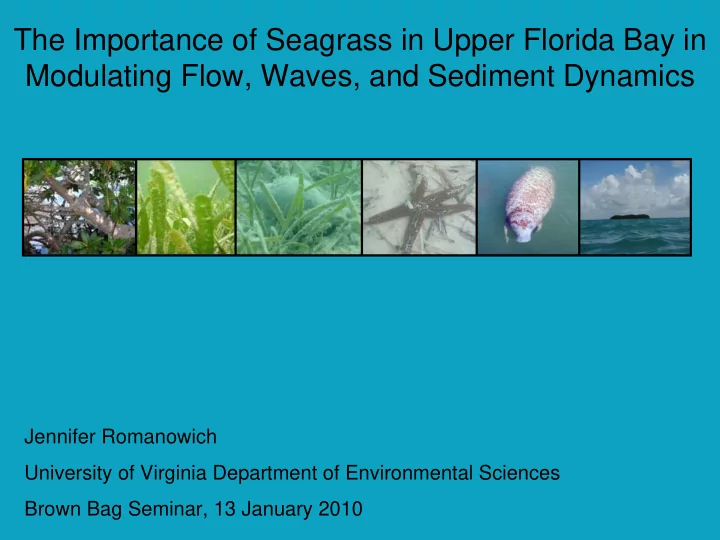
The Importance of Seagrass in Upper Florida Bay in Modulating Flow, Waves, and Sediment Dynamics

Jennifer Romanowich University of Virginia Department of Environmental Sciences Brown Bag Seminar, 13 January 2010

slide-2
SLIDE 2
  • Everglades:

– 50% human population of Florida – Loss of 50% of wetlands and 90% of bird population

  • Florida Bay:

– Seagrass support entire food chain – Naturally variable and currently vulnerable

Everglades and Florida Bay:

Everglades National Park Everglades National Park Florida Bay Florida Bay

slide-3
SLIDE 3

Connectivity:

  • 11,000 mi2 area of connected flow
  • Everglades buffered storms

and floods

  • Drainage to Florida Bay

– Salinity impact

From Villy Kourafalo SoFLA-HYCOM From Everglades Foundation

slide-4
SLIDE 4
  • Die-offs:

– Drought salinity 60% greater – Sulfide toxicity and hypoxia – Slime mold – Boat scarring

Photo from: University of Georgia Biological Oceanography Modeling Lab Jennifer Romanowich

  • Distribution depends on:

– Water depth/light – Nutrient availability and delivery – Salinity – Water clarity

Seagrass Ecosystem:

Open Mud Sparse Seagrass Intermediate Seagrass Dense Seagrass

slide-5
SLIDE 5

Restoration Efforts:

  • Everglades:

– New levee and drainage canal – Remove sections of Tamiami Trail – Widen spatial distribution of flow

  • Improve quantity, quality, timing and

distribution of flow

  • Understand flow interactions with

seagrass and sediment dynamics

  • Determine storm effects on seagrass

beds

http://www.evergladesplan.org/pub/restudy_eis.aspx

slide-6
SLIDE 6
  • Florida Bay Seagrass Meadows:

– Depth: 3-4m – Tidal range: 0.1-0.3m – Seagrass species: Thalassia testudinum

From Everglades National Park web site

Site Description:

slide-7
SLIDE 7

Instrument Deployment:

slide-8
SLIDE 8

Instrument Deployment:

cm/s

slide-9
SLIDE 9
  • Highest flow at Rabbit
  • Sediment high at bare and

Rabbit

Results:

Bottle Bare Rabbit Seagrass upper lower

Bottle Grass Rabbit Bottle Bare

  • Seagrass disrupts

boundary layer

  • Enhanced mixing with wind

even with high density

Bottle Bare Bottle Seagrass Rabbit Seagrass upper Rabbit Seagrass lower Bottle Seagrass

Days from Jan 2009 Days from Jan 2009 Days from Jan 2009

cm/s cm/s cm/s cm/s

slide-10
SLIDE 10

Summary:

  • Seagrass slow flow near bed
  • Waves in Florida bay increase sediment suspension
  • Small scale velocity patterns suggest enhanced

mixing in meadows

  • Bulk water from Everglades may be mixed into

seagrass meadow

slide-11
SLIDE 11

Acknowledgements:

Funding:

– Florida Everglades Foundation Fellowship – National Science Foundation Biological Oceanography Graduate Research Fellowship