Waking up to Danger How Drowsy Driving got on the publics radar in - - PDF document

waking up to danger
SMART_READER_LITE
LIVE PREVIEW

Waking up to Danger How Drowsy Driving got on the publics radar in - - PDF document

5/18/2010 Waking up to Danger How Drowsy Driving got on the publics radar in Massachusetts Lewis C. Howe L i C H Massachusetts Department of Public Health Safe States Webinar May 24, 2010 Alerting lawmakers to the scope of the problem


slide-1
SLIDE 1

5/18/2010 1

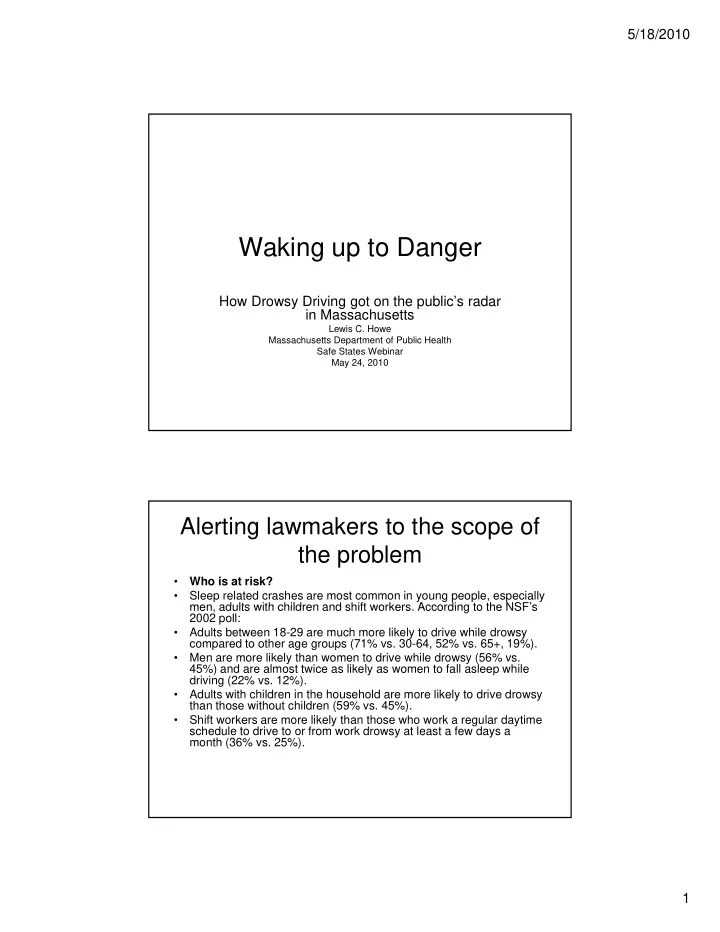
Waking up to Danger

How Drowsy Driving got on the public’s radar in Massachusetts

L i C H Lewis C. Howe Massachusetts Department of Public Health Safe States Webinar May 24, 2010

Alerting lawmakers to the scope of the problem

  • Who is at risk?
  • Sleep related crashes are most common in young people, especially

men adults with children and shift workers According to the NSF’s men, adults with children and shift workers. According to the NSF s 2002 poll:

  • Adults between 18-29 are much more likely to drive while drowsy

compared to other age groups (71% vs. 30-64, 52% vs. 65+, 19%).

  • Men are more likely than women to drive while drowsy (56% vs.

45%) and are almost twice as likely as women to fall asleep while driving (22% vs. 12%).

  • Adults with children in the household are more likely to drive drowsy

than those without children (59% vs. 45%).

  • Shift workers are more likely than those who work a regular daytime

schedule to drive to or from work drowsy at least a few days a month (36% vs. 25%).

slide-2
SLIDE 2

5/18/2010 2

As bad as OUI

  • Sleep deprivation increases the risk of a sleep-related crash; the

less people sleep, the greater the risk. According to a study by the AAA Foundation for Traffic Safety people who sleep six to seven AAA Foundation for Traffic Safety, people who sleep six to seven hours a night are twice as likely to be involved in such a crash as those sleeping 8 hours or more, while people sleeping less than 5 hours increased their risk four to five times.

  • A study by researchers in Australia showed that being awake for 18

hours produced an impairment equal to a blood alcohol concentration (BAC) of .05, and .10 after 24 hours; .08 is considered legally drunk.

  • Other research indicates commercial drivers and people with
  • Other research indicates commercial drivers and people with

undiagnosed sleep disorders such as sleep apnea and acute insomnia are also at greater risk for fall asleep crashes.

Legislative Mandate to Action

  • Enabling section from JO law 2007
  • Commission established to develop

effective prevention education strategies.

  • Hearings held at MA State House led to

release of report in March 2009.

slide-3
SLIDE 3

5/18/2010 3

The Result: A living document

  • “Asleep at the Wheel”
  • Report of the Special Commission on Drowsy

Report of the Special Commission on Drowsy Driving

  • Senator Richard T. Moore, Senate Chair
  • Joint Committee on Health Care Financing
  • Rachel Kaprielian, Registrar
  • Massachusetts Registry of Motor Vehicles

M J h A b h C i i

  • Mr. John Auerbach, Commissioner
  • Massachusetts Department of Public Health
  • February 2009

Convening partners for earned and paid media

  • Harvard Sleep Research
  • Massachusetts General Hospital
  • Boston Medical Center
  • Teamsters Local #25
  • Herb Chambers auto dealerships
  • Survivors of D.D.
slide-4
SLIDE 4

5/18/2010 4

Prevention Messages

  • Before “hitting the road”
  • Get adequate sleep—most adults need 7-9 hours to maintain proper

alertness during the day alertness during the day

  • Schedule proper breaks—about every 100 miles or 2 hours during

long trips

  • Arrange for a travel companion—someone to talk with and share the

driving

  • Avoid alcohol and sedating medications—check your labels or ask

your doctor

  • Countermeasures to Prevent a Fall-Asleep Crash While Driving
  • Stop driving
  • Stop driving
  • Take a nap
  • Drink a caffeinated beverage.
  • Be aware of rumble strips.

A word from our sponsors: Posters and handouts…

slide-5
SLIDE 5

5/18/2010 5

…and a TV spot in heavy rotation

slide-6
SLIDE 6

5/18/2010 6

Teamwork gets results Outcomes

  • MA Rumble Strip law
  • Distracted driving bill
  • “icrash” injury symposium, April 2010
  • AAA to undertake Drowsy Driving task

force summer 2010

slide-7
SLIDE 7

5/18/2010 7

AAA makes Drowsy Driving Prevention a Priority

  • Stay Alert! Drowsy Driving Is Dangerous Driving
  • Here’s a startling statistic: it's estimated that as many as

g y 250–thousand people doze off at the wheel every day – many for just a second or two, but that's long enough to cause a life-altering crash.

  • A significant percentage of us – especially teenagers –

are sleep-deprived. AAA's message: drowsy driving is impaired driving–affecting focus, reaction time, judgment, and alertness. Don't drive drowsy and don't let your friends or children

  • Don't drive drowsy, and don't let your friends or children

drive when they're tired. If you feel sleepy, pull over and rest, or call a friend or relative for help. View Drowsy Driving resources

Resources

  • NHTSA
  • National Sleep Foundation
  • Dr. Czeisler and Dr. Sanna, Harvard