Temporary Airspace Closure for Rocket Launches PROCEDURES AND - - PowerPoint PPT Presentation

temporary airspace closure for rocket launches
SMART_READER_LITE
LIVE PREVIEW

Temporary Airspace Closure for Rocket Launches PROCEDURES AND - - PowerPoint PPT Presentation

Temporary Airspace Closure for Rocket Launches PROCEDURES AND INITIATIVES Picture Courtesy: ISRO AIRSPACE CLOSURE Artillery Firing & Rocket Launches Notified Danger Areas: Danger Areas published in eAIP Active H24 (63 danger


slide-1
SLIDE 1

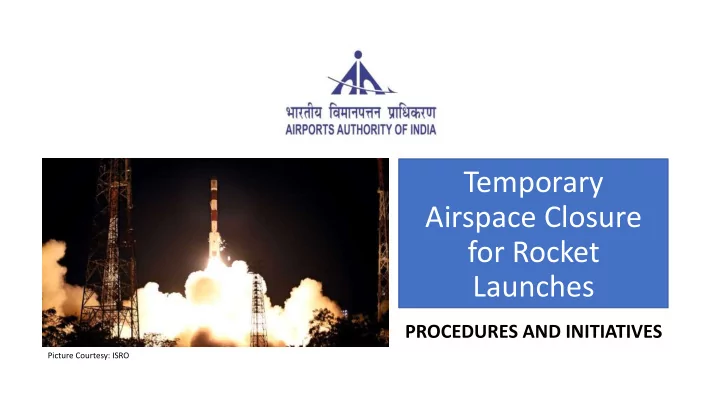
Temporary Airspace Closure for Rocket Launches

PROCEDURES AND INITIATIVES

Picture Courtesy: ISRO
slide-2
SLIDE 2

AIRSPACE CLOSURE

  • Artillery Firing & Rocket Launches
  • Notified Danger Areas: Danger Areas published in eAIP
  • Active H24 (63 danger areas published), or
  • Activated through NOTAM (65 danger areas published)
  • Ad-hoc areas: Published and activated through NOTAM
  • Used by Military and R&D agencies

More than 90% of danger areas are controlled by Military

slide-3
SLIDE 3

NOTIFICATION AND ACTIVATION

  • Annex 15 / DGCA India CAR requirements
  • Minimum 7 days notice
  • Airline requirements
  • 14 working days notice
  • 3 days notice of definitive window
  • Minimise activity duration
  • Avoid busy airways
  • Avoid peak hour traffic
  • Timely dissemination of “Activity Over” Information
  • Nominate Nodal Coordinators at ATC centres
slide-4
SLIDE 4

AIRSPACE AUDIT

  • Audit of military Restricted and Danger Areas conducted
  • The audit has identified:
  • Gaps in the AIP information
  • Inactive areas
  • Actual requirement of the Controlling Agencies
  • Negotiation underway with the military to realign and notify R/D

areas according to the actual requirement

slide-5
SLIDE 5

REALIGNING DANGER AREAS

  • Denotification of notified but unused Field Firing Ranges is in the final

phase

  • Efforts are on to convert R/D areas from Permanent to NOTAM-

activated and later to AMC-Manageable Areas.

  • Creation of new R/D areas is not encouraged. TRA/TSA will be

established and activated on FUA principles

slide-6
SLIDE 6

REALIGNING DANGER AREAS ….

  • VOD 174 (A) & (B) [Sriharikota] denotified
  • Large volume of airspace released. Only 20% being closed now.
  • VOD 175 (Thumba) realigned
  • Realigned area is about 30% of the original area; 14% when only VOD 175 (A)

is active

  • VOD 172 (A) [Cochin]denotified w.e.f 23 JUN 2016
  • Arrival, departure and overflying restrictions at Cochin International

Airport (VOCI) will be significantly reduced

slide-7
SLIDE 7

ROCKET LAUNCHES

  • VOD 174 (A) & (B) [Sriharikota] denotified.
  • Ad-hoc danger zones will be notified through NOTAM for each launch
  • Coordination and Notification Process streamlined
  • Initial intimation: D minus 45 days
  • Intimation of definitive launch window of 3 days: D minus15 days
  • Launch date confirmation: D minus 3 days and D minus1 day
  • “Launch-Over” confirmation: Within 30 minutes of the launch
  • NOTAMs: At D minus 15 and D minus 3 stages
slide-8
SLIDE 8

EFV LAUNCHES

  • Experimental Flight Vehicle (EFV) launches
  • Ad-hoc danger zones will be notified through NOTAM for each launch
  • Coordination and Notification Process streamlined
  • Launch intimation D minus15 days
  • NOTAM at D minus 8 stage
  • Launch window reduced to 2 days and 3 to 4 hours each day
  • Realigning Danger Areas
  • Realignment / Relocation / Reduction of danger areas to avoid

major busy international oceanic routes is in advance stage of negotiation

slide-9
SLIDE 9

EFV LAUNCHES

  • Standardising Danger Areas
  • Action underway to create standard danger areas which will help in

streamlining the airspace management process including identification of alternate routings for affected route segments

  • Changes in ATC procedures during airspace closures can also be standardised
  • LOA between Airspace User and ANSP
  • LOA between Controlling Authority of Danger Areas and ANSP for airspace

management during launches will be signed in near-term.

slide-10
SLIDE 10

REDEFINING LATERAL LIMITS OF ACTIVITY

slide-11
SLIDE 11

10 20 30 40 50 60 70 80 90 100

L507 P646 N895/G472 M770 L759 L301 P628 L510 N877 W111 W112

DAILY ROUTE-WISE TRAFFIC

Freeing up W112 helps in re-routing flights on other affected routes

slide-12
SLIDE 12

REALIGNING DANGER ZONE

slide-13
SLIDE 13

5 10 15 20 25 30 35

HOURLY TRAFFIC ON BOB ROUTES (Time in IST)

Option-1 0800 – 1000 IST 1000 -1100 IST (S/B) Option-2 1500 – 1700 IST 1700 -1800 IST (S/B)

OR

slide-14
SLIDE 14

EFV LAUNCHES - INFORMATION FLOW

Airspace User sends Range Memo to AAI CHQ AAI CHQ plots the area; forwards to ATC Centres for comments ATC Centres send comments to AAI CHQ AAI CHQ compiles the comments, resolves conflicts, issues approval to all concerned FIRs initiate NOTAM action Start of Activity Window Activity completed and airspace vacated by the user Nodal FIR cancels NOTAM & informs other affected FIRs

7 days 1 day 1 day 1 day 2 days < 30 min

slide-15
SLIDE 15

INITIATIVES – BIMT/3 CONCLUSION

  • India presented WP on Coordination For Rocket Launch Airspace

Closures in the BIMT-ATM/CG/3 meeting at Kolkata in DEC 2015 Conclusion BIMT 3/3:

  • BIMT States agreed that for post-NOTAM coordination for airspace

closure due to rocket launches:

  • Watch Supervisory Officer (WSO) [FIO in case of Bangladesh] of the FIR from

where the launch takes place will be the Primary Nodal Coordinator.

  • WSOs / FIO of the other affected FIRs to which danger areas extend,

will be the Secondary Nodal Coordinators.

  • The States also agreed to include the contact details of the Primary

and Secondary Nodal Coordinator, as appropriate, in the launch activity NOTAM.

slide-16
SLIDE 16

FOCUS AREAS

  • Use FUA principles to optimize airspace use during danger area

activation

  • Reduce launch window and slot timings
  • Provide sufficient notification to stakeholders
  • Immediate cancellation of NOTAMs on completion of activity
  • Standardise danger areas as TSAs, standardise alternate routings and

coordination procedures

  • Improve communication between affected States/ANSPs.

Identify Nodal Coordinators and publish their contact details

slide-17
SLIDE 17