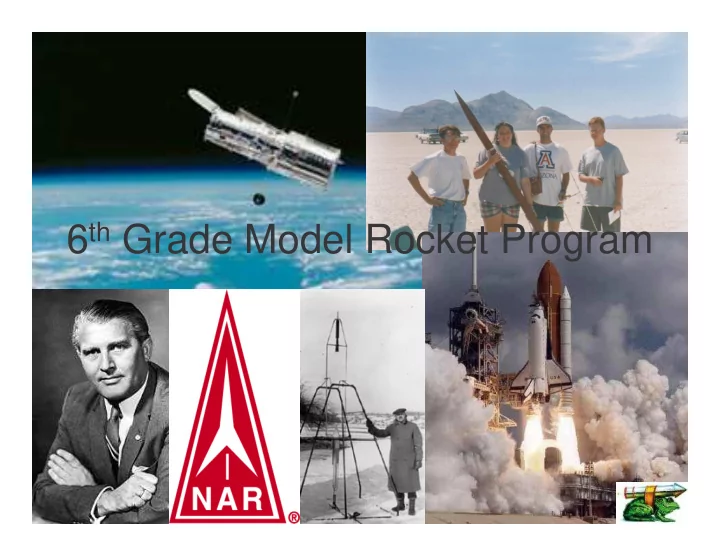
6 th Grade Model Rocket Program The 6 th Grade Rocket Program Day 1 - - PowerPoint PPT Presentation

6 th grade model rocket program the 6 th grade rocket
SMART_READER_LITE
LIVE PREVIEW

6 th Grade Model Rocket Program The 6 th Grade Rocket Program Day 1 - - PowerPoint PPT Presentation

6 th Grade Model Rocket Program The 6 th Grade Rocket Program Day 1 Investigate how and why a rocket works Determine what we will measure with our rocket Day 2 Predict how high the rocket will fly and what our instruments


slide-1
SLIDE 1

6th Grade Model Rocket Program

slide-2
SLIDE 2

2

The 6th Grade Rocket Program

  • Day 1

– Investigate how and why a rocket works – Determine what we will measure with our rocket

  • Day 2

– Predict how high the rocket will fly and what our instruments will measure – Launch the rocket!

  • Day 3

– Compare our predictions to what we measured with the instruments on the model rocket

slide-3
SLIDE 3

3

Today, we will…

  • Identify the parts of a model rocket
  • Describe the motion of a model rocket
  • Calculate the altitude of a model rocket

Then, we will answer three questions

  • What can we measure with a rocket?
  • What will the measurements look like?
  • How will we make these measurements?
slide-4
SLIDE 4

4

Parts of a rocket

slide-5
SLIDE 5

Picture of model rocket flight

slide-6
SLIDE 6

6

Model rocket engine

Ejection charge to deploy the recovery system Non-thrust delay and smoke tracking charge High thrust charge for lift-off and acceleration

Thrust Phase Coast Phase

slide-7
SLIDE 7

7

How do you describe the motion of a rocket?

  • What is the rocket’s position?

– Altitude – 332 meters high

  • How fast is the rocket changing its

position?

– Velocity – 75 meters/second

  • How fast is the rocket’s velocity

changing?

– Acceleration – 98 meters/second/second 98 meters/second2

slide-8
SLIDE 8

8

Velocity

  • Measures the distance moved per unit of time
  • Unit of measure
  • Meters per second, kilometers per hour, miles/hour
  • Examples

– Walking quickly = 10 km/hour = 2.8 m/sec – Car on freeway = 100 km/hour = 28 m/sec – Jet in flight = 1,000 km/hour = 280 m/sec – Space shuttle = 27,000 km/hour = 7,500 m/sec

  • Experiments

– How fast am I moving? – How far did I travel?

slide-9
SLIDE 9

9

Acceleration

  • Measures the change in velocity per unit of

time

  • Units of measure
  • Meters per second per second
  • Kilometers/hour2
  • Examples

– Acceleration of gravity = 1 g or 9.8 meters/second2 – Shuttle Thrust Phase produces 3 g – Blackout occurs at 4 – 6 g’s without special “anti-g suit” – Jet fighter acceleration = 9 g’s

slide-10
SLIDE 10

10

How can we predict the motion of a rocket?

  • How far will I travel in t seconds?

– d = v1 • t + ½ • a • t2 [1]

  • How far will I travel at velocity v?

– d = (v2

2 – v1 2) / (2 • a) [2]

  • How fast will I go in t seconds?

– v2 = v1 + a • t [3]

  • Definitions

– d = distance traveled – v1= velocity at start of time period – v2 = velocity at end of time period – a = acceleration

Observations for rockets

  • If v1 = 0, then d = ½ a • t2
  • If a = 0, then d = v • t
  • If v1 = 0, then d = v2/(2 • a)
  • If v1 = 0, then v = a • t
slide-11
SLIDE 11

11

How do we use these concepts?

  • A skydiver jumps out of an airplane 1,000

meters above the ground

– Initial velocity = 0 meters/second – Acceleration = 9.8 meters/second/second

  • The acceleration of gravity on Earth
  • How fast am I going after 1 second? 10

seconds?

  • How far have I traveled after 1 second? After

10 seconds?

slide-12
SLIDE 12

12

Skydiver summary

490 m 4.9 m 0 m distance 98 m/sec 9.8 m/sec 0 m/sec velocity 9.8 m/sec2 9.8 m/sec2 9.8 m/sec2 acceleration 10 seconds 1 second 0 seconds

  • After 10 seconds, the skydiver is going 3.5 times

faster than a car on the freeway!

  • After 10 seconds, the skydiver is almost ½ way

to the ground!

slide-13
SLIDE 13

13

What determines the motion of a rocket?

Newton’s 3 Laws of Motion 1. A body remains at rest, or in motion with a constant velocity, unless acted upon by an unbalanced force. 2. Acceleration = Force / mass 3. For every action (force) there is an equal and opposite re-action.

Sir Isaac Newton 1686

slide-14
SLIDE 14

14

3 Forces determine a rocket’s flight

  • Thrust

– Determined by the rocket engine

  • Gravity

– Acceleration of gravity (g) = 9.8 meters/second/second

  • Drag or air resistance

– Caused by the rocket moving through the air – Determined by the diameter of the rocket, shape of the rocket, and other factors

  • ForceTotal = FThrust – (FDrag + FGravity)

– Measured in Newtons

Gravity Drag Thrust

slide-15
SLIDE 15

15

How high will a rocket go?

Thrust Phase

  • Thrust pushes the rocket

upward

  • Gravity pulls the rocket

down

  • Drag slows the rocket
  • FTotal = FThrust – (FDrag +

FGravity) Coast Phase

  • Engine burnout, so the

thrust is zero

  • Gravity pulls the rocket

down

  • Drag slows the rocket
  • When the rocket reaches

apogee

– Velocity = 0 – Acceleration = 0

  • FTotal = FDrag + FGravity

AltitudeTotal = AltitudeThrust phase + AltitudeCoast phase

slide-16
SLIDE 16

16

How high will a rocket go (ignoring drag)?

Thrust Phase

FTotal = FThrust – FGravity Aupward = Arocket – Agravity Aupward = (Engine thrust/Rocket mass) – g AltitudeThrust Phase = ½ Aupward • t2

Coast Phase

FTotal = FGravity Vburnout = Aupward • tthrust duration AltitudeCoast Phase = V2

burnout / (2 • g)

Gravity Thrust Gravity

AltitudeTotal = AltitudeThrust phase + AltitudeCoast phase

slide-17
SLIDE 17

17

Example Calculation

  • A small model rocket – the micro V2

– 17.8 cm long – 1.89 cm diameter – Rocket

  • Mass = 0.028 kg
  • Weight = 0.27 Newtons

– Engine

  • Thrust = 10.7 Newtons
  • Thrust duration = 0.5 seconds
  • How high will this rocket fly?
slide-18
SLIDE 18

18

Small model rocket example

Thrust Phase Aupward = 372.3 m/sec2 = 38 g’s Altitude = 46.5 meters AltitudeTotal = 1,814.9 meters

Observations – During Thrust Phase - rockets gain a small amount of altitude and a large velocity – During Coast Phase - rockets gain most of their altitude

Coast Phase Vburnout = 186.2 m/sec Altitude = 1,768.4 meters

slide-19
SLIDE 19

19

slide-20
SLIDE 20

20

slide-21
SLIDE 21

21

Observations

  • Drag has a large impact on the altitude of

the rocket at apogee

– Calculating drag is complicated (trust me!)

  • Rockets gain a small amount of altitude

and a large velocity during the Thrust Phase

  • Rockets gain most of their altitude during

the Coast Phase

  • Model rockets go really fast and very high!
slide-22
SLIDE 22

22

Group Activity

  • What can we measure during the flight of

a model rocket?

slide-23
SLIDE 23

23

What do the measurements look like?

slide-24
SLIDE 24

24

How are the measurements made?

Rocket Data Acquisition System (R-DAS)

The CPU, or brain to do all the work Memory to record all the data The program, or instructions, to tell the CPU what to do.

  • 1. Wait for lift-off
  • 2. After lift-off,

take measurements The sensors that measure the data 200 times/sec

slide-25
SLIDE 25

6th Grade Model Rocket Program

Day 2

slide-26
SLIDE 26

26

Today, we will…

  • Calculate the altitude for our rocket launch

– We will ignore drag in the calculations – Extra credit – predict the altitude at apogee with drag

  • Predict the change in temperature for our

flight

  • Discuss safety on the rocket range
  • Launch the rocket!!
  • Record the data (if we have time)
slide-27
SLIDE 27

27

Group activity

  • Break into shipwreck groups
  • Complete the altitude calculation

worksheet

  • Predict how the temperature will change

during the flight

– Draw a graph and show how the temperature will change with altitude

  • Y-axis = temperature
  • X-axis = altitude

altitude temperature

slide-28
SLIDE 28

28

Rocket Worksheet

  • Equations of motion

– aupward = arocket engine – agravity – aupward = (engine thrust / total mass of the rocket) – g – altitudeburnout = ½ • aupward • t2 where t = thrust duration – vburnout = aupward • t where t = thrust duration – altitudeCoast phase = vburnout

2 / (2 • g) where g = 9.8 m/sec/sec

– altitudetotal = altitudeburnout + altitudeCoast phase

  • altitudetotal =
  • altitudeCoast phase =
  • vburnout =
  • altitudeburnout =
  • aupward =

Units Value Quantity

slide-29
SLIDE 29

29

Temperature vs. Altitude

Altitude Temperature Slope ~ 0.02 ° C/m

slide-30
SLIDE 30

30

Launch site safety rules

  • Everyone stand behind the launch table at

all times

  • Do not run up to the rocket when it lands.

You can trip and fall on the rocket and break it!

– Yes, it happened to me!

  • Only teachers are allowed to install the

engine and ignite it.

slide-31
SLIDE 31

31

6th Grade Model Rocket Program

Day 3

slide-32
SLIDE 32

32

Today, we will…

  • Compare the data collected yesterday with

your predictions

– Each group will present their predictions,

  • bservations, and conclusions to the class
  • Where can you learn more about rockets?
  • Discussion on the 6th Grade Model Rocket

Program

slide-33
SLIDE 33

33

slide-34
SLIDE 34

34

slide-35
SLIDE 35

35

Other model rocketry resources

  • Handbook of Model Rocketry by G. Harry Stine

– The best book on all aspects of model rocketry

  • www.nar.org

– The National Association of Rocketry

  • www.estes.com

– Manufactures model rocket kits and engines

  • www.nasa.gov

– Search for “model rocket” – lots of information!

  • Local hobby stores and rocketry clubs
slide-36
SLIDE 36

36

Discussion of the 6th Grade Model Rocket Program

slide-37
SLIDE 37

Thank you!