Answering some tough questions tool 1. Relationship and value of - - PDF document

answering some tough questions
SMART_READER_LITE
LIVE PREVIEW

Answering some tough questions tool 1. Relationship and value of - - PDF document

Kelli Retallick, Angus Genetics Inc. June 19, 2019 Navigating a new frontier: Pulmonary Arterial Pressure Kelli Retallick, M.S. AGI Genetic Service Director Saint Joseph, Missouri Path to a genetic selection Answering some tough questions


slide-1
SLIDE 1

Kelli Retallick, Angus Genetics Inc. June 19, 2019 Efficiency and Adaptability Committee, 2019 BIF Symposium, Brookings, S.D. 1

Kelli Retallick, M.S. – AGI Genetic Service Director Saint Joseph, Missouri

Navigating a new frontier: Pulmonary Arterial Pressure Path to a genetic selection tool

20 2013 PAP score collection began at the Association 20 2016 Collaboration with Colorado State University Su Summer 2018 Pauling thesis peer reviewed and published Fe

  • Feb. 2019

Research report release Ju July 2019 Cut-off for data by members Fa Fall 2019 Production EPD release for yearling PAP Sp Spring 2019 Research to incorporate additional data

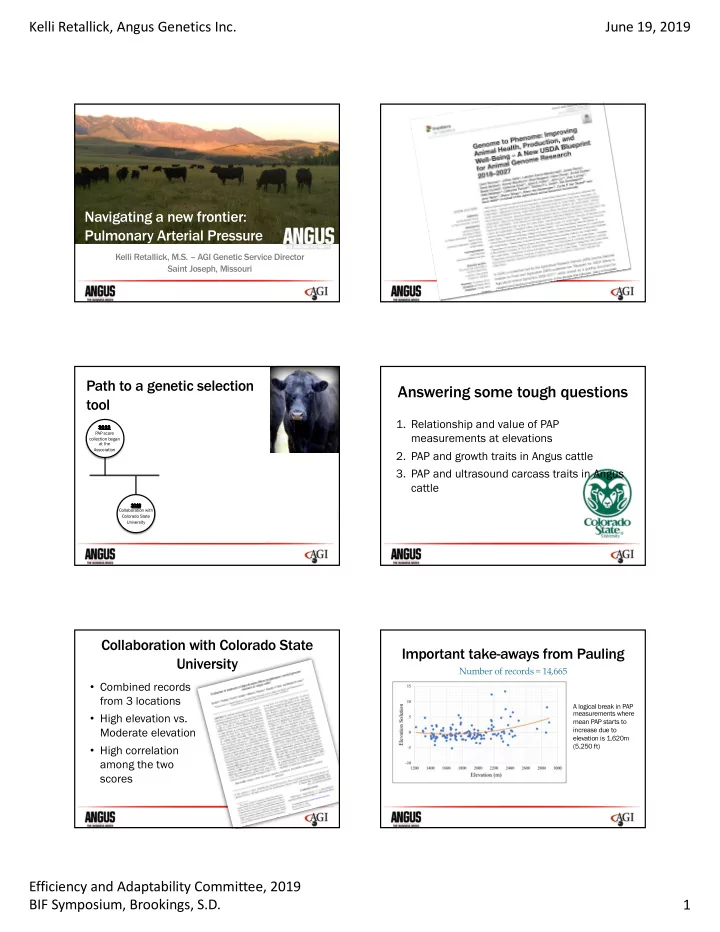
Answering some tough questions

  • 1. Relationship and value of PAP

measurements at elevations

  • 2. PAP and growth traits in Angus cattle
  • 3. PAP and ultrasound carcass traits in Angus

cattle

Collaboration with Colorado State University

  • Combined records

from 3 locations

  • High elevation vs.

Moderate elevation

  • High correlation

among the two scores

Important take-aways from Pauling

Number of records = 14,665

A logical break in PAP measurements where mean PAP starts to increase due to elevation is 1,620m (5,250 ft)

slide-2
SLIDE 2

Kelli Retallick, Angus Genetics Inc. June 19, 2019 Efficiency and Adaptability Committee, 2019 BIF Symposium, Brookings, S.D. 2 Strong correlation between the high and moderate elevation records HP HPAP MP MPAP HP HPAP 0.34 (0.03) 0.83 (0.15) MP MPAP 0.29 (0.09) No strong correlations between PAP with growth and carcass traits Path to a genetic selection tool

20 2013 PAP score collection began at the Association 20 2016 Collaboration with Colorado State University Su Summer 2018 Pauling thesis peer reviewed and published Fe

  • Feb. 2019

Research report release Ju July 2019 Cut-off for data by members Fa Fall 2019 Production EPD release for yearling PAP Sp Spring 2019 Research to incorporate additional data

Modelling the new trait: PA PAP EPD

  • Trait being predicted: Hi

High Altitude Yearling PAP

  • Ag

Age ~ covariate

– 320 – 720 days of age

  • El

Elevation ~ covariate

– Continuous

  • Co

Contemporary group: he herd/sex/test date/elevation ~ fixed effect

  • Mo

Moderate elevation PAP score ~ correlated trait

(based on work by Pauling et al., 2018)

  • Ge

Genomics – Single-Step Genetic Evaluation

Elevation breaks for incorporation into national cattle evaluation

  • High altitude: 5,500 ft or greater
  • Moderate altitude: 4,000 to <5,500 ft

Al Altitude No

  • No. of

Re Records Ac Actual Sc Scores Ed Edited Da Data He Heritability Hi High 4,200 28-180 30-80 0.32 Mo Moderate 1,500 25-139 30-80 0.16 r2=

2= 0.

0.80 80

slide-3
SLIDE 3

Kelli Retallick, Angus Genetics Inc. June 19, 2019 Efficiency and Adaptability Committee, 2019 BIF Symposium, Brookings, S.D. 3

Progress with Research EPD

  • Additional data captured

– 2,631 high elevation records – 896 moderate elevation records

Cu Current Si Sires = Registered Progeny within last 2 Years Me Mean EP EPD St

  • Std. Dev.

Mi Minimum Ma Maximum

  • 0.29

0.85

  • 3.63

5.86

Ben Benef efits:

  • Avoid pre-selection bias into

the evaluation

  • Include increased number of

records with a high correlation

  • Number of records

– ~ 3,000 total – ~1,000 with both weaning and yearling PAP at high altitudes

Future work: Incorporation of weaning PAP measurements Production PAP EPD to be released Late 2019 Path to a genetic selection tool

20 2013 PAP score collection began at the Association Su Summer 2018 Pauling thesis peer reviewed and published Fe

  • Feb. 2019

Research report released Ju July 2019 Cut-off for data by members Lat Late 2019 Production EPD release for yearling PAP Sp Spring 2019 Research to incorporate additional data 20 2016 Collaboration with Colorado State University

The value of PAP scoring will not diminish: education is key

  • A PAP EPD is not a replacement to the actual

scoring of animals to send to higher elevations

  • The value of a PAP EPD, just like any EPD, is

to identify parents for the next generations

  • Inclusion of genomics allows high altitude

breeders to identify bulls to utilize in breeding programs with less risk.

Questions & Discussion

Thank you for joining us!

Dan W. Moser, Ph.D. AGI President dmoser@angus.org 816-383-5196 Stephen Miller, Ph.D. Genetic Research Director smiller@angus.org 816-383-5157 Kelli Retallick, M.S. Genetic Service Director kretallick@angus.org 816-383-5190