UK Anti-Bribery Act: Meeting the Tough New Requirements Tough New - - PowerPoint PPT Presentation

uk anti bribery act meeting the tough new requirements
SMART_READER_LITE
LIVE PREVIEW

UK Anti-Bribery Act: Meeting the Tough New Requirements Tough New - - PowerPoint PPT Presentation

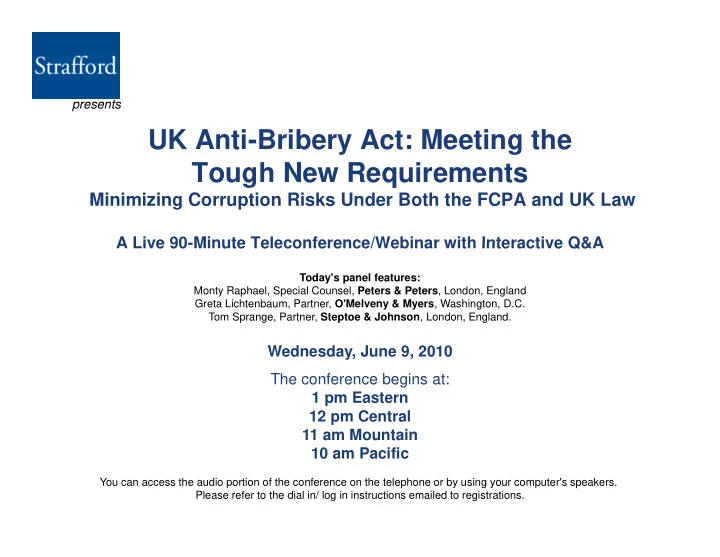
presents presents UK Anti-Bribery Act: Meeting the Tough New Requirements Tough New Requirements Minimizing Corruption Risks Under Both the FCPA and UK Law A Live 90-Minute Teleconference/Webinar with Interactive Q&A A Live 90-Minute


slide-1
SLIDE 1

presents

UK Anti-Bribery Act: Meeting the Tough New Requirements

presents

Tough New Requirements

Minimizing Corruption Risks Under Both the FCPA and UK Law

A Live 90-Minute Teleconference/Webinar with Interactive Q&A

Today's panel features: Monty Raphael, Special Counsel, Peters & Peters, London, England Greta Lichtenbaum, Partner, O'Melveny & Myers, Washington, D.C. T S P t St t & J h L d E l d

A Live 90-Minute Teleconference/Webinar with Interactive Q&A

Tom Sprange, Partner, Steptoe & Johnson, London, England.

Wednesday, June 9, 2010 The conference begins at: The conference begins at: 1 pm Eastern 12 pm Central 11 am Mountain 10 am Pacific 10 am Pacific

You can access the audio portion of the conference on the telephone or by using your computer's speakers. Please refer to the dial in/ log in instructions emailed to registrations.

slide-2
SLIDE 2

For CLE purposes, please let us know how many people are listening at your location by y

  • closing the notification box
  • and typing in the chat box your
  • and typing in the chat box your

company name and the number of attendees attendees.

  • Then click the blue icon beside the box

to send to send.

For live event only.

slide-3
SLIDE 3
  • If the sound quality is not satisfactory
  • If the sound quality is not satisfactory

and you are listening via your computer speakers please dial 1-866-258-2056 speakers, please dial 1 866 258 2056 and enter your PIN when prompted. Otherwise, please send us a chat or e- , p mail sound@straffordpub.com immediately so we can address the problem.

  • If you dialed in and have any difficulties

during the call, press *0 for assistance.

slide-4
SLIDE 4

UK Anti-Bribery law and its requirements and its requirements

Monty Raphael

Special Counsel, Peters & Peters Special Counsel, Peters & Peters

4

slide-5
SLIDE 5

New offences New offences

5

slide-6
SLIDE 6

Section 1: active bribery

  • Person (“P”) is guilty of an offence if:

Person ( P ) is guilty of an offence if:

– P offers, promises or gives a financial or other advantage to another person, and P intends the advantage: – P intends the advantage:

  • to induce a person to perform improperly a relevant function
  • r activity, or

t d f th i f f h

  • to reward a person for the improper performance of such a

function or activity. – Does not matter whether the person to whom the advantage is ff d t i h i t f / h f d

  • ffered etc. is same person who is to perform / has performed

function – Can be done through third party

6

slide-7
SLIDE 7

Section 1: active bribery

  • Or if:

Or if:

– P offers, promises or gives a financial or other advantage to another person, and – P knows or believes that the acceptance of the advantage would itself constitute the improper performance of a relevant function or activity performance of a relevant function or activity.

  • Can be done through third party
  • Can be done through third party

7

slide-8
SLIDE 8

Section 2: passive bribery

  • A person (‘R’) is guilty of an offence if:

A person ( R ) is guilty of an offence if:

– R requests, agrees to receive or accepts a financial or

  • ther advantage intending that, in consequence, a

relevant function or activity should be performed improperly (whether by R or another person). R – R

  • requests, agrees to receive or accepts a financial
  • r other advantage, and
  • the request, agreement or acceptance itself

constitutes the improper performance by R of a relevant function or activity relevant function or activity.

8

slide-9
SLIDE 9

Section 2: passive bribery

– R requests, agrees to receive or accepts a financial or R requests, agrees to receive or accepts a financial or

  • ther advantage as a reward for the improper

performance (whether by R or another person) of a relevant function or activity relevant function or activity. – In anticipation of or in consequence of R requesting, agreeing to receive or accepting a financial or other g g p g advantage, a relevant function or activity is performed improperly— by R or

  • by R, or
  • by another person at R’s request or with R’s

assent or acquiescence. q

9

slide-10
SLIDE 10

Section 2: passive bribery

  • In all cases, does not matter

,

– whether R requests, agrees to receive or accepts (or is to request, agree to receive or accept) the advantage directly or through a third party, – whether the advantage is (or is to be) for the benefit of R or another person.

  • Last three cases: does not matter whether R knows or

believes that the performance of the function or activity is improper.

  • Last case: where person other than R is performing the

p p g function or activity, it also does not matter whether that person knows or believes that the performance of the function or activity is improper. function or activity is improper.

10

slide-11
SLIDE 11

Section 3: ‘relevant function / activity’

  • any function of a public nature,

any function of a public nature,

  • any activity connected with a business,
  • any activity performed in the course of a person’s

employment,

  • any activity performed by or on behalf of a body of

persons whether corporate or not; persons, whether corporate or not;

  • when a person performing the function or activity is

– expected to perform it in good faith; – expected to perform it impartially; – in a position of trust by virtue of performing it

  • Counted even if no connection with / performed outside
  • Counted even if no connection with / performed outside

UK

11

slide-12
SLIDE 12

Section 4: relevant expectation

  • Section 4: ‘Improper performance’:

Section 4: Improper performance :

– Performed in breach of a relevant expectation, and – Is to be treated as being performed improperly if there is a failure to perform the function or activity and that failure is itself a to perform the function or activity and that failure is itself a breach of a relevant expectation.

  • ‘Relevant expectation’:

– Good faith / impartially: the expectation mentioned – In position of trust: any expectation as to the manner in which, or the reasons for which, the function or activity will be performed that arises from the position of trust mentioned in that condition.

  • Inclusion of past performance

12

slide-13
SLIDE 13

Section 5: expectation test

  • What a reasonable person in the UK would expect in

What a reasonable person in the UK would expect in relation to the performance of the type of function or activity concerned. L l t ti i t b di d d l it i

  • Local custom or practice is to be disregarded unless it is

permitted or required by the written law applicable to the country or territory concerned. y y

  • Written law:

– any written constitution, or provision made by or under legislation applicable to the country or territory concerned or legislation, applicable to the country or territory concerned, or – any judicial decision which is so applicable and is evidenced in published written sources.

13

slide-14
SLIDE 14

Section 6: bribery of foreign public officials

  • Person (“P”) who bribes a foreign public official (“F”) is

( ) g p ( ) guilty of an offence if P’s intention is to influence F in F’s capacity as a foreign public official.

  • P must also intend to obtain or retain business /

d t i d t f b i advantage in conduct of business.

  • P bribes F if, and only if—

– directly or through a third party, P offers, promises or gives any fi i l th d t financial or other advantage—

  • to F, or
  • to another person at F’s request or with F’s assent or

acquiescence, and acquiescence, and – F is neither permitted nor required by the written law applicable to F to be influenced in F’s capacity as a foreign public official by the offer, promise or gift.

14

slide-15
SLIDE 15

Section 6: bribery of foreign public officials

  • Influencing in capacity as a foreign public official:

g p y g p includes—

– omission to exercise functions, and – any use of F’s position as official, even if not within authority. any use of F s position as official, even if not within authority.

  • ‘Foreign public official’: individual who

– holds a legislative, administrative or judicial position of any kind, whether appointed or elected of a country or territory outside the whether appointed or elected, of a country or territory outside the United Kingdom (or any subdivision of such a country or territory), – exercises a public function—

  • for or on behalf of a country or territory outside the United

Kingdom (or any subdivision of such a country or territory), or

  • for any public agency or public enterprise of that country or

territory (or subdivision), or

  • is an official or agent of a public international organisation.

15

slide-16
SLIDE 16

Who is covered? Who is covered?

16

slide-17
SLIDE 17

Corporates

  • Liable for offences under sections 1, 2 or 6

Liable for offences under sections 1, 2 or 6

  • Also liable under Section 7: Failure of commercial
  • rganisations to prevent bribery

R l t i l i ti (‘C’) ilt if

  • Relevant commercial organisation (‘C’) guilty if a person

(“A”) associated with C bribes another person intending

– to obtain or retain business for C, or – to obtain or retain an advantage in the conduct of business for C.

17

slide-18
SLIDE 18

Corporates

  • Section 7(5): ‘relevant commercial organisation’:

Section 7(5): relevant commercial organisation :

– body incorporated under UK law + carries on a business (whether there or elsewhere) – body corporate (wherever incorporated) which carries

  • n a business, or part of a business, in any part of the

UK UK – partnership formed under UK law + carries on a business (whether there or elsewhere) – partnership (wherever formed) which carries on a business, or part of a business, in any part of the UK t d f i i ‘b i ’ – trade or profession is a ‘business’

18

slide-19
SLIDE 19

Corporates

  • Meaning of ‘associated person’ (section 8):

Meaning of associated person (section 8):

– performs services for or on behalf of C – capacity in which performs services does not matter p y p – A may (for example) be C’s employee, agent or subsidiary – Determined by reference to all relevant circumstances and not merely by reference to the nature of the relationship between A and C p – If A is employee of C, presumed that performs services unless contrary is shown

19

slide-20
SLIDE 20

Senior officers

  • Section 14: If offence under sections 1 2 or 6

Section 14: If offence under sections 1, 2 or 6 committed with consent / connivance of—

– a senior officer of the body corporate or Scottish y p partnership, or – a person purporting to act in such a capacity

  • senior officer / person (as well as the body

corporate or partnership) guilty of the offence D t l l i ffi / h

  • Does not apply unless senior officer / person has

‘close connection’ with UK

20

slide-21
SLIDE 21

Senior officers

  • ‘Close connection’:

Close connection :

– At the time acts / omissions concerned were done / made, person was:

  • a British citizen
  • a British citizen,
  • a British overseas territories citizen,
  • a British National (Overseas),
  • a British Overseas citizen,
  • a person was a British subject (under British Nationality Act

1981),

  • a British protected person within the meaning of that Act,
  • an individual ordinarily resident in the UK,
  • a body incorporated under the law of any part of the UK,

a body incorporated under the law of any part of the UK,

  • a Scottish partnership.

21

slide-22
SLIDE 22

Senior officers

  • ‘Director’:

Director :

– in relation to a body corporate whose affairs are managed by its members, means a member of the body corporate,

‘S i ffi ’

  • ‘Senior officer’:

– in relation to a body corporate, a director, manager, secretary or other similar officer of the body secretary or other similar officer of the body corporate, and – in relation to a Scottish partnership, a partner in the partnership

22

slide-23
SLIDE 23

Territorial application (section 12)

  • Sections 1 2 or 6:

Sections 1, 2 or 6:

– Offence committed if elements of offence occurred

  • utside UK when person has close connection with

UK

  • Section 7:

– offence committed even if no elements committed in UK – where no act or omission which forms part of an where no act or omission which forms part of an

  • ffence under section 7 takes place in the UK,

proceedings for the offence may be taken at any l i th UK place in the UK.

23

slide-24
SLIDE 24

Other matters

  • Permissible payments

Permissible payments

– No exception for facilitation payments – Likely approach of SFO y pp – Guidance may suggest small payments unlikely to be prosecuted?

  • Adequate procedures

24

slide-25
SLIDE 25

Penalties

  • Individuals:

Individuals:

– 10 years’ imprisonment – Unlimited fine

  • Corporates:

p

– Unlimited fine

25

slide-26
SLIDE 26

The future of plea bargaining The future of plea bargaining

26

slide-27
SLIDE 27

Plea bargaining in the UK: is it over?

Innospec: Thomas LJ, March 2010 Innospec: Thomas LJ, March 2010

  • SFO ‘had no power to enter into the arrangements made

and no such arrangements should be made again’

  • Considered $12.7 million fine to be ‘wholly inadequate’
  • Concluded with ‘considerable reluctance’, that ‘it would

neither be just nor fair in the unusual circumstances of neither be just nor fair in the unusual circumstances of this case for this court to impose a penalty greater than the amount allocated to the UK’.

  • Court in general ‘will not consider itself in any way

restricted in its powers’ by future agreements

27

slide-28
SLIDE 28

Plea bargaining in the UK: is it over?

Dougall: May 2010 Dougall: May 2010

  • Dougall confessed and fully cooperated with SFO
  • Signed agreement under SOCPA to provide immunity
  • SFO submitted that he should receive suspended

sentence C t i d t d D ll t d

  • Court ignored agreement and Dougall sentenced
  • Court of Appeal allowed
  • But with considerable caution: decision had ‘nothing to
  • But with considerable caution: decision had nothing to

do with any sentencing agreement between the prosecution and the defence’

28

slide-29
SLIDE 29

Will UK ‘credit’ penalties paid to US Will UK credit penalties paid to US prosecutors?

Whittle (arising from Marine Hose cartel): ( g )

  • Defendants return from US States to UK, charged and

pleaded guilty

  • Plea agreement stated that period of imprisonment
  • Plea agreement stated that period of imprisonment

should be reduced by one day for each day of the total term of the sentence of imprisonment imposed upon the defendant following his conviction for the UK cartel defendant following his conviction for the UK cartel

  • ffence
  • UK sentences reluctantly reduced in Court of Appeal:

– “We have our doubts as to the propriety of a US prosecutor seeking to inhibit the way in which counsel represent their clients in a UK court, but having heard no argument on the subject, we shall express no concluded view” shall express no concluded view .

29

slide-30
SLIDE 30

30

slide-31
SLIDE 31

Greta L.H. Lichtenbaum

The UK Bribery Act and the FCPA Compared

slide-32
SLIDE 32

Jurisdiction Under the FCPA

Anti-Bribery Provision

  • All U.S. companies – whether public or private

All U.S. companies whether public or private

  • Issuers (public companies who register securities) – whether foreign or not
  • Officers, directors, employees or agents, in the United States or abroad, of any
  • f the above

All U S iti d id t ( h i th ld dl f l )

  • All U.S. citizens and residents (anywhere in the world, regardless of employer)
  • Non-resident aliens and foreign entities that act or use U.S. mails or wires while

in the United States

  • U.S. companies may be liable for acts of foreign subsidiaries, JV partners, and
  • thers parties deemed to be acting as agents or over whom they have control

Books and Records and Internal Controls Provisions

  • Issuers – public companies, their officers and employees

32

slide-33
SLIDE 33

Jurisdiction Under the UK Bribery Act

  • Jurisdiction under the Bribery Act appears broader

than the FCPA at least as to corporations than the FCPA, at least as to corporations

  • Individuals can be guilty of an offense even if no act
  • r omission was in UK so long as (i) the acts or
  • missions would have been illegal if done in the UK

and (ii) the individual has a “close connection” to the UK (Section 12(2)) ( ( ))

  • Corporations can be guilty of an offense if they do

business in the UK, regardless of where the acts or i i hi h f t f th ff t k l

  • missions which form part of the offense take place

(Section 7(5))

33

slide-34
SLIDE 34

Commercial Bribery

  • Section 1 of the UK Bribery Act prohibits

bribery of private citizens wherever located bribery of private citizens, wherever located

– FCPA does not cover foreign commercial bribery – A violation of Section 1 can also be a predicate for A violation of Section 1 can also be a predicate for corporate liability under Section 7 – Because of the range of conduct potentially covered, corporations now have an added incentive to monitor all payments to and from third-parties third parties

34

slide-35
SLIDE 35

Definition of “Foreign Official”

  • Bribery Act’s definition somewhat ambiguous as to

inclusion of low-level bureaucrats inclusion of low level bureaucrats

– Definition of “foreign public official” requires that the individual “holds a legislative, administrative or judicial position of any kind whether appointed or elected” position of any kind, whether appointed or elected – Definition uses “public enterprise” instead of “instrumentality”

  • FCPA’s definition of “foreign official” explicitly

includes “employee of a foreign government or any department, agency or instrumentality thereof”

  • Bribery Act does not explicitly cover candidates for

Bribery Act does not explicitly cover candidates for political office

35

slide-36
SLIDE 36

Knowledge Requirements

  • Under both the FCPA and Bribery Act,

payments to foreign officials made through payments to foreign officials made through third-parties can form the basis of an offense

– FCPA requires knowledge, interpreted as actual ( S C knowledge or conscious avoidance (15 U.S.C. § 78dd-3(f)(3); United States v. Bourke, No. 05- 518) – Bribery Act does not use the term “knowledge.” Section 6 states that a person can bribe the foreign official directly or through a third party at g y g p y the foreign official’s request, assent or acquiescence

36

slide-37
SLIDE 37

Business Nexus

  • Bribery Act requires that “payment be made

to “obtain or retain business or an advantage to obtain or retain business or an advantage in the conduct of business” (Section 6(2))

– Language tracks OECD Anti-Bribery Convention

  • FCPA uses narrower “obtain or retain

business” formulation (§ 78dd-1)

lth h U S t h id d h th – although U.S. courts have considered whether addition of “any improper advantage” to prior subsection expands scope beyond payments i t d d t t t t (U S intended to secure a government contract (U.S. v. Kay, 359 F.3d 738, 754-56 (5th Cir. 2004))

37

slide-38
SLIDE 38

Legitimate Promotional Activities

  • FCPA provides an affirmative defense for

reasonable and bona fide business reasonable and bona fide business expenditures directly related to promotional activities (§ 78dd-1(c)) activities (§ 78dd 1(c))

  • No such defense in Bribery Act

– Parliament considered and rejected proposed Parliament considered and rejected proposed statutory language that would have carved out permissible commercial conduct C ti t h l li d l f – Corporations must have a clear policy and plan for monitoring travel and entertainment expenses

38

slide-39
SLIDE 39

Facilitating/Grease Payments

  • FCPA carves out facilitating or expediting

payments made to secure performance of payments made to secure performance of routine government action (§ 78dd-1(b))

  • No such carve out in Bribery Act
  • No such carve-out in Bribery Act

– Individuals and corporations subject to the Act should be careful in interactions with local regulators, e.g., customs clearance, license or visa renewal, annual inspections, etc.

39

slide-40
SLIDE 40

Local Law Defense

  • Both the FCPA and Bribery Act contain a

variation on this affirmative defense variation on this affirmative defense

– FCPA provides payment must have been lawful under the “written laws and regulations” applicable t th (§ 78dd 3( )(1)) to the payee (§ 78dd-3(c)(1)) – Bribery Act specifies that “F is neither permitted nor required by the written law applicable to F to be influenced…” (Section 6(3)(b))

  • Written law defined in a way that preferences UK law or

rules of a public international organization over local law

  • Local law must be contained in written constitution, piece
  • f legislation or published judicial opinion (Section 6(7))

40

slide-41
SLIDE 41

Scope of Corporate Liability

  • Corporations are strictly liable for the acts or
  • missions of persons associated with them
  • missions of persons associated with them

(Section 7)

  • Yet having “adequate procedures” in place to
  • Yet having adequate procedures in place to

prevent bribery is a complete defense

  • No “adequate procedures” defense under the

No adequate procedures defense under the FCPA but relevant in prosecutorial discretion to charge and in resolution of action g

41

slide-42
SLIDE 42

Other Differences

  • Bribery Act itself contains no books and

records or internal controls provisions though records or internal controls provisions, though

  • ther provisions of UK law create such
  • bligations
  • No requirement under Bribery Act for a

corrupt intent N i il f t th it f B ib A t

  • No civil enforcement authority for Bribery Act

– Bribery Act will primarily be enforced by the Serious Fraud Office – FCPA enforced by both DOJ and SEC

42

slide-43
SLIDE 43

Penalties

  • The Bribery Act

I di id l f t 10 i i t – Individuals face up to 10 years imprisonment, a fine, or both for each violation – Corporations subject to unlimited fines Corporations subject to unlimited fines

  • FCPA

– Individuals face five year maximum sentence; up y ; p to $250,000 fine – Corporations also subject to fines, conditional d f d ti t deferred or non-prosecution agreements, probation, and corporate monitors

43

slide-44
SLIDE 44
  • 805517

44

slide-45
SLIDE 45

UK Anti-Bribery Act: UK Anti Bribery Act: The Adequate Procedures Defence Procedures Defence

Thomas K. Sprange London June 2010

slide-46
SLIDE 46

Section 7 = An Affirmative Defence Section 7 = An Affirmative Defence

  • Section 7 contains an affirmative defence, whereby
  • rganisations can avoid criminal liability if they can establish

that they have “adequate procedures” in place designed to prevent bribery prevent bribery.

  • It will be the organisation’s burden to provide evidence and

establish, by a balance of probabilities, that its anti-corruption compliance procedures are “adequate”. p p q

  • Significant distinction between the Act and the approach taken

under the FCPA – although having adequate procedures can constitute a mitigating factor in FCPA prosecutions, such d ld t tit t t i ht ffi ti d f procedures would not constitute an outright affirmative defence under U.S. law.

46

slide-47
SLIDE 47

What Does “Adequate Procedures” Mean?

Th “ d d ” i l f d fi d i h A b h

  • The term “adequate procedures” is left undefined in the Act, but the

Act requires the Secretary of State to issue guidance on this topic.

  • Government has indicated that interested parties will be given an
  • pportunity to comment on the guidance before it is finalized.

l k l h d d ll d b l h h

  • Unlikely that proposed guidance will provide substantial insights that

are not already reflected in other international best practices standards.

  • The Government has stated that it does not intend to introduce

p esc ipti e standa ds and it ill not o tinel monito compliance prescriptive standards and it will not routinely monitor compliance (except, potentially, as a precondition to settlement or an element of a plea agreement in the context of enforcement actions).

  • Guidance is likely to take the form of general benchmarks, and the

Government has stated that it expects courts in determining whether Government has stated that it expects courts, in determining whether the “adequate procedures” defence applies, “to take into account the size and needs of the particular business being prosecuted.”

47

slide-48
SLIDE 48

Potentially Relevant Standards

G id li d d h h SFO li d i i J l 2009 id li lf

  • Guidance on compliance standards that the SFO outlined in its July 2009 guidelines on self-

reporting;

  • Chapter Eight of the U.S. Federal Sentencing Guidelines Manual, which governs penalties

imposed under the FCPA and sets forth standards for an effective compliance and ethics imposed under the FCPA, and sets forth standards for an effective compliance and ethics program;

  • the recently-published OECD Good Practice Guidance on internal controls, ethics, and

compliance;

  • the May 2008 Woolf Committee report on the BAE Systems anti-corruption compliance

program; and

  • ther compliance standards offered by non-governmental organisations in this area (such

as, for example, Transparency International and the World Economic Forum’s Partnering Against Corruption Initiative).

48

slide-49
SLIDE 49

Compliance Expectations: I nternally Compliance Expectations: I nternally

h i i h l

  • Tone at the top, supervision, the control

environment, and resources

  • Risk-based approach

Risk assessments

  • Policies and procedures

Third parties p

Other

  • M&A due diligence
  • Training

Training

  • Auditing
  • Investigations and remediation

49

slide-50
SLIDE 50

Compliance Expectations: Externally

  • Preventive steps (risk-

p ( based) are necessary and expected

Pre-engagement due diligence R di t d

Responding to red flags

Contractual and Other

Contractual and Other Safeguards

Oversight

50

O e s g t

slide-51
SLIDE 51

What Does This Mean I n Practise? What Does This Mean I n Practise?

  • Strong involvement and support from senior management and

the board of directors

  • Publish and disseminate clear written policies and procedures

(including specific procedures as appropriate covering issues (including specific procedures, as appropriate, covering issues such as dealings with intermediaries, processes for obtaining regulatory approvals from foreign governments, facilitating payments, travel and entertainment expenditures, and political p y , p , p and charitable contributions)

  • Ensure appropriate oversight and training of employees and

third party representatives

  • Implement transparent books and records procedures to ensure

that company funds are properly accounted for and cannot be used for the purpose of making improper payments

51

slide-52
SLIDE 52

Privileged and Data Protection Privileged and Data Protection

  • Preservation of Privileges under EU laws

UK Th Ri d i i li i i f h i

UK: Three Rivers decision – limitation on scope of what constitutes the “client” departs substantially from U.S. privilege approach.

Other EU Member States: varying approaches, many civil law countries do not consider in-house counsel communications to be cou t es do

  • t co s de
  • use cou se co

u cat o s to be privileged.

  • EU Data Protection Directive (95/ 46/ EC)

M i tifi ti t / t f d t bj t t ll t

May require notification to / consent from data subjects to collect and review data, or transfer data to United States (which is not recognized by EU as offering an “adequate level” of data protection).

Approaches vary by EU Member State. pp y y

  • These and related issues (e.g. European employment laws) could

surface in pre-emptive due diligence and other compliance contexts

52

contexts