
SLIDE 1
WADDEL ELEMENTRY SCHOOL
EXPANSION STUDY - JANUARY, 2014
Tai Soo Kim Partners Architects T 860-547-1970 • www.tskp.com
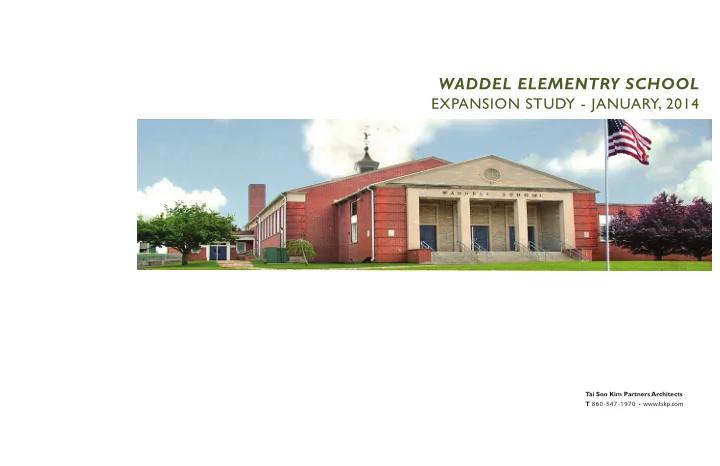
WADDEL ELEMENTRY SCHOOL EXPANSION STUDY - JANUARY, 2014 Tai Soo Kim - - PowerPoint PPT Presentation
WADDEL ELEMENTRY SCHOOL EXPANSION STUDY - JANUARY, 2014 Tai Soo Kim Partners Architects T 860-547-1970 www.tskp.com TABLE OF CONTENTS I EXISTING CONDITIONS II OPTION 1 III OPTION 2 SPACE ANALYSIS IV COST COMPARISON V APPENDIX -
Tai Soo Kim Partners Architects T 860-547-1970 • www.tskp.com
Tai Soo Kim Partners Architects · www.tskp.com
I II III IV V IV EXISTING CONDITIONS OPTION 1 OPTION 2 SPACE ANALYSIS COST COMPARISON APPENDIX - WASHINGTON ES EDUCATION SPECIFICATION
Tai Soo Kim Partners Architects · www.tskp.com
I -BACKGROUND
Tai Soo Kim Partners Architects · www.tskp.com
I - EXISTING CONDITIONS MAIN LEVEL LOWER LEVEL
CLASSROOM CIRCULATION ADMINISTRATION UTILITY & SERVICE CORE
PARENT CUE PARKING BUS CUE PARKING PAVED PLAY SERVICE
Tai Soo Kim Partners Architects · www.tskp.com
CLASSROOM CIRCULATION ADMINISTRATION UTILITY & SERVICE CORE
MAIN LEVEL LOWER LEVEL
11 - OPTION 1
Tai Soo Kim Partners Architects · www.tskp.com
LOWER LEVEL
CLASSROOM CIRCULATION ADMINISTRATION UTILITY & SERVICE CORE DEMO
MAIN LEVEL 111 - OPTION 2
Tai Soo Kim Partners Architects · www.tskp.com
1V - SPACE ANALYSIS
Tai Soo Kim Partners Architects · www.tskp.com
V - COST COMPARISON
Tai Soo Kim Partners Architects · www.tskp.com
Washington Elementary School Robertson Elementary School Manchester, Connecticut June 25, 2013 Draft MANCHESTER BOARD OF EDUCATION Ron Atwater Michael Crockett Maria Cruz Deborah Hagenow Kelly Luxenberg Neal Leon, Secretary Chris Pattacini, Chairman Jason Scappaticci Sarah Walton
The Manchester Board of Education has developed these specifjcations as required by the Connecticut State Department of
specifjcations defjne the objective, activities, programs, and space requirements of the facility so the educational goals
communication between and school administration/stafg is necessary. In this sense the education specifjcations provide an
The size and features of the spaces described in the Educational Specifjcations refmect the criteria necessary to support the educational program. The following identifjes the major elements to be incorporated into the school facility to accommodate the enrollment and program. Systems: 1. Complete fjre alarm and sprinkler system for all new spaces. 2. Integrated electronic communication system. A telephone/intercom and computer network connections in addition to capacity for streaming cable and satellite in each new offjce and classroom. 3. Air-conditioning in all areas. 4. Comply with Ct High Performance Schools requirements for energy effjciency. 4. Water fountains and lavatories throughout all new construction. 5. All new instructional spaces should have access to natural light and ventilation, including operable windows. 6. Wireless capability in all spaces. General Classrooms (20 Required) 1. Adequate power to support current and future technology needs. Special Education and Specialized Small Group Instruction Rooms (3 Special Ed, 3 Specialized Small Group Instruction Rooms Required) 1. Adequate power to support current and future technology needs. OT/PT Classroom (1 Required) 1. Offjce space for occupational therapist attached or adjacent. Project Classroom (1 Required) 1. Two sinks, one of which should be in a teacher’s demonstration area, and extra storage space for ongoing, hands on activities. Art Classroom (1 Required) 1. Four sinks distributed around the perimeter of the room. 2. Ample storage for supplies. Including lockable closet and cabinets. Provide separate storage space for After School Program. 3. Areas for display of both two and three dimensional art. 4. Separate kiln room with appropriate ventilation. Music Classroom (1 Required) 1. Adequate power to support current and future technology needs. Band/Orchestra/Chorus (1 Required) 1. Space adequate to house 75 musicians. 2. Adequate instrument storage for both band and orchestra instruments. 3. One sink.
Tai Soo Kim Partners Architects · www.tskp.com
4. Acoustically treated for instructional purposes. 5. Possible location on stage with acoustical partitions separating the space from adjacent spaces. Administration 1. Offjce for principal 2. Offjce for assistant principal. 3. Space for two clerical stafg. 4. Conference room 4. Work/copy/mail room. 5 Waiting area. 6. Full kitchenette with sink and storage. 7. Acoustical isolation for offjce. 8. File Storage Pupil Services (7 Offjces Required) 1. Offjces for one guidance counselor, school psychologist, school social worker, speech pathologists, and curriculum coaches. Nurse 1. Adjacent to the offjce areas 2. HC accessible toilet. 3. One sink. 4. Space for four cots. 5. Offjce with good visibility to student areas. 6. Waiting area. 7. Exam room. School Based Health Center 1. Adjacent to school nurse 2. HC accessible toilet. 3. One sink. 4. Offjce with good visibility to student areas. 5. Offjce for psychologist 6. Waiting area. 7. 2 Exam Rooms. 8. 1 Dental Exam Room. 9. Separate and secure entrance. Stafg/Work Room 1. Work counter 2. Provisions for a large copy machine adjacent to this space. 3. Room for a work table. Stafg Lounge 1. Room for tables. 2. Counter w/sink. 2. Located in close proximity to cafeteria. 3. Adjacent to or should house adult toilet rooms Custodial 1 Adequate custodial closets with service sinks throughout. Cafeteria 1. Capacity to accommodate all students in a maximum of four lunch waves. 2. Locate in close proximity to the outdoor play area. Library/Media Center. Gymnasiums 1. Provide an attached stage. Provide acoustical separation if the stage is used for music instruction. 2. Sized to accommodate at a minimum one full basketball court for elementary school use. Site Development 1. Separate traffjc patterns for buses and cars. 2. Parking for 160 cars minimum. 3. Multiple play areas with playscapes meeting district and state accessibility requirements. Miscellaneous Considerations 1. Minimize travel distances between rooms. 2. Easy community parking access to the gymnasium and cafeteria. The gymnasium and cafeteria must be segregated from the rest of the school building 3. Security entry lobby. Consistent with district and state standards.