W HY ? R IPARIAN AND E NVIRONMENTAL C ONSIDERATIONS Erosion - - PowerPoint PPT Presentation

w hy
SMART_READER_LITE
LIVE PREVIEW

W HY ? R IPARIAN AND E NVIRONMENTAL C ONSIDERATIONS Erosion - - PowerPoint PPT Presentation

S URREY EY S S ENS IVE E COSYST SYSTEM P ROTECTION TECTION M EASUR NSIT ITIVE URES ES F ORUM ON E NVIR AL A SSE FOR U RBAN D EVEL UM ON IRONMENT ONMENTAL SESS SSMEN MENT FOR VELOPMEN OPMENT O CTOBE OBER 19, 9, 20 2016 A GENDA Why ?


slide-1
SLIDE 1

SURREY

EY’S

SENS

NSIT ITIVE IVE ECOSYST SYSTEM PROTECTION TECTION MEASUR URES ES

FORUM

UM ON ON ENVIR IRONMENT ONMENTAL AL ASSE SESS SSMEN MENT FOR FOR URBAN DEVEL VELOPMEN OPMENT

OCTOBE

OBER 19,
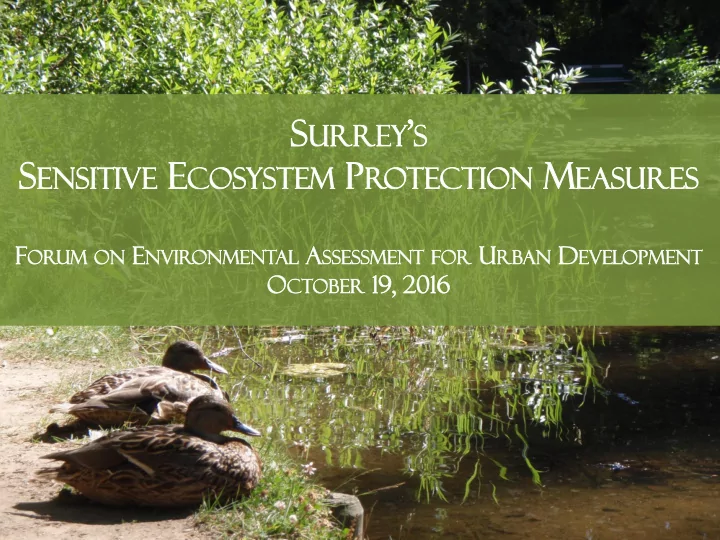
9, 20 2016

slide-2
SLIDE 2

AGENDA

Why?

  • Riparian and Environmental Considerations
  • Council Direction

What?

  • Sensitive Ecosystem Development Permit Areas

Where and How?

  • Protection Areas (BCS GIN and Streamside Zoning Bylaw)

How?

  • Amendment of OCP
  • Amendment of Zoning Bylaw

When?

  • Next Steps

2

slide-3
SLIDE 3

WHY?

RIPARIAN AND ENVIRONMENTAL CONSIDERATIONS

  • Erosion
  • Slope Stability
  • Trees
  • Drainage Maintenance Access
  • Encroachments
  • Invasive Species
  • Beaver Management
  • Public Access
  • Species at Risk
  • Biodiversity Conservation Strategy (BCS)
  • Riparian Areas Regulations (RAR)
  • Streamlined Process

3

slide-4
SLIDE 4

EROSION

Narrow riparian areas;

  • do not allow for natural creek movement –

require armouring / fortifying or purchasing at great expense.

  • Presents a major liability for homeowners as

well as the City Wider riparian areas increase resilience to erosion

slide-5
SLIDE 5

SLOPE STABILITY / TREE FAILURES

  • Erodes natural angle of

repose

  • Erosion often causes slope

instability to structures and trees (causes tree failures).

slide-6
SLIDE 6

EROSION / TREE FAILURES

Narrow riparian areas:

  • exacerbate erosion resulting in the

undermining of trees

  • do not allow tree failure without

liability

slide-7
SLIDE 7

DRAINAGE MAINTENANCE ACCESS

Require drainage access for:

  • streamflow conveyance

maintenance and

  • major and minor capital works
slide-8
SLIDE 8

HAZARD TREE MANAGEMENT

Native trees >30m tall – taller than the width of many riparian areas – trees may fall across entire riparian area targeting both sides of the greenspace. Narrow riparian areas are less resilient to wind-throw.

slide-9
SLIDE 9

ENCROACHMENTS

Narrow riparian areas are often enveloped within the adjacent private property due to their apparent ‘insignificance.’ Small lots often encroach on adjacent riparian areas to obtain more usable yard space

slide-10
SLIDE 10

INVASIVE PLANTS

Narrow riparian areas:

  • do not allow for interior forest

habitat

  • Are more susceptible to

invasive species invasion and are quickly degraded

  • Are more expensive as a unit

cost to maintain

slide-11
SLIDE 11

BEAVERS: FLOODING

  • Beaver dams may raise water

>1m in 24 hours above HWM

  • May cause flooding to adjacent

homes and infrastructure

  • Often not enough time for the

City to respond to flooding

slide-12
SLIDE 12

BEAVERS: HIGH WATER & HAZARD TREES

  • Beavers fell trees
  • Beaver dams raise water table

increasing tree root-plate failures

slide-13
SLIDE 13

TRAILS/PUBLIC ACCESS

  • Trails are not permitted within RAR SPEA area,
  • RAR setbacks do not allow for public access and use of riparian

areas

slide-14
SLIDE 14

BCS - WILDLIFE MOVEMENT

  • Riparian areas are natural dispersal corridors for

wildlife

  • Meet Biodiversity Conservation Strategy (BCS)

Green Infrastructure Network (GIN) objectives

  • The wider the wildlife corridor is, the more

functional and resilient it is

  • Narrow riparian areas reduce gravel recruitment

necessary for salmon spawning and stormwater conveyance measures

slide-15
SLIDE 15

SPECIES AT RISK

Federal and Provincial Species at Risk

  • Pacific Water Shrew
  • Salish Sucker
  • Oregon Forest Snail
  • Red-legged frog
  • More to come…

Many species are dependant on riparian areas Under SARA - Landowners must demonstrate ‘Effective Protection’

slide-16
SLIDE 16

Biodiversity Conservation Strategy (BCS)

~405+ acres (of remaining ~3100 acres) of unsecured BCS GIN could be conveyed with the proposed Streamside Protection Zoning Setbacks

4

slide-17
SLIDE 17

STREAMSIDE REGULATIONS BACKGROUNDER

1992: Surrey used DFO/MOE “Land Development Guidelines” 2006:

Local governments required to adopt RAR procedures (‘meet or beat’) in land-use decisions by March 31, 2006.

2013:

Changes to Fisheries Act (Fed) uncouple it from Variance Process under RAR

  • No more Surrey Environmental Review Committee (ERC)
  • Surrey follows interim procedure of Detailed RAR reports with peer review

2015:

Ombudsperson report identifies deficiencies in Provincial RAR Oversight

  • Provincial audit of Local Government compliance with RAR

5

slide-18
SLIDE 18

RIPARIAN AREAS REGULATION

  • March 31, 2006 - Local Government must ‘meet or beat RAR’

Interim Process

  • Detailed Riparian Area Regulations (RAR) Assessment with Peer Review
  • Qualified Environmental Professional (QEP)

(Must be regulated by an Act e.g: R.P.Bio, P.Eng, R.P.F., P.Ag, P.Geo, ASTTBC)

  • Focus on not causing Harmful Alteration

Damage Destruction (HADD) to Fish Habitat

  • Disconnect of Federal Fisheries Act

‘No Serious Harm’ not equivalent to ‘No HADD” results in no Variances to RAR

slide-19
SLIDE 19

COUNCIL DIRECTION

  • Establish a clear

understanding of the required setbacks and a site’s development potential

Develop Streamside/Riparian Regulations – Streamside Zoning Bylaw

  • Protect streams, BCS GIN

Habitat and Federal Species At Risk

Add Sensitive Ecosystem Development Permit Areas to fill OCP Placeholder

Goal – to develop a streamlined, transparent approval process whil managing for the City of Surrey’s Values and Liabilities

6

slide-20
SLIDE 20

WHAT?

SENSITIVE ECOSYSTEM DEVELOPMENT PERMIT AREAS (DPA’S)

DPA and Guidelines:

  • OCP (Local Government Act)
  • Identifies overall area requiring

protection

  • Identifies how development

should be managed and adjusted

  • Two types
  • 1. Green Infrastructure
  • 2. Streamside

7

slide-21
SLIDE 21

WHERE? DEVELOPMENT PERMIT AREAS

Green Infrastructure: Trigger for a DP?

  • Green Infrastructure Network (GIN)
  • Hubs
  • Sites
  • Corridors
  • Defined by Biodiversity

Conservation Strategy

8

slide-22
SLIDE 22

WHERE AND HOW? PROTECTION AREAS

Green Infrastructure:

  • Defined by using information in the BCS
  • Management Objectives in Biodiversity Management Areas

and Appendix J Recommendations

  • Ecosystem Development Plan (EDP) – specific to Green

Infrastructure

  • Submitted and Illustrated

in a DP Application as the “Green Infrastructure Protection Area”

9

slide-23
SLIDE 23

WHERE? DEVELOPMENT PERMIT AREAS

Streamside: Trigger for a DP?

  • Defined by Stream Types

and Classifications

  • Class A (Red)

– Fish bearing

  • Class A/O (Red dashed)

– Fish over-wintering

  • Class B (Yellow)

– Food / Nutrient Classifications

10

slide-24
SLIDE 24

WHERE AND HOW? PROTECTION AREAS

Streamside:

  • Determined by using Zoning Bylaw
  • Ecosystem Development Plan (EDP) – specific to Streamside

Area

  • Submitted and Illustrated in a DP Application as the:

“Streamside Protection Area”

11

slide-25
SLIDE 25

STREAMSIDE PROTECTION ZONING BYLAW

A streamside setback area is calculated by a QEP using the minimum distance from the top of bank

Development Application with FLEX option

Stream Types Class A or A/O Class B All streams except… 30m 20m Channelized 25m 15m Ditches 10m 7m Natural 30m 15m Large Ravines >60m 15m 15m

For lots that existed prior to [insert date], where zoning allows for single family dwelling and duplex uses, the streamside setback area is calculated by using the minimum distance from top of bank

Single family dwelling on existing lots – No FLEX

Stream Types Class A or A/O Class B All streams except… 15m 15m Ditches 10m 7m

12

slide-26
SLIDE 26

STREAMSIDE ZONING BYLAW– FLEX OPTION

Provided there is no loss in the total area of the streamside setback area, the minimum distance from the top of bank may be reduced by no more than *5 metres

  • r **3 metres and increased by no more than 10 metres.

13

slide-27
SLIDE 27

STREAMSIDE IMPACT MITIGATION PLAN

DVP Requests:

  • For proposed reductions to the Streamside

Protection Area beyond the Zoning Bylaw setbacks and Flex Allowance

  • Streamside Impact Mitigation Plan (IMP)

REQUIRED with DVP application

  • Illustrate and prove with QEP reports that

the proposed setback reduction will not have negative impacts:

  • RAR compliant
  • Increased flooding (beavers)
  • Unstable soil conditions
  • Inability to access for maintenance
  • Riparian habitat destruction etc
  • Administered by Council

14

slide-28
SLIDE 28

DEVELOPMENT SCENARIOS…

SFD ON EXISTING LOT (TABLE B.2 OF ZONING BYLAW)

CONSISTENT WITH FORMER LAND DEVELOPMENT GUIDELINES

15

slide-29
SLIDE 29

DEVELOPMENT SCENARIOS…

BP PRE-EXISTING NON-CONFORMING RENOVATION OR ADDITION

16

slide-30
SLIDE 30

DEVELOPMENT SCENARIOS…

SUBDIVISION WITH GREEN INFRASTRUCTURE PROTECTION AREAS

17

slide-31
SLIDE 31

DEVELOPMENT SCENARIOS…

SUBDIVISION WITH STREAMSIDE PROTECTION AREAS

18

slide-32
SLIDE 32

DEVELOPMENT SCENARIOS…

GREEN INFRASTRUCTURE AND STREAMSIDE PROTECTION AREAS

19

slide-33
SLIDE 33

CONSULTATION

  • Corporate Reports
  • Memo to Council (update)– Sept 2015
  • Local Governments Workshop
  • Stakeholder Workshop
  • City Committees
  • Stakeholder Information Session

20

slide-34
SLIDE 34

WHEN? NEXT STEPS

  • Corporate Report to Council July 25, 2016 – received 1st, 2nd reading

– Recommendations: 1) Amend OCP 2) Amend Zoning Bylaw 3) Identify upcoming Amendments to Tree Protection Bylaw 4) Identify upcoming Amendments to Soil Removal and Deposition Bylaw

  • Final Adoption of Bylaw Amendments - Sept 12, 2016
  • Updating other Bylaws (Tree Preservation Bylaw , Soil Bylaw etc…)
  • Implementation - Planning and Development Department

21

slide-35
SLIDE 35

QUESTIONS?

22