
SLIDE 1
1
VU @ D2.1.1
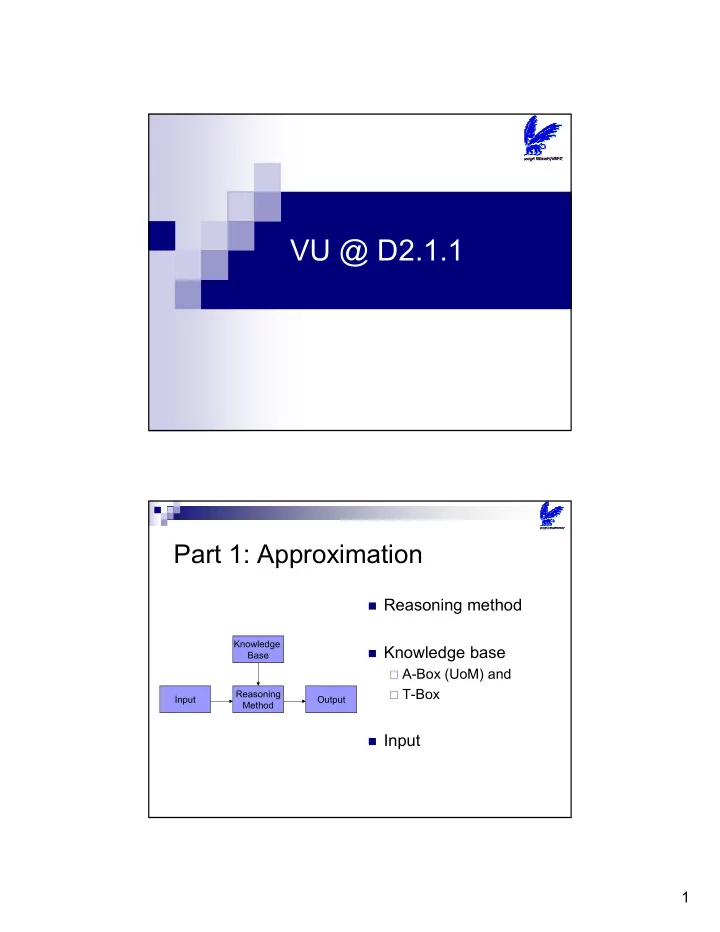
Part 1: Approximation
Reasoning method Knowledge base
A-Box (UoM) and T-Box
Input
Input Output Reasoning Method Knowledge Base
VU @ D2.1.1 Part 1: Approximation Reasoning method Knowledge - - PDF document
VU @ D2.1.1 Part 1: Approximation Reasoning method Knowledge Knowledge base Base A-Box (UoM) and T-Box Reasoning Input Output Method Input 1 Guidelines for Reasoning Methods Semantically well-founded providing a
Reasoning method Knowledge base
A-Box (UoM) and T-Box
Input
Input Output Reasoning Method Knowledge Base
Semantically well-founded
providing a clear answer to the problem
Computationally attractive
resulting in an easier computation of approximate answers
Improvable approximate
answers
Dual sound and complete Flexible to apply to different
problems
Input Output Reasoning Method Knowledge Base
Measurable Quality of the
approximate result
Recognizable Quality can be
determined at run time
Monotonicity over time and
input quality
Consistency Diminishing returns with
more improvements in the beginning
Interuptibility at any time Preemptability ensures
algorithm can be suspended and resumed
0.2 0.4 0.6 0.8 1 1 2 3 4 5 6 7 Quality Algorithm step Quality of algorithm
Boolean Constraint Propagation (BCP) sound but incomplete
Clausal BCP (restricted to clauses)
CNF-BCP Prime-BCP (intractable)
Formula BCP (intractable) Fact Propagation
S1-/S3-entailment sound and complete semantic approach
x ¬x
S1 S3 false true ? false
“Compile”
a knowledge base into another one with better computational
properties
Possibilities
Translate A-Box into a
role-free ABox
Knowledge compilation
Input Output Reasoning Method Knowledge Base
Normal A-Box Role-Free A-Box
Query Instances contained in the query Instances to be tested if contained
Exact Knowledge Compilation Approximate Knowledge Compilation
Input Output Reasoning Method Knowledge Base Input Output Reasoning Method
Knowledge Base++
Pre-Compile = Offline Reasoning
Prime implicants D Σ
Con-/Disjunction of Literals How to compute
Directly Derviable by unit
resolution
W.r.t. a tractable theory
Implicants D Implicats C
= =
Classical approaches
Language Restriction
(c.f. Role-Free A-Boxes)
Theory Approximation
(TA)
Methods for TA:
Upper bound:
if UP Q then Σ Q
Lower bound:
if LB Q then Σ Q
Upper Bound Lower Bound
= = ≠ ≠
UB Q
=
LB Q
≠ yes no No ≈ don’t care Yes ≈ don’t care
Implicants D Implicats C
Upper Bound Lower Bound