
SLIDE 1
Vote For Your Favorite Costume!
1
"Dog Parade" by editrixie is licensed under CC BY-ND 2.0 and annulla
A B C D E F
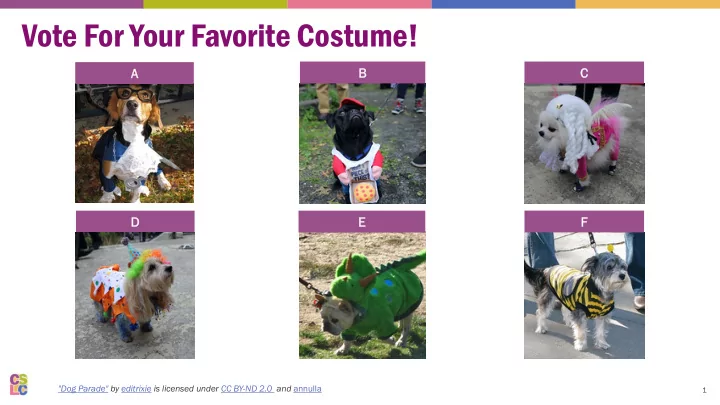
Vote For Your Favorite Costume! B C A D E F "Dog - - PowerPoint PPT Presentation
Vote For Your Favorite Costume! B C A D E F "Dog Parade" by editrixie is licensed under CC BY-ND 2.0 and annulla 1 Day 2 October 17, 2019 Learning Session 2 Welcome and Recap of Day 1 Jennifer Leonardo, PhD, MSW, LCSW
1
"Dog Parade" by editrixie is licensed under CC BY-ND 2.0 and annulla
A B C D E F
Day 2 October 17, 2019
3
4
Call (866) 835-7973 to listen and be heard Download resources in the File Share pod (above the slides) Mute yourself when you’re not talking (use phone’s mute button or press *#) This session is being recorded Use the chat (bottom left) to ask questions at any time This webinar is subject to the CSLC data agreement
5
6
Successes to Share Questions for Peers Quality Improvement Questions
7
Welcome and Recap of Day 1
Jennifer Leonardo, Director
Review homework highlights
Erin Ficker, CSLC Co-Manager
Team Present storyboard
LA Suicide and Self-Harm Prevention
Using Data Effectively
Maria Katradis, CSLC Co-Manager & Data Manager
Team Present storyboard
IA Poisoning Prevention
Team Present storyboard
WA Motor Vehicle Traffic Safety
Closing Remarks and Next Steps
Jenny Stern-Carusone, Associate Director
8
9
1.
did you appr approach u usin sing t the c checklist? 2.
at did y did you lear arn ab about y your pr project? 3.
at w was t as the mo most c chal allenging par part o
ing t through t the Checklist ist? 4.
r going t throu
h the Improvement Che hecklist, a are re y you
he s stage of
im impr provement y you in init itially t thought y you were? 5.
Based o
what at y you lear arned, wh what at’s n next f for your w work o
strategy?
10
11
12
13
14
15
16
Please enter your questions in the chat pod
Jane Herwehe, LA Debra Perna, LA Rosaria Trichilo, LA
17
Facilitator: Maria Katradis, SSHP Topic Lead
Presenters: Jane Herwehe he, M , MPH Debra P a Perna, a, R RN Rosar
ilo, M , MPH Bureau o
f Family H Health h – OPH PH – Louisiana D Dep ept.
ealth th
18
The P Probl
increased focus on children’s mental and emotional health
warranting review and action
fatalities using NVDRS
deaths by linking data from multiple sources including
19
Louisiana suicide rates have been increasing
ages 15-19 Louisiana suicide rate in 2017 for youth 10-19 years old exceeded the US rate
0.0 .0 1.0 .0 2.0 .0 3.0 .0 4.0 .0 5.0 .0 6.0 .0 7.0 .0 8.0 .0 9.0 .0 20 2007 07 20 2008 08 20 2009 09 20 2010 10 20 2011 11 20 2012 12 20 2013 13 20 2014 14 20 2015 15 20 2016 16 20 2017 17
Louis isian ana Su a Suic icid ide Rat ate P Per 100,000 Ages 10 10-19 19
Source: Vital Records, 2007-2017
students who took the 2017 Youth Risk Behavior Survey (YRBS)
attempting suicide
students reported attempting suicide
Source: Centers for Disease Control and Prevention (CDC). 1991-2017 High School Youth Risk Behavior Survey Data. Available at http://nccd.cdc.gov/youthonline/.
Source: Vital Records, 2007-2017
Between 2007 and 2017, 375 Louisiana youth age 10-19 died of suicide
Louisiana State Child Death Review (CDR) and Suicide Prevention Recommendations
Established in 1992, CDR aims to identify the causes of unexpected child death and methods for prevention
CDR wor
to:
death occur, support schools in responding to the loss
suicidal
Increase by a minimum of 1 the number of emergency departments in LDH Region 4 that are implementing universal screening for suicide risk with valid screening tools among children 10-19 years old.
25
26
CoLeads
Prevention Manager
Manager
Local Partners
Family Tree Lafayette
Physician and Pediatric Director
Director
27
shift in AIM
resulted in research into practices, tools and clinical pathways
principles of CQI, but there has not been the chance to practice these just yet given progress.
Title V program and garnered increased interest in success of this collaborative.
28
stakeholders
including ED healthcare personnel, to the Learning Collaborative
Martin, Vermilion and Iberia
children 10 through 19 years of age
29
30
youth report suicidal ideation
with universal screening
31
Screen Primary Care Provider Involvement after d/c. Evaluate Admit Discharge Home Safety Plan Post d/c Case Management Parental Education
A quick guide for
guides for ED staff to use with parents/children while in ER.
(how to access, what is their role, warm handoff. Will they check in with family?
United HC) Same questions.
with ED staff.
NASP Preventing Youth Suicide, Tips for Parents and Educators
consent needed.
with parent while in ED, let them know that you are notifying the PMD. Screeners to consider:
Who to screen?
Prevention Lifeline)
Screen positive - Yes
33
34
Option for universal screening . . .
35
# of schools and health care organizations that use a valid and reliable screening tool for suicide risk Decision to switch and start with health care organizations
As of October 2019 - 1 Emergency Department
approach tools
Relevance of the philosophy of “Slow down to go fast .. .” Importance of deliberate planning, stakeholder analysis, stakeholder needs assessment, and researching best approach to meet needs Need to include the Quality Improvement professional in the CSLC improvement projects Testing interventions in systems within which the bulk of the CSLC team has no involvement requires more time. i.e. the majority of the team is considered state or local gov’t employees and not health care providers.
36
community service providers to address mental health of youth
37
Thank nk you t u to o
r Team! Lafayett tte Area C a Cham ampion ions a s and P Partn tners
Farmer, Brittney Williams, Adrienne Huval Louisian isiana Offic ice o
Behavio ioral al H Health:
Louisian isiana Depar partm tment o t of E Educat ation ion:
Louisian isiana Offic ice o
Public ic H Health th - Burea eau o
Family ly H Healt lth
Caitlin LaVine, Nora McCarstle
38
39
Jane Herwehe, MPH Data Team Lead Louisiana Department of Health- Office of Public Health - Bureau of Family Health Jane.herwehe@la.gov www.partnersforfamilyhealth.org 504-568-3504 Danita LeBlanc, LCSW-BACS Suicide Prevention Coordinator Louisiana Department of Health – Office of Behavioral Health Adult, Child and Family Division Danita.leblanc@la.gov 225-342-9682
40
Please enter your questions in the chat pod
41
we intend to go.
It It d dep epend ends o
n wher ere e we ar e are in e in our ur story.
42
Develop
and Prediction
Test
variety of conditions
Implement
Spread
and spread to other locations
43
we’re in. Our stories evolve, so can our data.
analyze data.
44
45
Activities
leadership and champions
Cycle
test
partnerships and team
system
secure materials and equipment
pilot sites with frontline workers available to test strategies Data Collection
Analysis
Discussion Notes
Culling resources that you need to put together to begin testing Informing Next Steps
need
and evidence- informed programs
buy-in
Data to Submit to CSLC
Description
Measures
Forms
46
Activities
safety strategies
variety of locations and settings
extremes
Act Cycle
implications of implementing the strategy in sites Data Collection
learning and adaptations from tests
Indicators identified in PDSAs
Stakeholder Analysis Informing Next Steps
settings
Changes necessary for success
virtual
Data to Submit to CSLC
Description
Measures
Measures
Abandon Change
Operationalizing Forms
47
Activities
support through policy and procedure updates
strategies into
and plans
and roles
frontline workers and new hires
to leverage existing funding or pursue new funding to sustain strategies
Data Collection
Analysis Completion and periodic reviews of the Implementation Checklist (Phases of Improvement Checklist) Informing Next Steps
Changes necessary for success
Data to Submit to CSLC
Description
Measures
90-Day Aims
Forms
Checklist
Activities
champion
leadership support
aim
team
(use Spread Planner)
communications strategy and materials
system
Cycle Data Collection
Spread Planner Develop a communications strategy Develop a measurement plan Progress Indicators CSLC Measures Ongoing Stakeholder Analysis
Informing Next Steps
settings
necessary for success
champions Data to Submit to CSLC
Description
Measures
Aim
Abandon Change
Operationalizing Forms
48
49
Develop
and Prediction
Test
variety of conditions
Implement
Spread
and spread to other locations
50
Janet N Nelso son
Strategy Team Manager
51
52
Tam ammy N Noble, R RN, B BSN SN, CSPI CSPI Team am D Dat ata M Man anag ager Education Coordinator and Specialist in Poison Information Iowa Poison Control Center Aman anda da McCurle rley, M MSW SW Team Me Member Health Facilities Surveyor Iowa Department of Public Health Miche hele le Tilotta, M , MPA, B , BSN, R , RN Pr Proje ject Co Coordinator Substance Abuse Block Grant Manager/Synar Coordinator Iowa Department of Public Health Toby Y Yak ak, Ph PhD, M MPH PH Epide demio iologis ist Lead Epidemiologist Iowa Department of Public Health
The Poison Prevention Team also receives guidance from the State Epidemiological Workgroup and Prevention Partnership’s Advisory Council which is made up of state and local stakeholders throughout Iowa
53
Calls to the Io
2018 consistently decre
substance poisonings and animal exposures, but calls for
Chart data provided to IDPH from Iowa Poison Control Center Opioid & Stimulant Stats 02.06.2019
54
10,000 20,000 30,000 40,000 50,000 60,000 70,000 2009 2010 2011 2012 2013 2014 2015 2016 2017 2018
Total Calls to IPCC (All Substances)
Total calls Info Animal Exposure Exposure (Human)
Chart data provided to IDPH from Iowa Poison Control Center Opioid & Stimulant Stats 02.06.2019
55
Charts and data from Iowa Poison Control Center Highlights – FY 2018
56
Chart and data from Iowa Poison Control Center Highlights – FY 2018
57
Strateg egy:
materials, videos) on the services provided by poison control centers. Mea Measur ure: e:
Goal 1 l 1)
materials by identifying gaps and establishing contacts with four new partners. Goal 2 l 2)
materials by identifying at least one additional gap.
Identify Information Distribution Gap Provide Poison Prevention Materials Poisoning Numbers Decrease
58
59
Women, en, Inf Infant ant’s ’s and and Chil ildren Pr en Program
Missi ssion
who are at nutrition risk by providing nutritious foods to supplement diets, information on healthy eating, and referrals to health care. Measure e
Iowa Poison
60
Chart from CSN CSLC Site
61
62
63
64
Please enter your questions in the Q & A pod
Will Hitchcock, WA
65
Facilitator: Jenny Stern- Carusone, MVTS Topic Lead
66
Motor Vehicle injuries continue to be one of the leading cause of unintentional injuries in the state of Washington.
April 2023, reduce annual traffic fatalities for ages 0-19 by 7.7% annually from 51 in 2017 to 31 in 2022.
measured by number of inspections available to communities.
programs to teens across the state using Impact Teen Driver curriculum
67
68
Aim: Reduce annual traffic fatalities for ages 0-19 by 39% from 51 to 31 between 2017 to 2022.* Implement and Spread teen driver safety programs Track number of technicians Track and follow-up with community members receiving TOT for ITD Support and track number of ITD courses held and number of teens participating CPSTs Target Zero Managers Safe Kids Coalitions WTSC Safe Kids Worldwide WTSC Safe Kids Impact Teen Driver Org Schools Parents Teens Community Members Track number of inspection stations.
*aligns with Target Zero goals related to the 0- 19 age group proportion
Improve Driver attitudes and norms around safe driving culture CPST training to maintain and enhance skills of certified techs and educate community Track # of CPS Courses Track renewal rate.
2020 – will shift focus to outreaching to daycare centers, birthing hospitals,
educating pediatricians, birthing hospitals, daycare settings on CPS, they will convey this information to parents/caregivers.
trainings provided outside CPST events to transporters. And number
69
Strat ateg egy 1 1: Implement and spread child passenger safety education to parents/caregivers(e.g. how to correctly install child safety seats, buckle harness, etc.)
Strat ateg egy 3 3: Train and certify child passenger safety technicians in counties throughout the state or jurisdiction
providing education to communities with effective outcomes in reducing CP serious injuries and deaths
address attrition and manage within budget constraints
CPSTs with active certification, recertification rate, inspections stations, certification courses.
70
Strat ateg egy 5 5: Implement and spread evidence-based teen driver safety programs to teens throughout the state
with Safe Kids Chelan-Douglas implementing Teens in Cars in 2018-19.
across the state to determine who has been trained in curriculum and create a map of areas to target for implementation based on available trained trainers as well areas needing 'train the trainer' sessions to spread Impact Teen Drivers state wide.
courses across the state; 2number of participants per community population; 3number of ITD courses implemented within 90 days of training completion
71
Manager - Co-Lead
Benton-Franklin
72
agencies
some canceled meetings.
73
trainers to connect with School Districts and help organize event through Safe Kids Coalitions and Target Zero Managers and their coalitions
themselves as a unit rather than different pieces of the work or solution
74
75
Please enter your questions in the chat pod
76
Learning Session 1 February 2019 Learning Session 2 October 2019 Learning Session 3 April 2020 Launch Cohort 2
Cohort 1 November 2018 through April 2020
Applications for new teams will be posted on the CSN website in January 2020. We encourage current states to share this information with peers who might want to launch a new strategy team/new topic for your state. Current teams are encouraged to continue into the next cohort. We will have a simple ‘confirmation form’ for those teams to complete towards the end of Cohort 1.
isonin ing P Preventio ion: Tuesday, November 12th, 1-2 pm ET
ing P Preventio ion: Thursday, November 14th, 4-5 pm ET
Suic icide de an and d Se Self-Har arm P Preventio ion: Friday, November 8th, 1-2 pm ET
Motor V Vehi hicle T Tra raffic S Safety: Tuesday, November 19th, 1-2 pm ET
ID P Prevention
79
This Photo by Unknown Author is licensed under CC BY
81
Visit our website: www.ChildrensSafetyNetwork.org
To request technical assistance, please fill out our TA Request Form.
82