VOLUME 1: The 2012/13 Preliminary Food Crop Production Forecast for - - PDF document

volume 1 the 2012 13 preliminary food crop production
SMART_READER_LITE
LIVE PREVIEW

VOLUME 1: The 2012/13 Preliminary Food Crop Production Forecast for - - PDF document

United Republic of Tanzania 10 10 Ministry of Agriculture Food Security and Cooperatives 8 6 4 2 0 Mz Mz Cr Cr Nc Nc Tot AGSTATS FOR FOOD SECURITY VOLUME 1: The 2012/13 Preliminary Food Crop Production Forecast for 2013/14 Food


slide-1
SLIDE 1

AGSTATS FOR FOOD SECURITY

2 4 6 8 10 10 Mz Mz Cr Cr Nc Nc Tot

VOLUME 1: The 2012/13

Preliminary Food Crop Production Forecast for 2013/14 Food Security EXECUTIVE SUMMARY

Crop Monitoring and Early Warning National Food Security Division Ministry of Agriculture Food Security and Cooperatives P.O. Box 9192, Tel 2865950, Fax 2865951, E-Mail: dnfs@kilimo.go.tz Dar es Salaam, Tanzania Dar es Salaam August, 2013

United Republic of Tanzania Ministry of Agriculture Food Security and Cooperatives

slide-2
SLIDE 2

Page 2

Preliminary Forecast of Food Security for 2013/14

&

Preliminary Forecast of Food Crop Production for 2012/13

Foreword

Starting 1992/93, the then Ministry of Agriculture through its National Early Warning System has developed and operated the food security assessment procedure with some specially designed tools to capture data, initially at a seasonal frequency involving the use of a sample survey questionnaire, (FSQ1) to address „subjectivity‟ problems and later on at a weekly and a monthly frequency involving routine reporting forms (WRS1-5 and RRS1) to address „early warning issues for food security. Overtime, following challenges and opportunities surrounding the system these forms and questionnaires have been evolving towards the currently improved version where 10 different forms retrieving data from districts and sample villages towards assessing food situation and reporting with a reasonable statistical accuracy around the “AGSTATS for Food Security” Report to forecast eminent food security situation at national and sub-national level while opening doors of opportunities towards deeper insights of short- term to long-term interventions. While sample surveys using FSQ1 is now 20 years old addressing subjectivity problems in district estimates the routine reporting system using WRS1-5 and RRS1 has prevailed for 10 years addressing urgency and ad hoc issues amidst stringent budgetary constraint. In recent years following rampant data gaps occasionally experienced in some retrievals it was necessary to introduce three additional forms which are retrieving more data to harmonize food security reflection at ground level to address the data gaps. The forms are TSA, Jed 6 and Jed 7 which are respectively intended to get local authority and expert opinion on general aspects of agriculture and food security as well as prices and rainfall data on record. For effectiveness purposes, the forms are used at the beginning and at the middle of consumption year which runs from 1st June to 31st May every year during respective preliminary and final forecast surveys conducted for validation purposes in company of the other structured forms explained earlier above. The outcome of these tools contributes to the output given by AGSTATS for Food Security and enables us to analyse production, requirement and food security status both at national and sub-national levels. Actions taken in sustaining food security acknowledge the need to involve stakeholders in all areas which must be supported by dissemination of this report. Improvement of data reliability accuracy and precision in this output has been 100% subject to resource availability by Government and commitment on the part of professional capacity in place. Amidst the implementation of this Preliminary Forecast exercise the team recognizes the presence of 4 newly instituted regions viz. Geita, Katavi, Njombe and Simiyu and in due respect initiated the process of disentangling them from parent affiliates namely Mwanza, Rukwa, Iringa and Shinyanga regions

  • respectively. While the process continues from 2011/12 final forecast, the results presented in this report

reflects presence of „compound‟ regions namely: Rukwa/Katavi, Kagera/Geita, Mwanza/Geita, Shinyanga/Geita/Simiyu and Iringa/Njombe, implying that while the administrative regions are already established the process of disentangling continues towards establishing statistical baselines into the future of the institutionalized regions viz. Katavi, Geita, Njombe and Simiyu. The disentangling process will ultimately add the new regions into the list of 21 to 25 regions once done. With compound regions the number of regions remains 21 at SSR analysis level but despite the challenges around the process attempts have been made to present vulnerable areas in 25 regions. Back in the history of Early warning system a similar exercise happened while disentangling Dar es Salaam and Manyara regions from the hitherto Coast and Arusha regions respectively. The eventuality

  • f this process will pave way to a lower level disentangling process that will cover new districts which are

relatively numerous.

slide-3
SLIDE 3

Page 3

Preliminary Forecast of Food Security for 2013/14

&

Preliminary Forecast of Food Crop Production for 2012/13

Main Highlights

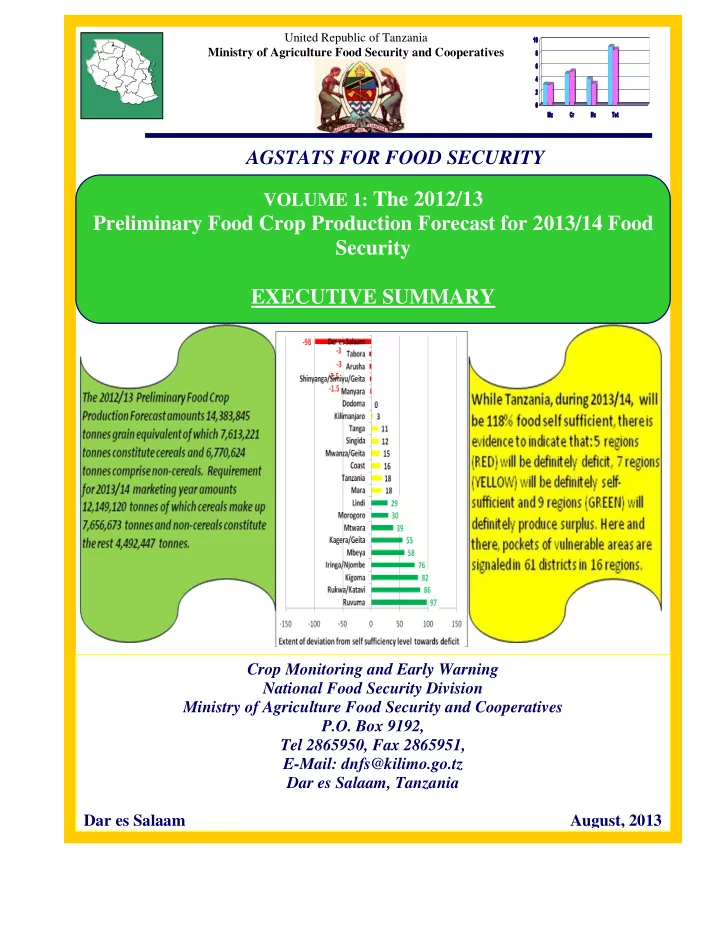
 The 2012/13 Preliminary Food Crop Production Forecast amounts 14,383,845 tonnes grain equivalent of which 7,613,221 tonnes constitute cereals and 6,770,624 tonnes comprise non-

  • cereals. Requirement for 2013/14 marketing year amounts 12,149,120 tonnes of which cereals

make up 7,656,673 tonnes and non-cereals constitute the rest, 4,492,447 tonnes.  Based on these availability and requirement figures, a self sufficient status of 118% is attainable in terms of total food crops whereby cereals make up 99% and non-cereals make up 151%. In terms of gap/surplus analysis, this is respectively, 2,234,726 tonnes surplus of total food, of which a cereal gap amounting 43,452 tonnes coexists with a non-cereal surplus amounting 2,278,177 tonnes.  While at national level the upper end self sufficiency is impressively evidenced by 9 regions (GREEN) that will definitely produce surplus and 7 regions (YELLOW) which will be definitely self-sufficient, there is evidence to indicate that: 5 regions (RED) will be definitely

  • deficit. Towards operational setting to curb food insecurity in the country vulnerable areas are

well signaled in 61 districts in 16 regions out of the current total of 25 regions (151 LGAs).  The identified vulnerable areas will be closely monitored while in-depth vulnerability assessments will be carried out as a necessary step towards appropriate intervention actions.  Compared to previous season, production increase of 8% has been observed in total food (15% in non-cereals and 2% in cereals). While leading cases of increase were notable in bananas (56%), Potatoes (33%), millets (28%) and rice (12%) the decline was most evident in two digits in wheat (16%) and pulses (10%). Other crops which show single digit changes are as per Table 3 and Appendix 6. The 8% broad gain is due to, among other causes, relatively better rains in respect of timely onset and a fairly appropriate distribution experienced over the season.  An analysis of carryover stocks (COS) shows that, on the eve of new marketing year 2013/14 a total of 336,060 tonnes food stock was carried over into 2013/14 marketing year of which 26,801 tonnes was held in NFRA (National Food Reserve Agency) warehouses while 141,229 tonnes was held by private stockists and 168,030 tonnes was estimated as farm retention. Together with the 2,234,726 tonnes of food surplus arrived at as above, the total food availability, over and above the national requirement becomes 2,570,786 tonnes.  It is however cautioned that the forecast is sensitive to vuli performance and about 466,236 tonnes is likely to deplete off, substantially reducing the amount in forecast. The Vuli contribution which would normally be 2,496,289 tonnes is currently predicted to stand at 2,030,053 tonnes signifying a possible draw-down impact as indicated if trends maintain the usual performance.  It is highly recommended that the earmarked food surplus areas and food deficit areas are seen as opportunities and challenges that need to be appropriately addressed. Local market potential as per deficit signals should be well exploited prior to external orientation of any surplus food.

slide-4
SLIDE 4

Page 4

Preliminary Forecast of Food Security for 2013/14

&

Preliminary Forecast of Food Crop Production for 2012/13

Background During the month of June1, 2013 the National Food Security Division (Crop Monitoring and Early Warning) carried out a regular Preliminary food crop production forecast survey to predict food crop harvest status for 2012/13 and the corresponding availability for 2013/14. While the main objective was to establish the preliminary status concluded through capturing the effect of influential crop production factors that ruled over the growth stages from seed germination towards maturity, specific

  • bjectives were threefold: first, to establish statistically if food crop production has a substantial

influence in agricultural performance, secondly, if national and local level food security status can be accounted for using the forecasts and, thirdly, if food security vulnerability is satisfactorily perceived to warrant vulnerability assessment. The exercise involved collection of the 2012/13 data and information from all 151 LGAs of mainland Tanzania in collaboration with Regional Agricultural Advisors (RAAs) and the District Agricultural and Livestock Development Officers (DALDOs) partly through routine crop monitoring and early warning tools and partly through actual fielding of MAFC teams of experts to ground proof crop performance in both unimodal and bimodal areas correspondingly in respect of msimu, vuli and masika rainfall patterns of the 2012/13 crop season. Comprehensive analyses covering different retrievals were undertaken and results are presented in this report. The results concentrate on national and regional level food security status with main highlights of regions and districts bearing areas at risk. Methodology Briefly, the methodology of crop forecasting fundamentally combined 3 consecutive steps, Eye estimation approaches (EEM) used by DALDOs, Projective-forecasting Method (PFM) used by MAFC and the Food crop production forecasting sample survey (FCPFS) with background of joint design, test and approval by National Bureau of Statistics (NBS) and MAFC under the technical guidance of the United National Food and Agriculture Organization (FAO) and later manned by

  • MAFC. Later on, in the process of analyzing Self Sufficiency Ratios (SSRs) and National Food

Balances Sheets (NFBS) also following the technical guidance of FAO, the methodology extends to the calculation of food production in grain equivalent terms. While Area and Production estimates largely borrows from DALDO estimates and partially improved by projective forecasting methods, Yield is largely improved by Agrometeorological approaches that borrow from plant-water-satisfaction indices and production is computed and presented in grain equivalent terms. Calculation of Self Sufficiency Ratios (SSRs) follows a simple food adequacy principle whereby production is related with local food crop requirement surrounding consumption and other uses based on requirement parameters employed by CMEW (See Appendix 8) and are presented in percentage terms. The difference between preliminary forecast and final forecast is best based on the principle of kobechakuota whereby different phenological stages are monitored and estimated in percentage terms and cropped area. The area estimated during preliminary forecast focuses at planted area while

1 The month when preliminary forecast data is due for collection/retrieval.

slide-5
SLIDE 5

Page 5

Preliminary Forecast of Food Security for 2013/14

&

Preliminary Forecast of Food Crop Production for 2012/13

during final forecast the area switches to harvested area and the kobechakuota principle guides the estimates towards mature and harvestable crop. Initially, the crop is largely in the vegetative and germination stages which is later promoted into mature and grain filling stages. In both these extreme stages, only traces of flowering stages are visible. Methodological development has often corresponded with challenges surrounding imminent parameters been estimated. Arguably, concerns have been raised around how challenging is it to address statistical reflection of newly formed regions born from hitherto existing regions? For example, the 4 newly established regions viz. Katavi, Geita, Simiyu and Njombe are to be untied from old affiliates through Disentangling. Given a newly born region, disentangling is a process of revisiting situational settings while acknowledging inherited background of parent region towards present (2012/13) baselines. For example, in food security situations, statistics associated with SSR, Gap/Surplus analysis and vulnerable areas must be revisited based

  • n

agricultural measures/parameters used to measure food security. Disentangling is essentially a 5 step process covering (i) Identification and location, (ii) Establishing agric. potential and (iii) determining active crop cultivation trends, (iv) examining food supply and (v) mapping vulnerability trends. Thus, while the process continues through these steps, the results presented in this report reflect presence of compound regions namely: Rukwa/Katavi, Kagera/Geita, Mwanza/Geita, Shinyanga/Geita/Simiyu Iringa/Njombe, reflecting that while the administrative regions are already established the process of disentangling continues towards establishing statistical baselines into the future of new regions namely Katavi, Geita, Njombe and Simiyu. With compound regions the number of regions remains 21 at SSR analysis level but despite the challenges around the process, attempts have been made to present vulnerable areas in 25 regions. Findings SSR shows the extent of deficits and surpluses as a locally available and accessible surplus sink and emergency based vulnerability management before considering external market opportunities available in neighbouring countries or elsewhere. From the analysis, it has been found that 14,383,845 tonnes of food crops will be available from farm production comprising 7,613,221 tonnes

  • f cereals2 and 6,770,624 tonnes of non-cereals3 (Table 1, Figure 1, Appendix 1 and Appendix 2) and

will meet national food requirement amounting 12,149,120 tonnes of food by 118 percent implying a 2,234,726 tonnes of surplus food (Table 1, Appendix 2). An alternative approach is the national food balance sheet which relates country to country food balance status to guide policies of whether to export or import and the extent thereof.

2 The cereal crops covered under CMEWS include maize, sorghum, millets, rice and wheat. 3 The non-cereals include pulses, cassava, banana and potatoes

slide-6
SLIDE 6

Page 6

Preliminary Forecast of Food Security for 2013/14

&

Preliminary Forecast of Food Crop Production for 2012/13

slide-7
SLIDE 7

Page 7

Preliminary Forecast of Food Security for 2013/14

&

Preliminary Forecast of Food Crop Production for 2012/13

Table 1: The 2012/13 National Level Preliminary Food Crop Production versus Requirement and gap (-)/surplus(+) analysis for 2013/14 (GRAIN EQUIVALENT tonnages) Cereals Maize Sorghum&Millets Rice Wheat Cereals Production 5,173,666 1,040,730 1,307,308 91,517 7,613,221 Requirement 4,819,651 1,762,750 840,487 233,784 7,656,673 Gap (-)/ Surplus(+) 354,015

  • 722,021

466,821

  • 142,267
  • 43,452

Non-cereals Pulses Banana Cassava Potatoes Non- cereals Production 1,641,493 1,306,628 1,943,222 1,879,280 6,770,624 Requirement 771,818 815,545 2,036,224 868,860 4,492,447 Gap (-)/ Surplus(+) 869,675 491,083

  • 93,001 1,010,420

2,278,177 TOTAL Cereals Non-cereals TOTAL Production 7,613,221 6,770,624 14,383,845 Requirement 7,656,673 4,492,447 12,149,120 Gap (-)/ Surplus(+)

  • 43,452

2,278,177 2,234,726

slide-8
SLIDE 8

Page 8

Preliminary Forecast of Food Security for 2013/14

&

Preliminary Forecast of Food Crop Production for 2012/13

Carryover Stocks Analysis and its reflection to total surplus availability An analysis of Carryover Stocks (COS) shows that, on the eve of new food marketing year (1st June, 2013) a total of 336,060 tonnes of food stock was carried over into 2013/14 marketing year, of which 26,801 tonnes was held in NFRA premises while 141,229 tonnes was held by private stockists and 168,030 tonnes retention was estimated at farm level (Table 2 and Figure 2). Table 2: Carryover Stocks Analysis, 1 June, 2013 (Tonnes) Added to the 2,234,726 tonnes preliminary forecast of food surplus arrived at as above, the total food available, over and above national requirement is 2,570,786 tonnes. On the crop wise basis, wheat is the largest followed by maize, pulses and rice. Sorghum is the minor and is only been attempted at public premises, the NFRA (Fig. 2). Figure 2: Crop-wise Carry-Over Stock Analysis, 1st June, 2013 (%) May, 2013 private stocks NFRA stocks Farm retention Total Stocks Maize 2,218 26,799 29,017 Rice 6,479 6,479 Wheat 116,005 116,005 Sorghum

  • 2

2 Pulses 16,527 16,527 COS 141,229 26,801 168,030 336,060

slide-9
SLIDE 9

Page 9

Preliminary Forecast of Food Security for 2013/14

&

Preliminary Forecast of Food Crop Production for 2012/13

Time series analysis Time series analysis shows that, compared to previous season, production increase of 8% has been

  • bserved in total (2% in cereals and 15% in non-cereals). Crop-wise swings vary from -16% in

wheat to 55% in banana with other crops standing as per Table 3 below and Appendix 6.

Table 3: A comparative analysis of Preliminary Production of Major Food Crops for 2012/13, based on available series (1986/87 - 2012/13) (Thousand tonnes and percentages as indicated)

Compared to trend values computed from 1992/93-2011/12 (a reasonable period of reliable food crop statistics adopted by CMEW), total tonnage for 2012/13 (14,383,846 tonnes) stands at up by 13%. Compared to last year, the total stands up by 8% with total cereals standing up by 2% and non-cereals up by 15%. Comparisons with other measures in trend analysis such as 25 years average and 5 years average for total food crops, cereals and non-cereals as well as for different crops are as per Table 3 and Appendix 6. SSR variations overtime back to 1994/95 shows that except for 5 years where food shortage was generally felt in the range of 5-12%, the nation was on average self sufficient in the range of 102- 117%. This year breaks the record by achieving an SSR level of 118% (Appendix 7). Vuli Contribution Based on most recent proxy value of seasonal crop performance, the normal vuli contribution to total food crop production during 2012/13 Preliminary Forecast revises to 33% bimodal area perspective

  • r 17% national aggregate perspective. As of current availability, it contributes 27% bimodal areas

perspective or 14% national aggregate perspective. In tonnage terms, this would normally amount 2,496,289 tonnes but currently stands at 2,030,053 tonnes (Table 4).

Table 4: Vuli contribution to 2012/13 total production - Normal and Current

REGION Production (Tonnes) Vuli contribution (%)- Normal Scenario Normal-Vuli contribution (T) Vuli contribution (%)

  • 2012/13

2012/13-Vuli contribution (T) Bimodal-Tz 7,514,001 33 (last year 32) 2,496,289 27 (last year 26) 2,030,053 Total-Tz 14,383,845 17 (last year 17) 2,496,289 14 (last year 14) 2,030,053 Estimated draw down 466,236 (Last year 434,396)

slide-10
SLIDE 10

Page 10

Preliminary Forecast of Food Security for 2013/14

&

Preliminary Forecast of Food Crop Production for 2012/13

Pending the anticipated 2013/14 vuli observation, the draw-down impact of 466,236 Tonnes is sensitively expected from the preliminary forecast. The draw down is 7% harsher than the 434,396 tonnes observed last year (Table 4, Appendix 3). Sub-national level Food Security At sub-national level, the 2012/13 production is predicted to meet food requirement for 2013/14 marketing year in 16 regions of which 9 regions will produce surplus with SSR of 129% upwards to 197% and 7 regions will produce at SSR of 100%-118%. The rest (5 regions) will produce at a definitely deficit status with SSR of 2%-98% (See Fig. 3).

Legend For Deficit For Self Sufficient For Surplus 300 600 150 Kilometers

¯

North-Pemba south-Pemba North-Unguja Zanzibar West Lindi 129 Tabora 97 Mbeya 158 Ruvuma 197 Singida 112 Kigoma 182 Mara 118 Arusha 97 Rukwa/Katavi 186 Pwani 116 Dodoma 100 Tanga 111 Morogoro 130 Iringa/Njombe 176 Manyara 98 Kagera/Geita 155 Mwanza/Geita 115 Mtwara 139 Shinyanga/Simiyu/Geita 98 Manyara 98 Kilimanjaro 103 Dar es salaam 2

Figure 3: Tanzania Food Supply Analysis and Self Sufficiency Ratio for 2013/14 (Based on the 2012/13 Preliminary Food Crop Production Forecasts)

slide-11
SLIDE 11

Page 11

Preliminary Forecast of Food Security for 2013/14

&

Preliminary Forecast of Food Crop Production for 2012/13

Notwithstanding, here and there, pockets of vulnerable areas are scattered over 61 LGAs in 16 regions of which 4 have produced surplus, 6 have only meet local demand and 6 have produced at deficit levels. Implicitly, 9 regions out of 25 regions (new list) are declared free of agriculture related vulnerability nightmare (See Appendix 4). Vulnerability From the above, it is notable that except for Dar es Salaam, which is largely non-agricultural, the deficit regions (4 therefore) bear 20 LGAs with high level vulnerability and a serious warning is accordingly sent out. Further warnings are focused to 12 additional regions bearing pockets of food shortage in 41 additional LGAs, 28 from 8 definitely self sufficient regions and 13 from 4 definitely surplus regions. The rampant vulnerability amidst self sufficient and surplus food security status signify that, the lower down from national level, the worse and the national self sufficient status masks the true colors that are better reflected at lower levels down towards households. Accordingly the following recommendations are worth implementation. Recommendations  From above, a total of 61 LGAs in 16 regions have been identified to bear vulnerable areas and should be subjected to an in-depth vulnerability assessment towards a necessary intervention by Government.  The food surplus regions (9 in total) and food deficit regions (5 in total) should be seen as

  • pportunities and challenges that need to be appropriately addressed. Local market potential

reflected by deficit indicator signals should be well exploited prior to external orientation of predicted surplus and before worrying too much from any perceived shortfall.  Whilst working towards liberalized market with neighbouring countries, the initiative to establish local import-export interaction points should be enhanced for transparency purposes and in an endeavour unofficially gain from trade and regional integration. Concurrently, the recent initiatives towards improved food access and utilization information should be encouraged and supported beyond existing initiatives towards availability and stabilization.  The foreign market sink, though apparently challenging should be seen as opportunities that are encouragingly unraveling national growth potential beyond existing local market. Nevertheless, local market supplies are more paramount to adequately saturate before any trigger towards an external orientation now.

slide-12
SLIDE 12

Page 12

Preliminary Forecast of Food Security for 2013/14

&

Preliminary Forecast of Food Crop Production for 2012/13

slide-13
SLIDE 13

Page 13

Preliminary Forecast of Food Security for 2013/14

&

Preliminary Forecast of Food Crop Production for 2012/13

Appendix 2: Total Food Supply Forecast at Regional level for the 2013/14 Marketing Year (Based On 2012/13 Preliminary Food Crop Production Forecasts)

slide-14
SLIDE 14

Page 14

Preliminary Forecast of Food Security for 2013/14

&

Preliminary Forecast of Food Crop Production for 2012/13

Appendix 3: Vuli contribution to total production - Normal and Current Based on Preliminary Forecast 2012/13

slide-15
SLIDE 15

Page 15

Preliminary Forecast of Food Security for 2013/14

&

Preliminary Forecast of Food Crop Production for 2012/13

Appendix 4: Vulnerable Areas for 2013/14 Based on 2012/13 Preliminary Forecast

slide-16
SLIDE 16

Page 16

Preliminary Forecast of Food Security for 2013/14

&

Preliminary Forecast of Food Crop Production for 2012/13

Appendix 5: Recall food situation at regional and district levels back to 2008/09

slide-17
SLIDE 17

Page 17

Preliminary Forecast of Food Security for 2013/14

&

Preliminary Forecast of Food Crop Production for 2012/13

slide-18
SLIDE 18

Page 18

Preliminary Forecast of Food Security for 2013/14

&

Preliminary Forecast of Food Crop Production for 2012/13

Appendix 7: Self Sufficiency Variations Overtime in Tanzania, 1994-2014 (Percentage deviation from 100%)

slide-19
SLIDE 19

Page 19

Preliminary Forecast of Food Security for 2013/14

&

Preliminary Forecast of Food Crop Production for 2012/13

Appendix 8: Methodological Considerations-I. Production expressed in Tonnes (Grain Equivalent) = Area (in Hectare) x Yield (in Tonnes/Hectare). NB: Grain equivalent calculations assume a common denominator among all cereals while roots, tubers and plantains compare at 1:3 ratio. Requirement R = Average Per capita Consumption requirement of 650g/day + Parameter % estimates of production that is committed to other uses. Consumption requirement is estimated as average kg. per person per crop as follows: Maize 86kg, Millets 18kg, Rice16 kg, Sorghum 18 kg, Wheat 5 kg, Bananas18 kg, Cassava 44 kg, Potatoes 19 kg, Pulses 13 kg totaling up to 237 kg. Respective “other uses” are estimated as percentage extraction from produced crop that is used for mainly seed, feed, losses and trade as shown on the Table below. Food Requirement Table Parameters used for estimating food requirement per crop

Crop Consumption Other uses (% removed from Production) Requirement per capita Seed2 Feed2 Losses2 Trade2 Total Kilograms Percent Percent Percent Percent % removed Cereals Maize3 86 1.3 2 8.7 4.4 16.4 Millet5 18 2.3 0.6 7.7 10.6 Rice4 16 2.5 2.5 1.8 6.8 Sorghum 18 1.5 0.6 8.5 10.6 Wheat 5 2.5 2.5 5 Non- Cereals Bananas7,8 18 Cassava7 44 Potatoes7,9 19 Pulses6 13 5 2.5 2.5 10 Total 237

P/R=SSR (expressed in %). SSR Categories are: Deficit (<100%), Self Sufficient <=100<120%, Surplus >=120%) Vulnerable areas (VA): derived directly from RRS1 questionnaire as filled-in by DALDO statistical experts is based on households expected to produce <=30% of norm. Requirement per day per person = 0.650 kilograms Cereal Equivalent 1 = Per capita annual consumption Cereal Equivalent 2 = Percent used from total production 3 = Whole grain 4 = Paddy converts to rice at 65 percent ratio. 5 = Includes bulrush and finger millet 6 = Mainly beans but other pulses (groundnuts, peas, grams etc) included 7 = Based on dry weight from which waste is already subtracted 8 = Includes sweet and cooking bananas 9 = Includes round and sweet potatoes. Source: Ministry of Agriculture and Cooperative, Dar es Salaam, Food Security Bulletin, July 14, 1993
slide-20
SLIDE 20

Page 20

Preliminary Forecast of Food Security for 2013/14

&

Preliminary Forecast of Food Crop Production for 2012/13 Appendix 9: Methodological Considerations-II. As highlighted in the Foreword to this report, the early warning system has been increasingly worked around subjectivity towards Objectivity, absence or late availability of data towards timeliness and inability to access data sources towards a staunch ability to address urgency and ad hoc data needs. While sample surveys using FSQ1 is now 20 years old addressing subjectivity problems the routine reporting system using WRS1-5 and RRS1 has prevailed for 10 years addressing ad hoc data needs for generating food security reports for decision making amidst stringent budgetary constraint common in Tanzania. In a nutshell, the functions of the Field forms vary but resemble in that they are used by field MAFC staff to record, validate and prepare data for retrieval by Headquarter supervisors as follows:

  • 1. targets and implementation of crop cultivation at field level (WRS1: Weekly Retrieval System

1);

  • 2. phenological phases applying Kobechakuota principle at field crops (WRS2: Weekly

Retrieval System 2);

  • 3. crop pests both at pre-harvest and post harvest phases (WRS3: Weekly Retrieval System 3);
  • 4. food availability at local market (WRS4: Weekly Retrieval System 4);
  • 5. rainfall precipitation as locally perceived (WRS5: Weekly Retrieval System 5);
  • 6. various food security variables and principally area change per crop from previous season

(FSQ1: Food Security Questionnaire 1 applied in NBS based sample villages);

  • 7. various agricultural and food security variables on monthly basis (RRS1: Routine Reporting

System 1);

  • 8. conventionally reported information by local authority as guided by CMEW short list (TSA:

TSA=Tripple S Analysis =SSS Analysis = Snap-Shot Stories);

  • 9. average monthly prices at local markets (Jed6: Price table No. 6);
  • 10. monthly rainfall mm and days as received per local station (Jed7: Rainfall table No. 7);

The National Early Warning System has been instrumental in producing regular information to inform on crop target implementation, field crop progress along phenological phases, pest threat afield and awarehouse, food availability and market forces, rainfall prevalence amidst drought/water stressed agriculture in Tanzania, detection of vulnerable areas as locally perceived by experts and improving on objectivity through a village-level sample survey. With this system we have been able to produce on annual basis, preliminary forecast and final forecast reports and trigger a vulnerability assessment that zooms into detected hotspots at district level towards household level. The system has also been instrumental in preparing monthly food security updates and other ad hoc reports in response to management needs. The

  • ther unique contribution has been that of populating and updating national food balance sheets

and sharing with the process of integrating regional food security situation in this respect with EAC and SADC along regional food balance sheet approach.

slide-21
SLIDE 21

Page 21

Preliminary Forecast of Food Security for 2013/14

&

Preliminary Forecast of Food Crop Production for 2012/13

Appendix 10: Total Food Supply Forecast at Regional level for the 2013/14 Marketing Year (Based on 2012/13 Preliminary Food Crop Production Forecasts)

slide-22
SLIDE 22

Page 22

Preliminary Forecast of Food Security for 2013/14

&

Preliminary Forecast of Food Crop Production for 2012/13 Legend For Deficit For Self Sufficient For Surplus 300 600 150 Kilometers

¯

North-Pemba south-Pemba North-Unguja Zanzibar West Lindi 129 Tabora 97 Mbeya 158 Ruvuma 197 Singida 112 Kigoma 182 Mara 118 Arusha 97 Rukwa/Katavi 186 Pwani 116 Dodoma 100 Tanga 111 Morogoro 130 Iringa/Njombe 176 Manyara 98 Kagera/Geita 155 Mwanza/Geita 115 Mtwara 139 Shinyanga/Simiyu/Geita 98 Manyara 98 Kilimanjaro 103 Dar es salaam 2

Tanzania Food Supply Analysis for 2013/14

(Based on the 2012/13 Preliminary Food Crop Production Forecasts)

In general, while Tanzania is expected to be food self sufficient at 118% 5 regions are notably definitely deficit and 16 regions are foreseen to continue experiencing vulnerability in 61 LGAs. Vigilance is strongly recommended against likely adversity.