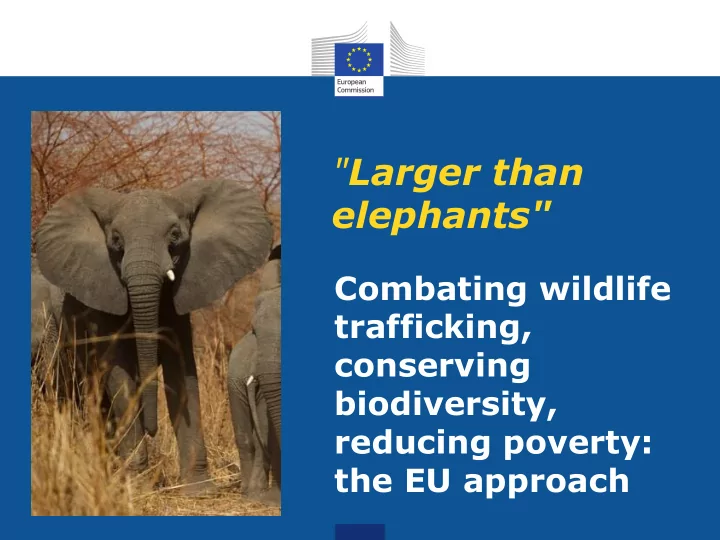
" Larger than elephants" Combating wildlife trafficking, - - PowerPoint PPT Presentation

larger than elephants
SMART_READER_LITE
LIVE PREVIEW

" Larger than elephants" Combating wildlife trafficking, - - PowerPoint PPT Presentation

" Larger than elephants" Combating wildlife trafficking, conserving biodiversity, reducing poverty: the EU approach Biodiversity for Life Flagship Initiative " Contribute to halting biodiversity loss and reducing


slide-1
SLIDE 1

"Larger than elephants"

Combating wildlife trafficking, conserving biodiversity, reducing poverty: the EU approach

slide-2
SLIDE 2

Biodiversity for Life Flagship Initiative

  • " Contribute to halting biodiversity loss and

reducing poverty by promoting a cross-cutting and innovative approach to fully integrate biodiversity and ecosystem conservation with socio-economic development and poverty eradication".

  • Three priority areas, in line with the EU

Agenda for Change:

  • 1. Good governance of natural resources
  • 2. Biodiversity for Food security
  • 3. Nature-based solutions towards green

economy

  • 4. Wildlife Crisis Window (WCW)
  • Give more prominence and enhanced profile

for biodiversity within the development agenda, thus… increase resources.

slide-3
SLIDE 3

EU support to African National Parks

Park W

since 2001

Niokolo-Badiar

1995-2005

Odzala

since 1992

Lopé

since 1992

Pendjari

1985-1989

Manovo…

since 1989

Garamba

since 2005

Virunga

since 1988

Salonga

since 2002

Zakouma

since 1988

Kalahari

1998-2002

slide-4
SLIDE 4
  • EuropeAid: third world biggest donor

for biodiversity ( €1.6 billion 2006- 2013)

  • Capacity building for protected areas

management (long experience in Africa)

  • Integration of biodiversity in forest

management, climate change adaptation and mitigation, rural development and food security, marine resources management;

  • Big poaching peak pressures on wildlife

in the 80s

  • New, stronger pressure on biodiversity

in the 2000s: poaching, land-use change, demographic growth, globalisation…

EU Context

slide-5
SLIDE 5

The study: Larger than elephants

  • Identify at the scale of Sub-Saharan Africa the

principal threats to wildlife (including animals and plants) and the most appropriate responses for the next 10 years.

  • Not limited to wildlife trafficking, but focused
  • n conservation and sustainable

management of wildlife and its linkage with development.

  • Important for the aid programming
  • Not limited to EU activities but can be a frame

for many sources of funding

  • Reviewed and endorsed by a wide array of

stakeholders from the conservation community.

Credit: Gregoire Dubois

slide-6
SLIDE 6

Causes Habitat Poaching destruction

slide-7
SLIDE 7

Causes Climate Change

Credit: Gregoire Dubois

slide-8
SLIDE 8

Underlying Drivers

  • Demography
  • Overpopulation/growth rate
  • Irresistible consumer demand
  • Governance & management
  • Poor governance/corruption
  • Weak legislation
  • Civil conflict
  • Low management capacity and budget
  • Economy / other
  • Poverty/few livelihood alternatives
  • Breakdown of traditions controlling access

to land and hunting areas

  • Globalisation
  • Land tenure

Current population: 13 million 2100 population: 130 million Zambia

slide-9
SLIDE 9

Conservation and sustainable development of 80 Key areas for conservation Institutional strengthening and capacity-building Stopping the illegal killing, trafficking and demand of wildlife products

Site-level National International

Information systems for better decision-making

slide-10
SLIDE 10

Planned activities at local level

  • Concentrated in 80 Key Landscapes

for Conservation covering ± 300 N.P.

  • Management of protected areas

(anti-poaching, ecological monitoring, tourism, finance…)

  • Livelihood improvement around

KLCs by development projects (agriculture, energy, etc.) and community-based resource management

  • Sustainable management of

biological resources (bushmeat, fuelwood, etc.)

slide-11
SLIDE 11

Economic development and conservation

The case of Virunga N.P.

  • Supported by EU from 1988 till

2020

  • Strong pressure for land due to

population and available other resources in the park (oil, minerals, wood)

  • Anti-poaching activities (150

rangers killed in the last 20 years)

  • Economic development based
  • n hydropower energy,

fisheries, tourism and agroindustry

  • >100,000 jobs created
slide-12
SLIDE 12

Planned activities at national level

  • Policy and institutions
  • Institutional strengthening
  • Land planning and management at

the landscape level

  • Law revision and enforcement,

combatting corruption

  • Fight against illegal trafficking
  • Socio-Economy
  • Management of bushmeat resources
  • A solution to fuelwood crisis
  • Alternative revenues
slide-13
SLIDE 13

Planned activities at international level  Demand

  • Political dialogue with Asian countries
  • Awareness-raising at demand-side
  • Trade regulation
  • Regional cooperation (lessons

learned, observatories…)

 Trafficking

  • Capacity-building of customs, police,

justice

  • Support to UN and NGOs (ICCWC,

EAGLE…)

Credit: Gregoire Dubois

slide-14
SLIDE 14

Strategic approaches to widlife conservation...

  • Coastal and marine areas of Africa
  • Latin-America
  • Asia

Still to come soon...

slide-15
SLIDE 15

EDF - National 22.3% EDF- Regional 21.4% EDF - ACP 19.0% Latin America/Asia 5.0% GPGC - BES 22.3% GPGC - others 10.0%

Total budget for B4LIFE flagship 2014-2020 across several funding instruments or programmes:

around 1 billion EUR

Possible EU Trust Fund for Wildlife Conservation ?

slide-16
SLIDE 16

Increasing political uptake

  • Jan 2014: EP Resolution on wildlife crime
  • Feb 2014: Commission Communication on the EU approach against

Wildlife Trafficking

  • April 2014: EU on-line consultation and conference – 170 experts, 34

countries, key IOs, >20 NGOs. Summary of contributions to the consultation published in Nov 2014.

  • Feb 2014: London Declaration; Jun 2014: UNEA Resolution; Mar 2015:

Kasane Statement.

  • April 2015: Joint Declaration of EU and AU Commissioners mentions

cooperation on illegal wildlife trafficking .

  • Regional and national political

dialogues under Art. 8 of the Cotonou Agreement: wildlife conversation and wildlife crime increasingly addressed to tackle both the supply and demand side.

  • July 2015: UNGA Resolution on

Illegal Wildlife Trafficking

slide-17
SLIDE 17

Toward an Action Plan

  • EU action plan on Wildlife trafficking in preparation by

Commission (ENV, DEVCO, HOME, JUST, EEAS…).

  • Based on strong support from stakeholders while the

consultation.

  • DEVCO provides input to this Action Plan on the

development aspects, through its 'Larger than Elephants' report.

  • Roadmap published (Aug 2015) http://ec.europa.eu/smart-

regulation/roadmaps/docs/2015_env_087_action_plan_wild_trafficking_en.pdf

slide-18
SLIDE 18

Next steps

Adoption planned for first quarter 2016

Discussion in relevant working groups (environment, development, justice, home affairs, external action)

Aiming at Council Conclusions still under NL Preseidency

slide-19
SLIDE 19

Envisaged focus areas

Promoting prevention

Strengthening enforcement and implementing existing rules both domestic and globally

Building a strong global partnership among source, transit and market countries

Integrates inputs from the Strategic Approach to AfricanWildlife Conservation

  • f the

Action Plan

slide-20
SLIDE 20

Questions for feedback

  • how to further improve donor coordination, both within the

EU, with third countries, including in the partner countries?

  • how to address the link between corruption, wildlife

trafficking and poverty more effectively?

  • how to best target support for demand reduction

measures?

  • how to ensure that cooperation actions against WLT

ensures the involvement of local and indigenous communities in wildlife conservation and management?

slide-21
SLIDE 21

More information

  • n:
  • The EU Action Plan against Wildlife

Trafficking:

http://ec.europa.eu/environment/cites/trafficking _en.htm

  • The Strategic Approach to African Wildlife

Conservation:

http://capacity4dev.ec.europa.eu/b4life/documen t/larger-elephants-input-eu-strategic-approach- african-wildlife-conservation-updated-version

slide-22
SLIDE 22