white elephants and corruption in Durban what were losing what - - PowerPoint PPT Presentation

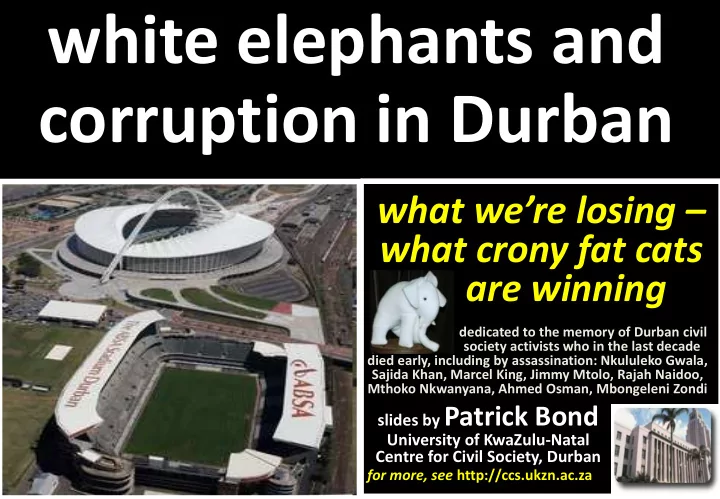
white elephants and
SMART_READER_LITE
LIVE PREVIEW

white elephants and corruption in Durban what were losing what - - PowerPoint PPT Presentation

white elephants and corruption in Durban what were losing what crony fat cats are winning dedicated to the memory of Durban civil society activists who in the last decade died early, including by assassination: Nkululeko Gwala, Sajida


slide-1
SLIDE 1

what we’re losing – what crony fat cats are winning

for more, see http://ccs.ukzn.ac.za

slides by Patrick Bond University of KwaZulu-Natal Centre for Civil Society, Durban

white elephants and corruption in Durban

dedicated to the memory of Durban civil society activists who in the last decade died early, including by assassination: Nkululeko Gwala, Sajida Khan, Marcel King, Jimmy Mtolo, Rajah Naidoo, Mthoko Nkwanyana, Ahmed Osman, Mbongeleni Zondi

slide-2
SLIDE 2
slide-3
SLIDE 3
slide-4
SLIDE 4
slide-5
SLIDE 5
slide-6
SLIDE 6
slide-7
SLIDE 7

a new nick-name: ‘Zuptas’

slide-8
SLIDE 8
slide-9
SLIDE 9
slide-10
SLIDE 10
slide-11
SLIDE 11
slide-12
SLIDE 12
slide-13
SLIDE 13
slide-14
SLIDE 14
slide-15
SLIDE 15
slide-16
SLIDE 16
slide-17
SLIDE 17
slide-18
SLIDE 18
slide-19
SLIDE 19
slide-20
SLIDE 20
slide-21
SLIDE 21
slide-22
SLIDE 22

The cars included Mercedes-Benzes, two Porsches and two Maseratis. Three of the couple’s other exotic cars, including two Lamborghinis, were not at the house.

slide-23
SLIDE 23

Sutcliffe’s rebuttal to Manase (25 July 2013)

  • The Ngubane reports: Friends, partners and wild claims.
  • Irregular expenditure and Section 36 expenditure identified : Cleaning up the books provided further opportunities to

divide ourselves

  • The Manase process: Almost all documentation provided by officials
  • The Manase report: Disclaimers, no audi alterem partem and lots spent.
  • The MEC’s pronouncements: No Audi Alterem Partem and no recourse allowed to those victimised…

Section A: Submissions made and Manase qualifications

  • “The report … has been prepared for the exclusive administrative use of the Department and their legal advisors only.

This document does not purport to be a final forensic report in any form whatsoever …. Section D: Irregular expenditure: housing

  • Manase recommended that : DCMs Kumar and Naidoo and Housing Head Pather be supplied with the report and based
  • n their response, disciplinary action be considered. However, they were not provided the report!
  • BUT
  • Krish Kumar was charged under Section 105(1(c) of the MFMA: This section of the Act does not apply to him at all!
  • Derek Naidoo: Why only him, when he was part of a committee (BAC)!
  • The process followed to regularize irregular expenditure was based on legal advice and National Treasury have supported

what we did and used eThekwini as the model.

  • Neither of the DCMs (Kumar and Naidoo) were responsible at all for incurring any of the irregular expenditure;
  • Council condoned the irregular expenditure, after considering that the expenditure was value for money.
slide-24
SLIDE 24

AJ Dold R596 638.44 AM Peters R689 532.48 FB Stevens R538 538.04 NA Macleod R799 155.36 S Harilal R506 605.68 RL Gooden R512 730.72 J Parkin R506 605.68 MO Sutcliffe R1 145 022.12 D Naidoo R 630 299.52 JM Ellingson R 528 553.80 K Aswanth-Kumar R 727 026.48 RS Maphumulo R 650 951.64

not alone at the scene

  • f the

crime

slide-25
SLIDE 25

Sutcliffe’s rebuttal (10 June 2013):

the new lads are much worse!

slide-26
SLIDE 26
slide-27
SLIDE 27

Can Durban Recover From City-scale Neoliberal Nationalism?

Looting Durban

by PATRICK BOND 2 January 2012

This is the South African city of Durban’s first week since 2002 without City Manager Michael Sutcliffe. He became well known across the world as a target of community and environmental activism, for catalyzing a $400 million stadium for the soccer World Cup in 2010, and for hosting the COP17 climate summit last month, in a city

  • f 3.5 million of whom a third are dirt-poor and another third struggle as underpaid

workers. Why did they put up with Sutcliffe’s mainly malevolent rule? Alongside constituencies of fisherfolk, streetchildren and informal traders, many grassroots groups like the South Durban Community Environmental Alliance, the Chatsworth Westcliff Flatdwellers, Abahlali base Mjondolo shackdwellers and Clairwood Ratepayers and Residents Association have long condemned race- and class-biased municipal policy and Sutcliffe’s viciousness. But the prestige of the African National Congress (ANC) liberation movement means the ruling party has been comfortably re-elected since the days of Mandela (1994-99). Until the leading trade unions break their alliance with the ANC, that won’t change, and ruthless men like Sutcliffe will stay at the top of government.

slide-28
SLIDE 28

Sutcliffe versus Durban

2020 Olympics gentrification, crony-privatisation

‘Durban’s most hated man’,

Sunday Times, 10 October 2009

…Sutcliffe, who admits that he is probably the most-hated

man in Durban, says his critics are "laggards, wimps and whingers". To the DA, Sutcliffe, who took up the job in 2002, is a racist, a "baiter of minorities" who runs the city with an iron fist to the detriment of its residents in general and minorities in particular. To the Left, he is the face of "neo-liberal" policy, a city

  • fficial whose decision-making is out of step with ANC policy

and whose agenda makes him no friend of the working class. To ratepayers' bodies he is a high-handed autocrat who forces unpopular decisions down their throats. Residents heckle Sutcliffe when he walks on the beach and boo when he is acknowledged at public events, while the Internet abounds with blogs attacking him. Sutcliffe acknowledges his unpopularity, but is dismissive of his detractors. He says white Durbanites, whose quality of life has increased significantly in the city, would do better if they "took a step back and used their intellect and education to understand that they have led wonderful lives". Sutcliffe conceded it was "very hard" to deal with the "vitriolic" attacks on himself and his family. "When my wife, Felicity, and I walk on the beach people say the most horrible things. It's not nice to walk into a restaurant and have every table leer at you," he said. At a recent KwaZulu-Natal Philharmonic Orchestra performance, he was booed loudly on being introduced by director Bongani Tembe. "I said to myself, is that what makes them happy? (It must be) some kind of white-male penis thing."
slide-29
SLIDE 29
slide-30
SLIDE 30
  • verturning Sutcliffe’s legacy – 3 stages:

1) victories during Sutcliffe’s era:

  • halting ‘Link Road’ through the heart of Clairwood;
  • permitting continued trade at Warwick Market (not replacement by crony’s shopping mall);
  • overturning many Sutcliffe bans on protests in central Durban

2) post-Sutcliffe victories:

  • getting fisherfolk back into the harbour;
  • reapplying for Blue Flag beach status and filling empty municipal buildings at beach;
  • ending corrupted housing ‘waiting lists’ and reversing corruption unveiled by Manase;
  • winning resources for protesting communities (Wentworth flats, Kennedy Road, Zakaleni, Bottlebrush);
  • getting land restitution for Qadi people under Inanda Dam

3) harder to win:

  • ending endemic corruption and Section 36 abuse revealed in the Manase Report;
  • providing electricity and water to shack settlements he long refused to service;
  • fixing the broken housing subsidy system, including decent services to flats;
  • making Durban a genuinely non-racial and non-exclusionary city;
  • ending the threat of White Elephants trampling Durban for years to come;
  • reversing the Sutcliffe/Transnet plan for massive port/petrochemical expansion
slide-31
SLIDE 31
  • verturning Sutcliffe’s legacy – 3 stages:

1) victories during Sutcliffe’s era:

  • halting ‘Link Road’ through the heart of Clairwood;
  • permitting continued trade at Warwick Market (not replacement by crony’s shopping mall);
  • overturning many Sutcliffe bans on protests in central Durban
slide-32
SLIDE 32
  • n infrastructure, long-term damage done
  • shift of Durban’s economic gravity northwards into much

more exclusionary, rich areas (Umhlanga, Ballito)

  • new, unnecessary R8 bn King Shaka airport, Dube trade port
  • in South Durban, controversial port/petrochem expansion
  • highway expansion and Warwick Junction overpass
  • bus privatisation disaster thanks to crony capitalism
  • housing: construction corruption, failure to lower backlog
  • water: very little for shack settlements; ‘sanitation edge’ =

‘Urinary Diversion’ controversy; ‘Free Water’ pricing hurt the poor most; bulk supply and sewage maintenance crises

  • energy: high-emissions corporations include smelter, petro-

chemicals, auto factories, pulp, container transport

  • solid waste: dubious ‘Clean Development Mechanism’

gimmick at Africa’s largest landfill (Bisasar Rd)

slide-33
SLIDE 33
  • 2) post-Sutcliffe victories:
  • getting fisherfolk back into the harbour;
  • reapplying for Blue Flag beach status and filling empty municipal buildings at beach;
  • ending RDP housing ‘waiting lists’ and reversing corruption unveiled by Manase;
  • winning resources for protesting communities (Wentworth flats, Kennedy Rd, Zakaleni, Bottlebrush);
  • getting land restitution for Qadi people under Inanda Dam
slide-34
SLIDE 34

3) harder to win:

ending endemic corruption and his Section 36 abuses; electricity, water for shack settlements he long refused to service; fixing housing subsidy system, including decent services to flats; reversing 2011 plan for R250bn port/petrochemical expansion; making white elephants extinct, finally; ending rampant segregation that splits Durban society

slide-35
SLIDE 35

inherited from apartheid: Durban’s insidious racial segregation

slide-36
SLIDE 36

amplified from apartheid: Durban’s insidious class segregation

slide-37
SLIDE 37

amplified from apartheid: Durban’s insidious toilet segregation

‘sanitation edge’

slide-38
SLIDE 38

uShaka Marine World I C C

slide-39
SLIDE 39

Point luxury flats & new yacht harbour

underutilised new airport 40 km north

  • f Durban
slide-40
SLIDE 40
  • riginal stadium subsidies before escalations: R9 bn,

but final subsidies at least R25 bn + R20bn of infrastructure, and huge (often unnecessary) import bill = rising foreign debt

slide-41
SLIDE 41

Durban’s R3.1 bn ($390mn)

‘Alien’s Handbag’

  • ut of sight: vast backlogs of housing,

water/sanitation, electricity, clinics

slide-42
SLIDE 42

Trevor Phillips, former CEO .

  • f Premier Soccer League:

“What the hell are we going to do with a 70,000-seater football stadium in Durban once the World Cup is over? Durban has two football teams which attract crowds of

  • nly a few thousand. It would have been more sensible

to have built smaller stadiums nearer the football- loving heartlands and used the surplus funds to have constructed training facilities in the townships.”

so who uses Mabhida after July 2010?

(Sharks champion rugby team said ‘no thanks’ – old, next-door, 52,000-seat stadium much better)

slide-43
SLIDE 43

White elephant protested: victory at Warwick Junction against new mall

next door to Mabhida: perfectly functional 52,000-seater Kings Park Stadium hosting Sharks rugby

slide-44
SLIDE 44
slide-45
SLIDE 45

would have covered housing upgrades (R30 000) for 100 000 homeless people in each city

stadium costs above R3 bn: Cape Town, Joburg, Durban

slide-46
SLIDE 46

SA’s white elephants:

new stadiums: Durban, Cape Town, Port Elizabeth, Nelspruit, Polokwane refurbished Soccer City – but none can consistently fill stands

slide-47
SLIDE 47
slide-48
SLIDE 48
slide-49
SLIDE 49

Back of Port Zoning Plan, secret 2011 municipal document

slide-50
SLIDE 50

R250 billion shipping-petrochem makeover: 1) 1-3) deepening/widening of old port 2) 4) new roads & dug-out port (old airport) 3) 5-6) major expansion of old port

slide-51
SLIDE 51

Transnet’s South Durban Dig-Out Port:

ubiquitous image of what we can expect

slide-52
SLIDE 52
slide-53
SLIDE 53

who’s breeding the white elephants?

  • Johan van Zyl, Toyota SA CEO: ‘Durban

as a brand is not strong enough to simply say “come and invest in Durban”. What it needs to attract investors are big projects. Durban needs to keep ahead of the

  • competition. China is building ports

they don’t even know when they will

  • use. If return on investment is the

line of thinking we may never see the infrastructure.’ – 6 February 2012

slide-54
SLIDE 54

who wins from

infrastructure spending?

  • Peter Bruce, editor of Business Day: ‘mine more and

faster and ship what we mine cheaper and faster’ – February 13 2012

  • Minister of Economic Development Ebrahim Patel:

‘We took account of the lessons of the 2010 World Cup infrastructure and the growing experience in the build programmes for the Gautrain, the Medupi and Kusile power stations, the Freeway improvement programme and the major airport revamps.’ – Feb 2012

slide-55
SLIDE 55

single buoy mooring: 80% of SA’s intake Sapref: BP/Shell Engen: 80% Petronas (Malaysia)

in an already hypertoxic South Durban, ‘Africa’s armpit’

Toyota car assembly Mondi paper mill hazardous petro- chemical plants Africa’s biggest port Island View tank farm Africa’s largest oil refining complex container terminals freight traffic

(often illegal)

new capacity: R250 billion plan!

slide-56
SLIDE 56
slide-57
SLIDE 57
slide-58
SLIDE 58
slide-59
SLIDE 59

will state/capital’s incremental strategy plus community co-optation work?

slide-60
SLIDE 60