<virtualization> Feedback-directed emulation IP address - - PDF document

virtualization
SMART_READER_LITE
LIVE PREVIEW

<virtualization> Feedback-directed emulation IP address - - PDF document

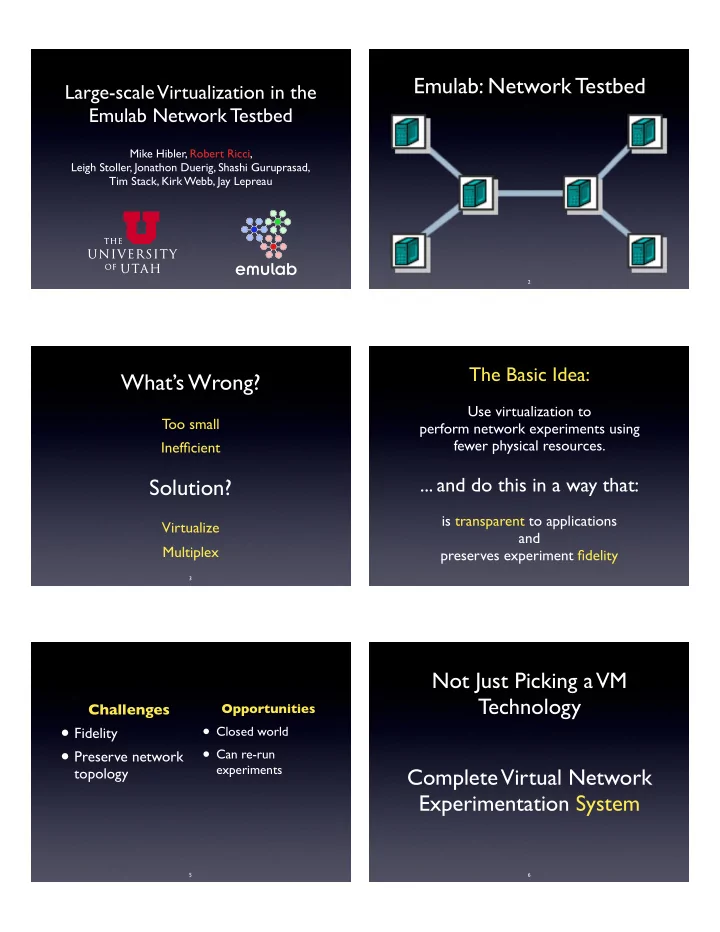
Emulab: Network Testbed Large-scale Virtualization in the Emulab Network Testbed Mike Hibler, Robert Ricci, Leigh Stoller, Jonathon Duerig, Shashi Guruprasad, Tim Stack, Kirk Webb, Jay Lepreau 2 The Basic Idea: Whats Wrong? Use


slide-1
SLIDE 1

Large-scale Virtualization in the Emulab Network Testbed

Mike Hibler, Robert Ricci, Leigh Stoller, Jonathon Duerig, Shashi Guruprasad, Tim Stack, Kirk Webb, Jay Lepreau

Emulab: Network Testbed

2

What’s Wrong?

Too small Inefficient

3

Solution?

Virtualize Multiplex

The Basic Idea: ... and do this in a way that:

is transparent to applications and preserves experiment fidelity Use virtualization to perform network experiments using fewer physical resources. Challenges

  • Fidelity
  • Preserve network

topology

Opportunities

  • Closed world
  • Can re-run

experiments

5

Not Just Picking a VM Technology Complete Virtual Network Experimentation System

6

slide-2
SLIDE 2

Full System

  • Virtualization technology
  • Host and network
  • Resource mapping
  • Feedback-directed emulation
  • IP address assignment
  • Scalable control system
  • Routing table calculation

7

<virtualization>

Start: FreeBSD jail

  • Namespace isolation
  • Virtual disks
  • We added network virtualization:
  • Ability to bind to multiple interfaces
  • New virtual network device (veth)
  • Separate routing tables

9 10

<mapping> What does it mean to make a good mapping?

slide-3
SLIDE 3

Good Mapping

  • Pack well
  • Use resources efficiently
  • Specifying packing criteria
  • Do it quickly
  • Critical path for creating an

experiment

13

assign

  • Solves an NP-hard problem
  • Pack both nodes and links
  • Avoid scarce resources
  • Paper: [Ricci+:CCR03]
  • Based on simulated annealing
  • We extended for virtual nodes

14

Resource-Based Packing

  • Use quantities we can directly

measure

  • Resource-based system

“This virtual node uses 100 MHz of CPU” “This physical node has 3 GHz of CPU”

  • Works well for heterogenous virtual

and physical nodes

15

Assigning Quickly

Small Topologies

17

Virtual Topologies

18

slide-4
SLIDE 4

Prepass

19

Scaling With Prepass

20

200

Mapping Quality

21

<feedback> How do I know how tightly I can pack my virtual nodes? I don’t! Closed, repeatable world

slide-5
SLIDE 5

The Plan

  • Pick a packing
  • Run experiment
  • Monitor for artifacts
  • If artifacts found:
  • Re-pack
  • Repeat

25

  • Pick a packing
  • Run experiment
  • Monitor for artifacts
  • If artifacts found:
  • Re-pack
  • Repeat

Picking Initial Packing

  • Start one-to-one
  • Possibly with a subset of topology
  • Start tightly packed
  • Optimistically assume low usage

26

Monitoring for Artifacts

  • CPU near 100%
  • Significant paging activity
  • Disk utilization

27

Re-Packing

  • Measure resource use
  • Feed into resource-based packing

28

Feedback in a Nutshell

  • Rely on packing, not isolation
  • Discover packing factors empirically
  • Re-use between experiments

29

<numbers>

slide-6
SLIDE 6

kindex: Packing Factors Feedback Case Study

Round Transactions Per Second Response Time (s)

Bootstrap: 74 physical 2.29 0.43 Round 1: 7 physical 1.85 0.53 Round 2: 7 physical 2.29 0.43

Deployed Use

  • Creation time: 7 minutes for 100 nodes
  • 5,125 experiments
  • 296,621 virtual nodes
  • 32% of Emulab nodes virtual
  • 5.75 average packing factor
  • Average: 58 nodes, max: 1,000 nodes

33

Conclusion

  • Virtualization increases Emulab’s capacity
  • Transparently
  • Preserves fidelity
  • Requires solving several challenging

problems

  • Proven useful in production

34

www.emulab.net

<end/>

Related Work

  • Virtual Network Emulation
  • ModelNet, DieCast
  • Virtual Machines
  • Xen, VMWare, vservers, OpenVZ, NET
  • Network Virtualization
  • NetNS, OpenVZ, Trellis, IMUNES
  • Feedback-based Mapping
  • Hippodrome

36

slide-7
SLIDE 7

ModelNet

  • Applications can only run on edge nodes:

single-homed only

  • More basic virtualization
  • No artifact detection
  • No feedback system
  • Emulab has richer control framework
  • Scales to much larger interior networks

37

Minimal Effective Virtualization

  • Application transparency
  • Application fidelity
  • System capacity

38

Application Transparency

  • Real applications
  • Simulation
  • Virtual machines
  • Keep most semantics of unshared machines
  • Simple processes
  • Preserve experimenter’s topology
  • Full network virtualization

39

Application Fidelity

  • Physical results Virtual

results

  • Virtual node interference
  • Perfect resource isolation
  • Detect artifacts and re-run

40

System Capacity

  • Low overhead
  • In-kernel (vservers, jails)
  • Hypervisor (VMWare, Xen)
  • Don’t prolong experiments
  • DieCast

41