
SLIDE 1
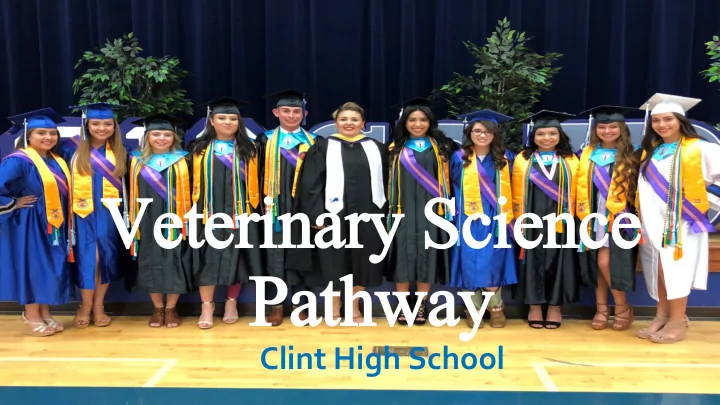
Veterinary Science Pathway
Clint High School
Veterinary Science Pathway Clint High School Veterinary Science - - PowerPoint PPT Presentation
Veterinary Science Pathway Clint High School Veterinary Science Pathway Overview of Program Program Requirements Curriculum Certification & Licensing Cohort #s Selection Process Curriculum Outline Texas A&M
Clint High School
Veterinary Science Pathway
▪ Overview of Program ▪ Program Requirements ▪ Curriculum ▪ Certification & Licensing ▪ Cohort #’s ▪ Selection Process
Curriculum Outline – Texas A&M Agrilife/4-H & TEKS
▪ 100 Lessons to complete ▪ Powerpoint of 100 Lessons ▪ TEKS alignment – Just released 12/1
TEKS
▪ Classes need to be aligned to what your school offers Small Animal Management Veterinary Medical Applications Advanced Animal Science
CURRICULUM/COURSE REQUIREMENTS
▪ @ CLINT HIGH SCHOOL….not state ▪ Have 3 years to complete requirements ▪ Lesson requirements will be broken into 3 school years(100 lessons) ▪ Internship of 300 hours must be completed before examination/graduation
2018-19 2019-20 2020-2021 10th grade Small Animal Management 11th grade Advanced Animal Science 12th grade Veterinary Medical Applications Internship 300 total hrs
Veterinary Science Pathway
Ability to work towards advanced academics & AP Dual Credit Dual Enrollment-On Ramps and continue is STEM program with different pathway
▪ 300 internship hours ▪ 200 classroom hours ▪ 100 classroom lessons
300 hours in an approved facility
Begin end of Freshman year
City of El Paso Animal Services
by 50%
2016
monitoring anesthesia, vital signs
Other Experiences
Real world & Hands on
Clinical Skills for the Classroom
Assisting in Surgery Skills
▪ Preparing a Surgical Site of a Dog ▪ Removing Sutures in a Dog ▪ Preparing a Surgical Pack for Sterilization ▪ Opening a Surgical Pack ▪ Gowning & Gloving for Surgery
Assisting in the Laboratory Skills
▪ Using a microscope ▪ Applying Bandage to Leg of a Horse ▪ Removing Bandage From Leg of a Horse
Assisting in Bandaging Skills
Clinical Skills
▪ Assisting in Restraining & Handling
Small Animals Skills
▪ Removing a Dog From a Cage ▪ Restraining a Dog in Sternal Recumbency ▪ Removing a Cat From a Cage ▪ Restraining a Cat in Lateral Recumbency ▪ Assisting in Restraining & Handling
Large Animals Skills
▪ Tying a Bowline Knot on a Horse ▪ Tying a Clove Hitch on a Horse Stanchion ▪ Tying a Reefer’s Knot on a Horse Stanchion ▪ Placing a Tail Tie on a Cow ▪ Haltering a Cow ▪ Using a Nose Tong in a Cow ▪ Haltering a Horse ▪ Using a Nose Twitch and Clamp in a Horse Office & Farm Experiences
Certification
Licensed Veterinarian Assistant TVMA Exam fee is $135 Proctored through county agent at your school
Needed for Veterinary Assistant Examination
▪ 1. Describes vaccinations for cattle. ▪ 2. Describes vaccinations for horses. ▪ 3. Describes vaccinations for sheep & goats. ▪ 4. Describes vaccinations for dogs. ▪ 5. Describes vaccinations for swine. ▪ 6. Describes vaccinations for cats. ▪ 7. Recognizes the symptoms commonly
associated with animals affected by rabies.
▪ 8. Uses procedures that ensure personal safety
when handling animals suspected of having rabies.
▪ 9. Demonstrates a basic understanding of the
most commonly used veterinary drugs.
▪ 10. Properly identifies and disposes of expired
substances.
Certification Exam
Partnerships
MOU’s
Cohort #’s and what it takes
▪ Started with 12 in 1st cohort ▪ Add 12-16 each cohort ▪ Depends what partnerships you have Private Clinics Mobile Vets Facilities and Operations (breeders, production) Humane Society or Rescue Groups Local Shelter
Selection Criteria for Cohort
▪ Dedicated student that is willing to go above & beyond ▪ Not your typical student ▪ Interest in a life science career after high school (Dr, Nurse, Vet, Biology, Research) ▪ Not the “stereo typical” Ag/FFA student ▪ Parent support ▪ Parent Interview if needed ▪ Student Interview ▪ Pre Vet Class taken as Freshman
Complete the Application
Nikki Boutwell Ag Science Teacher Clint High School Clint Tx Nicholle.Boutwell@Clint.net 915-525-6100