Ma king the Sto rmwa te r Co nne c tio n: MS4 F lo a ta b le s Mo - - PowerPoint PPT Presentation

ma king the sto rmwa te r co nne c tio n ms4 f lo a ta b
SMART_READER_LITE
LIVE PREVIEW

Ma king the Sto rmwa te r Co nne c tio n: MS4 F lo a ta b le s Mo - - PowerPoint PPT Presentation

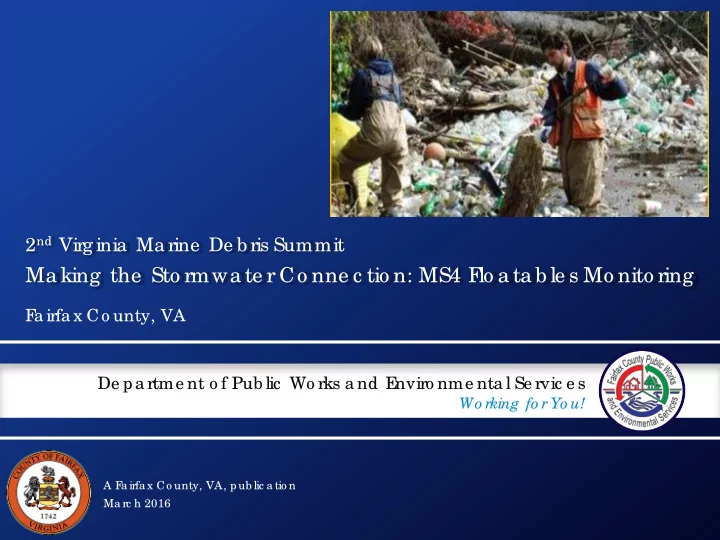
2 nd Virg inia Ma rine De b ris Summit Ma king the Sto rmwa te r Co nne c tio n: MS4 F lo a ta b le s Mo nito ring F a irfa x Co unty, VA De pa rtme nt o f Pub lic Wo rks a nd E nviro nme nta l Se rvic e s Wo rking fo r Yo u! A F a


slide-1
SLIDE 1

A F a irfa x Co unty, VA, pub lic a tio n

De pa rtme nt o f Pub lic Wo rks a nd E nviro nme nta l Se rvic e s

Wo rking fo r Yo u!

2nd Virg inia Ma rine De b ris Summit

Ma king the Sto rmwa te r Co nne c tio n: MS4 F lo a ta b le s Mo nito ring

F a irfa x Co unty, VA

Ma rc h 2016

slide-2
SLIDE 2

2016 VA Ma rine De b ris F

a irfa x Co unty, Virg inia

2

slide-3
SLIDE 3

2016 VA Ma rine De b ris “We All L

ive Do wnstre a m”

3

slide-4
SLIDE 4

2016 VA Ma rine De b ris

F a irfa x Co unty MS4 Pe rmit

  • Municipal Separate Storm Sewer System = “MS4”
  • Sanitary sewers separate from storm drain network (no CSOs)
  • Effective date of new MS4 permit (Phase I): April 1, 2015 (no foolin’!)
  • Permit is issued to Fairfax County and provisions apply to all county

government agencies (FCPS has their own permit)

  • Permit covers the jurisdictional land area of Fairfax County, excluding the

Towns of Clifton, Vienna, and Herndon; the Cities of Fairfax and Falls Church; Fort Belvoir; Dulles International Airport; and the VDOT road system

  • Stormwater Planning Division (SWPD) of DPWES:
  • Oversees MS4 program planning process
  • Coordinates & tracks permit compliance (within Stormwater and with outside

partners – other government agencies, non-government agencies and private

  • rganizations)
  • Assembles, develops and submits annual report to DEQ
slide-5
SLIDE 5

2016 VWMC Co nfe re nc e

F lo a ta b le s Re q uire me nts

  • Monitoring requirement: “No later than 24 months after the

effective date of the permit, the permittee shall develop and implement a floatables monitoring program. The intent of the monitoring program is to determine the loading of floatables from the MS4 to streams within Fairfax County. The permittee will implement the floatables monitoring program as follows:

  • a) Monitoring shall be conducted at five (5) monitoring sites located at

MS4 outfalls and/or streams receiving discharges from the MS4.

  • b) Monitoring shall be conducted once per quarter after program

implementation.

  • c) The monitoring program shall include the count of floatables

visually observed and length or area of sites assessed.”

  • Floatables also folded in to IDDE/IHRR requirements: “The

permittee shall continue to implement a program to reduce the discharge of floatables (e.g. litter and other human-generated solid refuse) in accordance with Part I.C.3.”

  • Outreach/Education requirements
slide-6
SLIDE 6

2016 VA Ma rine De b ris F

lo a ta b le s Mo nito ring T ime line

  • Annual Report for FY16 (July ’15 – June ‘16), due October 1, 2016:

Update on the development of the floatables monitoring program.

  • By March 31, 2017: Finalize monitoring protocols for the floatables

monitoring program

  • During FY17 Second Quarter (April ‘17 – June ’17): Conduct first

quarter of floatables monitoring

  • Annual Report for FY17 (July ’16 – June ‘17), due October 1, 2017:

Monitoring protocols for the floatables program (permit language does not require we report first quarter monitoring results until FY18 report)

  • Beginning with the Annual Report due October 1, 2018, each Annual

Report shall include:

– a list of sites monitored – a summary of the monitoring protocols used – a summary of the monitoring results (counts) and analyses

6

slide-7
SLIDE 7

2016 VA Ma rine De b ris T

ra sh Asse ssme nt fo r I mpro ve d E nviro nme nts (T AF I E )

  • Originally developed by multiagency “Trash

Team” (SWPD, Solid Waste, CFC, NVSWCD) in 2012

  • Comparable with regional stream cleanup

protocols (Adopt-a-Stream, PWC, Internat’l Coastal Cleanup)

  • Counts + rapid assessment of “trashiness”
  • Trash items grouped into categories (plastic, glass,

metal etc.) with items of particular concern highlighted based on BPJ/observation in field (e.g. plastic beverage bottles, six-pack rings, cigarette butts)

  • Original goal: survey and count floatables pre-

and post-cleanup

  • However, picking up floatables not part of new

permit’s monitoring requirements

slide-8
SLIDE 8

2016 VA Ma rine De b ris “Citize n Sc ie ntists”

  • Looking for schools with a stream on or

adjacent to grounds containing an MS4

  • utfall
  • Schools agree to do a visual assessment
  • f trash four times a year using TAFIE:
  • Identify stream reach
  • Lat, long, co watershed
  • 100-foot stream reach + 10

feet from top of bank on both sides

  • Participants walk the reach (MAY

NOT enter stream channel)

  • Tally & categorize trash
  • Count data will be used for permit

compliance

  • Obvious outreach/education benefits!
slide-9
SLIDE 9

2016 VA Ma rine De b ris “Citize n Sc ie ntists”

  • Focusing on 5th graders to

enhance the school system’s Fields of Science study unit

  • Some interest in combining

with 4th grade Virginia Watersheds study unit

  • High school? (Maybe)
  • Scouts? (Maybe)
slide-10
SLIDE 10

2016 VA Ma rine De b ris E

nd o f Pipe T ra sh T ra ps

10

slide-11
SLIDE 11

2016 VA Ma rine De b ris Ba nda lo ng T

ra sh T ra p

11

slide-12
SLIDE 12

2016 VA Ma rine De b ris

Pilo t Studie s

End of Pipe

  • Reached out to partner organizations and stakeholders for known trashy
  • sites. Also received political pressure for Union Mills Pond and Accotink

Creek sites

  • Used model to predict additional trashy sites
  • When scoping, assessed sites for:
  • Access (this was the biggest one)
  • Safety
  • Amount of trash (needed something we knew would be trashy in the future)
  • Tidal? y/n (Tidal sites excluded)
  • Near homes (sites within eyeshot of homes were rejected)
  • Desktop scoping for upstream drainage area and impervious (bigger drainage

and impervious =better candidate)

  • Appropriate outfall type? (circular)
  • Appropriate channel type upstream? (must be closed channel, pipe installed

at daylight to avoid clogging by upstream organics)

slide-13
SLIDE 13

2016 VA Ma rine De b ris I

de ntifying T ra sh Ho t Spo ts

13

slide-14
SLIDE 14

2016 VA Ma rine De b ris

Pilo t Studie s

Bandalong

  • Political pressure to install in Little Hunting, but also likely best location

due to channel size and amount of trash

  • Similar requirements as end-of-pipe, but open channel upstream

permitted

  • Must be wide/deep enough to accept bandalong
  • Easement access for maintenance required
  • Good floodplain access to prevent upstream flooding after installation
slide-15
SLIDE 15

2016 VA Ma rine De b ris

Outre a c h

  • Stream litter page

www.fairfaxcounty.gov/dpwes /stormwater/streamlitter.htm

  • Channel 16 videos, podcasts
  • Fact sheets
  • MWEES
  • Partnerships with
  • rganizations that conduct

volunteer stream cleanups (CFC, NVSWCD, AFF, CVW)

  • Lots more!

15

slide-16
SLIDE 16

Additio na l I nfo rma tio n

For additional information, please contact

2016 VA Ma rine De b ris

16

LeAnne Astin, Ecologist (703)324-5879 leanne.astin@fairfaxcounty.gov

slide-17
SLIDE 17

17