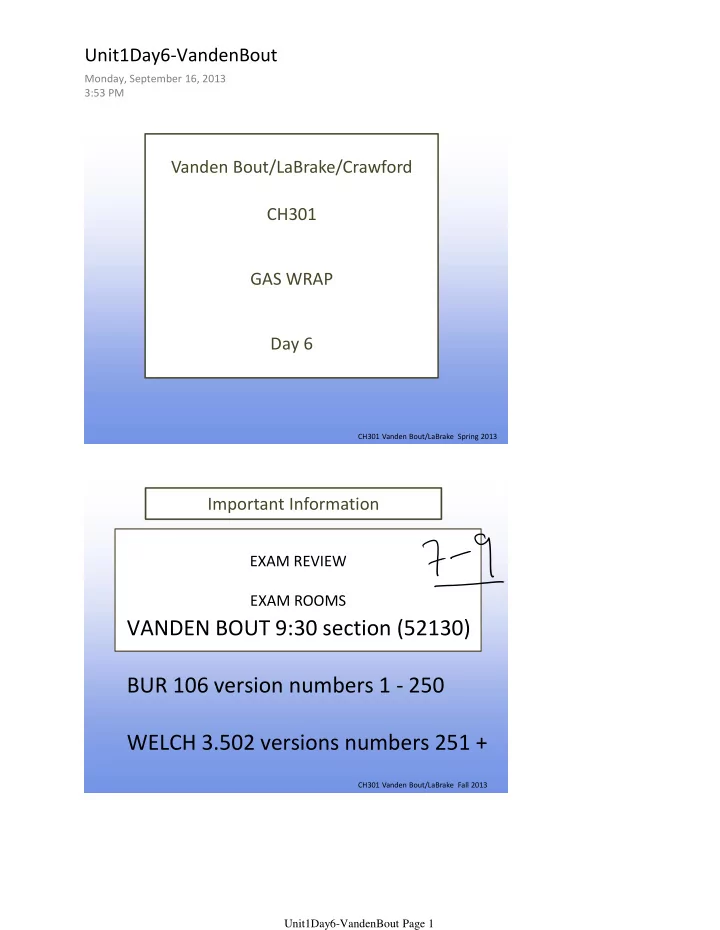
VANDEN BOUT 9:30 section (52130) BUR 106 version numbers 1 - 250 - - PDF document

vanden bout 9 30 section 52130 bur 106 version numbers 1
SMART_READER_LITE
LIVE PREVIEW

VANDEN BOUT 9:30 section (52130) BUR 106 version numbers 1 - 250 - - PDF document

Unit1Day6-VandenBout Monday, September 16, 2013 3:53 PM Vanden Bout/LaBrake/Crawford CH301 GAS WRAP Day 6 CH301 Vanden Bout/LaBrake Spring 2013 Important Information EXAM REVIEW EXAM ROOMS VANDEN BOUT 9:30 section (52130) BUR 106


slide-1
SLIDE 1

CH301 Vanden Bout/LaBrake Spring 2013

Vanden Bout/LaBrake/Crawford CH301 GAS WRAP Day 6

CH301 Vanden Bout/LaBrake Fall 2013

Important Information

EXAM REVIEW EXAM ROOMS

VANDEN BOUT 9:30 section (52130) BUR 106 version numbers 1 - 250 WELCH 3.502 versions numbers 251 +

Unit1Day6-VandenBout

Monday, September 16, 2013 3:53 PM Unit1Day6-VandenBout Page 1

slide-2
SLIDE 2

CH301 Vanden Bout/LaBrake Fall 2013

QUIZ: CLICKER QUESTION 1 (points for CORRECT answer)

Which of the following relationships is a supported by Dalton’s Law of Partial Pressure?

  • A. PV = nRT
  • B. P(V-nb) = nRT
  • C. Ptotal = XiPi
  • D. Pi = XiPtotal
  • E. Pi = XtotalPtotal

CH301 Vanden Bout/LaBrake Fall 2013

QUIZ: CLICKER QUESTION 2 (points for CORRECT answer)

Non-Ideal Gas behavior can be modeled empirically by accounting for the non-ideal behavior with correction terms. The Hard Sphere model corrects for the fact that the space that the molecules occupy matters, and thus the measured volume is no longer the volume that is available to the gas particles in a particular sample. A.TRUE B.FALSE

WHAT DO YOU THINK?

When working on an in-class learning activity, if I get stuck then I typically…

A) Give up and wait for the answer to be given. B) Ask classmate sitting by me a question.

Unit1Day6-VandenBout Page 2

slide-3
SLIDE 3

CH 301 Vanden Bout/LaBrake Spring 2013

When working on an in-class learning activity, if I get stuck then I typically…

A) Give up and wait for the answer to be given. B) Ask classmate sitting by me a question. C) Raise my hand so I can ask one of the TAs for help. D) Go back over what I did in order to figure out where I went wrong. E) Not Applicable, for I have not gotten stuck yet.

CH 301 Vanden Bout/LaBrake Fall 2013

Jimmy - Neuroscience Major http://www.youtube.com/watch?v=hQU6TuBkXUk&feature=youtu.be

Unit1Day6-VandenBout Page 3

slide-4
SLIDE 4

CH 301 Vanden Bout/LaBrake Fall 2013

WHAT should YOU do when you are STUCK?

  • Face the Challenge
  • Willing to engage in the learning
  • pportunities in each class
  • Exert Effort
  • Willing to work hard and practice in

pursuit of understanding

  • Seek Help
  • Willing to ask for help when you are stuck

(Ambrose et al., 2010)

CH302 Vanden Bout/LaBrake Fall 2013

What are we going to learn today? −Understand Gas Behavior

  • Empirical Model – Gas Laws
  • Density (number and mass)
  • Molar Mass
  • Gas Stoichiometry
  • Mixtures
  • Physical Model - Kinetic Molecular
  • Gas velocity distribution
  • Diffusion and Effusion
  • Limits of Models
  • Assumptions
  • Correction Factors

1

Unit1Day6-VandenBout Page 4

slide-5
SLIDE 5

CH301 Vanden Bout/LaBrake Fall 2013

DEMONSTRATE SOME GAS BEHAVIORS

  • Demonstrate –
  • Volume varying with pressure
  • Empirical Model – 1660 ish
  • Boyle
  • Demonstrate –
  • Volume varying with temperature
  • Empirical Model 1780 ish
  • Charles
  • Demonstrate –
  • Pressure varying with amount of gas
  • Empirical model – 1810 ish
  • Avogadro

CH301 Vanden Bout/LaBrake Fall 2013

Combining the Laws: PV=nRT

The empirically derived laws are very useful in solving: 2 STATE PROBLEMS: 1 STATE PROBLEMS:

Unit1Day6-VandenBout Page 5

slide-6
SLIDE 6

CH301 Vanden Bout/LaBrake Fall 2013

QUIZ: CLICKER QUESTION 1

A 5.0 mol sample of Ne is confined in a 3.14 L vessel at a pressure of 2.5 atm. What is the number density of the gas? What is the mass density of the gas?

  • A. Not enough information
  • B. 1.6 mol/L ; 32 g/L
  • C. 32 mol/L; 1.6 g/L
  • D. 16 mol/L; 3.2 g/L

CH301 Vanden Bout/LaBrake Fall 2013

QUIZ: CLICKER QUESTION 2 http://ch301.cm.utexas.edu/simulations/gas-laws/GasLawSimulator.swf

What is the total pressure of the gas mixture that contains: 0.267 atm He 0.317 atm Ar 0.277 atm Ne?

QUIZ: CLICKER QUESTION 3

What is the mole fraction of Ar in a gas mixture that contains: 0.267 atm He 0.317 atm Ar 0.277 atm Ne?

Unit1Day6-VandenBout Page 6

slide-7
SLIDE 7

CH301 Vanden Bout/LaBrake Fall 2013

What is the mole fraction of Ar in a gas mixture that contains: 0.267 atm He 0.317 atm Ar 0.277 atm Ne?

CH301 Vanden Bout/LaBrake Fall 2013

Physical Model – KMT

The next three questions are to be discussed amongst the sectors, and answers are to be put on paper. Everyone should try to get something on paper, first then share results, and pick the best. A representative will come to document camera to share results. Bragging rights are on the line!

Unit1Day6-VandenBout Page 7

slide-8
SLIDE 8

CH301 Vanden Bout/LaBrake Fall 2013

Physical Model I – KMT

MARSHMALLOW IN SYRINGE - FULL EXPLANATION – BOTH MACROSCOPIC PROPERTIES AND MICROSCOPIC MODELING

CH301 Vanden Bout/LaBrake Fall 2013

Physical Model II – KMT

BALLOON DIPPED IN LIQUID NITROGEN, PROVIDE A FULL MACROSCOPIC AND MICROSCOPIC DESCRIPTION

Unit1Day6-VandenBout Page 8

slide-9
SLIDE 9

CH301 Vanden Bout/LaBrake Fall 2013

Physical Model III – KMT

BALLOON IN VACUUM CHAMBER – PROVIDE A FULL MACROSCOPIC AND MICROSCOPIC DESCRIPTION OF GAS

CH301 Vanden Bout/LaBrake Fall 2013

QUIZ: CLICKER QUESTION 4

You have two gases under identical conditions. One gas has a density that is double that of the

  • ther gas. What is the ratio of the rate of diffusion
  • f the high density gas compared lower density gas
  • A. 2 times less
  • B. Sqrt(2) times less
  • C. 2 times faster
  • D. sqrt(2) times faster
  • E. they are identical

Unit1Day6-VandenBout Page 9

slide-10
SLIDE 10

CH301 Vanden Bout/LaBrake Fall 2013

QUIZ: CLICKER QUESTION

Given the following reaction: 2CO + O2  2CO2 Initially you have a container with 2 moles of CO gas and 3 moles of O2 gas at a constant temperature of 25 °C and a constant pressure of 1

  • atm. What is the final volume after the reaction is

complete? What is the partial pressure of the CO2 gas?

CH301 Vanden Bout/LaBrake Fall 2013

  • The particles are so small compared with the distance between

them that the volume of the individual particles can be assumed to be negligible (zero)

  • The particles are in constant motion. The collisions of the

particles with the walls of the container are the cause of the pressure exerted by the gas.

  • The particles are assumed to exert no forces on each other;

they are assumed to neither attract nor repel each other.

  • The average kinetic energy of a collection of gas particles is

assumed to be directly proportional to the Kelvin temperature

  • f the gas.

The IGL can be derived mathematically given the following assumptions ( assumptions of the KMT)

Unit1Day6-VandenBout Page 10

slide-11
SLIDE 11

CH301 Vanden Bout/LaBrake Fall 2013

Upon conditions when the gases do not follow those assumptions must correct the model Examples: Hard Sphere Model and Vander Waal’s Model

Unit1Day6-VandenBout Page 11