
SLIDE 1
+
Utilising alternative delivery methods in teaching traditional tax curriculum: The Taxation 335 Study Tour and Reflective Journaling
Annette Morgan and Nicole Wilson-Rogers
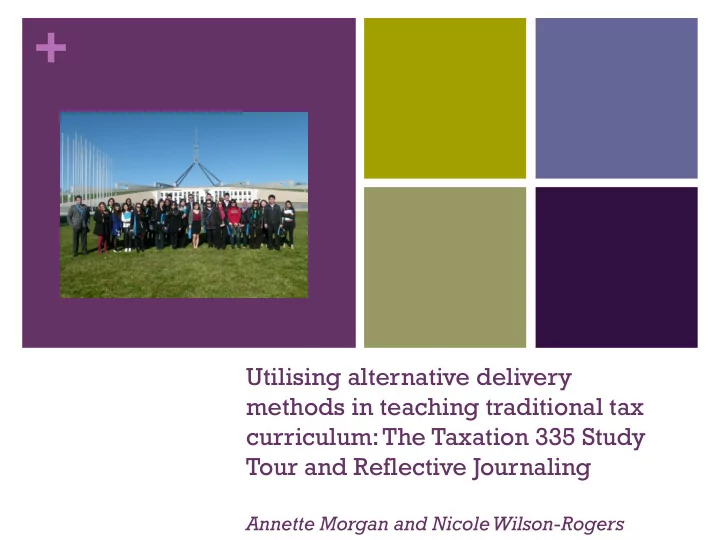
+ Utilising alternative delivery methods in teaching traditional - - PowerPoint PPT Presentation
+ Utilising alternative delivery methods in teaching traditional tax curriculum: The Taxation 335 Study Tour and Reflective Journaling Annette Morgan and Nicole Wilson-Rogers + For the things we have to learn before we can do them, we
Annette Morgan and Nicole Wilson-Rogers
To give an overview of the use of a study tour in conjunction
with reflective journaling to teach aspects of the Taxation Administration 335 course.
The aim is not to comprehensively explore the teaching and
learning literature in relation to these methods.
Context – the unit for which Study Tour utilised A short video – highlights of the Study Tour Aim of the Study Tour and Assessment Method chosen – journaling Structure of Study Tour – life cycle of a tax Challenges of Organising the Tour Highlights Student, Staff and Agencies Feedback
Taxation administration – examines the administration of
Australian taxation law and examines existing governance frameworks.
Final year unit. Students who did not attend
Undertook a field trip to the ATO.
To engage students by allowing them to meet representatives of
agencies involved in the taxation administration field in Australia and discuss their role in taxation administration and powers.
To allow students to see the physical locations and premises of
important agencies and organisations.
Experiential education utilised to enable students to:
Consider and evaluate the relationship between various agencies/players in
the taxation field. (Including considering whether there is any duplication of the key functions of any organisations);
Broaden their views on the tax system and the profession (in relation to both
their studies and future career opportunities);
Make concrete links between the content discussed in class and the relevance
it has in practice to members of the tax profession.
Develop an awareness of other views on the function and benefits of taxation.
Part of the Assessment was the production of a reflective journal at the
conclusion of the study tour.
Several Definitions, for example Thorpe defines Reflective Journals as:
“written documents that students create as they think about various concepts, events, or interactions over a period of time for the purpose of gaining insights into self-awareness and learning.”
Aims: To reinforce for students what they learnt on the study tour (to help combat
the information overload)
To allow them to reflect on changes of perception that might have occurred
as a result of obtaining an enhanced understanding of a particular
To allow students to recognise and reflect on broader benefits of the study
tour other than just content related gains (eg new friendships/job
To draw connections between what students experienced and its relevance
to practice (eg when to advise a client to approach the Ombudsman)
5 days, 26 students and 4 staff. Overall the tour tracked the “lifecycle of a tax”
Policy
Parliament, Treasury, Board of Taxation, Taxation Institute
Implementation/Drafting
Parliamentary Counsel
Administration
Australian Taxation Office
Governance/Review
High Court, Ombudsman, Inspector General
Administration. Co-ordinating the students. Obtaining speakers and liaising with the agencies and
presenters.
“The study tour to Canberra more than met my expectations. It proved to be an excellent way to learn more about taxation and the various aspects of the Australian taxation system. The combination of different
the tour and the quality of the content and speakers” “Being in the senate was a lot more surreal than I expected. As soon as I stepped in I had little flash backs of watching the news and seeing members of the opposition hurling aggressive retorts at the
influential and life changing decisions are made became so real to me. This is where both the mining tax and carbon tax were passed. The future of our taxation system is determined in this room and here I am casually sitting in it.”
“At times I feel like my work ethic is going in vain, that I don’t know
enough people, powerful people, to get me where I need to be and that my grades aren’t good enough. But just sitting there with the Commissioner and telling me that work ethic and attitude really does matter gives me all the motivation I could ever need to continue pushing through.”
“I really appreciated how level headed the Commissioner is when it
comes to administering the law, his idea was to administer the law consistently and fairly, he also admitted that he personally sometimes may not agree with the intent of the law, but his job is to administer the law and not to change it…The Commissioner started his career as a graduate with the ATO and worked his way up from there, this makes me believe that I can do anything I want with my career to be the best that I can be.”
“I was impressed by the way that Chief Justice French
referred consistently to his pocket sized constitution.”
“Overall, I would have to say that the study tour exceeded my
the table was phenomenal. Every person that spoke to us was
time which more than likely was better utilised elsewhere. I learned many things that I expected to learn and many more interesting things that I did not expect to learn.”
Integral in developing a deeper understanding of the taxation system
and governance frameworks.
Provided an awareness of all the players in the taxation field and the
relationships between them.
Enhanced social skills. Presentation skills (Tax Practitioners Board and those presenting to the
agencies).
Punctuality. Formulating appropriate and interesting questions for the personnel
from the agencies.
Presented the taxation team with ideas for alternative ways of
presenting materials at Curtin/ focus needed in various materials.
“If your students now have an enhanced understanding of the
Australian Taxation system, then it was time well spent for all
“Well done on getting your students such exposure.” Simon
Passlow, Office of the Commonwealth Ombudsman
“We get a lot of people up here with a special interest in
particular reforms, but it's not often we get a chance to talk to a large group with a general interest in tax reform, and it's good to hear that some of the issues generated conversations
it always helps to have people interested and engaged in these discussions.” Staff – Wayne Swan’s Office Treasury
Looking further into using alternative delivery methods
throughout the tax programme.
International study tour.