Using honey bees to disseminate strawberry. the biocontrol agent - - PDF document

using honey bees to disseminate
SMART_READER_LITE
LIVE PREVIEW

Using honey bees to disseminate strawberry. the biocontrol agent - - PDF document

The problem The fungus Botrytis cinerea causes grey mould disease - a serious economic problem on a number of field crops, including Using honey bees to disseminate strawberry. the biocontrol agent Gliocladium B. cinerea has the ability


slide-1
SLIDE 1

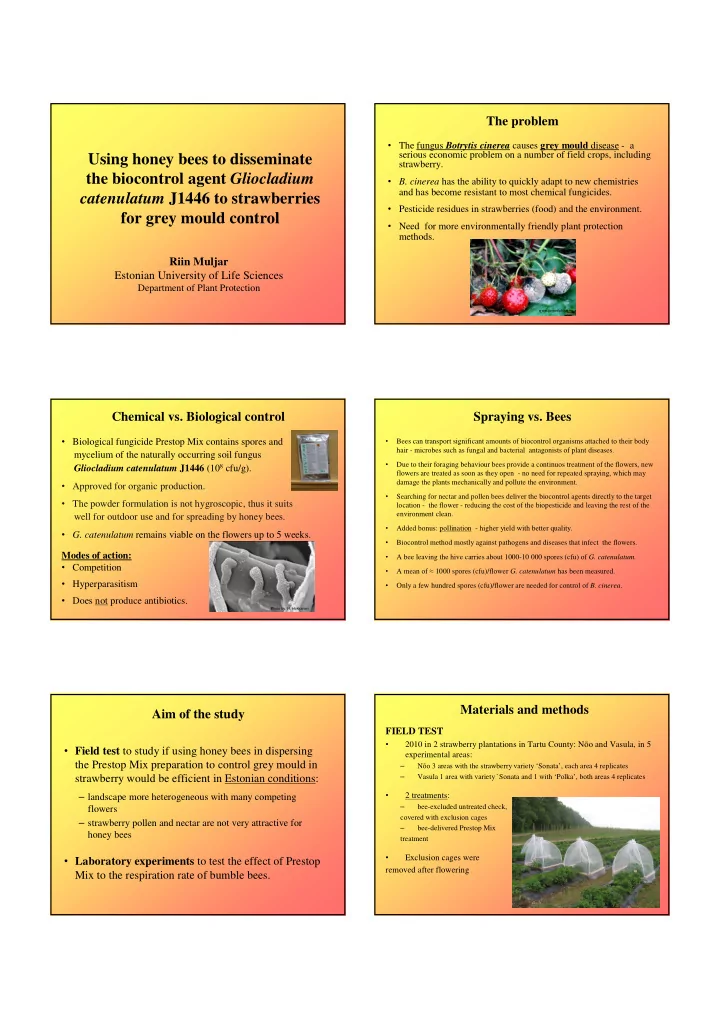
Using honey bees to disseminate the biocontrol agent Gliocladium catenulatum J1446 to strawberries for grey mould control

Riin Muljar Estonian University of Life Sciences

Department of Plant Protection

  • The fungus Botrytis cinerea causes grey mould disease - a

serious economic problem on a number of field crops, including strawberry.

  • B. cinerea has the ability to quickly adapt to new chemistries

and has become resistant to most chemical fungicides.

  • Pesticide residues in strawberries (food) and the environment.
  • Need for more environmentally friendly plant protection

methods.

The problem

www.uoguelph.ca

  • Biological fungicide Prestop Mix contains spores and

mycelium of the naturally occurring soil fungus Gliocladium catenulatum J1446 (108 cfu/g).

  • Approved for organic production.
  • The powder formulation is not hygroscopic, thus it suits

well for outdoor use and for spreading by honey bees.

  • G. catenulatum remains viable on the flowers up to 5 weeks.

Modes of action:

  • Competition
  • Hyperparasitism
  • Does not produce antibiotics.

Chemical vs. Biological control

Photo by. H. Hokkanen

  • Bees can transport significant amounts of biocontrol organisms attached to their body

hair - microbes such as fungal and bacterial antagonists of plant diseases.

  • Due to their foraging behaviour bees provide a continuos treatment of the flowers, new

flowers are treated as soon as they open - no need for repeated spraying, which may damage the plants mechanically and pollute the environment.

  • Searching for nectar and pollen bees deliver the biocontrol agents directly to the target

location - the flower - reducing the cost of the biopesticide and leaving the rest of the environment clean.

  • Added bonus: pollination - higher yield with better quality.
  • Biocontrol method mostly against pathogens and diseases that infect the flowers.
  • A bee leaving the hive carries about 1000-10 000 spores (cfu) of G. catenulatum.
  • A mean of ≈ 1000 spores (cfu)/flower G. catenulatum has been measured.
  • Only a few hundred spores (cfu)/flower are needed for control of B. cinerea.

Spraying vs. Bees

  • Field test to study if using honey bees in dispersing

the Prestop Mix preparation to control grey mould in strawberry would be efficient in Estonian conditions:

– landscape more heterogeneous with many competing flowers – strawberry pollen and nectar are not very attractive for honey bees

  • Laboratory experiments to test the effect of Prestop

Mix to the respiration rate of bumble bees.

Aim of the study

FIELD TEST

  • 2010 in 2 strawberry plantations in Tartu County: Nõo and Vasula, in 5

experimental areas:

– Nõo 3 areas with the strawberry variety ‘Sonata’, each area 4 replicates – Vasula 1 area with variety `Sonata and 1 with ‘Polka’, both areas 4 replicates

  • 2 treatments:

– bee-excluded untreated check, covered with exclusion cages – bee-delivered Prestop Mix treatment

  • Exclusion cages were

removed after flowering

Materials and methods

slide-2
SLIDE 2
  • Honey bee hives (2 hives/ha) were placed at the

edge of strawberry fields at first bloom, to each hive we attached a special dispenser containing the Prestop Mix preparation.

  • Prestop Mix was added in the dispenser daily
  • Exiting the hive the bees walk through the

Prestop Mix powder, which sticks on their legs and hairy body.

  • The dispener is a flat box with two openings,

bees go in through one opening and out from the

  • ther, that way they won´t carry the powder

into the hive.

Materials and methods

Picture by Riin Muljar

Photo by. H. Hokkanen Photo by. H. Hokkanen

  • Bee dissemination of Prestop Mix was started at the onset of strawberry

flowering, and was continued until the end of flowering.

  • No chemical treatment was used.
  • Twice a week we counted the number of honey bees on the flowers.
  • Ripe strawberries were picked every other day, the number of healthy and

diseased berries were recorded.

  • We compared:

– The bee-disseminated treatment with the untreated check by counting the healthy and Botrytis-infected berries in both treatments. – Botrytis infection in strawberry varieties ‘Sonata’and ‘Polka’.

Materials and methods

LABORATORY TESTS

  • Feeding test – commercially produced bumble bee colonies

were fed for three weeks:

– Test bumble bees with pollen and a mix of sugar solution and the Prestop Mix preparation – Control bumble bees with pollen and sugar solution only.

  • Contact test

– Test bumble bees dusted with the Prestop Mix powder – Control bumble bees untreated

  • Infrared gas analyser was used to measure the respiration rate
  • f the test and control bees by recording the amount of CO2

release (VCO2 ml h-1).

Materials and methods

  • Treating strawberry plants with the bee-dispersed Prestop Mix

significantly reduced the proportion of infected berries - over 10% compared to the check (p < 0,001).

FIELD TEST Results

slide-3
SLIDE 3
  • Efficiency of the treatment depended somewhat on the

strawberry variety - more efficient in ‘Sonata’ (p=0,067):

– In `Polka` about 10% less diseased berries – In `Sonata` up to 25% less diseased berries

  • ‘Sonata’ more attractive?

FIELD TEST Results

Contact test:

  • Dusting the bumble bees with Prestop Mix powder lowered

somewhat the respiration rate of the treated bumble bees, but no significant effect was found (p=0,1206).

LABORATORY TEST Results

Feeding test:

  • Feeding the bees with Prestop Mix had no effect on the respiration

rate of treated bumble bees compared with the control (p=0,8).

  • Previous studies - no negative impact to bee reporoduction and

foraging behaviour has been found.

LABORATORY TEST Results

  • Using honey bees to disseminate the biocontrol agent

Gliocladium catenulatum J1446 to strawberries for grey mould control is effective in Estonian conditions.

  • Effiectiveness of grey mould control may depend on the

strawberry variety and its attractiveness to honey bees.

  • Gliocladium catenulatum J1446 doesn´t have a negative impact
  • n the respiration rate of bumble bees.
  • This is a pilot study and further research is needed.
  • This biocontrol method is a promising alternative for estonian
  • rganic farmers and for use in integrated pest management to

gain effective control of grey mould in an environmentally friendly manner.

Conclusions

Acknowledgements

  • Ministry of Agriculture
  • ETF grant 7391, sf0170057s09
  • AS Baltic Agro
  • Verdera Oy
  • Valdis Kaskema
  • Imbi Rohejärv
  • Jaanus Tull

Thank you for your attention!