Has the honey bee a future? Some facts about honey bees Pollinate - - PowerPoint PPT Presentation

has the honey bee a future some facts about honey bees
SMART_READER_LITE
LIVE PREVIEW

Has the honey bee a future? Some facts about honey bees Pollinate - - PowerPoint PPT Presentation

Has the honey bee a future? Some facts about honey bees Pollinate 60% of all commercial crops Contribute 400m annually to the economy Pollinate 70% of winter forage for birds and small wild animals More facts about honey bees


slide-1
SLIDE 1

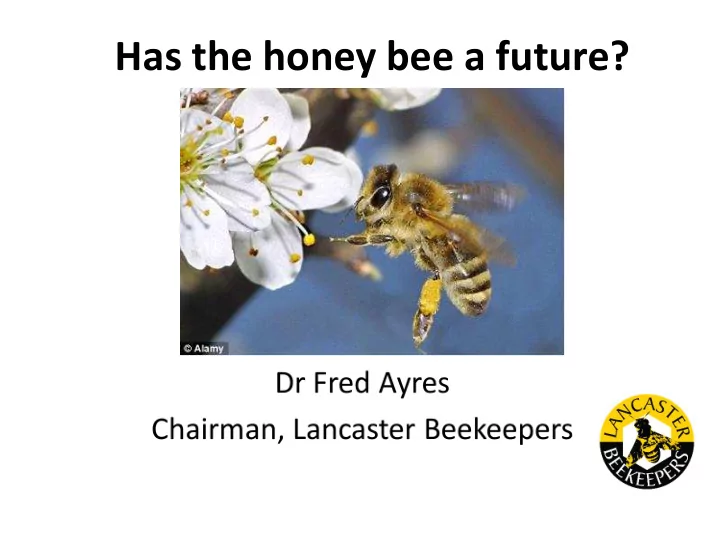
Has the honey bee a future?

slide-2
SLIDE 2

Some facts about honey bees

  • Pollinate 60% of all commercial crops
  • Contribute £400m annually to the economy
  • Pollinate 70% of winter forage for birds and

small wild animals

slide-3
SLIDE 3

More facts about honey bees

  • Around 6 billion honey bees in UK
  • 95% maintained by hobbyists
  • Population declining by around 25% year on

year

slide-4
SLIDE 4

Reasons for decline

  • Reduction in forage due to farming practices
  • UK obsession with closely mown grass
  • Extensive use of pesticides
  • Foreign importations
  • Weather
slide-5
SLIDE 5

Changing farming practices

  • Enriching soil
  • Reduction of hedges
  • Monoculture

Possible solution – wildlife corridors

slide-6
SLIDE 6

Changing farming practices

slide-7
SLIDE 7

Obsession with mown grass

  • Verges
  • Publicly owned amenity land
  • Industrial estates

Possible solution – converting unused mown grass into maintained wild flower meadows

slide-8
SLIDE 8
slide-9
SLIDE 9
slide-10
SLIDE 10
slide-11
SLIDE 11

Extensive use of pesticides

Neonicotinoids are highly effective,systemic pesticides, applied to seeds that:

  • Kill pollinators over a period of time
  • Affect bees’ location senses
  • Are banned in most of Europe but not UK
  • Freely available in most Garden Suppliers
slide-12
SLIDE 12

Foreign importations

British dark bee A m mellifera Italian bee A m lingustica Carniolan bee A m carnica

slide-13
SLIDE 13

Imported diseases

Varroa mite American foul brood European Foul brood

slide-14
SLIDE 14

Weather

To understand how weather affects bees it is necessary to understand the bees’ life cycle

slide-15
SLIDE 15

Honey bee life cycle

slide-16
SLIDE 16

Honey bee life cycle

Queen starts to lay eggs in mid January Around April / May bees produce queen cells Bees swarm before new queens hatch

slide-17
SLIDE 17

Honey bee life cycle

Newly hatched queens MUST mate successfully within 3 weeks

  • r will never be able to lay fertile eggs

Bad weather may prevent this!

slide-18
SLIDE 18

Honey bee life cycle

Honey bees normally live 5 to 6 weeks

► 0 - 6 days cell cleaning, general hive cleaning ► 3 - 9 days feeding the brood ► 3 - 15 days attending the queen ► 6 - 18 days honey processing ► 12 - 20 days wax production and comb building ► 20 - death hive ventilation

guard duty nectar, water & propolis collection

The exception is those bees hatching in October will cluster round the queen and remain largely inactive until the queen starts to lay again around January /February

These bees have a maximum life span of around 26 weeks

slide-19
SLIDE 19

Weather

  • Bad weather in Spring prevents queens from

mating successfully

  • Long winters result in “winter” bees dying

before “spring” bees hatch

slide-20
SLIDE 20

We are fighting back

slide-21
SLIDE 21

We are fighting back

  • Breeding native honey bees
  • Training new and developing beekeepers
  • Campaigning for wildlife corridors
  • Lobbying Council to plant wildflowers on

waste land rather than cutting grass

slide-22
SLIDE 22

You can help!

You can help by:

  • Reducing use of pesticides
  • Planting more nectar producing plants
  • Reducing areas of lawns
  • Supporting campaigns for wildlife corridors and wildflower

meadows