
SLIDE 1
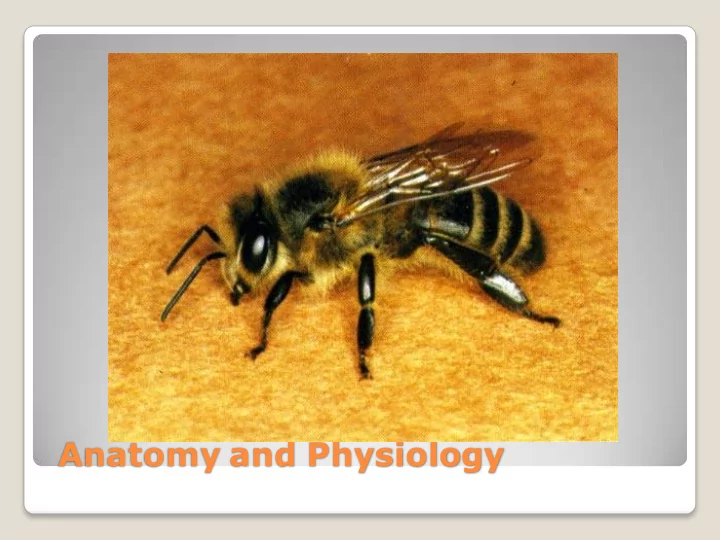
Anatomy and Physiology Honey bees 3 segments Exoskeleton Bees have - - PowerPoint PPT Presentation
Anatomy and Physiology Honey bees 3 segments Exoskeleton Bees have a hard outer covering call an exoskeleton The exoskeleton helps protect the delicate internal structures, conserves internal body fluids so the body does not desiccate,
Bees have a hard
exoskeleton The exoskeleton helps protect the delicate internal structures, conserves internal body fluids so the body does not desiccate, and also serves as a protective barrier to the entry of
skeleton is made of a material called Chitin The body of the bee is covered with setae or branched hair
(plumose) body hairs.
unbranched hairs covering their body which are for sensory purposes. The hairs extend from the body exoskeleton that gives shape and form to a bee.
Eye Tarsus Head
Feb 13, 09
at the top of the head between the bee’s two larger compound eyes. The ocelli detect light but can’t focus or arrange an image like the larger compound eyes Ocelli register intensity, wavelength, and duration of light. At dusk the
causing the bees to return to their hives.
about their environment: Tiny sensory hairs on each antenna allow them to smell, taste, feel air movements and to communicate with one another
7,000 hexagonal facets. Each facet is like a mini-eye, containing its own lens and sensory cells
mandible, are built for many uses: They can
be used to ingest food, manipulate wax to build the hive cells, feed the young or queen, and even fight
bee’s head is used to ingest liquids such as nectar, honey or water. The proboscis is tipped with a spoon-shaped glossa
Mandibles Tongue
Antennae receive and analyze highly volatile substances that are responsible for odor and
movement of air ( , sounds, temperature and humidity . Aide in communication
Johnston's organ is a collection of sensory cells found in the pedicel (the second segment)
motion in the flagellum (third and final antennal segment). Johnston's organ can also sense
in a bowl shape, each of which contains a mechanosensory neuron
The scrape of the drone is shorter than in the workers but the flagellum is longer with 12 rings compared to 11 in worker and queen
Pollen press Pollen comb
RIGHT (hind) leg and
its medial surface. From top to bottom are the tibia,
basitarsus, and four short tarsal segments. Between the
tibia and basitarsus is the flattened, notched pollen press.
The ranks of hairs act as combs for grooming and pollen
to
capacity with pollen, the rastellum (rake) is used to unload
the comb by scraping it into the press where the pollen is
compressed and transferred to the tibial baskets
pollen
groomed from the right side of the body is combed from
the inner surfaces of the middle and forelegs by the left
hind leg, from which it is removed by the right rastelhun
for deposition in the pollen basket of the same leg. The
MIDDLE LEFT Mediolateral view, of the pollen press. The floor of the press is edged with fine hairs, and its surface is covered with denticlelike cuticular spines or
down and lie over the press and a picket of shorter , stiff spines (rastellum) lines the dorsomedial margin of the press. Small mechanoreceptor hairs are visible at the leading edge of the spatulate hairs (upper left). (x 100) TOP LEFT Hairs on the medial surface of the
these hairs contrasts markedly with the basitarsal hairs, which have serrated edges and a fairly sharp
specialized hairs of the tibia may have an important function in the process of gathering and packing
Pretarsus – foot – very important part of the bee is the part the allows the bee to cling to surfaces smooth or rough The claws aid in clinging to rough surfaces The arolium aids in clinging to smooth surfaces . The Antenna cleaner
Spiracle use for breathing
Four basic functions of Glands in Honeybees
wax gland produce wax in segments of abdomen nasonov gland
abdomen
wing buzzing mandibular gland makes lipids for larval food/alarm pheromone '2-heptanone'/ and queen substance. produced in the head sting pheromone gland makes the alarm 'isopental'. produced in the stinger arnhart gland leaves the 'scented footprint' on flowers and hive. produced in the tarsal segment
salivary gland secretes
the mouth hypopharyngeal gland produces royal jelly, produced in the head
Dufour gland secretions are utilized in defense by workers or reproduction In queens.
MANDIBULAR GLANDS Reduced or well developed in the young worker depending on colony condition; produces “royal jelly” components.
HYPOPHARYNGEAL GLANDS
Most developed in worker nurse bees to produce “brood food”.
Rudimentary in the queens but may produce some communication chemicals with these glands (under investigation).
Absent or vestigial in the drone (debated question).
secretes
in converting sugars
leaves the 'scented footprint' on flowers and hive. produced in the tarsal segment
makes the alarm 'isopental'.
Sting pheromone gland
Sting pheromone gland
produce wax in segments of abdomen worker only segments 4,5,6 and 7
Unlike mammals the circulatory and respiratory systems are mostly separated . The circulatory system is “open”, consisting of a dorsal heart and aorta to assist in blood
The main functions of the circulatory system are to transport food from the midgut to body cells, transport gases, hormones, defensive proteins, waste materials from cells to excretory
Blood (hemolymph) has only a minor role in gas transport.
system.
CO2 away from cells.
their abdomens to increase gas exchange and expand air sacs of the trachea like bellows, facilitating greater gas exchange.
muscles indirectly connected to the wings contain cytochrome, a molecule which enhances gas exchange.
Consists of the brain and 7 ganglia at various junctions throughout the body. Most locomotion is controlled by the ganglia not the brain. A beheaded insect can move it’s legs and wings vigorously. A decapitated bee can walk and sting but flying is not possible because it is out of balance without the head. The bee brain consists of a small bundle of cells with all the automatic functions transferred to the ganglia (~spinal cord). The ganglia are reduced to barely visible proportions. Bees are able to learn and have “short-term” memory.
Enormous
to workers.
Mated queen is
an egg-laying machine; up to 2,000 eggs per day.
Queens mate in
the 2nd week of adult life with 5- 20 males in 1-3 mating flights and will never mate again.
Sperm is
stored in the spermatheca; enough to last a life span of 2-8 years.