
SLIDE 1
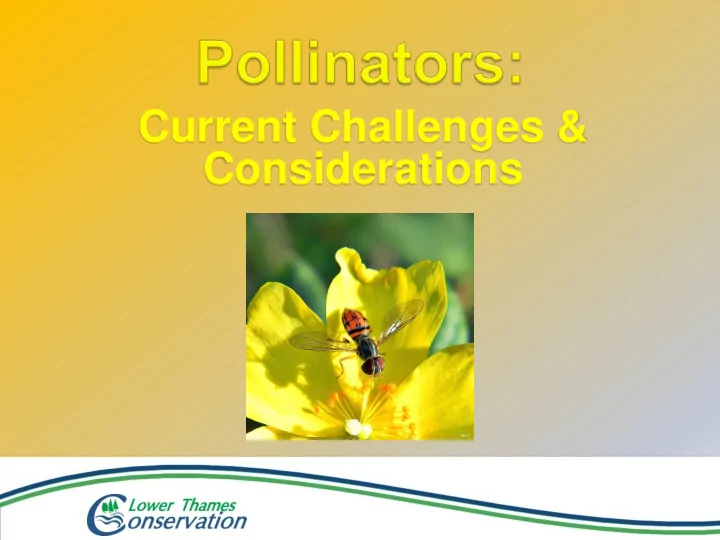
Considerations Neonicotinoid Pesticides (Neonics) Systemic insect - - PowerPoint PPT Presentation
Current Challenges & Considerations Neonicotinoid Pesticides (Neonics) Systemic insect uptake through plant tissues, pollen, nectar. In Ontario, neonicotinoid-treated seeds are often used preventatively, even if there is no
Neonicotinoid Pesticides (Neonics)
Systemic – insect uptake through plant tissues, pollen, nectar. In Ontario, neonicotinoid-treated seeds are often used preventatively,
even if there is no evidence of a pest problem. Almost 100% of corn seed and roughly 60% of soybean seed are treated with neonicotinoids. There is widespread over use of treated seeds.
The Canadian federal Pest Management Regulatory Agency concluded
that the majority of honey bee mortalities in Ontario in 2012 and 2013 were a result of exposure to neonicotinoid insecticides. This is likely due to contaminated dust exposure generated during the planting
Effects on European honeybees include:
navigation and reproduction.
Disorder (CCD) and other diseases.
Ontario Gov’t wants 80% reduction in neonicotinoid treated acreage by
2017.
Image Courtesy of Tony Linka Illustration
Neonicotinoid effects on honeybees have been studied extensively. Honeybees form large colonies and honeybee behaviour encourages
worker bees to gather from productive nectar source areas that may have been treated or contaminated by neonicotinoids. This means whole colonies may be weakened or die due to single source exposure.
wise.
Studies at Cornell University are finding native pollinators are up to three times more efficient!
beneficial insects. Soil conservation, nutrient loading, environmental and personal health, and farm aesthetics are also positive outcomes of planting native species in marginal or fringe areas of low return.
all the other beneficial insects attracted, are cost and effort free.
to maintain or even increase their
something (pesticide, weather, disease etc.),
FENCELINE Native Plant Pollinators Attracted Soil Type Growth Conditions Flowering Timeline American Pasqueflower Anemone patens Honey Bee, Large Mining Bees, Syrphid Flies, Bee Flies, Sweat Bees Sand to Loam Sun to part sun, mesic to dry soil Mid-March to May Prairie Phlox Phlox pilosa Peck’s Skipper, many other Butterflies, Clearwing Moth, Green Sweat Bees, Small Carpenter Bees, Yellow-Faced Bees, Leafcutter Bees, Bumble Bees, Syrphid Flies, Hummingbird Sand to Clay Loam Sun to part sun, wet-mesic to dry soil April to June Butterfly Milkweed Asclepias tuberosa Honey Bee, Green Sweat Bees, Small Carpenter Bees, Small Resin Bees, Sweat Bees, Leafcutter Bees, Cuckoo Bees, Ants, Soldier Beetles, Milkweed Leaf Beetle, Monarch Butterfly, Sulphur Butterflies, Crescent Butterflies, Great Spangled Fritillary Butterfly, Thread-Waisted Wasps, Paper Wasps, Hummingbird Sand to Loam Sun, mesic to dry soil June to August Yellow Coneflower Ratibida pinnata Many beneficial predatory insects, Honey Bee, Mining Bee, Bumble Bees, Long-Horned Bees, Sweat Bees, Green Sweat Bees, Cuckoo Bees, Mint Moths, Wavy-Lined Emerald Moth, Azure Butterflies, Syrphid Flies, Soldier Beetles Sand to Clay Loam Sun to part sun, wet-mesic to dry soil Mid-June to September Wild Bergamot Monarda fistulosa Honey Bee, Bumble Bees, Sweat Bees, Green Sweat Bees, Small Resin Bees, Wool Carder Bees, Long-Horned Bees, Cuckoo Bees, Great Black Wasp, Eastern Tiger Swallowtail Butterfly, Silver Spotted Skipper Butterfly, Monarch Butterfly, Great Spangled Fritillary Butterfly, Snout Moths, Hummingbird Clearwing Moths, Soldier Beetles, Banded Long-Horned Beetle, Hummingbird, many
Sand to Clay Loam Sun to part sun, wet-mesic to dry soil July to September WOODLAND EDGE Native Plant Pollinators Attracted Soil Type Growth Conditions Flowering Timeline Wild Geranium Geranium maculatum Honey Bee, Bumble Bees, Small Carpenter Bees, Sweat Bees, Mason Bees, Mining Bees, Cuckoo Bees, Syrphid Flies, Thick-Headed Flies Sand to Clay Loam Part sun to shade, wet-mesic to dry soil April to June Smooth Solomon’s Seal Polygonatum biflorum Bumble Bees, Small Carpenter Bees, Sweat Bees, Digger Bees, Green Sweat Bees, Hummingbird Sandy Loam to Clay Loam Part sun, wet-mesic to mesic-dry soil May to July Large-Leaved Aster Eurybia macrophylla Honey Bee, Bumble Bees, Yellow-Faced Bees, Sweat Bees, Green Sweat Bees, Mining Bee, Syrphid Flies Sand to Clay Part sun to shade, wet-mesic to mesic-dry soil July to mid- September Zigzag Goldenrod Solidago flexicaulis Honey Bee, Sweat Bees, Yellow-Faced Bees, Green Sweat Bees, Mining Bees, Bumble Bees, Brown Hooded Owlet Moth, Mason Wasps, Thread-Waisted Wasps, Carrot Wasps, Paper Wasps, Yellowjacket Wasps, Syrphid Flies, Soldier Beetles Sandy Loam to Clay Loam Part sun to shade, wet-mesic to dry soil Mid-August to October WETLAND, POND or STREAM EDGE Native Plant Pollinators Attracted Soil Type Growth Conditions Flowering Timeline Marsh Marigold Caltha palustris Sweat Bees, Green Sweat Bees, Mining Bees, Syrphid Flies, Ants Sandy Loam to Clay Sun to part sun, wet-mesic soil April to mid-May Canada Anemone Anemone canadensis Mining Bees, Small Carpenter Bees, Sweat Bees, Yellow-Faced Bees, Green Sweat Bees, Syrphid Flies, Long-Horned Beetles, Fruitworm Beetles, Tumbling Flower Beetles Sand to Clay Sun to part sun, wet to mesic soil May to August Swamp Milkweed Asclepias incarnata Bumble Bees, Yellow-Faced Bees, Sweat Bees, Green Sweat Bees, Small Resin Bees, Leafcutter Bees, Honey Bee, Paper Wasps, Great Black Wasp, Yellowjacket Wasps, Great Golden Digger Wasp, Square-Headed Wasps, Monarch Butterfly, Red Admiral Butterfly, Great Spangled Fritillary, Skipper Butterflies, Sulphur Butterflies, Swallowtail Butterflies, Hummingbird Clearwing Moth, many other moths, Tachinid Flies, Bee Flies, Syrphid Flies, Soldier Beetles, Long-Horned Beetles, Banded Long- Horned Beetles, Hummingbird Sand to Clay Sun to part sun, wet to mesic soil July to August Spotted Joe Pye Weed Eutrochium maculatum Bumble Bees, Long-Horned Bees, Leafcutter Bees, Cuckoo Bees, Honey Bee, Monarch Butterfly, Eastern Tiger Swallowtail Butterfly, Azure Butterflies, Skipper Butterflies, Tortoiseshell Butterflies Sand to Clay Sun to part sun, wet to mesic soil July to September Common Boneset Eupatorium perfoliatum Bumble Bees, Green Sweat Bees, Sweat Bees, Yellow-Faced Bees, Mining Bees, Sand Wasps, Paper Wasps, Bald-Faced Hornets, Potter Wasps, Beetle Wasps, Bee Wolves, Grass-Carrying Wasps, Thread-Waisted Wasp, Thynnid Wasps, Cuckoo Wasps, Tachinid Flies, Syrphid Flies, Thick-Headed Flies, Bee Flies, Monarch Butterfly, Swallowtail Butterflies, Virginia Creeper Clearwing Moth, Soldier Beetles Sand to Clay Sun, wet to mesic soil July to October
Clump plantings of native species on marginal or fringe areas of low return.
Plants listed are suited for soils and growth conditions found in the McGregor Creek subwatershed area. This list is also applicable to most locations in Southern Ontario.
Mining Bees Small Carpenter Bee Large Carpenter Bee Sweat Bee Yellow-faced Bees Leafcutter Bees Blue Orchard Bee
Syrphid Flies
contribution of non-bee pollinators to crop pollination. Non-bees performed 25- 50% of the flower visits and while being less efficient pollinators than bees, they made twice as many visits thereby compensating for pollination ability.
native habitat areas are available, these productive insects are not as dependant on land use changes, probably allowing them to keep pollinating
Ants Wasps Butterflies & Moths Beetles
PREDATORS! Biological Control for FREE! The following
depict just a short example of predatory insects attracted.
Prey on caterpillars, grasshoppers, crickets, mealybugs,
whitefly, drosophila flies, aphids etc..
Syrphid fly
thrips, corn borers or corn earworms and
Ladybird Beetles
scale insects, mites, mealy bugs, whiteflies, thrips, and the eggs of
Lacewings
aphids, immature caterpillars and other insects.
Parasitoids – Many wasps and flies use native plant
Braconid Wasps
larvae.
host causing death, then wasp larvae pupate. Tachinid Flies
host.
nectar.
Increase native pollinator numbers and diversity.
Reduce reliance on a single pollinator’s presence/health.
Improve productivity and profits through more efficient and cost effective pollination.
Attract natural pest control.
Decrease soil loss to erosion.
Decrease nutrient and sediment loading to our streams, rivers and lakes.
The Ontario Soil and Crop Improvement
Farm businesses can have a free assessment