
SLIDE 1
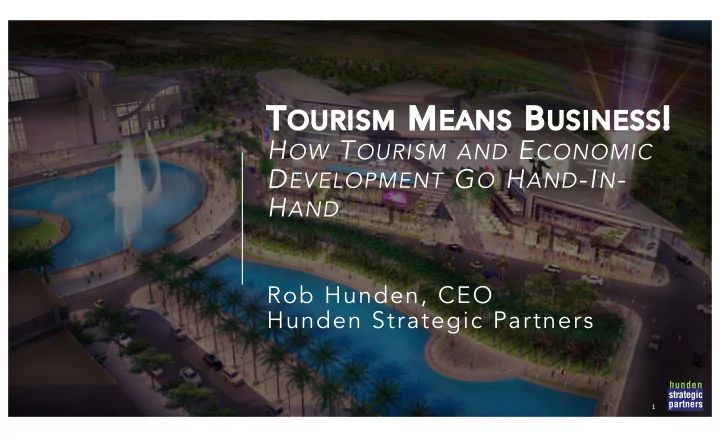
TOU
OURISM SM MEA EANS NS BUS USINESS!
HOW TOURISM AND ECONOMIC DEVELOPMENT GO HAND-IN- HAND
Rob Hunden, CEO Hunden Strategic Partners
1
USINESS ! OURISM EANS H OW T OURISM AND E CONOMIC D EVELOPMENT G O - - PowerPoint PPT Presentation
T OU SM M EA NS B US USINESS ! OURISM EANS H OW T OURISM AND E CONOMIC D EVELOPMENT G O H AND -I N - H AND Rob Hunden, CEO Hunden Strategic Partners 1 To download this presentation, visit: https://hundenpartners.com/downloads/ 2
1
2
§ Backgrounder § The Challenge for DMO’s: Communicating Your Value Proposition § Small Pieces § Medium Sized Places § Large Places § Call to Action: So Now What? § Questions
4
Master Placemaking
Physical Programming Market Feasibility Financial Feasibility Funding Options/Public Incentives Economic & Fiscal Impact Analysis RFQ/P Processes Partnership Options Business Plans
5
San Juan Phoenix Kentucky Madison Chicago Fort Worth
6
7
Public and Private Sector Employment Experience
City of Indianapolis Bond Bank/Mayor’s Office 1996 - 1998 Capital Markets, Consulting 1999 - 2005 Hunden Strategic Partners – 2006 - Present
25 Years of Industry Experience Nationwide
600+ Projects and Studies Speaker, Teacher and Author Move projects from Concept to Reality
8
Rob Rob Hunden, unden, Pres esident dent & CEO EO
9
Value to the Local Economy
DMO’s recognize the value
the tourism and placemaking industry to their local economy even when politicians and EDC’s do not. Yet what does the evidence show?
Migration
While many factors drive growth and migration patterns, including cost of living, taxes and job growth, we see migration moving toward areas with strong and growing tourism.
12
13
14
Migration
The fact is, people are migrating to places that have made placemaking, tourism and quality of life a priority. With the Baby Boomers retiring, they are moving to places they enjoyed visiting on vacation and for conventions during their careers. Millennials are choosing based
similar factors, with an emphasis on experience.
Migration
Often, these are lower tax states and cities, but people must be drawn to a place. Cost of living cannot be the
People are drawn to a place they enjoyed visiting, has a growing and vibrant sense of place, downtown area and walkable, interesting areas with fun things to do, etc.
Benefits for Both Sides
The fact is, the things you build for tourists (event centers, attractions, districts) benefit local citizens and are often paid for with visitor dollars (hotel, auto rental and restaurant taxes).
Who Do We Build it For?
BUT, we
really shouldn’t be building for the tourist per se. What we know to be true is that visitors are drawn to the things that are attractive to locals. Do not build for the visitor. They can see right through that! Build for the local, make it unique to you, and the visitor will follow.
The New Consumer of today is different than any generation before them. The unique needs and desires creates an interesting opportunity in the creation of new attractions and facilities. What’s important: § Social Media is King § Efficiency and Immediacy § Authenticity and Transparency § Casual Lifestyle § One-World Concept § Value of Experiences § Soullessness of Sameness § Visual Appeal § Community § Multiple Music Genres § Lifestyle Options § Environment/Animals § Travel § Vehicles/Biking § Big Ticket Items § Currency § Adventure with Food § Cooking vs. Take-out § Fonts and Design § No Loyalty to Big Corporations § Charitable Companies § Gaming and On- Demand Streaming § Esports § Work Smarter Not Harder § Pop-Ups § Online Perks § Efficient Urban Living § Authentic Process/Product § Television and Movies § Geeking Out and Hi- Tech § Thrills and Experience § Fitness § Team Sports § Dating
The new consumer sees social media as a way to create their own personal brand and social value. All information is constantly updated. Younger generations also prefer real-time social media platforms such as Instagram and Snapchat, while
Any new facility must have ample Wi-Fi and charging stations. IM IMPLIC ICATIO IONS Use it to promote events, authenticity, videos. Be aware that it can also ruin you, but don’t let that take your edge away.
We live in a world of instant access. Videos, information, and coupon deals all come in the blink
an eye through smartphones and
If they are forced to wait, the outcome better be worth the delay. IM IMPLIC ICATIO IONS Experiences should be available without long lines, advance planning. Pop-up experiences should be part of the plan!
The new consumer demands authenticity and transparency, especially with government, business corporations and authority. Big corporations and politicians are seen with
with accountability to their product and the community they serve. IM IMPLIC ICATIO IONS Pop-up shops and authentic vendors bringing new and different experiences, products and food/drink. Cannot assume a 5-7 year lease will work.
The new consumer places a priority on the value
would rather spend money on a Coachella concert than invest hundreds into a new suit. Luxury items such as expensive jewelry or investing in a suit for a job, therefore, are decreasing in popularity. IM IMPLIC ICATIO IONS Standard in-line retail and chain restaurants are passé. Careful about investing in anchor- experiences like Top Golf. While experiential, these will fade as all
experiences do. Experiences must be constantly re-imagined within a space. Plan for it.
The new consumer prefers to live-in-the-moment and values visually dynamic apps, design and architecture with no boundaries. Sharing unique design through social media amplifies this trend. IM IMPLIC ICATIO IONS The ability to present constantly changing and engaging graphics (video or light) is critical and allows the experience to change constantly. Times Square mini-version, but interactive, everywhere. An iPhone is more interesting, constantly, so that is the competition for time/attention.
The new consumer has fewer possessions because most of what they need is accessible online and delivered the next day. Therefore, tiny houses and apartments are the rage. Their living quarters are more about affordability, physical accessibility, convenience and ease. They like to have quick access to retail that offers daily provisions, and prefer to shop online for durable goods. They do not require homes near most other retail, and only shop at those stores if they can’t wait for Amazon to ship it to them. IM IMPLIC ICATIO IONS Smaller portions at restaurants, smaller packaging and products. These may influence tenants, but maybe not real estate as much.
People of all ages are seeking out authentic processes and products from unique processes. The Kentucky Bourbon Trail and Craft Trail distilleries are great examples. Even within this tourism explosion, a certain segment seeks out non-corporate, single-batch bourbons and related
unique product, while 20% is everything else. IM IMPLIC ICATIO IONS The whole experience, landscaping, music and lighting, not to mention tenants, cannot feel corporate or mass produced. People will pay more for the “inefficient” experience, process or product.
§ 12,000 square feet § 100% Colombian artisan retail products § 133 total stalls offers a new flexible and changing array
retail to keep locals interested (received 5,000 applications) § Very small pop-up shop spaces (about 8’x5’)
27
Located in the Oxbow District of Napa, Oxbow Public Market has become a food and gathering place for residents and visitors throughout the Napa Valley. § 40,000 square feet § Scenic outdoor deck with seating along the Napa River § Local food vendors, artisan cafes and organic produce outlet for local farms § First 3 years were slow and had to reassess the tenant mix, add promotions § Popular as a stopping point between San Francisco and the heart of Wine Country
28
Located in Atlanta on the BeltLine recreation trail and opened in 2014, Ponce City Market is housed in the fully renovated Sears, Roebuck & Company building. The rooftop Skyline Park area offers panoramic views, a bar, an upscale club, and is a major attraction by itself. Event space, bike valet and showers for cyclists are available. § Cost $250 million
§ Rental Rates: $1,595 - $3,500+ per month (some affordable housing also available)
29
31
2010 – 2018 Growth: 41.3% 2015 – 2018 Growth: 14.0% Focused on tourism, downtown, recreation, quality of life. Situated between Provo, Orem, Salt Lake City & Ski Resorts
32
Heber Micro 2018 Area Population: 33,240
2010 – 2018 Growth: 13.8% 2015 – 2018 Growth: 11.2% Once devastated by timber and industry decline; rebounded due to tourism and quality of life, as well as low cost of living and power, which attracted data centers from Facebook & Apple in 2010, 2012.
33
Prineville 2018 Area Population: 23,900
2010 – 2018 Growth: 16.4% 2015 – 2018 Growth: 11.0% Last Year Job Growth: 5.3% Exurb of Atlanta and north of Athens, using downtown and quality of life to lure those looking for the best of both worlds.
34
Jefferson 2018 Area Population: 70,400
2010 – 2018 Growth: 15.8% 2015 – 2018 Growth: 9.9% Most centrally-located city in Washington, home to Central Washington University, growing
properties at much lower prices = more land at affordable prices than cities west of the Cascades.
35
Ellensburg 2018 Area Population: 47,400
36
2010 – 2018 Growth: 24.3% 2015 – 2018 Growth: 11.0% Last Year Job Growth: 4.9% Isolated desert community attracts both outdoor recreation enthusiasts (proximity to Zion National Park), and workers in the service industry. Las Vegas is just
every five new residents were not born in St. George.
37
2010 – 2018 Growth: 25.0% 2015 – 2018 Growth: 10.9% Attracts families with higher incomes due to proximity to recreation opportunities such as first class skiing and Yellowstone National Park. Montana State University adds a big-city cultural flair. Recently expanded airport is now the busiest in Montana, offering best connectivity in the region.
38
Bozeman 2018 Area Population: 112,000
2010 – 2018 Growth: 21.7% 2015 – 2018 Growth: 10.3% Last Year Job Growth: 3.0% Tourism growth and laid-back, craft-beer, artsy, and outdoorsy lifestyle, with no headaches of big city. Ample skiing, rock climbing, hiking, and far sunnier weather than the coast. Entrepreneurs thrive, with the most new registered businesses in the state in 2017.
39
Bend-Redmond 2018 Area Population: 192,000
2010 – 2018 Growth: 24.3% 2015 – 2018 Growth: 10.3% Last Year Job Growth: 3.1% White and blue collar industries both booming in Fort Collins and Greeley, due to pro-business
People want to be near the mountains, but away from the urban intensity and expense of Denver.
40
Greeley 2018 Area Population: 314,300
2010 – 2018 Growth: 19.6% 2015 – 2018 Growth: 7.4% Two spines of growth: Eastern Shore along the coast of Mobile Bay, growing affluent string of Mobile suburbs with upscale shopping and quaint
has beach tourism. Foley Sports Complex draws youth tournaments and tourism.
41
2018 Area Population: 218,000
42
2010 – 2018 Growth: 27.7% 2015 – 2018 Growth: 11.5% Last Year Job Growth: 4.5% Known for tourism, now becoming a truly balanced economy, with higher education and retirees moving in.
43
Myrtle Beach 2018 Area Population: 481,000
2010 – 2018 Growth: 20.3% 2015 – 2018 Growth: 8.7% Last Year Job Growth: 3.5% Burgeoning high-tech corridor (Silicon Slopes). Utah Valley State University growing + Brigham Young University. While close to Salt Lake City’s suburbs, Provo-Orem has its own distinct youthful culture and a more business-friendly climate.
44
Provo-Orem 2018 Area Population: 634,000
2010 – 2018 Growth: 18.5% 2015 – 2018 Growth: 8.2% Last Year Job Growth: 3.6% Young families seeking jobs and and seniors seeking a moderate climate and low cost of living, attracted by the mountains and sunny weather. Tech companies relocating from Seattle and San Francisco + organic growth.
45
Boise 2018 Area Population: 730,000
2010 – 2018 Growth: 18.5% 2015 – 2018 Growth: 6.7% Last Year Job Growth: 1.8% Focused on downtown, biking, walkability, culture, quality of
in hotels, museums and downtown.
46
Northwest Arkansas 2018 Area Population: 550,000
2010 – 2018 Growth: 10.0% 2015 – 2018 Growth: 3.9% Last Year Job Growth: 1.2% Focused on curated downtown, recreation, quality
facility development.
47
Greenville-Spartanburg 2018 Area Population: 907,000
48
2010 – 2018 Growth: 26.3% 2015 – 2018 Growth: 8.3% Last Year Job Growth: 2.1% Tech and university center. Massive expansion of convention center just approved to accommodate demand.
49
Austin 2018 Area Population: 2,168,000
2010 – 2018 Growth: 14.4% 2015 – 2018 Growth: 6.4% Last Year Job Growth: 2.4% Massive expansion of convention center underway to support continued demand
Becoming a real city!
50
Las Vegas 2018 Area Population: 2,232,000
2010 – 2018 Growth: 17.3% 2015 – 2018 Growth: 6.1% Last Year Job Growth: 3.0% Downtown placemaking and event facilities throughout the region. Expanding airports support diverse marketplace.
51
DFW 2018 Area Population: 7,540,000
2010 – 2018 Growth: 15.9% 2015 – 2018 Growth: 6.0% Last Year Job Growth: 2.8% Converting tourism into economic development, adding new facilities, attractions and downtown renaissance.
52
Phoenix 2018 Area Population: 4,858,000
2010 – 2018 Growth: 15.6% 2015 – 2018 Growth: 5.6% Last Year Job Growth: 2.6% Focused on downtown, tourism, music, culture. New convention center helped downtown turn the corner and now supports 1 million room nights.
53
Nashville 2018 Area Population: 1,931,000
The Villages + 38% Cape Coral/Fort Myers + 22% Orlando + 21% Lakeland/Winter Haven + 18% Naples-Marco Island + 18% Crestview-Fort Walton Beach/Destin + 18% Punta Gorda + 16% Sebastian-Vero Beach + 14% Port St. Lucie + 14% Jacksonville + 14% Daytona Beach + 12% Sarasota/Bradenton + 7%
54
55
Built Environment + Events + Leveraged Assets (natural beauty, etc.) = Economic Development, Tourism, Migration
57
What can you influence?
EDC and DMO pro’s can influence policy, sure. But directly, you can change the built environment through studies, funding tools and coordination, including:
Entertainment)
Self-Study: Facilities & Events Master Plan
Unlike tourism
economic master plans that often focus
intangibles like
strategy
branding, places need to understand what they offer in terms of the built environment. A place becomes compelling with the help of the curated, built environment.
Feasibility Studies
Once a high-level matrix of gaps and strengths in terms
development is known, then deep-dive feasibility studies can be conducted, whether that is for a convention center, youth sports complex, urban entertainment district, hotel
Development 101
In my other classes and in real life, we teach and study development processes to move communities through that process. With over 600 studies and $4 billion in transformative projects
things. Our goal is to help EDCs, DMOs and
understand what comes next and how to get there.
Development 101
Facilities & Events Assessment & Master Plan Market and Financial Feasibility Study Political & Financial Buy-In Developer Solicitation & Selection Deal Development & Funding
63
64
Rob Hunden President and CEO Hunden Strategic Partners 213 W. Institute Place, Suite 707 Chicago, Illinois 60610 (O) 312.643.2500 (C) 312.933.3637 www.hundenpartners.com rhunden@hundenpartners.com