USCMS HCALTriDAS HCALTriDAS USCMS Lehman 2000 Project Timeline - - PowerPoint PPT Presentation

uscms hcaltridas hcaltridas uscms
SMART_READER_LITE
LIVE PREVIEW

USCMS HCALTriDAS HCALTriDAS USCMS Lehman 2000 Project Timeline - - PowerPoint PPT Presentation

USCMS HCALTriDAS HCALTriDAS USCMS Lehman 2000 Project Timeline 2000 2001 2002 2003 2004 Pre-production Final Demonstrator Prototype Installation Prototype Cards Limited scope Hardware Production Begins: Begins:


slide-1
SLIDE 1

Boston University. 6-Apr-01 1

USCMS USCMS HCALTriDAS HCALTriDAS

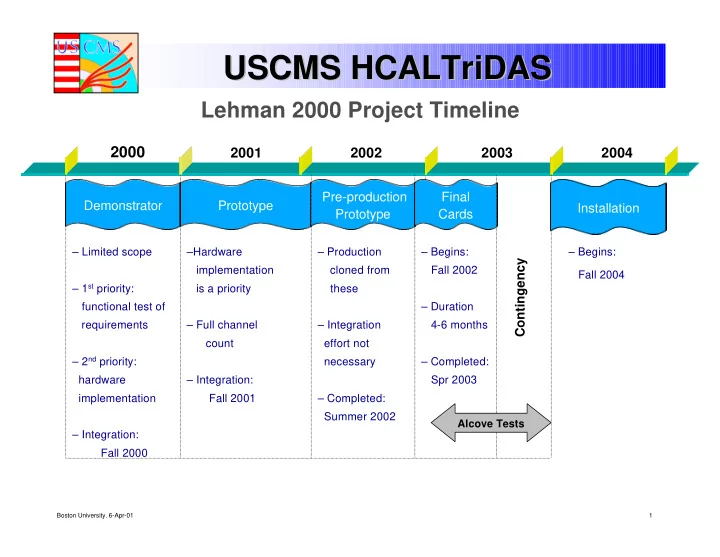
Lehman 2000 Project Timeline

2000

2001 2002 2003 2004

Demonstrator Prototype Pre-production Prototype Final Cards Installation

– Limited scope – 1st priority: functional test of requirements – 2nd priority: hardware implementation – Integration: Fall 2000 –Hardware implementation is a priority – Full channel count – Integration: Fall 2001 – Production cloned from these – Integration effort not necessary – Completed: Summer 2002 – Begins: Fall 2002 – Duration 4-6 months – Completed: Spr 2003 – Begins: Fall 2004

Contingency

Alcove Tests

slide-2
SLIDE 2

Boston University. 6-Apr-01 2

USCMS USCMS HCALTriDAS HCALTriDAS

2001 2002 2003 2004

Demonstrator Prototype

Pre- production

Final Cards Installation

– Limited scope – 1st priority: functional test of requirements – 2nd priority: hardware implementation – Integration: Fall 2000 –Hardware implementation is a priority – Full channel count – Integration: Fall 2001 – Production cloned from these – Integration effort not necessary – Completed: Summer 2002 – Begins: Fall 2002 – Duration 4-6 months – Completed: Spr 2003 – Begins: Fall 2004

Contingency

Alcove Tests

Current Project Timeline

slide-3
SLIDE 3

Boston University. 6-Apr-01 3

USCMS USCMS HCALTriDAS HCALTriDAS

Schedule Slippage

  • We are about 6 months behind relative to Lehman00
  • Deadline of production cards coming in by late 2002 is still feasible

– We will make pre-production cards sufficient for Alcove tests – Will allow us to find any bugs and maybe service any design change requests

  • What will have to be reduced?

– Prototype stage

  • Change from 1 year to 6 months

– Pre-production stage

  • Change from 1 year to 3 months

– Ongoing software/firmware development for integration/commissioning

slide-4
SLIDE 4

Boston University. 6-Apr-01 4

USCMS USCMS HCALTriDAS HCALTriDAS

Prototype/Production Phase

  • Depends a lot on what link we use

– If GLINK: “already” debugged and understood (at 40MHz)

  • Maybe also at 80MHz
  • Need to do studies (digital, analog, BER, etc)

– If NOT GLINK:

  • Need to start another board ASAP to understand new technology
  • Schedule and cost implications

– Tullio is already busy! – Not in the budget

  • Depends on 40MHz vs. 80MHz

– (or in other words, 2 chan/fiber vs. 3 chan/fiber)

  • Any other increase in tasks?

– FNAL source tests were not considered in Lehman00

slide-5
SLIDE 5

Boston University. 6-Apr-01 5

USCMS USCMS HCALTriDAS HCALTriDAS

Current Schedule Risks

  • Data transmission into HTR

– Glinks 40 vs. 80 MHz

  • 80MHz ok, but only if it works SOON

– Other technology?

  • Vitesse, Cypress, TI all make 8B/10B transceivers….

– TI’s TLK1501, does 8B/10B presenting 16 bits data @ .6 to 1.5 Gbps – Requires another I/O board to be built and debugged. – We would need to figure out how to do this. – Can be done, but we would probably need more engineering. – We would do this at UMD, NOT FNAL!

  • Production assembly line

– I did not fully appreciate the difficulty of checking out ~500 cards! – We need to plan how this is going to happen…

  • Pay some company? Probably too expensive, we don’t think this would work
  • Do it at UMD? Need to get going.
  • Do it at FNAL? Might make more sense….

– We do not yet have a plan for this but will work on it with help….

slide-6
SLIDE 6

Boston University. 6-Apr-01 6

USCMS USCMS HCALTriDAS HCALTriDAS

HTR Costs

  • Lehman estimate:

– $2.5k/card – BUT I left out the following:

  • Optical connectors and detectors for feeding deserializer chips

– What do they cost?

  • Demonstrator boards use Stratus (Methode), cost $100/pair in quantity
  • For 16 channels, this is an additional $800

– What are the alternatives?

  • e.g. Infinion (or Infinio-like) Parallel Optical Link (PAROLI)

– 12-channel connectors/detectors – 1.6 Gb/sec – Cost for ~500 Rx $476 each, 40-52 week lead time

» Today’s price, quote from AVNET

  • More and more companies are getting into this
  • Long lead times, etc, means that we need to have this decided NOW

– Certainly by this fall

$2,500 Total $500 Rx (16 @ $30 + Vitesse + LVDS…) $400 Misc (FIFOs, MUX, VME, etc.) $200 Connectors $200 Fab/Assy $200 PC Board $1,000 FPGA (4 per card)

slide-7
SLIDE 7

Boston University. 6-Apr-01 7

USCMS USCMS HCALTriDAS HCALTriDAS

HTR M&S Costs 40MHz v 80MHz

  • Lehman 00 cost estimate increases by $400/HTR card

– Still only an estimate – 25% contingency?

  • 80MHz (3 channels/fiber)

– Definitely cheaper – 12 fiber config – same cost as Lehman – 8 fiber config – much cheaper

Lehman00 $2,500 $20 $480 $400 $200 $200 $200 $1000 N/A 32 40 16fibers/ 2 chan 36 32 24 24 # Channels 9,9,9,9 (4) 8,8,8,8 (4) 9,9,6 (3) 8,8,8 (3) Channels/FPGA (# FPGA) 80 40 80 40 Frame clock (MHz) $2,100 $320 $50 $288 $400 $200 $200 $200 $450 8fibers/ 3 chan $50 $50 $50 Vitesse + LVDS… $2,600 $480 $432 $400 $200 $200 $200 $600 12 fibers/ 3 chan 16 fibers/ 2 chan 12fibers/ 2 chan Item $2,900 $640 $576 $400 $200 $200 $200 $600 $2,400 Total $480 PAROLI ($40/fiber) $432 Rx @ $36 $400 Misc (FIFOs, MUX, VME, etc.) $200 Connectors $200 Fab/Assy $200 PC Board $450 FPGA 20k400 (large uncert’s)

slide-8
SLIDE 8

Boston University. 6-Apr-01 8

USCMS USCMS HCALTriDAS HCALTriDAS

HTR Cost Comparison

  • Baseline Lehman00:

– 40MHz @ 32channel/HTR increase $200k – Costs estimates will change when we place orders!

  • FPGA, PAROLI, etc.

– 32chan/card x 18 cards = 576 chan/crate – DCC can handle?

  • Cost vs risk

– 80MHz reduces cost, increases risk, and DCC cannot handle @ 36chan/HTR – 40MHz reduces risk

  • ~$100k increase in cost over baseline (16 fibers/HTR)
  • This does NOT include FIBER CABLE PLANT COSTING!
  • Note on PAROLI:

– There may be serious implications as to how the fibers are bundled going into the HTR…

$1.94M 35 - $500k 11/30 - $200k 494 - $1.19M $2.4k 3/30 (80MHz) $2.09M 40 - $570k 12/34 - $220k 617 - $1.30M $2.1k 3/24 (80MHz) $1.74M $2.03M $2.39M Total 26 - $370k 35 - $500k 40 - $570k DCC/HRC 9/22 - $150k 413 - $1.12M $2.9k 3/36 (80 MHz) 11/30 - $200k 12/34 - $220k VME Racks/Crates 463 - $1.33M 617 - $1.58M Number of HTR $2.9k $2.4k HTR Cards 2/32 (40 MHz) 2/24 (40MHz) Item

slide-9
SLIDE 9

Boston University. 6-Apr-01 9

USCMS USCMS HCALTriDAS HCALTriDAS

“What is to be done?” – V. Lenin

  • If 40MHz Glink…
  • Will work
  • We will make our source calib, test beam, and production milestones
  • If 80MHz 8B/10B…
  • Might work but will definitely require more engineering/prototyping
  • With additional engineering we could definitely meet

– Test beam, production milestones

  • Source calib milestone? No way. But we could consider:

– Put CERN chip on HCAL front-end now. – Run as Glink for source calib using current demonstrator cards

» Means we will have to make more of these

– Switch front-end to 8B/10B for the rest of the project

  • Build HTRs with 12 fibers/3 channels per fiber
  • Might need to have more than 1 DCC per crate (additional $200k)
  • Be aware – still large contingencies for FPGA content of cost
  • We will be wasting money on HTR Glinks demonstrators

Remember…”it takes money to make money”

– but keep in mind that 80MHz means we are still in R&D. – With 40MHz we are now heading out of R&D and into prototyping and integration