
SLIDE 1
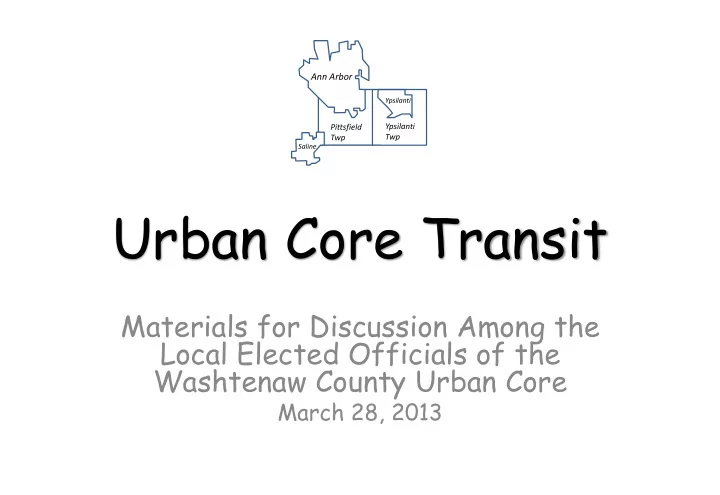
Urban Core Transit
Materials for Discussion Among the Local Elected Officials of the Washtenaw County Urban Core
March 28, 2013
Pittsfield Twp
Saline
Ann Arbor
Ypsilanti Twp
Ypsilanti
Urban Core Transit Materials for Discussion Among the Local Elected - - PowerPoint PPT Presentation
Ann Arbor Ypsilanti Ypsilanti Pittsfield Twp Twp Saline Urban Core Transit Materials for Discussion Among the Local Elected Officials of the Washtenaw County Urban Core March 28, 2013 2 Welcome and Thank You Dear Urban Core Leaders,
March 28, 2013
Pittsfield Twp
Saline
Ann Arbor
Ypsilanti Twp
Ypsilanti
2
Dear Urban Core Leaders, Thank you for your commitment to finding a regional solution to the growing transit needs in the Greater Ann Arbor Area. We hope you found the initial meetings with your peer elected
happy to facilitate these meetings and provide a forum for discussion of transit issues in the Urban Core. The attached package of information encapsulates several ‘themes’ or scenarios that have been set forth during these
to different sets of needs that were expressed to us by local elected officials and their constituents. This is not a proposal; it is offered as a structured way to facilitate discussion, and decisions, among local elected officials seeking to address important public transit issues. We hope this will be useful as you prepare for the Urban Core Transit Meeting on March 28th. The document describes each theme in terms of services included, their financial implications, and the benefits they can provide to the region and to individual communities. The document also contains answers to the many questions we have heard, in meetings with and among elected leaders over the past couple months. These are in the form of a simple, concise “Sidebars” section, with a table of contents to help you find the questions and answers that are most important to you. When we meet on March 28th, we hope the participants can come to a consensus on a vision for service that we can then detail in preparation for the next question: How do we get there? We are grateful to Mandy Grewal and Pittsfield Township for hosting this event at their township hall at 6201 W. Michigan Avenue (corner of Michigan Ave. and Platt Road.) We look forward to seeing you all on Thursday, March 28th at 5:00 p.m. Sincere thanks, Michael Ford, CEO Ann Arbor Transportation Authority
Alternative Dispute Resolution (5 minutes)
3/26/2013 4
3/26/2013 5
(Problem Statement)
travel needs?
within the existing service footprint?
growing areas?
3/26/2013 6
Sustain Improve Expand
Improve & Expand
Township POSA Services
Ypsilanti Township and Pittsfield Township
Townships
New Annual Funding Needs - 2019
$180K (Ypsilanti - $160K)
New Annual Funding Needs - 2019
$2.8 M
New Annual Funding Needs - 2019
$3.6 M
New Annual Funding Needs - 2019
$5.4M
Travel Needs Met
Providing 6.6M fixed route bus trips, and 167K dial-a-ride trips annually on services in Ann Arbor, Ypsilanti, Ypsilanti Township, Pittsfield Township and selected other communities.
Travel Needs Met
Addt’l Trips Served (2020): 501K Addtl’ Households within 1/4 mile Total: 9,540 Seniors: 883 Low Income: 960
Travel Needs Met
Addt’l Trips Served (2020): 1.5M Addt’l Households within 1/4 mile Total: 21,125 Seniors: 1,459 Low Income: 2350
Travel Needs Met
Addt’l Trips Served (2020): 1.67M
3/26/2013 7
Pittsfield Twp
Saline
Ann Arbor
Ypsilanti Twp
Ypsilanti
Pittsfield Twp
Saline
Ann Arbor
Ypsilanti Twp
Ypsilanti
Pittsfield Twp
Saline
Ann Arbor
Ypsilanti Twp
Ypsilanti
Pittsfield Twp
Saline
Ann Arbor
Ypsilanti Twp
Ypsilanti
Maintain existing services so our current riders won’t lose needed travel options Enhance services within the existing AATA footprint to provide more travel
Extend services into new areas where population and employment growth needs transit support. Continue the evolution of the transit system by enhancing the existing network and connecting it to the areas of new growth.
POSA partners.
expanded into Ypsilanti, Ypsilanti Township and Pittsfield Township and there remains unsatisfied need for the service.
3/26/2013 8
Pittsfield Twp
Saline
Ann Arbor
Ypsilanti Twp
Ypsilanti
Route #4 Improvements
New Routes, More Direct Service
Route 8 Pauline: More frequent peak, extended hours Route 9 Jackson becomes two new routes (B, C), providing greater coverage, extended hours and improved evening frequency Route 12 Miller/Liberty becomes 3 new routes (A, D, G) providing greater coverage and extended hours Route 15 Scio Church/W Stadium becomes 2 new routes (E, F) providing greater coverage, extended hours and improved midday frequency 16 Ann Arbor-Saline and 17 Amtrak-Depot St: Extended hours
3/26/2013 9
Pittsfield Twp
Saline
Ann Arbor
Ypsilanti Twp
Ypsilanti
Improve Ann Arbor (west)
Includes ‘budget neutral’ (see p. 23) services: Ann Arbor Circulator (not shown), Chelsea Express, Canton Express All improved and expanded services include corresponding expansions of ADA dial-ride services.
Improve Interurban (Ann Arbor Pittsfield Ypsi Twp Ypsilanti)
Better Crosstown Connections
Routes 1 Pontiac-DhuVarren: Extended hours Route 3 Plymouth: More direct, extended hours Route 4 Washtenaw: More frequent all day long, extended hours Route 5 Packard: More frequent evenings, extended hours Route 6 Ellsworth: More frequent peak, extended hours Route 22 North-South: Extended hours
3/26/2013 10
Pittsfield Twp
Saline
Ann Arbor
Ypsilanti Twp
Ypsilanti
All improved and expanded services include corresponding expansions of ADA dial-ride services.
Improve Ypsilanti and Ypsilanti Township
New Routes, More Frequent Service, More Direct Service, Weekend Service, Increased Evening Service
Routes 10 (Ypsilanti NE), 11 (Ypsilanti S) and 20 (Grove- Ecorse) become 7 new routes (I, J, K, L, M, N, O).
3/26/2013 11
Pittsfield Twp
Saline
Ann Arbor
Ypsilanti Twp
Ypsilanti
All improved and expanded services include corresponding expansions of ADA dial-ride services.
3/26/2013 12
Service Frequency (buses/hour) – Weekday Peak – Existing System
Pittsfield Twp
Saline
Ann Arbor
Ypsilanti Twp
Ypsilanti
3/26/2013 13
Service Frequency (buses/hour) – Weekday Peak – Improved System
Pittsfield Twp
Saline
Ann Arbor
Ypsilanti Twp
Ypsilanti
3/26/2013 14
Service Frequency (buses/hour) – Weekday Evening – Existing System
Pittsfield Twp
Saline
Ann Arbor
Ypsilanti Twp
Ypsilanti
3/26/2013 15
Service Frequency (buses/hour) – Weekday Evening – Improved System
Pittsfield Twp
Saline
Ann Arbor
Ypsilanti Twp
Ypsilanti
residential areas, commercial areas, the Library and Ypsilanti Civic Center.
downtown Ann Arbor and University of Michigan
Huron St and I-94
services for seniors, people with disabilities, and the general public, including connections to neighboring communities
3/26/2013 16
Pittsfield Twp
Saline
Ann Arbor
Ypsilanti Twp
Ypsilanti
All improved and expanded services include corresponding expansions of ADA dial-ride services.
3/26/2013 17
Pittsfield Twp
Saline
Ann Arbor
Ypsilanti Twp
Ypsilanti
Includes ‘budget neutral’ (see p. 23) service: Saline Circulator (S)
residential areas, downtown Saline, Briarwood, Walmart, Meijers, Pittsfield Twp offices and others.
downtown Ann Arbor and University
Walmart and vicinity of Carpenter Rd and I-94
for seniors, people with disabilities, and the general public, including connections to neighboring communities
All improved and expanded services include corresponding expansions of ADA dial-ride services.
City of Ann Arbor City of Ypsilanti Ypsilanti Township Pittsfield Township City of Saline
Sustain <-------------------------- $180 -----------------------------> Improve 2,355 296 100 88 Expand 2,614 473 338 162 17 Expand & Improve 4,061 694 497 209 24
New Net Costs ($000’s), by Community, 2019 (Service Costs Allocated based on Service Hours) City of Ann Arbor City of Ypsilanti Ypsilanti Township Pittsfield Township City of Saline
Sustain <-------------------------- $180 -----------------------------> Improve 1,461 249 684 444 Expand 1,784 304 835 543 138 Expand & Improve 2,716 463 1,272 826 210 New Net Costs($000’s), by Community, 2019 (Service Costs Allocated based on Population)
3/26/2013 18
Improve
Pittsfield Twp
Saline
Ann Arbor
Ypsilanti Twp
Ypsilanti
Expand
Pittsfield Twp
Saline
Ann Arbor
Ypsilanti Twp
Ypsilanti
Improve & Expand
Pittsfield Twp
Saline
Ann Arbor
Ypsilanti Twp
Ypsilanti
Service Hours Population
Distribution of Costs Among Jurisdictions – Different Approaches Create Different Results
3/26/2013 19
$2.8 M $3.6 M $5.4M
All Households
City of Ann Arbor City of Ypsilanti Ypsilanti Township Pittsfield Township City of Saline TOTAL
Improve 158* 0* 921 15 10,387 Expand 158* 0* 7,632 10,252 7,319 25,203
Additional Households Within ½ Mile of a Route - Weekdays Senior Citizens
City of Ann Arbor City of Ypsilanti Ypsilanti Township Pittsfield Township City of Saline TOTAL
Improve 20* 0* 64 1 1,321 Expand 20* 0* 425 668 1,076 2,169
Low Income
City of Ann Arbor City of Ypsilanti Ypsilanti Township Pittsfield Township City of Saline TOTAL
Improve 16* 0* 185 1 669 Expand 16* 0* 1,218 589 367 2,174
3/26/2013 20
Numbers for Ann Arbor and Ypsilanti are low because most service improvements in these locations are related to improved bus frequency and time of day rather than geographic coverage. See pages 12 – 15 for depictions of how bus frequency increases for the “Improve” and “Expand” scenarios. For a graphical depiction of this information, see the Appendix “Buffer Maps”.
All Households
City of Ann Arbor City of Ypsilanti Ypsilanti Township Pittsfield Township City of Saline TOTAL
Improve 1,693 1,316 11,995 15 15,019 Expand 1,693 1,316 18,706 6,742 28,457
Additional Households Within ½ Mile of a Route - - Sat, Sun or Both Senior Citizens
City of Ann Arbor City of Ypsilanti Ypsilanti Township Pittsfield Township City of Saline TOTAL
Improve 367 82 1,199 1 1,649 Expand 367 82 1,560 334 2,343
Low Income
City of Ann Arbor City of Ypsilanti Ypsilanti Township Pittsfield Township City of Saline TOTAL
Improve 176 422 2,632 1 3,231 Expand 176 422 3,665 380 4,643
3/26/2013 21
Numbers for Ann Arbor and Ypsilanti are low because most service improvements in these locations are related to improved bus frequency and time of day rather than geographic coverage. See pages 12 – 15 for depictions of how bus frequency increases for the “Improve” and “Expand” scenarios. For a graphical depiction of this information, see the Appendix “Buffer Maps”.
– Scio Township – service extensions – Ann Arbor Township – service
extensions, dial-a-ride services
– Superior Township – new local route,
dial-a-ride services
– Village of Dexter – new ExpressRide – City of Chelsea – preserve ExpressRide – Canton Township – preserve ExpressRide – City of Saline – create Circulator – City of Ann Arbor – create Circulator
Washtenaw Communities
AirRide, Detroit & other SE MI links
3/26/2013 22
– A way for communities to initiate participation in the regional system – For newer partners or those with less developed service – Still can be used for existing POSA partners if participation in a regional
– “Budget Neutral” relative to a millage- funded authority, that is, participants’ funding equals cost of service – Creates opportunities for combining private, institutional, and public funding to share costs commensurate with benefits
Urban Core Transit
As we discuss the fundamental issue of what we will choose as our theme for Urban Core Transit (Sustain / Improve / Expand), there are many other issues that people ask about or have opinions on. We have assembled short ‘sidebar’ discussions of the issues most frequently raised and included them in the following sections.
3/26/2013 23
I. Planning Principles
1. Goals and Objectives, pg. 26 2. Key Transit Issues, pg. 27
II. Transit Network Design
3/26/2013 24
3/26/2013 25
The key principles governing the creation of the Countywide Transit Master Plan have been carried forward into the current efforts that more closely focus
Plan, entitled as follows: The “Shared Community Visioning Report”, published in October, 2010; and “The Transit Audit and Needs Assessment”, published November, 2010. Materials from each report are reproduced below.
Goals and objectives were derived through a review of nearly 50 plans prepared by
(from the “Transit Audit and Needs Assessment Report”)
We have distilled the specific needs identified in this assessment into five overarching transportation issues in Washtenaw County. Addressing these issues will be essential to the improvement of transit service in the coming years. Each of the five issues is discussed in detail below. Insufficient access to lifeline destinations Limited access to vital destinations, such as grocery stores and medical facilities, can have serious health implications. This is especially relevant in low-income areas and areas with large senior and disabled
represent key employers. Limited accessibility of these destinations creates a barrier between transit-dependent residents and desirable jobs, which is a negative for both residents and employers. Accessibility of lifeline destinations within the City of Ann Arbor, which contains approximately a third of Washtenaw County residents, is fairly
Arbor and Ypsilanti have no fixed-route service providing access to grocery stores, medical offices, and other essential destinations. Demand-responsive service is available in many of the outer cities and villages, but is generally limited to certain groups, and offers service to a limited set of destinations. The majority of the 6% of County residents that live in the City of Ypsilanti have service to most lifeline 3/26/2013 26 destinations during weekdays, but very limited service at night and on weekends. If transit access to key destinations continues to be limited, it is likely that the existing income gaps between different parts of the County will widen, as areas with limited access will continue to be seen as undesirable places to live and work. Increasing road congestion As the demand for travel across Washtenaw County increases, roads in the area are expected to become significantly more congested, increasing trip lengths for all road users. SEMCOG forecasts that in Ann Arbor, population will increase by 1.1% from 2010 to 2035, while employment will increase by 13.3%, indicating that an increasing number of people will be traveling to and within Ann Arbor for work. Among the most prominent corridors/areas of expected congestion growth are I-94 west of Ann Arbor, US 23 north of Ann Arbor, Michigan Avenue between Saline and Ypsilanti, many of the corridors between Ann Arbor and Ypsilanti, and Western Ann Arbor. Many of these are key travel corridors, and if increasing congestion is not addressed, connectivity throughout the County will suffer considerably. Unchecked increases in congestion will also drive dispersed development, particularly of employment locations, and have a negative impact on economic efficiency.
Lack of transit connectivity throughout the County Currently, connections between the cities and villages of Ann Arbor, Ypsilanti, Chelsea, Dexter, Manchester, Saline, and Milan are very limited. Improved connectivity will allow outer cities and villages to strengthen economic ties with each other and with Ann Arbor and Ypsilanti and make it easier for these locations to market themselves as ‘destinations.‘ This will support the development of the regional economy. On the other hand, if connectivity does not improve, many residents of the outer cities and villages will remain isolated from other activity centers in the County. Of the outer cities and villages in Washtenaw County, only Chelsea and Dexter are currently connected to Ann Arbor by fixed-route transit. Manchester, Milan, and Saline are currently not served by any fixed-route
generally limited to certain groups, and offers service to a limited set of
riders valued transit service outside of Ann Arbor-Ypsilanti as ―very important‖ or ―of some importance.‖ Increasing mobility needs due to an aging population Seniors 65 and above currently make up 9% of Washtenaw County‘s population, and seniors over the age of 85 account for 1% of County
approximately 23% of the population, and the population over the age of 85 is expected to grow considerably. As the population ages and seniors become more dispersed throughout the region, there will an increasing need for transportation options for this market segment, in order to maintain individuals‘ current standards of living. 3/26/2013 27 As drivers age, vision loss, hearing loss, reduced reaction times, as well as more serious conditions such as dementia frequently detract from the ability to safely drive a car. According to the National Institute on Aging, more than 600,000 American seniors stop driving every year; at this point, these seniors are completely dependent on others for their transportation
transportation, it can play a major role in allowing seniors to maintain a sense of independence and social connections with others. Transit can increase its appeal to choice riders Among the additional benefits of improving transit service, and in turn attracting more riders, are increased safety and positive environmental
private autos. As a result, fewer crashes result when more people opt to take transit instead of driving. In addition, efficiently run bus service produces fewer emissions per passenger trip than private autos. To the extent travelers choose to use TheRide instead of driving, the negative environmental impacts of transportation in the County will be reduced. Auto trips may often have a significant travel time advantage over transit
things such as reading or napping.
“I’ve driven all my life; what will I do if I can’t?”
Additionally, route, schedule, and fare information can be challenging to find or to understand, making it difficult for new or infrequent riders to feel comfortable trying the service. Potential choice riders can also be discouraged by many other factors such as comfort, safety, and security. According to the 2009 AATA Onboard Survey, 37% of TheRide riders own
increase its share of these choice riders, it will need to make improvements in these areas to make transit more competitive with private auto. 3/26/2013 28
To appeal to choice riders, AATA (TheRide) has introduce a wide variety of services aimed at specialized markets.
1. TWO TYPES OF TRANSIT SERVICES Comprehensive Transit Services A primary mission of the Ann Arbor Transportation Authority since its inception has been to provide bus service for people who don’t drive. This includes seniors, youth, people with disabilities, low-income persons, and
Transit is the primary means of transportation for many people, and transit service needs to be comprehensive to meet their needs to get to and from work, school, medical appointments, shopping, and many other activities. For people who depend on transit, service is needed throughout the area, and at a broad range of times. The basic structure of AATA’s routes was designed to meet these comprehensive needs. It is a “pulse” system with coordinated connections at central points. That is, many routes converge at the transit center in downtown Ann Arbor with buses from most routes scheduled to meet at the same time (there are also timed connections at downtown Ypsilanti, Briarwood Mall, across from Arborland, and Meijer on Carpenter). This type
population because it distributes trips efficiently. It makes it possible for a person can get from nearly anywhere in Ann Arbor to anywhere else in Ann Arbor with a travel time of no more than 45 minutes. This is generally true, even evenings and weekends when most routes only operate once every 60 minutes. The most recent review of the system was done in a study undertaken in 2007 by transportation consultant Parsons Brinckerhoff at the behest of AATA, the City of Ann Arbor, the Ann Arbor Downtown Development Authority, and others. The analysis concluded that the current network design was most appropriate to the travel and geographical conditions of the service area, and that pursuit of a grid system is not recommended. 3/26/2013 29 Convenient Transit Services Increasingly, the AATA’s bus service has been asked to help to reduce the growth in traffic congestion and parking demand in Ann Arbor. This requires different service. Traffic congestion is concentrated during weekdays, particularly in peak commute hours. Frequent, direct (i.e. without transferring) service is required to induce people to choose to use the bus when they have the option to drive and park. In addition, use of bus service is largely dependent on external factors, particularly the supply and price of parking. In Ann Arbor, this means that the opportunity for AATA to attract commuters is primarily downtown and the U of M campus where parking is limited and commuters have to pay to park. Since 1993, the AATA has added a significant amount of service designed to serve this “choice” market, and much of the 57% increase in the number of riders over the last ten years has come from this market. In AATA’s 2011 survey of bus passengers, 37% of riders reported that they could have driven, which is up from 18% in the 1998 survey. This increase is the result
employers such as the University of Michigan, and downtown Ann Arbor with the AATA’s getDowntown Program. Even with this growth, the share of the commuter market served by AATA is relatively small. About 5-8% of all trips during peak-hours are taken by
characteristics of highway traffic flow are such that a shift in a relatively small proportion of peak-period trips can lead to substantial reductions in
Transportation Research Board, 2003). The AATA is continuing its efforts to attract commuters through promotional efforts, park and rides, VanRide, ExpressRide, and cooperative ventures with employers, universities and government agencies. At the same time, we are continuing our commitment to provide comprehensive service for people who depend upon bus service to meet their daily needs.
3/26/2013 30
“HUB-AND-SPOKE VS. GRID SYSTEM” Excepted from Jarrett Walker’s blog Human Transit http://www.humantransit.org/2009/04/why-transferring-is-good-for-you- and-good-for-your-city.html To complete your trip in a world-class transit system, you may have to make a connection, or "transfer" as Americans say. That is, you may have to get off one transit vehicle and onto another. You probably don't like doing this, but if you demand no-transfer service, as many people do, you may be demanding a mediocre network for your city. There are several reasons for this, but let's start with the most selfish one: your travel time. Imagine a simple city that has three primary residential areas, along the top in this diagram, and three primary activities of employment or activity, along the bottom. In designing a network for this city, the first impulse is to try to run direct service from each residential area to each activity center. If we have three
Suppose that we can afford to run each line every 30 minutes. Call this the Direct Service Option. Now consider another way of serving this simple city for the same cost. Instead of running a direct line between every residential area and every activity center, we run a direct line from each residential area to one activity center, but we make sure that all the resulting lines connect with each other at a strategic point. Now we have three lines instead of nine, so we can run each line three times as often at the same total cost as the Direct Service option. So instead of service every 30 minutes, we have service every 10 minutes. Let's call this the Connective Option. Asking people to "transfer" is politically unpopular, so the Direct Service option is the politically safe solution, but if we want to maximize mobility with our fixed budget, we should prefer the Connective option.
The Connective Network is faster, even though it imposes a connection, because of the much higher frequencies that it can offer for the same total budget. As cities grow, the travel time advantages of the Connective Network
residential areas and three activity centers, we had six of each. In this case, the direct-service network would have 36 routes, while the connective network would have only six. You can run the numbers yourself, but the answer is that the Direct Service network still takes 35 minutes, while the Connective network is down to only 25 minutes, because of the added frequency. Other Advantages of Connective Networks Several factors support Connective networks over Direct Service networks.
Average travel time is better than the worst-case time calculated
a 30-minute trip, but one-third of the market (those still served by a direct route) has an even faster trip.
The Connective network is made
more frequent
stimulates ridership directly, especially when we consider the needs of people who have to make several trips in a day, or who want to travel spontaneously, and who therefore need to know that service is there whenever they need it.
The Connective network is simpler. A network of three frequent lines is much easier to remember than a network of nine infrequent ones. Marketing frequent lines as a Frequent Network can enhance the ridership benefits of this simplicity. 3/26/2013 31 Most transit networks start out as Direct Service networks with relatively little focus on connections, but as the city grows bigger and more complex, connections become more important. In most cases, though, there’s a transition from a Direct Service network to a Connective one, a transition that often requires severing direct links that people are used to in order to create a connection-based structure
More information on adding a new route: http://www.humantransit.org/07box.html
How do I benefit from services provided in other communities? Why should my community pay for services used by people who live in other communities? Many services cross community boundaries, and the cost for such service is not easily broken down and assigned to each community. AATA’s Route #4 Washtenaw travels through two cities (Ann Arbor and Ypsilanti) and two townships (Pittsfield and Ypsilanti). Services often provide benefit to the ‘destination’ location as well as the ‘residence’ location. AATA’s Chelsea Express service attracts residents from Chelsea, Grass Lake, Manchester and
parking spaces. The more people that come into town without a car, the fewer parking spaces at up to $50,000 per space – that are needed. When transit brings people into a community from other areas, it boosts the local economy. Employers gain access to workers, schools gain access to students, and businesses benefit from purchases made by visitors and commuters. When one community pays for the services used by residents of another community, it is
25,000 commuters daily into Washtenaw County where those workers consume roadway, transit and parking resources. But Washtenaw Co sends about 17,000 commuters daily into Wayne Co. By 2035, 670,000 trips daily will end in Ann Arbor. Nearly one-third of those will come from neighboring communities. Washtenaw County maintains its economic strength, in part, by drawing commuters into the county from other areas.
3/26/2013 32
A company like Zingerman’s depends on a wide reach to get its employees to work (below is a map showing Zingerman downtown employee origins by zip codes. Currently, many more people commute in to Ann Arbor’s central area than commute out. (SOURCE: Connecting Williams Street Market Study) The University of Michigan attracts thousands of employees daily into Ann Arbor from all over Southeast Michigan. 3/26/2013 33
In Michigan there are a few, but limited local options to fund transit through the transit agency (property tax, raising fares, and bonds for capital projects). Local governments may use several options for raising funds as enabled by the state: general funds, property taxes, employment taxes, etc.). During the past few years the Federal and State Transit funding has remained untouched through the budget cuts. The Board of AATA approved a policy to retain a three month new assets program that will ensure a minimum safety net of our existing and future operating budgets for up to three months. As the Federal and State budgets become increasingly unpredictable and the expiration of Federal Programs, such as earmarks for transit, and Map 21 (current transit funding program), the leadership that AATA’s Board has taken to place safeguards into our budget process will ensure the continued responsible spending of the Public’s Funds on the transit needs for our community’s future. For a detailed analysis of how transit is funded, please see Todd Litman’s Local Funding Options for Public Transportation which can be found here: http://www.vtpi.org/tranfund.pdf. Funding Options for Sustaining, Improving or Expanding Urban Core Transit Questions: What funding sources are available to pay for improvements to, or expansion of, the urban core transit system? What is available now? Why not wait for some of the funding sources we have been hearing about, like the RTA? These options describe future State Budget Amendment opportunities for the transit industry. With each example there are timing issues related to how quickly funds may be available for use by a transit
to become law and/ or a majority vote of local residents.
1. HOW TRANSIT IS FUNDED In Michigan, local funding provides the basis for transit service. State and Federal funds match local dollars and riders pay fares to use the services offered. Therefore, local funding is the primary determinant of the level and quality of transit services. Sufficient and consistent funding allows a local transit system to develop and flourish. Increased funding allows for improvement of services. Inconsistent funding results in an inconsistent system and does not allow for longer-term investments and growth of ridership. The Ann Arbor area has been exceptionally fortunate with constant local support for transit, allowing AATA to offer a wide variety of services at a high level. For every dollar spent on AATA transit, approximately: 33% is from local millages or Purchase of service agreements (POSA’s) 30% is from State Operating Assistance 19% is from fares or 3rd party payment of fares 15% is from Federal sources 3% is from advertising and other sources The Capital funding needed for purchasing buses, facilities, and equipment is a blend of 80% Federal grant funding and 20% State Matching Funds. How to fund transit improvements Local funding: Sustained improvements in service like increased frequencies and expanded night and weekend hours require local
by federal Congestion Mitigation and Air Quality grants, but require local funding to continue. 3/26/2013 34
Funding Option Local Amount (AATA) Action Needed Readiness Local Millage levies under Act 55 or Act 196
Dedicated Transit Tax Ballot measure in the affected area(s) and a majority in favor No legislation or constitutional action required. Can be put in place within months of local decision.
General Fund
Discretionary Local Board Approval No legislation or constitutional action required. Can be put in place within months of local decision.
Passenger Fares
Fare change increment which may reduce ridership AATA Board Approval and Public Input No legislation or constitutional action required. Can be put in place within months of local decision.
The following measures are all options proposed within the Governor’s 2014 budget. ALL would require legislative approval first, then additional action as specified. Wholesale Gas Tax Increase - $0.19 cents per gallon
The Local Bus Operating Assistance Program would rise to approximately $181 million for distribution to all Local Bus Operators per MDOT Formula. This would bring additional funds to AATA of approximately $1 million Change to the Constitution of Michigan which in turn requires approval of Statewide ballot vote. Proposed as part of the Governor’s 2014 Budget One year to ramp up before fees could be dispersed to AATA
Sales Tax - 2% increase to all items but food and beverage
The Local Bus Operating Assistance Program would rise to approximately $181 million for distribution to all Local Bus Operators per MDOT Formula. This would bring additional funds to AATA of approximately $1 million Change to the Constitution of Michigan. Approval of Statewide ballot vote. Proposed as part of the Budget Would take two years to ramp up before fees could be dispersed to AATA.
Motor Vehicle Increase – Statewide for all vehicles
The Local Bus Operating Assistance Program would rise to approximately $181 million for distribution to all Local Bus Operators per MDOT Formula. This would bring additional funds to AATA of approximately $1 million Twelve month ramp up in Secretary of State Offices in order change the computer system to collect the extra fees and a process to distribute to each County. Legislative Concept
3/26/2013 35
Legislation in late 2012 created a Regional Transportation Authority, with limited ability to raise revenue. The RTA-related options are listed below: RTA Area Wide Millage
Unknown as this depends on the RTA millage level requested The RTA Board would have to meet and will have to approve a millage request Ballot measure in the 4-county area and a majority in favor Legislative Concept
Motor Vehicle Fee
If this was approved by the voters within the RTA Area then Washtenaw County may contribute approximately $7.5 million In which the RTA Board would have control over the distribution to AATA The RTA Board would have to meet and will have to approve a millage request Ballot measure in the 4-county area and a majority in favor Legislative Concept
NOTE: A person who gets on the #10 route in Ypsilanti Township, and transfers to the #4 route at the Ypsilanti Transit Center is counted as one passenger boarding in each jurisdiction
Expenses:
Revenues: 1. Total Cost of Service is then Multiplied by the Federal and State Percentages 2. Passenger Fares 3. Total Cost: (Federal Operating Ratio + State Operating Ratio + Passenger Fares) = Revenue Subtotal Local Share:
The existing Purchase of Service Agreements (POSA) duration is limited to an annual agreement for each community. These agreements are assumed to end or be replaced with another funding mechanism. This mechanism could be a longer duration POSA, new general fund contribution for longer deration, or a local
developing a successful route is a three year introductory process. This ensures consistent ridership, route adjustments and timing to ensure long term sustainability of the route. In the future, AATA requests that future POSA agreements are signed for a Three Year Period in keeping with industry standards.
Currently the AATA has Purchase of Service Agreements (POSA’s) with the City of Ypsilanti, Pittsfield Township, Superior Township, and Ypsilanti Township. Some of these agreements have existed for more than thirty years. Over the years as our service has changed so has the cost of the agreements. The Service Hour basic method for calculating the POSA rate has remained constant since the beginning of POSA
through a community. Starting with the Service Hours the calculation is run through the following items:
distributed by the Federal and State distribution formula, otherwise known as Formula Funds. The formula funds are a percentage to offset the cost of
not operate the route. As of 2013 the State Operating Ratio is 30.65% and the Federal Ratio is 15%.
bus, by route and location. We use this to determine the annual ridership by
the number of boardings for the jurisdiction is multiplied by the average fare per passenger.
fare because of discount fares (passes, half fare for k-12 students and low- income persons, and free for seniors and people with disabilities) and transfers. A rider who pays a $1.50 fare and transfers to a second route is paying $0.75 to each route.
3/26/2013 36
costs since 2007. In addition, over the past five years, AATA has managed the ever increasing and volatile price of diesel fuel by participating in the fuel futures market and saving an additional $500,000. Other Cost Saving Measures: In 2010, we began the process to increase the hiring of part-time Motor Coach Operators, switched from traditional phone service to Voice-Over Internet Protocol (VOIP), changed to a more cost effective health care plan, switched from #1 ultra-low sulfur bio-diesel (10%) to #2 ultra-low sulfur bio-diesel (20%) and upgraded our energy management system to control facility natural gas and electricity costs. Over the five years (2003-2008), TheRide’s cost-saving measures represented a mere 1.4% annual increase in fixed route service costs at a time when most of our peer transit agencies in our own state and across the country were seeing average cost increases of four percent.
Higher costs for goods and services resulting from inflationary pressures in addition to declining state eligible operating revenue and lower property tax collections have been an ongoing challenge for a number of
measures and seeking out alternate revenue sources in order to maintain the level of service provided to the communities it serves each and every day. Wages, Employee Benefits and Legacy Costs: The AATA pension plan has always been a defined contribution plan. The AATA has no unfunded liabilities. In 2007, AATA addressed its legacy costs by converting its defined benefit post-retirement health care benefit plan into a defined contribution health care savings plan and front loaded much of the future costs. This lowered the unfunded liability by $8 million from $10 million to $2 million. Even though health care costs have increased by an average of 10-12% each year since 1999, management employees pay 20% of the health care premiums and members of the labor union pay 10% now and will pay 20% of the health care premiums by 2016. This represents an annual savings of $270,000. In 2012, AATA instituted a wage freeze for all non-union employees and increased their contributions to healthcare from 10% to 20% for an estimated savings $130,000 Fuel Savings: The cost of diesel fuel has increased over 500% since 1998. By purchasing hybrid electric vehicles, AATA has been able to save $1.1 million on fuel 3/26/2013 37
INITIATIVES: NATIONAL, STATE, LOCAL
The Center for Transportation Excellence reviewed and analyzed transportation ballot measures over the period 2000–2005 in its report titled Transportation Finance at the Ballot Box; Voters Support Increased Investment & Choice. According to the authors, approval rates for transportation measures hit 80 percent in 2004 and 2005. Early indications for 2006 suggested that this trend was to accelerate with several significant measures already approved in primary elections the year the report came out and 40 or more measures slated for consideration that fall. In the six elections reviewed in the report, voters in 33 states had approved 70 percent of all transportation measures generating funding conservatively estimated in excess of $70 billion. The use of property taxes has been particularly widespread in portions of the
various Michigan counties. Twelve of the fourteen measures were successful. In the first half of 2006, four additional Michigan counties had announced plans for a transportation property tax vote. Property tax measures have the highest victory rate of any financing type. From 2000-2005, more than 80 percent of all property tax measures related to transportation were winners at the ballot box. From 2000 to 2005, no ballot measure increasing an existing property tax for transportation has been defeated, and only one property tax extension measure has gone down to defeat.
3/26/2013 38
As you jump ahead to the past three years, you will find that transportation ballot measures continue to be very successful in Michigan. In 2010 there were 21 transit ballot measures with 19 of them winning voter approval (90% success rate.) Of these initiatives, three were new millages, 14 were renewals and four were increases in existing transit millages. In 2011 there were 12 transportation ballot initiatives with 11 out of 12 initiatives passing (91% success rate.) These measures were all property tax millages. Out of the 12 measures, one was a new transit millage, seven were renewals of transit millages and four were for increased transit funding. In 2012 the number and success of transportation ballot measures jump dramatically to 33 with 32 initiatives passing (97% success rate.) Of these 33 ballot initiatives, seven were new transit millages, 16 were renewals, six were increases in transit funding, three were reinstatements of transit funding and one was to end access to transit services. Data supplied by the Center for Transportation Excellence. For more information, please click here: www.cfte.org.
The following service is "very" or 'somewhat" important Defined Area Communities Included Respondents who say Public Transit is Important Favorable view of TheRide People who use or family uses public transit in the past year Residents who support a 1-mill property tax to fund countywide transit Dial- A-Ride New Dial-a- Ride Plus More frequency, nights, weekends in the cities Express service to/from Park-and- Ride Real- time bus info. AirRide Service City of Ann Arbor City of Ann Arbor 80% 91% 66% 72% 87% 86% 84% 84% 81% 81% Pittsfield and Ypsilanti Ypsilanti, Ypsilanti Township and Pittsfield Township 80% 90% 40% 61% 89% 85% 84% 82% 79% 74% City of Saline and Eastern Townships City of Saline, Village
Townships of Augusta, York, Saline, Lodi, Scio, Webster, Northfield, Ann Arbor, Salem and Superior 60% 87% 26% 53% 85% 79% 78% 75% 75% 71%
3/26/2013 39
SOURCE: A COMMUNITY ATTITUDE SURVEY OF WASHTENAW COUNTY VOTERS REGARDING AATA - Survey Conducted - November 2011
Urban Core Transit
3/26/2013 40
3/26/2013 41 Buffer maps depict the number of households within a certain distance of a transit line and can be used as one good measure of how changes in the transit system produce benefits for more people. In the maps below, we have shown the number of households within ¼, ½ and 1 mile of the nearest transit line. By comparing the two maps, it is possible to discern visually how an expanded system might provide higher accessibility and mobility for greater numbers of people.
3/26/2013 42 Buffer maps depict the number of households within a certain distance of a transit line and can be used as one good measure of how changes in the transit system produce benefits for more people. In the maps below, we have shown the number of households within ¼, ½ and 1 mile of the nearest transit line. By comparing the two maps, it is possible to discern visually how an expanded system might provide higher accessibility and mobility for greater numbers of people.
Themes (Scenarios) rev 3-26-13 DISTRIBUTION COPY.pptx