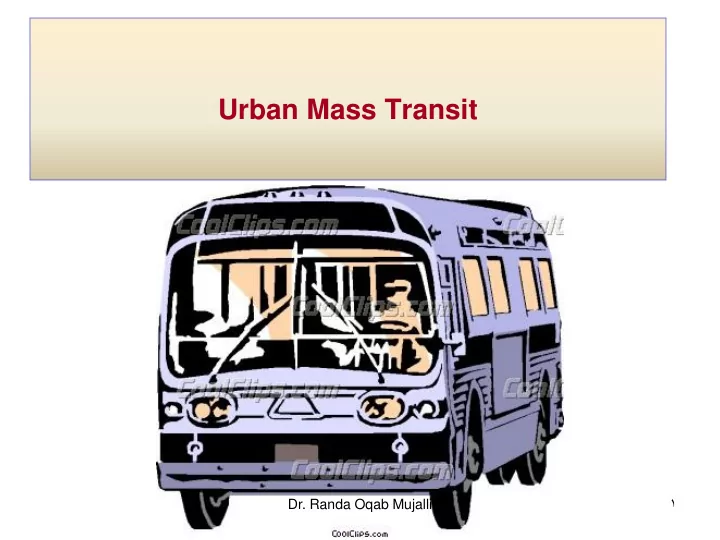
Urban Mass Transit 1 Dr. Randa Oqab Mujalli Most Recent Urban - - PowerPoint PPT Presentation

urban mass transit
SMART_READER_LITE
LIVE PREVIEW

Urban Mass Transit 1 Dr. Randa Oqab Mujalli Most Recent Urban - - PowerPoint PPT Presentation

Urban Mass Transit 1 Dr. Randa Oqab Mujalli Most Recent Urban Public Transport Systems 2 Bus Rapid Transit (BRT) 1 Articulated Bus 4 Metro 3 Light Rail Transit (LRT) Dr. Randa Oqab Mujalli 2 Advantages of mass Transit: 1.


slide-1
SLIDE 1

1

Urban Mass Transit

  • Dr. Randa Oqab Mujalli
slide-2
SLIDE 2

Most Recent Urban Public Transport Systems

1 – Articulated Bus 2 – Bus Rapid Transit (BRT) 3 – Light Rail Transit (LRT) 4 – Metro

2

  • Dr. Randa Oqab Mujalli
slide-3
SLIDE 3

3

Advantages of mass Transit: 1. High capacity 2. Energy efficiency 3. Less pollution 4. Reduce congestion 5. Lower cost

  • Dr. Randa Oqab Mujalli
slide-4
SLIDE 4

4

System Classification: A. By Route Type: 1. Cross town 2. Radial 3. Circumferential 4. Grid

  • Dr. Randa Oqab Mujalli
slide-5
SLIDE 5
  • Dr. Randa Oqab Mujalli

5

slide-6
SLIDE 6

6

B. By Service: 1. Residential collection system 2. Feeder system 3. Line-haul system 4. Downtown distribution system

  • Dr. Randa Oqab Mujalli
slide-7
SLIDE 7

7

  • Dr. Randa Oqab Mujalli
slide-8
SLIDE 8

8

Performance Measures: 1. Cost efficiency (cost per passenger mile) 2. Labor productivity (passenger miles per employee) 3. Energy efficiency (energy consumption per passenger mile) 4. Accessibility (within walking distance) 5. Quality of service (LOS: A – F based on travel time, % of trips on time, …)

  • Dr. Randa Oqab Mujalli
slide-9
SLIDE 9

9

System Economics

Five Categories: 1. Operating wages and benefits (straight time and

  • vertime wages)

2. Transportation cost (fuel, maintenance, …) 3. Vehicle costs (insurance, license, damage, …) 4. Fixed overhead costs (management, office expenditures, …) 5. Capital costs (depreciation, …)

  • Dr. Randa Oqab Mujalli
slide-10
SLIDE 10

10

Transit Financing

  • 1. General taxes (property, sales, & income

taxes,

  • 2. Auto disincentive taxes (gasoline, registration,

parking taxes)

  • 3. Direct benefit financing (local government

subsidies)

  • 4. Non-transit related taxes (cigarette taxes)
  • Dr. Randa Oqab Mujalli
slide-11
SLIDE 11

11

Transit Rate

F = Fb + K N Where: F = fare to be paid Fb = base fare K = increment in price per zone N = number of zones crossed

  • Dr. Randa Oqab Mujalli
slide-12
SLIDE 12

12

Types of Bus Service

1. Local bus Transit: provides service on city streets & subject to interference from other traffic 2. Rapid Bus Transit: has exclusive right of way & can maintain higher speeds 3. Subscription Bus Service: Works on a daily or weekly basis 4. Dial-A-Bus System: user calls a central computer and request a bus. Used for elderly and handicapped

  • Dr. Randa Oqab Mujalli
slide-13
SLIDE 13

13

System Components

  • A. Bus Transit Vehicle:

The transit bus has a seat capacity of ten or more

  • passengers. For Local buses, the area also provides

space for standees in case of high demand. Types of vehicles: 1. Minibus (length = 18-20 ft, # of seats = 16-24) 2. Conventional (length = 30-40 ft, of seats = 35 – 54) 3. Articulated (length = 55 – 60 ft, # of seats = 35-70) 4. Double deck (length = 25 – 35 ft, # of seats = 50 – 90 ft)

  • Dr. Randa Oqab Mujalli
slide-14
SLIDE 14

14

  • B. Bus Travel-way

1. Shared travel-way (affected by traffic delay and congestion) 2. Reserved lanes (separated from other types of vehicles) 3. Bus streets 4. Traffic signal preemption Warrants for reserved lanes: a. Freeways: at least 300 buses during peak period b. City Streets: at least 30 – 40 buses during peak hour

  • Dr. Randa Oqab Mujalli
slide-15
SLIDE 15

15

  • C. Bus Stop

The main goals in planning and designing bus stops: 1. Provide direct bus access to and from express roads and busways 2. Minimize bus layover in order to maximize berth capacity 3. Separate loading from unloading operations 4. Utilize each berth by minimizing the number of different routes 5. Minimize walking distance to walking bus lines 6. Utilize automobile parking to reduce bus mileage in low density residential areas

  • Dr. Randa Oqab Mujalli
slide-16
SLIDE 16

16

  • Maximum spacing of stops for local bus system is

usually about 0.5 miles

  • Bus stops (according to their location from intersections)

are: 1. Near side (the bus is going to turn right on the same intersection) 2. Far side (the bus is going to turn left on the next intersection) 3. Midblock (the bus is going straight or intersection stops are not possible)

  • Dr. Randa Oqab Mujalli
slide-17
SLIDE 17
  • Dr. Randa Oqab Mujalli

17

slide-18
SLIDE 18

18

  • Special bus stop turnout are provided on freeways

near park & ride services

  • Bus stops may have:
  • Only a sign
  • A bench
  • A shelter

Shelters may have advertising, telephones, scheduling information, …

  • Dr. Randa Oqab Mujalli
slide-19
SLIDE 19

19

Operating Characteristics

  • A. Service routes

The factors that affect bus demand are: 1. Density of residential areas 2. Non-residential areas size and density 3. Distance between residential and non- residential areas 4. Average auto ownership 5. Level of service of the bus system 6. Bus fares

  • Dr. Randa Oqab Mujalli
slide-20
SLIDE 20

20

The factors that affect the bus route configurations: 1. The overall system service 2. The geography of the area 3. Streets and highways available for bus use 4. Other competing transit services in the area Route Layouts: 1. Radial 2. Circumferential 3. Grid

  • Dr. Randa Oqab Mujalli
slide-21
SLIDE 21

21

  • B. Service Frequency

Frequency: f = n / N

f = frequency required (busses/hr) n = demand for service (passenger/hr) N = maximum number of passengers per bus (bus capacity)

  • Dr. Randa Oqab Mujalli
slide-22
SLIDE 22

22

Headway: h = tda + tdb

h = minimum headway between buses in minutes tda = average dwell time for alighting in seconds tdb = average dwell time for boarding in seconds

  • Dr. Randa Oqab Mujalli
slide-23
SLIDE 23

23

Dwell time = the total a mount of time a bus spends at a bus stop tda = aA + C (for alighting only) tdb = bB + C (for boarding only) a, b = average alighting, boarding service time per passenger in seconds A, B = alighting, boarding passengers per bus in peak 10-15 C = Clearance time between successive buses in seconds

  • Dr. Randa Oqab Mujalli
slide-24
SLIDE 24

24

a = 1.5 – 2.5 seconds, b = 2.5 – 3.5 seconds for fares collected by the driver b = 1.5 – 2.5 seconds for fares collected before boarding C = 15 seconds

  • Dr. Randa Oqab Mujalli
slide-25
SLIDE 25

25

  • C. Service Capacity

The factors that affect the capacity of a busway: 1. Roadway capacity 2. Bus station platform capacity 3. Headway 4. Vehicle capacity: determined by

A. Seating capacity (number of seats) B. Standing capacity (# of standees considering health/safety standards)

  • C. Crush capacity (# of standees ignoring

health/safety standards)

  • Dr. Randa Oqab Mujalli
slide-26
SLIDE 26

26

Ct = Ca + z.Cb Rc = 60 Ct / h Ct = total vehicle capacity Ca = vehicle seating capacity Cb= ultimate vehicle standing capacity z = allowable fraction of ultimate vehicle standing capacity Rc = maximum route capacity in passengers per hour h = minimum headway in minutes

  • Dr. Randa Oqab Mujalli
slide-27
SLIDE 27

27

  • D. Scheduling

Where vehicle headways are greater than 10 minutes, the headway must be in 5 minute increments (15, 20, 25, 30, …)

  • Dr. Randa Oqab Mujalli
slide-28
SLIDE 28

28

Urban Mass Transit

  • Dr. Randa Oqab Mujalli