Update in diagnosis I have no disclosures and management of UTIs - - PDF document

update in diagnosis
SMART_READER_LITE
LIVE PREVIEW

Update in diagnosis I have no disclosures and management of UTIs - - PDF document

3/14/18 Update in diagnosis I have no disclosures and management of UTIs Brian S. Schwartz, MD UCSF, Division of Infectious Diseases Case Lecture outline 27 y/o female presents to your clinic with 4 Challenges in cystitis days


slide-1
SLIDE 1

3/14/18 1

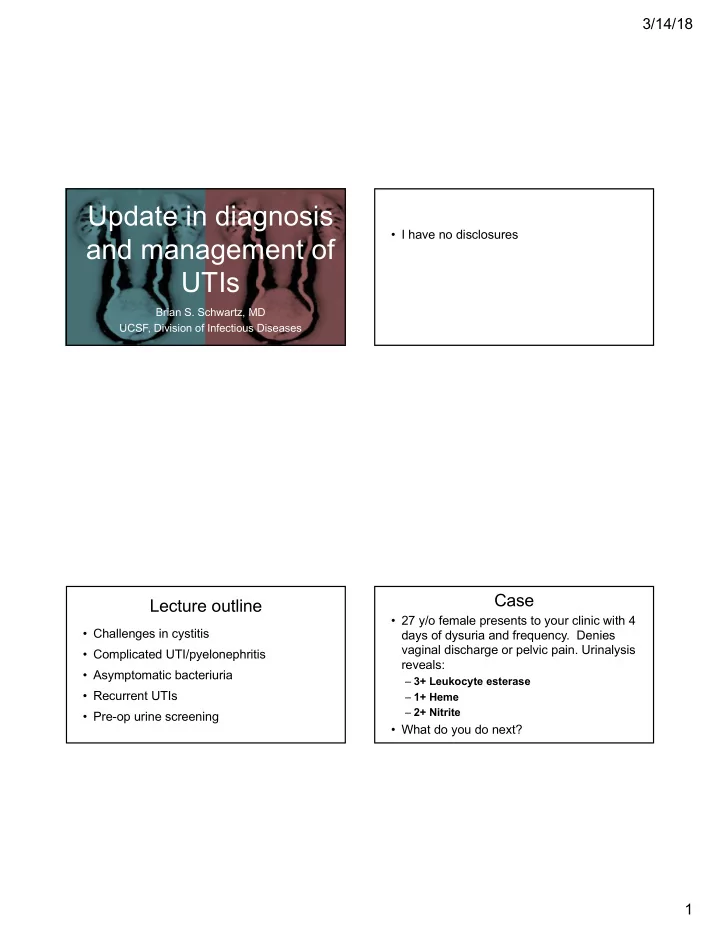
Update in diagnosis and management of UTIs

Brian S. Schwartz, MD UCSF, Division of Infectious Diseases

  • I have no disclosures

Lecture outline

  • Challenges in cystitis
  • Complicated UTI/pyelonephritis
  • Asymptomatic bacteriuria
  • Recurrent UTIs
  • Pre-op urine screening

Case

  • 27 y/o female presents to your clinic with 4

days of dysuria and frequency. Denies vaginal discharge or pelvic pain. Urinalysis reveals:

– 3+ Leukocyte esterase – 1+ Heme – 2+ Nitrite

  • What do you do next?
slide-2
SLIDE 2

3/14/18 2

Do you obtain a urine culture?

A.Yes B.No

Do you give empiric antibiotics?

  • A. No
  • B. Nitrofurantoin x 5 days
  • C. TMP-SMX x 5 days
  • D. Ciprofloxacin x 3 days
  • E. Cefazolin x 7 days

When should you get a urine culture for uncomplicated cystitis?

  • Uncomplicated UTI: culture not needed

– Will likely be susceptible E coli

  • Culture if…

– Complicated UTIs (pyelo) – Recurrent UTIs – High local rates of resistance

Hooton TM. NEJM. 2012

IDSA guidelines for uncomplicated UTI

Goal: Low resistance, lowcollateral damage

  • Nitrofurantoin 100 mg PO BID x 5 days
  • TMP-SMX DS PO BID x 3 days

– avoid if resistance >20%, recent usage

  • Fosfomycin 3 gm PO x 1

Gupta K. CID 2011

slide-3
SLIDE 3

3/14/18 3

Nitrofurantoin in elderly?

  • Study of older women (mean age 79)

– Mean GFR was 38 mL/min

  • Evaluated for Rx failure on different abx

– Other vs. nitrofurantoin – 130/1989 (6.5%) vs. 516/3739 (13.8%), CI 0.36-0.53

  • However, higher Rx failure in high GFR group too
  • Cipro more effective than nitrofurantoin in all
  • Failure rate same for nitrofurantoin vs. TMP-SMX

Singh N. CMAJ. 2015

Safety of nitrofurantoin in elderly?

  • Age > 65 years with Dx cystitis
  • N=13,421 (2007-12)
  • Evaluated for nitrofurantoin use ≈ lung injury
  • Nitrofurantoin exposure ≠ lung injury
  • Chronic use ≈ lung injury (aRR 1.53 [1.04-2.24])

Santos JM. JAGS. 2016

Take home on nitrofurantoin and elderly?

  • May be less efficacious
  • Unlikely dangerous for Rx
  • Danger increase for chronic suppression

You start TMP-SMX… Day 2 -Urine culture: > 100K CFU/mL of enterococcus (S - Amox; R- TMP-SMX). Clinical: symptoms a little better

  • A. Change to amoxicillin
  • B. Continue present Rx

C.Stop all antibiotics

slide-4
SLIDE 4

3/14/18 4 Utility of the midstream void culture?

  • > 200 pre-menopausal women w/ dysuria
  • Midstream void and catheter specimen
  • Cultures positive

–99% midstream –74% catheter specimens

Hooton TM. NEJM. 2013

Utility of the midstream void culture?

  • E. coli, Klebsiella, S. saprophyticus

– Strong correlation (102) with catheter specimen

  • Mixed culture (86%)

– E. coli often in catheter specimen

  • Enterococcus and Group B strep (10% cultures)

– Nearly never found in catheter specimens – 61% had E. coli grew from catheter cultures

  • Midstream cultures going to change treatment?

Hooton TM. NEJM. 2013

You start TMP-SMX… Day 2 -Urine culture: > 100K CFU/mL of enterococcus (S - Amox; R- TMP-SMX). Clinical: symptoms a little better

A.Change to amoxicillin B.Continue present Rx C.Stop all antibiotics

How is guideline compliance?

  • Grigoryan. Open Forum Infect Dis. 2015

Quinolones Nitrofurantoin TMP-SMX

  • ther
slide-5
SLIDE 5

3/14/18 5

Ciprofloxacin

  • Grigoryan. Open Forum Infect
  • Dis. 2015

TMP-SMX

  • Grigoryan. Open Forum Infect
  • Dis. 2015

Nitrofurantoin

  • Grigoryan. Open Forum Infect
  • Dis. 2015

Treatment of complicated UTI

  • Complicated

Anyone other than a healthy woman without recurrent infections

  • Empiric therapy (7-14 days):

– Non-pregnant: ciprofloxacin/levofloxacin – Pregnant women: Nitrofurantoin or cephalexin

slide-6
SLIDE 6

3/14/18 6

Treatment of UTI in men

  • Diagnosis:

–Obtain culture –Assess for STDs (urethritis)

  • Treatment:

–Quinolone, TMP-SMX favored –Duration 7-14 days –If recurrent consider prostatitis

Shorter course of antibiotics may be OK in men with UTI?

  • 39,149 Veterans with UTI
  • Antibiotic duration

≤ 7 days: 35% (median 7 days) > 7 days: 65% (median 10 days)

  • Veterans who received > 7 days:

– No reduction in recurrences, more C. difficile

Drekonja DM. JAMA Intern Med. 2013

ESBL trends at UCSF

2013 2014 2015

Oral antibiotics active against ESBL Gram negative pathogens

20 40 60 80 100 Fosfomycin Nitrofurantoin Doxycycline Cipro Amox-clav

% isolates susceptible Prakash V. AAC 2009

n=46

slide-7
SLIDE 7

3/14/18 7 Fosfomycin (Monurol)

  • Activity against Gram pos and neg
  • FDA approved for Rx of uncomplicated UTI
  • Treatment for complicated infections:

– 3 gm (mixed in 4 oz H2O) Q2 days for 7-14 d

Catheter-associated UTI

  • Hard to Dx:

– Bacteriuria common – Often unable to give symptoms

  • Pathogens

– More resistant GNRs – Candiduria common, most cases don’t treat

  • Treatment

– Change Foley – Antibiotics 7-14d

Hooton TM. Clin Infect Dis. 2010

Recommended empiric Rx of pyelonephritis in a young woman?

  • A. Ceftriaxone 1 gm IV q24
  • B. Moxifloxacin 400 mg IV/PO q24
  • C. Nitrofurantoin 100 mg PO q12
  • D. Cefpodoxime 200 mg PO q12

Empiric treatment of pyelonephritis

  • Recommended

– Cipro 500 mg PO/IV q12 (Levo ok, not Moxi) – Ceftriaxone 1 gm IV q24

  • Not recommended

– TMP-SMX – Nitrofurantoin – Cefpodoxime

  • Health-care associated: B-lactam
slide-8
SLIDE 8

3/14/18 8 Case

  • 65 y/o female w/ DM presents to clinic for routine
  • evaluation. She has been feeling well. A urinalysis

is sent to look for proteinuria and the lab processes for culture because bacteria are seen

  • UA: WBC-0, RBC-0, Protein-300
  • The next day you are called because the urine

culture has >100,000 Klebsiella pneumoniae

What do you recommend?

  • A. No antibiotics indicated
  • B. Ciprofloxacin and await susceptibilities
  • C. Repeat culture in 1 week and if bacteria

still present then treat

Case

  • 65 y/o female w/ DM presents to clinic for routine
  • evaluation. She has been feeling well. A UA is

sent to look for proteinuria and when the leukocyte esterase is +++, the lab sends culture

  • UA: WBC->50, RBC-0, Protein-300
  • The next day you are called because the urine

culture has >100,000 Klebsiella pneumoniae

What do you recommend?

  • A. No antibiotics indicated
  • B. Ciprofloxacin and await susceptibilities
  • C. Repeat culture in 1 week and if bacteria

still present then treat

slide-9
SLIDE 9

3/14/18 9

Case

  • 65 y/o female w/ DM presents to clinic for
  • evaluation. Complains of dysuria and
  • frequency. A UA and urine culture are sent.
  • UA: WBC->50, RBC-0, Protein-300
  • The next day you are called because the urine

culture has >100,000 Klebsiella pneumoniae

1c: What do you recommend?

  • A. No antibiotics indicated
  • B. Empiric ciprofloxacin and await susceptibilities
  • C. Repeat culture in 1 week and if bacteria still

present then treat

Answers: Antibiotics?

  • 1a. Asymptomatic bacteriuria, no pyuria

– no antibiotics indicated

  • 1b. Asymptomatic bacteriuria, with pyuria

– no antibiotics indicated

  • 1c. Cystitis (symptoms and pyuria)

– Antibiotics indicated

Definition: Asymptomatic bacteriuria

  • Bacteriuria without symptoms

–Midstream: ≥105 CFU/ml –Cath: ≥102 CFU/ml

  • Pyuria is present > 50% of patients
slide-10
SLIDE 10

3/14/18 10

Which patient(s) should be treated for asymptomatic bacteriuria?

  • A. Patients with T2 paralysis
  • B. Patients > 75 years of age
  • C. Patient 1 year post renal transplant
  • D. Patient undergoing TURP

Asymptomatic bacteriuria

Pre-menopausal women 1-5% Pregnant women 2-10% Post-menopausal women, 50-70 yrs 3-9% Diabetics 9-27% Elderly in LTC facilities (women; men) 15-50% Pts with spinal cord injuries 23-89% Pts undergoing HD 28% Pts with indwelling catheters 25-100%

  • Nicolle. CID. 2005

Who should you treat with asymptomatic bacteriuria?

  • Clear benefit

– Pregnant women – Patients undergoing traumatic urologic interventions with mucosal bleeding (TURP)

  • Possible benefit

– Neutropenic

  • Nicolle. CID. 2005

Who does not benefit from Rx of asymptomatic bacteriuria?

  • Premenopausal (non-pregnant) women
  • Postmenopausal women
  • Institutionalized men and women
  • Patients with spinal cord injuries
  • Patients with urinary catheters
  • Diabetics
  • Patients > 3 months post renal transplant

Asscher AW. BMJ. 1969; Abrutyn E. J Am Soc Ger. 1996;

slide-11
SLIDE 11

3/14/18 11 Treatment of asymptomatic bacteriuria in diabetic women

  • Placebo controlled, RCT (N=105)
  • Diabetic women w/ asymptomatic bacteriuria
  • Intervention: Antimicrobial vs. placebo x 14d
  • 1 endpoint: Time to 1st symptomatic UTI
  • 42% Rx vs. 40% placebo, p=0.42

Harding GKM. NEJM 2003; Cai T. Clin Infect Dis. 2015

Asymptomatic bacteriuria in renal transplant recipients

  • > 2 mo post transplant + ASB, N=112
  • 1outcome: Pyelonephritis

–7.5% vs. 8.4% (OR 0.88, 95% CI 0.22-3.47)

  • 2outcomes: C diff, UTI, MDR infx, rejection

–No significance difference

Origuen J. AJT. 2016

The patient with bacteriuria unable to tell you if they have symptoms?

  • No concern for infection = no treatment
  • Concern for infection exists

1. Always look for other sources (blood, lungs, etc.) 2. If no pyuria, do not treat 3. If candiduria, most cases don’t treat 4. If other source identified, stop UTI treatment

Is asymptomatic bacteriuria protective?

  • 712 women with asymptomatic bacteriuria

Cai T. Clin Infect Dis. 2012 Symptomatic UTI (%) Follow-up No Antibiotics Antibiotics Stats 3 months 11 (4%) 32 (9%) NS 6 months 23 (8%) 98 (30%) p<0.0001 12 months 41 (15%) 169 (73%) p<0.0001

slide-12
SLIDE 12

3/14/18 12

Is asymptomatic bacteriuria protective?

  • 712 women with asymptomatic bacteriuria

Cai T. Clin Infect Dis. 2012 Symptomatic UTI (%) Follow-up No Antibiotics Antibiotics Stats 3 months 11 (4%) 32 (9%) NS 6 months 23 (8%) 98 (30%) p<0.0001 12 months 41 (15%) 169 (73%) p<0.0001

Is asymptomatic bacteriuria protective?

  • 712 women with asymptomatic bacteriuria

Cai T. Clin Infect Dis. 2012 Symptomatic UTI (%) Follow-up No Antibiotics Antibiotics Stats 3 months 11 (4%) 32 (9%) NS 6 months 23 (8%) 98 (30%) p<0.0001 12 months 41 (15%) 169 (73%) p<0.0001

Is asymptomatic bacteriuria protective?

  • 712 women with asymptomatic bacteriuria

Cai T. Clin Infect Dis. 2012

Symptomatic UTI (%) Follow-up No Antibiotics Antibiotics Stats 3 months 11 (4%) 32 (9%) NS 6 months 23 (8%) 98 (30%) p<0.0001 12 months 41 (15%) 169 (73%) p<0.0001

65 y/o woman has had 3 UTIs in the last 6 months. What would be your next step to prevent recurrent UTIs?

  • A. Daily suppressive nitrofurantoin
  • B. Intra-vaginal estrogen

C.Cranberry tablets D.Urology consult

slide-13
SLIDE 13

3/14/18 13

Recurrent UTIs in women

  • 20-30% will have a recurrent UTI in 6 mo
  • Risk factors:

– Frequent sex, spermicide, new partner – Genetic: Age of 1st UTI ≤ 15 yrs; Mother h/o UTIs – Urinary incontinence

Scholes D. JID. 2000; Raz R. CID 2000.

Pathogenesis of UTI in women

Prevent vaginal colonization w/ uropathogens Prevent growth

  • f uropathogens

in bladder Correct anatomic/neurologic problems

Prevention of recurrent UTIs

  • Prevent vaginal colonization w/ uropathogens

– Avoid spermicide – Oral probiotics – Intravaginal probiotics – Intravaginal estrogen (post-menopausal)

  • Prevent growth of uropathogens in bladder
  • Correct anatomic/neurologic problems

Intravaginal estrogen for UTI prevention?

How does this work?

  • Alters vaginal mucosa à promotes lactobacillus

– Reduced pH inhibits growth of enteric flora

  • Reverses atrophy of uretheral epithelium

– Improves bladder emptying

Raz R. JID 2001

slide-14
SLIDE 14

3/14/18 14 Intra-vaginal estrogen

Show me the data!

  • 93 post-menopausal women w/ recurrent UTIs
  • RCT (estriol intrvaginal vs. placebo)

–0.5 mg estriol QD x 2 wk à 2x/wk x 8 mo

  • 1 outcome: Recurrent UTIs

–0.5 (estriol) vs. 5.9 (placebo) UTI/pt-yr; p < 0.001

Raz R. NEJM. 1993

Intra-vaginal estrogen

Show me the data!

Raz R. NEJM. 1993

% Colonized with organism Pre-Rx Estriol Placebo Lactobacillus Enterobacteriaceae

67 67

Intra-vaginal estrogen

Show me the data!

Raz R. NEJM. 1993

% Colonized with organism Pre-Rx à Post-Rx Estriol Placebo Lactobacillus 0à61 0à0 Enterobacteriaceae 67à31 67à63

Prevention of recurrent UTIs

  • Prevent vaginal colonization w/ uropathogens
  • Prevent growth of uropathogens in bladder

– Increase voiding – Methenamine hippurate – Cranberry juice – Postcoitol or daily antibiotics

  • Correct anatomic/neurologic problems
slide-15
SLIDE 15

3/14/18 15 Can increasing fluids reduce UTI risk?

  • Premenopausal women w/ recurrent UTI
  • Randomized: +1.5L/d vs. no change (n=140)
  • Fluid group: more fluid, voids, reduce urine Osms
  • 1 outcome: recurrent UTIs episodes in 12 m

– 1.6 vs.3.1; OR .52, 95% CI (0.46-0.6), p<0.01

Hooton TM. ID Week. Oct 2017

Methenamine hippurate

  • FDA approved for prevention of recurrent UTI
  • Methenamine

formaldehyde

  • Reduced UTIs in women with no renal tract

abnormalities

– RR 0.24, (95% CI 0.07 to 0.89)

Cochrane Review. 2012

Cranberry Juice to prevent UTIs

How does it work?

  • Inhibits adhesions produced by E. coli
  • Only vaccinium berries

– Cranberry, blueberry, lingonberry, huckleberry

  • Lots of studies done
  • Many different formulations, many different

endpoints

Raz R. CID. 2004

Finally put to cranberry to rest…

  • RCT, placebo controlled
  • Subjects: 185 women >64 years
  • Intervention: 2 cranberry tabs daily (= 20 oz juice)
  • Outcomes:

Cranberry Placebo P value Bacteriuria + Pyuria 29% 29% P=.98 Sympt UTIs 10 12 NS

Juthani-Mehta M. JAMA. 2016

slide-16
SLIDE 16

3/14/18 16

Postcoital antibiotics

  • RCT in college

women

  • Intervention:

–½ TMP-SMX SS vs. placebo post-coitol

Stapelton A. JAMA. 1990

TMP-SMX N=16 Placebo N=11

x 6 months

UTI

2 (13%) 9 (82%)

Intermittent self-administration of antibiotics

  • Healthy women with ≥ 2 UTIs in past 12 mos
  • Given sterile cups and Rx for levofloxacin
  • 172 episodes of self-initiation performed

– 84% micro confirmed

  • Conclusion: self-treatment can be successful

Gupta K et al Ann Int Med 2001;135:9

Continuous antibiotic prophylaxis

  • Highly efficacious
  • Studied regimens:

– TMP-SMX: 1/2 SS tab nightly or SS 3X/week – TMP: 100 mg nightly – Nitrofurantoin: 50-100mg nightly

  • Associated with antibiotic resistance
  • 30% have recurrence 6 mo after stopping

Nicolle LE. Infection. 1992

Prevention of recurrent UTIs

  • Prevent vaginal colonization w/

uropathogens

  • Prevent growth of uropathogens in bladder
  • Correct anatomic/neurologic problems
slide-17
SLIDE 17

3/14/18 17

When to evaluate for anatomic abnormalities in women with recurrent UTIs?

  • Rads and cystoscopy unrevealing in most cases
  • Red flags suggesting that a urologist is needed

– Hematuria w/o dysuria – Incontinence – Elevated creatinine – Recurrent Proteus infections (struvite stones)

Fowler JE. NEJM. 1981; Mogensen P. B J Urol. 1983

Pre-menopausal Post-menopausal

Avoid spermicide Increase fluids (+1.5L/d) Intra-vaginal estrogen Increase fluids (+1.5L/d) Post-coitol antibiotics

Management of Recurrent UTIs*

Post-coitol antibiotics Antibiotic suppression in select cases *Obtain imaging and/or urology evaluation if hematuria w/o dysuria, elevated Cr, incontinence, stones, recurrent Proteus UTI Methenamine hippurate Methenamine hippurate

Does pre-op asymptomatic bacteriuria predispose to prosthetic joint infections?

  • RCT 471 pts for hip replacement
  • Pyuria+à culture+ à randomized
  • Treatment vs. placebo for bacteriuria
  • Results:

– No reduction in prosthetic joint infections (PJI) – No correlation of urine culture and PJI organisms

Cordero-Ampuero J. Clin Ortho Relay Res. 2013

Summary

  • Nitrofurantoin is 1st choice for uncomplicated

cystitis, TMP-SMX ok too

  • Be aware of ESBL E. coli and limited Rx options
  • Asymptomatic bacteriuria should be treated in

select patients only

  • Think about non-antibiotic Rx 1st for recurrent

UTIs, such as intra-vaginal estrogen, fluids

slide-18
SLIDE 18

3/14/18 18

brian.schwartz@ucsf.edu