unlimited use and unrestricted exposure , the lead agency shall - - PDF document

unlimited use and unrestricted
SMART_READER_LITE
LIVE PREVIEW

unlimited use and unrestricted exposure , the lead agency shall - - PDF document

Alternatives for Managing the Nations Complex Contaminated Michael Kavanaugh 1 Groundater Sites: NRC 2013: Key Findings, and Overview of Transition Assessments Alternatives for Managing the Nations Complex Contaminated Groundwater


slide-1
SLIDE 1

Alternatives for Managing the Nation’s Complex Contaminated Groundater Sites: NRC 2013: Key Findings, and Overview of Transition Assessments Michael Kavanaugh –1

“Alternatives for Managing the Nation’s Complex Contaminated Groundwater Sites: NRC,2013; Key Findings, and Overview of Transition Assessments”

  • Dr. Michael C. Kavanaugh, P.E., NAE

Principal Presentation to Federal Remediation Technology Roundtable (FRTR) Washington, D.C. May 14, 2014

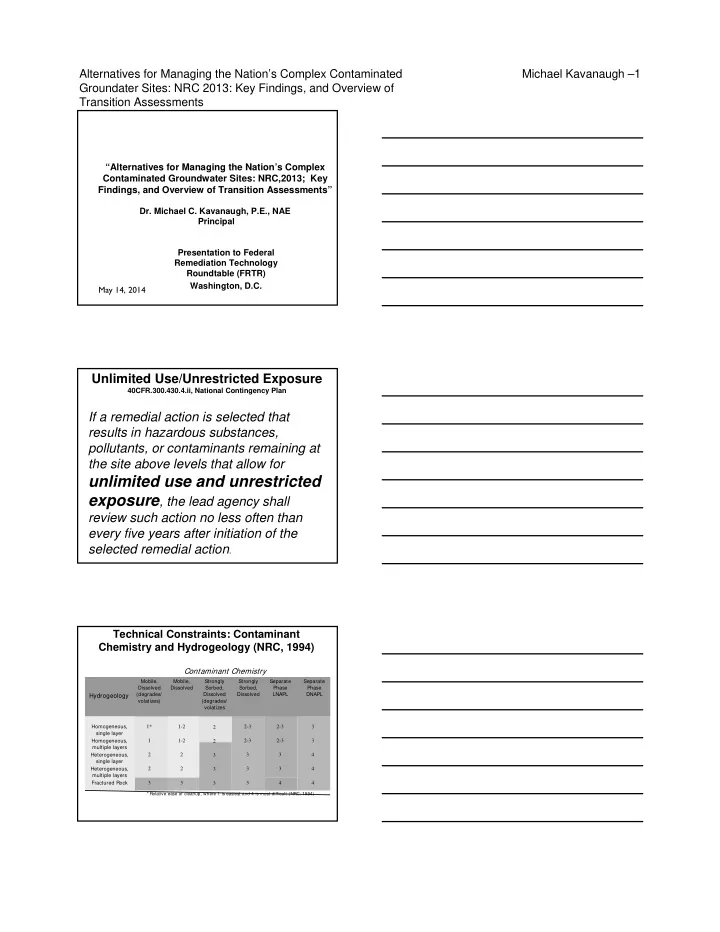
Unlimited Use/Unrestricted Exposure

40CFR.300.430.4.ii, National Contingency Plan

If a remedial action is selected that results in hazardous substances, pollutants, or contaminants remaining at the site above levels that allow for

unlimited use and unrestricted exposure, the lead agency shall

review such action no less often than every five years after initiation of the selected remedial action.

Technical Constraints: Contaminant Chemistry and Hydrogeology (NRC, 1994)

* Relative ease of cleanup, where 1 is easiest and 4 is most difficult (NRC, 1994)

Contaminant Chemistry

Homogeneous, single layer Homogeneous, multiple layers Heterogeneous, single layer Heterogeneous, multiple layers Fractured Rock 2-3 2-3 3 3 3 2-3 2-3 3 3 4 3 3 4 4 4 1* 1 2 2 3 1-2 1-2 2 2 3 2 2 3 3 3 Mobile, Dissolved (degrades/ volatizes) Mobile, Dissolved Strongly Sorbed, Dissolved (degrades/ volatizes Strongly Sorbed, Dissolved Separate Phase LNAPL Separate Phase DNAPL

Hydrogeology

slide-2
SLIDE 2

Alternatives for Managing the Nation’s Complex Contaminated Groundater Sites: NRC 2013: Key Findings, and Overview of Transition Assessments Michael Kavanaugh –2

Status of CERCLA Sites

http://www.epa.gov/superfund/sites/npl/status.htm February 27, 2014

Non- Federal Federal Totals Proposed Sites 49 4 53 Final Sites 1,162 157 1,319 Deleted Sites 358 17 375

Construction Complete

1,085 73 1,158

Examples of Complex Sites

Attributes of Highly “Complex Sites”

  • Large releases of contaminants
  • ver long time frames
  • Highly heterogeneous subsurface

geologic environments

  • Some contaminants recalcitrant

and persistent

  • Levels of contaminants several
  • rders of magnitude above levels allowing for UU/UE (e.g.,

MCLs)

  • Several years of remedial efforts with an indication of

“asymptotic” performance – multiple 5-year reviews

  • Life cycle costs to achieve restoration exceeding $20-$50

million

slide-3
SLIDE 3

Alternatives for Managing the Nation’s Complex Contaminated Groundater Sites: NRC 2013: Key Findings, and Overview of Transition Assessments Michael Kavanaugh –3

Background: Overview of Groundwater Restoration Unresolved Challenges of Groundwater Cleanup

  • Many sites with groundwater contamination remain open

and restoration to “unlimited use/unrestricted exposure” (UU/UE) and final “closure” uncertain in a “reasonable” timeframe.

  • Long term management of orphan CERCLA sites

transitioning to state responsibility following 10 years of

  • peration.
  • 10-15 sites/year into the future according to Jim Woolford,

(EPA, 2013).

  • States financially constrained – long term management

liabilities an issue.

  • The “complex site” problem

Conclusions – Size of the Problem

  • 126,000 sites that have not yet reached closure is likely an

underestimate

  • Could not determine the total number of sites with residual

contamination above levels allowing for UU/UE

  • Must be > 126,000
  • Estimated future cost of $110-127 billion likely an

underestimate

  • More than 12,000 sites likely “complex”
  • This represents the approximate sum of high

priority sites (CERCLA, DoD, DOE, RCRA CA) Key Finding: Current Technical Capabilities to Achieve UU/UE

  • “Based on what is known about the effectiveness of

remediation technologies (as described in this chapter [4]), the Committee concluded that regardless of the technology used, the complete removal (i.e., restoration) of contaminant mass at complex sites is unlikely. Furthermore, the Committee discovered no transformational remedial technology or combination of technologies that can overcome the current challenges associated with restoring contaminated groundwater at complex sites. At these sites, some amount of residual contamination will remain in the subsurface after active remedial actions cease, requiring long-term management.” (page 114, NRC, 2013)

slide-4
SLIDE 4

Alternatives for Managing the Nation’s Complex Contaminated Groundater Sites: NRC 2013: Key Findings, and Overview of Transition Assessments Michael Kavanaugh –4

EPA Recognizes Alternative Approaches Are Needed for Sites Where Restoration is Unlikely

EPA Roadmap July, 2011

Decision Process Leading to Three Generic End States

  • Remedial Action Objectives Achieved
  • This would include UU/UE but RAOs could deviate from

UU/UE

  • Long-Term Active Management
  • Operating remedy plus appropriate monitoring, reporting, 5-

year reviews, institutional or legal controls, community

  • utreach
  • Long-Term Passive Management
  • No active remedy but appropriate monitoring, reporting, 5-year

reviews, institutional or legal controls, community outreach

  • Consideration of factors to transition to no-monitoring

requirements, where appropriate

slide-5
SLIDE 5

Alternatives for Managing the Nation’s Complex Contaminated Groundater Sites: NRC 2013: Key Findings, and Overview of Transition Assessments Michael Kavanaugh –5

Alternative Decision Making Process Metrics to Support “Diminishing Returns” Hypothesis

  • Statistical methods confirming declining trend in

concentrations.

  • Statistical confirmation of target reduction in mass

flux/mass discharge.

  • For LNAPL recovery, asymptotic performance based on

LNAPL/water ratios.

  • Risk reduction metric; cost per unit risk reduction.
  • Exposure pathways eliminated and risks of residual

contamination below threshold levels.

  • Sustainability metrics; e.g. GHG emissions per unit mass

removed. Factors to be considered in a Transition Assessment – NRC 2013 Report

  • Expanded analysis of costs and risk reduction for viable

alternatives including containment.

  • Sustainability assessments of options.
  • Additional site characterization with advanced diagnostic

tools (e.g. to estimate assimilative capacity of aquifer) if justified.

  • Risk assessment and risk analysis of post-remedy

conditions.

  • Particular focus on level of safety in any containment remedy,

active or passive – a risk analysis of residual contamination.

  • A risk-based or risk-informed decision process – (see

“Science and Decisions” NRC, 1999)

  • Expanded community outreach and education.
slide-6
SLIDE 6

Alternatives for Managing the Nation’s Complex Contaminated Groundater Sites: NRC 2013: Key Findings, and Overview of Transition Assessments Michael Kavanaugh –6

EPA Risk Management: Aspirational Goals and Permitting Programs

  • Aspirational Goals
  • UU/UE in CERCLA
  • MCLGs in SDWA
  • Fishable, swimmable waters in CWA
  • Delany clause -FDA
  • Permitting Programs
  • NPDES in CWA
  • NAAQS – MACT Standards
  • RCRA – Containment of hazardous wastes

Empirical Safety Factors in Decision Making

  • EPA human health risk assessments
  • Default values – factors from 1 to 1000
  • Linear extrapolation from animal studies for dose-response curve
  • Explicit defaults and missing defaults
  • Exposure assessments – Percentile default values (e.g. soil

ingestion rate for children of 200 mg/day, 65th percentile)

  • Establishing MCLs
  • MCLGs for potential human carcinogens; MCL based on risk

management decision (e.g. analytical limitations)

  • Food Quality Protection Act – factor of 10 to protect infants

for pesticide limits. Geotechnical Engineers Methodology for Risk Analysis

  • f Dams: Design Assumptions and Safety Factors
  • F. Silva; T. Lamb; W. Marr, JOURNAL OF GEOTECHNICAL AND

GEOENVIRONMENTAL ENGINEERING, Dec. 2008

slide-7
SLIDE 7

Alternatives for Managing the Nation’s Complex Contaminated Groundater Sites: NRC 2013: Key Findings, and Overview of Transition Assessments Michael Kavanaugh –7

The Future: LTM as an Infrastructure Problem

  • Goal of long-term management “end states”:

minimize probability of failure and consequences

  • f same
  • A Geotechnical Engineering Perspective:

Applying appropriate “best design practices” with “safety factors”

Risk Management Decision is a Trade Off Decision

Concluding Remarks

  • Central Theme of NRC 2013 Report

How nation should deal with residual contamination post- remedy at large number of sites – transition guidance needed.

  • A persistent “tradeoff” problem requiring leadership and

effective communications.

  • Ultimately, from a sustainability perspective, there are limits to

resource diversion for pursuing restoration. A pragmatic approach to an ethical problem – regulatory flexibility imbedded in all environmental regulations allowing for creative solutions.

  • Research efforts needed to ensure that long term

management infrastructure meets acceptable residual risk levels and that residual risk is allocated equitably.

slide-8
SLIDE 8

Alternatives for Managing the Nation’s Complex Contaminated Groundater Sites: NRC 2013: Key Findings, and Overview of Transition Assessments Michael Kavanaugh –8

Questions?

Michael C. Kavanaugh MKavanaugh@geosyntec.com