United Kingdom & United States TRACER / FSCS Combined Analysis - - PDF document

united kingdom amp united states tracer fscs combined
SMART_READER_LITE
LIVE PREVIEW

United Kingdom & United States TRACER / FSCS Combined Analysis - - PDF document

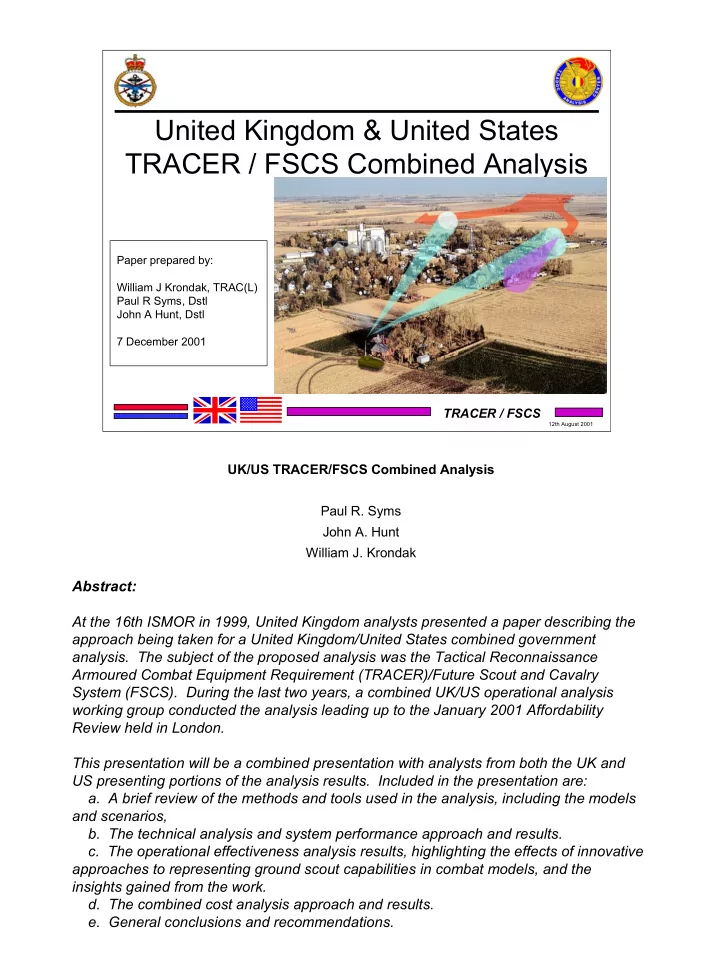
United Kingdom & United States TRACER / FSCS Combined Analysis Paper prepared by: William J Krondak, TRAC(L) Paul R Syms, Dstl John A Hunt, Dstl 7 December 2001 TRACER / FSCS 12th August 2001 UK/US TRACER/FSCS Combined Analysis Paul R.


slide-1
SLIDE 1

1

12th August 2001

TRACER / FSCS

United Kingdom & United States TRACER / FSCS Combined Analysis

Paper prepared by: William J Krondak, TRAC(L) Paul R Syms, Dstl John A Hunt, Dstl 7 December 2001

UK/US TRACER/FSCS Combined Analysis Paul R. Syms John A. Hunt William J. Krondak

Abstract: At the 16th ISMOR in 1999, United Kingdom analysts presented a paper describing the approach being taken for a United Kingdom/United States combined government

  • analysis. The subject of the proposed analysis was the Tactical Reconnaissance

Armoured Combat Equipment Requirement (TRACER)/Future Scout and Cavalry System (FSCS). During the last two years, a combined UK/US operational analysis working group conducted the analysis leading up to the January 2001 Affordability Review held in London. This presentation will be a combined presentation with analysts from both the UK and US presenting portions of the analysis results. Included in the presentation are:

  • a. A brief review of the methods and tools used in the analysis, including the models

and scenarios,

  • b. The technical analysis and system performance approach and results.
  • c. The operational effectiveness analysis results, highlighting the effects of innovative

approaches to representing ground scout capabilities in combat models, and the insights gained from the work.

  • d. The combined cost analysis approach and results.
  • e. General conclusions and recommendations.
slide-2
SLIDE 2

2

12th August 2001

TRACER / FSCS

  • Pre 1997 - UK and US each conduct research on ground scout

technologies

  • Mar 97 - US and UK began Cooperative Program Exploratory Analysis
  • Apr 97 - US Joint Requirements Oversight Council (JROC) validated

Mission Needs Statement (MNS)

  • Nov 97 - Terms of Reference for Analysis drafted at Operational Analysis

Working Group meeting in UK. Signed by Mr. Hollis, DUSA(OR) for US and Mr. Larcombe (Director Science (Land)) for UK

  • Feb 98 - MOU signed by US
  • Jul 98 - MOU signed by UK following Strategic Defence Review
  • Jan 99 - Project Definition/Advanced Technology Demonstration

contracts signed by US and UK with two competing consortia

  • Mar 99 - Combined Analysis Plan signed by US and UK
  • Jan 01 - General Officer Affordability Review

Background

  • 1. Introduction. Many countries recognize that they must cooperate to develop and

produce affordable and interoperable military systems for their future security needs. In the area of ground-based surveillance and reconnaissance, the United Kingdom (UK) and the United States (US) began a cooperative Project Definition (PD) and Advanced Technology Demonstration (ATD) phase to build a new manned ground scout vehicle. UK and US government analysts conducted a study during the PD/ATD phase to help inform the government leaders regarding the development decisions at the end of the

  • phase. The analysis informed an Affordability Review held in January 2001 in London.
  • 2. Background. Both UK and US military leaders recognized that a ground scout

provided capabilities that could not be met by aerial surveillance and reconnaissance systems or by other intelligence means. The existing systems in use by the US and UK are effective but aging. Their platforms limit the incorporation of new technology becoming available through research. Thus, both nations sought to cooperatively develop a replacement for the existing systems. The chart shown here illustrates the steps taken to cooperatively develop a system and conduct a combined analysis.

slide-3
SLIDE 3

3

12th August 2001

TRACER / FSCS

Study Objective & Approach

The objective of this Combined Analysis is to determine the most cost effective ground scout system to replace the current ground scout vehicles used by US and UK forces.

CAP

PM FSCS AMSAA TRAC Dstl USAARMC

TRACER IPT

SPS/CF

ECC Integration of analyses and study questions accomplished through the CAP and its study modules.

  • 3. Study objective. The government analysis conducted in the combined analysis

program was designed to help make national authorities “informed customers” regarding proposals from the two industry consortia under contract to develop integrated demonstrators during the PD/ATD phase. The specific study objective (shown in the chart above) was to determine the most cost effective ground scout system to replace the existing UK and US ground scout vehicle systems.

  • 4. Study approach. The study approach was developed through creation of the

Combined Analysis Plan (CAP). The CAP included input from agencies shown on the chart above. They included the US Army Armor Center (USAARMC), Project Manager Future Scout and Cavalry System (PM FSCS), US Army Materiel Systems Analysis Activity (AMSAA), and US Army Training and Doctrine Command Analysis Center (TRAC). United Kingdom contributors included the Equipment Capability Directors for ISTAR and Direct Battlefield Engagement, the TRACER Integrated Project Team and Specialist Procurement Service, Cost Forecasting (SPS/CF) in the Defence Procurement Agency and finally the Defence Science & Technology Laboratory (Dstl), formerly known as DERA, which includes the Analysis and Integrated Systems

  • Sectors. With so many different organisations spread across the UK and USA, there was a

high reliance on voice and data communications. This, together with an Integrated Product and Process Development (IPPD) environment in widespread use across the programme, was highly effective.

slide-4
SLIDE 4

4

12th August 2001

TRACER / FSCS

CAP Study Modules

M-T.0: Integrated Systems Analysis M-T.1.1: Integrated Sensor Capabilities M-T.1.2: Integrated Survivability M-T.1.3: Integrated C4I Capabilities M-T.2.1: Firepower Analysis M-T.2.2: Mobility/Transportability Analysis M-O.1 Mission Needs M-O.2 Scenario Development M-O.3 Operational Effectiveness M-O.4 TRACER/FSCS C4I Interactions M-O.5 TRACER/FSCS Interactions w/RISTA Assets M-O.6 Analysis of Ground Reconnaissance M-O.7 Force Design M-O.8 Operational Sustainability M-C.1 Life Cycle Costs M-C.2 Training Impact Analysis M-C.3 Logistics Impact Analysis M-C.4 Manpower Requirements Analysis M-C.5 Estimated Cost of Potential Technologies M-C.6 TRACER/FSCS Variants M-T.2.3 Reliability & Cost Analysis span Technical Modules M

  • I

. I n t e g r a t i

  • n

M

  • d

u l e

  • 5. CAP study modules. The study approach used a hierarchical structure of

questions derived from the study objective. The questions were then gathered into logical areas managed under four sub-groups covering General/Setting, Technologies/ Performance, Operational Effectiveness, Cost and Integration. The analysis working group then created and assigned a series of study modules that would address the questions. This chart shows the study modules categorized in the technical, operational, and cost groupings. As each module was completed, its output was used as input to answer the hierarchical structure of questions. The study modules were addressed in a time schedule broken in segments. This provided management a tool to help allocate resources and assess progress. The integration of the 21 study modules into a coherent analysis was achieved through the Integration Module. This final module was executed by co-locating the UK and US study teams in November 2000 and January 2001. This was an essential part of the reconciliation of results and harmonisation into a single presentation and set of reports for the January 2001 Affordability Review.

slide-5
SLIDE 5

5

12th August 2001

TRACER / FSCS

Combined Analysis Segments

Develop MOE and MOP Develop scenarios & settings (MTW, SSC, SASO/OO) Enhance and review models and simulations Gather and transfer technical data and scenario data Conduct performance analysis Run and analyse force-level combat simulations Collect and analyse cost data Integrate and report for Affordability Review (Jan 01) Update and report analysis for FD/EMD decision (2002) Segment 1 Segment 2 Segment 3

Three Segments of the CAP

  • 6. Combined analysis segments. This chart shows the general method for the

conduct of the analysis. Study leaders decided that three segments would adequately define the main activities and enable them to appropriately manage the analysis. 6.1 Segment 1. The first segment was devoted to the development of measures

  • f effectiveness and measures of performance suitable for assessment of

reconnaissance, selection and development of scenarios, review and enhancement

  • f models and simulations, and the preparation of technical performance data and

scenario data. 6.2 Segment 2. In segment two, the analysts conducted a combined performance analysis for sensors, survivability, C4I, Mobility, Firepower, ran and analyzed the force-on-force combat simulations, collected and analyzed cost and reliability data, and integrated all the analysis into a report and briefing for the Affordability Review. 6.3 Segment 3. Segment 3 included analysis that supported revisions and updates to the Combined Operational Requirements Document and Technical Requirements Specification and Confirmatory Concept work that assessed additional variations in cost and effectiveness based on the outcome of segment 2.

slide-6
SLIDE 6

6

12th August 2001

TRACER / FSCS

Character of Analysis

SCOPE

  • Largest and most complex acquisition analysis undertaken

jointly by the UK and US Armies

  • 6 major analytic agencies

– 40+ principal investigators – 10 Initial Government Concepts – >35 concept variations – 10 force-level scenarios – 6 force-level models and 30+ performance models

Analytic Challenges:

  • Sharing of national data and scenario data
  • Scout contributions to force & scout-enabled force lethality
  • Integrated Sensors (FLIR, mast mounted sensor, Radar, fusion)
  • Command, Control, Comms, Computers & Intelligence (C4I)
  • Integrated Survivability
  • 7. Approach. This was certainly the largest and most ambitious acquisition study undertaken by the

Armies of the US and UK. Mr. Mike Bauman, Director of US Army TRADOC Analysis Center, and Mr. Alan Dixon, Deputy Director Equipment Capabilities-Science (Direct Battlefield Engagements) of MOD were the co-study directors. The analysis included six major analytic agencies and dozens of other contributing organizations. The team of over 40 principal analysts and over 100 contributors assessed ten initial government concepts in ten force-level scenarios and four smaller vignettes. Six force-level models and over thirty performance models and simulations supported the analysis.

  • 8. Analytical challenges. Sharing technical data and scenario information proved to be a considerable

challenge and required much effort to resolve. Conducting a combined analysis separated by the Atlantic Ocean required extensive telephonic exchanges as well as several meetings where analysts co- located to compare data, review modeling results, develop insights, and prepare reports. The modeling

  • f scouts and reconnaissance capabilities in US and UK models and relating scout success and scout-

enabled fires (scouts calling artillery, helicopter, or air strikes against acquired targets) to mission success of the force also required effort. Considerable progress was made, but more work remains. Research on sensor fusion indicated that methods for representing this capability are immature. This applies to both the fusion of multiple sensors on a single platform as well as the fusion of information from a variety of sensors in different locations. The approach adopted for Integrated Survivability required the development of new models and analytical approaches. The area of Command, control, communications, computers, and intelligence (C4I) was another concern. Most combat simulations portray or assume well-developed command and control systems, appropriate decisions, and assured

  • communications. To analyze differences required modeling changes. Additional work in this area is

planned.

slide-7
SLIDE 7

7

12th August 2001

TRACER / FSCS

Technical Performance Models

C4I

  • TRACER/FSCS Analysis

Model (TRACMAN)

  • Irregular Terrain Model

(ITM)

  • System Performance

Model (SPM) Mobility

  • Drive C
  • NATO Reference

Mobility Model (NRMM)

  • Analytic Path Model
  • Fuel Use Model
  • Intervisibility Statistics

Program

  • Line-of-Sight 1.1
  • Stochastic Path Model

(SPM)

  • Vehicle Acceleration

Model (VAM) Sensors

  • Amethyst
  • Acoustic Propagation

Prediction Model (APPM)

  • PHI
  • Acquire
  • Radar Range Equations
  • Acoustic Battlefield Aid

(ABFA)

  • FLIR-92
  • Range Advantage

Spreadsheet Model Reliability

  • MasterPR

Vulnerability

  • LANCE
  • Modular UNIX-based

Vulnerability Estimator Suite (MUVES)

  • Stochastic Quantitative

Analysis of System Hierarchies (SQuASH)

  • Support Warfare

Analysis Mean Area of Effects (SWAMAE) Survivability

  • Acquisition Task

Performance Model (ATPM)

  • Infrared Calculation

(INFRACAL) Firepower

  • Passive Vehicle Target

Model (PVTM)

  • Scenario Weighted

Incapacit’n Score (SWIS)

  • Integrated Air Target

Vulnerability Assessment Library (INTAVAL)

  • Probability of Hit (Phit)

UK US Common

  • 9. Technical performance models. This chart shows the technical performance models

used by the UK and US analysts. Those used solely by the UK are shown in red, those used by the US are shown in blue, and those used in by both are highlighted in green. Detailed discussion of each model is beyond the scope of this paper. However, note that tools such as the Acquire model, Radar Range Equations, and the NATO Reference Mobility Model are among the models used by both countries. Also note that the models used by a nation tend to complement and supplement the models used by the other so that the combined technical performance analysis achieved a high level of robustness and credibility.

slide-8
SLIDE 8

8

12th August 2001

TRACER / FSCS

Scenarios & OE Models

Desert Major Theatre of War (MTW)

  • Bde Attack Zone Recon

CASTFOREM

  • Battle Group (BG) Attack

ATLAS

  • Formation Recce (FR) Defence

STAMGEN,SOLWAY

  • FR Offence

ATLAS, STAMGEN

  • Screen Security Vignette

CASTFOREM Hilly Wooded MTW

  • Corps Counterattack

VIC

  • Zone Recon Vignette

CASTFOREM Rolling Plains MTW

  • Cav Regt Zone Recon

CASTFOREM

  • BG Attack

ATLAS

  • FR Defence

ATLAS,STAMGEN,SOLWAY

  • FR Offence

ATLAS, STAMGEN Small Scale Contingency (SASO/OO)

  • Div Cavalry Zone Recon

CASTFOREM

Scenario Model

  • 10. Scenarios and operational effectiveness (OE) models.

10.1 Scenarios. The combined analysis used each of the scenarios shown in this chart. The scenarios represent a range of settings from major theaters of war (MTW) and NATO Regional Contingencies (NRC) to small scale contingencies and operations other than war. The geographic regions represent a range from rolling wooded terrain to desert to severely restricted wooded and hilly terrain. Each scenario was modeled in a combat simulation, and analyst examined the output to determine the effectiveness of the different concept vehicles. Effectiveness was determined for force, system and subsystem levels. 10.2 Force simulations and models. The list of models used for OE analysis was rather extensive. The US Combined Arms and Services Task Force Evaluation Model (CASTFOREM) and the UK Assessment Tool for Land Systems (ATLAS) carried the biggest load in the analysis. Other tools such as the US Vector-in-Commander (VIC) and the UK’s Surveillance and Target Acquisition Message Generator (STAMGEN) provided analysis in key areas.

slide-9
SLIDE 9

9

12th August 2001

TRACER / FSCS

Initial Government Concepts

UK Baseline US Baselines US/UK New Start Systems Upgrade Systems

  • 11. Initial government concepts. This chart shows the ten Initial Government Concepts

evaluated in the combined analysis. Since the analysis was being conducted at the same time as the two consortia were developing their concepts, the Government analysts participated in regular meetings with consortia representatives to ensure that the technologies included in the government concepts bracketed the technologies being considered by the Industrial consortia. 11.1 The Baselines included current UK and US ground scout vehicles. 11.2 Upgrade concepts included two tracked armoured vehicle Upgrades, one with a new sensor, and

  • ne with a new weapon and a mast-mounted sensor. A third Upgrade was a wheeled armoured vehicle

with an upgraded sensor package. 11.3 New Start concepts included wheeled and tracked vehicles with the same nominal mission equipment. They were small enough to be transported on a C-130 aircraft and both had similar mast-mounted sensors and new weapon systems. A third alternative was an armoured reconnaissance vehicle that was not C-130 capable but transportable on C-17 aircraft while the fourth New Start was similar to the tracked C-130 capable New Start scout but carried an anti-tank guided missile as its primary weapon system rather than the medium calibre cannon.

slide-10
SLIDE 10

10

12th August 2001

TRACER / FSCS

Critical Study Questions

Level One Question: What are the cost and effectiveness values of TRACER/FSCS options? Level Two Questions: General (G) What are the settings to be used? Technical (T) What are the integrated system performance, cost and risk estimates for each alternative? Operations (O) What is the operational effectiveness of each alternative? Cost (C) What is the cost of each alternative?

  • 12. Critical study questions. The chart above shows the top level question related to the

study objective and the level two sub-questions. In subsequent charts, the level three questions assigned to the technical, operational, and cost sub-groups will be shown and examples of results relevant to answering those questions will be shown.

slide-11
SLIDE 11

11

12th August 2001

TRACER / FSCS Level Three Technical Questions: T-1. What are the performance and risk estimates for potential sub-system technologies, correlated to cost? T-2. What is the optimal mix of TRACER/FSCS technologies (e.g. sensors, weapons, and signature management)? T-3. What are the most risk-adjusted cost effective sub-systems technologies and system level concepts? T-4. What techniques are required for the operator to make most effective use of potential new TRACER/FSCS technical capabilities? T-5. What are the best technology solutions that should be integrated into the TRACER/FSCS vehicle?

Technical Analysis Questions

Module Approach: M-T.0. Integrated Systems Measure Analysis M-T.1.1 Integrated sensors capabilities M-T.1.2 Integrated survivability analysis M-T.1.3. Integrated C4I capabilities M-T.2.1 Firepower analysis M-T.2.2 Mobility Analysis M-T.2.3 System Reliability

  • 13. Technical Analysis.

13.1 Technical questions and modules. This chart shows the questions for the technical

  • analysis. The analysts then developed modules to address the questions. Because of the

expected resource requirements associated with module fulfillment and because some of the questions had already been addressed extensively in the prior research and analysis, the analysts prioritized the modules. Priority one modules (shown on the left) required the development of new models and data. Priority two modules (shown on the right) used new data in existing models. 13.2 Issues. Several unique issues were addressed by the technical analysis working

  • group. Among them was the issue of integrated sensor suites. The question arose about

how to assess the performance and operational effectiveness of a system with several different sensor capabilities integrated onto a single platform. Another issue was how to address the differences in capability and the operational impact of different mobility

  • systems. The next two charts show some examples of results and insights regarding

these two issues.

slide-12
SLIDE 12

12

12th August 2001

TRACER / FSCS

  • Mast increases survivability by 2 - 3 times.
  • All systems with ATR achieve similar

Intelligence Points and Acquisitions, greater than those without ATR.

2 4 6 8 10 12 14 16 18 20 22

B a s e l i n e N e w s t a r t

  • N
  • _

M a s t N

  • _

R a d a r T A A T D I B A S ( m a s t ) I B A S ( t u r r e t )

Intelligence Points

1 2 3 4 5 6

B a s e l i n e N e w S t a r t N

  • _

M a s t N

  • _

R a d a r T A A T D I B A S ( m a s t ) I B A S ( t u r r e t )

Blue Scout Losses

10 20 30 40 50 60

B a s e l i n e N e w s t a r t

  • N
  • _

M a s t N

  • _

R a d a r T A A T D I B A S ( m a s t ) I B A S ( t u r r e t )

Total Acquisitions Identifications

Number of Blue Acquisitions & IDs

Integrated Sensor Capabilities

  • 14. Technical analysis - integrated sensor suites. The comparisons on this chart show

results from a combat scenario. To assess the contributions of the various sensor components, various combinations were examined. The x-axis on the charts shows the

  • combinations. Note that the vertical scales are different for each chart.

14.1 Sensor impact on survivability. A comparison of the Baseline and the tracked New Start shows significant improvement for the New Start in survivability. Equipped with an Aided Target Recognition (ATR) component, the New Start and No-radar systems both perform significantly better than the Target Acquisition Advanced Technology Demonstrator (TAATD) Baseline case which has no ATR. Note that the effect of the mast further enhances survivability because the mast allows the vehicle to not only elevate its sensors to better view the battlefield, but also allows it to conceal the hull and turret from view behind terrain features. 14.2 Sensor impact on acquisition. The systems with ATR showed considerable improvement in both acquisitions and “intelligence points”. “Intelligence points” are a measure of performance linked to the relative value of the systems and units acquired by the scout system. Note that the TAATD with the improved Infrared Imaging system also showed improvement over the other Baseline systems whether they were equipped with a mast or not.

slide-13
SLIDE 13

13

12th August 2001

TRACER / FSCS On severe terrain, the speed of the wheeled vehicle cannot make-up for the large no-go terrain penalty, resulting in greater distances traveled and much higher exposure times. On benign terrain that imposes small no-go terrain penalties, the modest increase in travel distances required

  • f wheeled vehicles is more than

compensated by their speed, leading to reduced exposure times.

Mobility - Wheels or Tracks

(Path Model Results)

Mean In-View Time and Travel Distance as a Function of No-Go Terrain

  • 10

10 20 30 40 50 60

2.2 3.6 3.9 8.85 16 20.5

Percent Difference in No-Go Area (Wheels - Tracks) % Difference from Track Baseline Delta In-View Time Delta Distance

Percent No-Go Terrain Examples Europe Dry: 3.4% Europe Wet: 7.9% Asia Dry: 11.2% Asia Wet: 17.2%

  • 15. Mobility analysis. This chart shows the difference in exposure time (in-view time)

between the tracked New Start and the wheeled New Start plotted against the difference in no-go terrain between the two vehicles. No-go terrain is terrain that a particular vehicle cannot traverse. The analysis used multiple path-following simulations assessing a wide sample of terrain so difference in no-go performance could be detected. Results were normalised to the tracked New Start. 15.1 The x-axis represents how much more terrain was no-go for the wheeled vehicle. Blue bars represent (in percent) how much more time the wheeled scout was in view and exposed to the enemy. The red bars show how much farther it had to travel caused by having to maneuver around no-go regions that the tracked vehicle could traverse. 15.2 On benign terrain, the wheeled scout can perform better than the tracked scout. However, as the percentage of no-go terrain increases, route selection for wheeled scout requires increases in the distance traveled, and the time spent in view of potential enemy forces increases. As the terrain becomes more severe, the speed advantage of the wheeled vehicle is lost.

slide-14
SLIDE 14

14

12th August 2001

TRACER / FSCS

Operational Analysis Questions

Level Three Operational Questions: O-1. What is the ability of each alternative to satisfy the commander’s critical information requirements? O-2. What is the operational effectiveness of each alternative from a system perspective and from a force-on-force perspective under varying battlefield conditions? O-3. What are the operational effectiveness levels achieved on the UK guided missile TRACER/FSCS alternative? Should this capability be integrated

  • n future TRACER/FSCS platforms in a medium force?

O-4. What is the effect of other C4ISR linkages and long range communications? O-5. What is the effect of using long range standoff killers assisting ground scouts? O-6. What is the survivability of each alternative? O-7. What are the interactions of the TRACER/FSCS with other reconnaissance systems? O-8. What is the preferred method of employment of the British TRACER/FSCS?

  • 16. Operational effectiveness (OE) analysis.

16.1 Operational effectiveness questions and modules. The questions addressed by the

  • perational effectiveness analysis are shown on the chart above. The analysts developed

four different modules (not shown here) to address these questions. 16.2 Note that the first question relates to how the scout system will satisfy the commander’s critical information requirements. When the commander and staff do a mission assessment for an upcoming operation, they determine what information they must gather to increase their chances for achieving success. Establishing a set of critical information requirements thus enables the intelligence staff and subordinate units to focus their reconnaissance and surveillance efforts. One of the subsequent charts shows how ground scouts contribute in gathering priority information requirements for the commander. 16.3 Standoff killers refers to artillery and missile systems as well as helicopters armed with guided weapons that can be used in a ‘fire and forget’ mode. The scout’s capability to enable these types of fires proved very effective in the operational analysis modeling.

slide-15
SLIDE 15

15

12th August 2001

TRACER / FSCS

Priority Information Requirements

P e r c e n t o f P I R s

0% 10% 20% 30% 40% 50% 60% 70% 80% 90% 100% GOOD WX POOR WX POOR WX NO HELOS

In this scenario, scout helicopters are given the most credit for PIRs in good and poor weather conditions. In general, the other sensors (COMINT, ELINT and radar) cannot achieve the PIRs by themselves, but contribute to their accomplishment by

  • ther platform sensors

(EO/IR).

Other Sensors Ground Scouts Helos

Under conditions prohibiting helicopter operations, ground scouts compensate for the lack of helicopters, and sustain high PIR satisfaction. The ground scouts actually achieved 30- 50% of PIRs but were credited with 15-30% due to operational considerations. Higher resolution modeling corroborates 15-19% unique detections by ground scouts.

Good Weather Poor Weather Poor Weather w/ No Helo

  • 17. Priority information requirements. A variety of sensors contribute to fulfilling the

commander’s priority information requirements (PIR). In general, signals intelligence and radars cannot by themselves confirm the PIR. They may cue other imaging sensors to confirm the PIR and provide the level of information the commander needs for engagement and maneuver decisions. 17.1 The analysts examined a scenario under various conditions to determine what sensors contributed to fulfillment of the commander’s PIR. In general, PIR satisfaction requires identification of specific units rather than just detection of systems. Thus more credit went to ground scouts and helicopters than signal intelligence and radars. Having the soldier’s eyes observing the enemy provided the recognition and identification required for PIR satisfaction. Note that in poor weather, the ground scout is able to compensate for the inability of helicopters to fly and gather information.

slide-16
SLIDE 16

16

12th August 2001

TRACER / FSCS

OE - Acquisition

Little/no difference among New Starts and Upgrades Except in SASO scenario Upgrades and New Starts are at least 40% better than Baselines in all scenarios Total Ground Scout Acquisitions of Red (Normalized to GN2 Across Scenarios & Weather Conditions)

Baselines Upgrades New Starts

0.00 0.20 0.40 0.60 0.80 1.00 1.20 1.40 1.60 Better Worse

  • 18. Total ground scout acquisitions of Red systems.

18.1 Note that this was a novel approach to looking at the total acquisition capabilities of the various alternatives across a wide range of scenarios and models. The values for acquisition from each scenario and model were normalised to the values obtained for the tracked New Start since that alternative was common to all the model and scenario simulation comparisons. 18.2 The Upgrades and New Starts in this comparison were at least 40 percent better in total acquisitions than the Baseline systems. The Stability and Support Operation (SASO) scenario was an exception because of the difference in the lethality of the threat forces in that scenario. The Baseline system survived nearly as well as the Upgrades and New Starts and thus acquired similar numbers of targets. The variability for

  • ne of the New Starts resulted from the wide range of scenarios that the UK analysts used

as well as the many excursions where they varied the system capabilities.

slide-17
SLIDE 17

17

12th August 2001

TRACER / FSCS

Cost Analysis Questions

Level Three Cost Questions: C-1. What is the estimated cost of each potential technology? C-2. What are the training, logistics and manpower requirements impacts for each alternative? C-2. What is the Life Cycle Cost (LCC) of each alternative? C-4. What are the potential development costs of building TRACER/FSCS variants for a medium force? Module Approach: M-C.1. Life cycle costs. M-C.2. Logistics impact. M-C.3. Training impact. M-C.4. Manpower requirements. M-C.5. Potential technology costs. M-C.6. TRACER/FSCS variants.

  • 19. Cost analysis questions and approach. The chart above shows the cost questions and

cost module approach. The costing method included building a full life cycle cost estimate to include research, development, test, and evaluation (RDT&E), procurement, and operation and sustainability (O&S) cost for each alternative. In addition, the modules included a training impact assessment, a logistics impact assessment, manpower requirements, and evaluation of the technology costs associated with the promising new technologies that may be applied to the scout system. The next chart shows the harmonized cost comparison.

slide-18
SLIDE 18

18

12th August 2001

TRACER / FSCS

Cost - Total Whole Life (Life Cycle)

UK

Operations & Maintenance Military Personnel Procurement (Ammunition) Procurement Research, Development, Test & Eval

Constant FY00$(B)

US/UK costs are harmonized within ± 10%.

0.0 5.0 10.0 15.0 20.0 25.0 30.0 B2/B3 GUI GU2 GU3 GN1 GN2 GN3 GN4

US

Baselines New Starts Base Upgrades New Starts lines

  • 20. Cost analysis. The US analysed costs for the US Baselines, Upgrades, and New
  • Starts. The UK analysed costs for the UK Baseline, a US Baseline, and the New Starts.

The costs are harmonised to within ten percent. The costs are based on a 30-year life with appropriate national training hours, training mileage, and live fire training considered. 20.1 For the UK the whole life costs for the New Starts are about 2 to 3 times as expensive as the Baselines. Although the procurement cost for the missile-equipped system is less than the other New Starts, its ammunition procurement costs are higher because of the missile costs versus the cannon munitions costs. 20.2 For the US, there is little difference in costs between the New Starts and Upgrades. The Upgrades are expensive because of the costs of integrating new technologies onto legacy platforms. The wheeled Upgrade system is lower in cost because of lower manufacturing costs as well as higher expected reliability and its effect on overall operating and maintenance costs.

slide-19
SLIDE 19

19

12th August 2001

TRACER / FSCS

Findings & Conclusions

Technologies:

  • Sensors: Stabilized high

performance, large aperture thermal imager contributes significantly to scout mission success.

  • Survivability: Mast-enabled stand
  • ff can provide major reduction in

scout losses.

  • C4I: Line of Sight (LOS) and

beyond LOS, assured on-demand communications are vital.

  • Organic Lethality: Need medium

(35-40mm) cannon system to meet

  • requirements. Air burst munitions

significantly improve effects against dismounted threat. General:

  • This study demonstrated that the

future ground scout can achieve significant acquisition “overmatch” and contribute significantly to the force effectiveness through acquired intelligence and leveraging of force lethality (e.g., recce-enabled fires).

  • The technologies analyzed offer

significant capabilities for future ground scouts and potentially other future systems as well.

  • This study serves as a foundation

upon which to continue analysis of future concepts that rely heavily upon information and internetted force capabilities.

  • 21. Findings and Conclusions. The findings on the left relate to the technologies assessed by

the combined analysis. 21.1 Sensors. The large aperture thermal imaging sensors proposed for the New Start concepts provide a level of long-range identification of targets that contributes significantly to mission success. On-the-move stabilisation is a key factor in sensor capability. 21.2 Survivability. One of the key contributions of the mast-mounted sensor is that it provides stand-off and the opportunity to occupy turret-defilade positions. 21.3 C41. Because of the scout concepts’ ability to enable indirect fires against the enemy

  • utside of direct fire range, assured communications are vital to success.

21.4 Lethality. A medium calibre cannon of 35-40mm size with appropriate fire control meets the system requirements. The study found that the dismounted enemy soldier may be the greatest threat to the future ground scout. In scenarios where dismounts threaten the scout, cannon-fired air burst munitions enhance the scout’s ability to continue its mission. 21.5 General. On the right are general conclusions regarding this effort. The study demonstrated that the ground scout contributes to the force’s mission success through intelligence and reconnaissance-enabled fires. The technologies considered in the study offer significant capabilities for ground scouts as well as other future systems. Finally, this study serves as an evolving methodology on which to continue analysis for future concepts relying on information and internetted force capabilities.

slide-20
SLIDE 20

20

12th August 2001

TRACER / FSCS

Any Questions?

William J Krondak, TRAC Fort Leavenworth: krondakw@trac.army.mil Paul R Syms, Dstl Analysis: prsyms@dstl.gov.uk John A Hunt, Dstl Integrated Systems: jahunt@dstl.gov.uk

  • Dr. Paul R. Syms is a principal scientist in the Analysis Sector of the UK Defence Science and

Technology Laboratory (Dstl). He received a Bachelor of Science degree in Applied Biology from Brunel University, and a doctorate in entomology from the University of London’s Queen Mary College. He has worked in military operational analysis for ten years. He can be contacted by e-mail at prsyms@dstl.gov.uk.

  • Mr. John A. Hunt is the Dstl Technical Focus for the TRACER/FSCS Programme. He graduated from

the University of London’s Imperial College with a Bachelor of Science degree in Mechanical Engineering and has a Master of Science degree in Military Vehicle Technology from RMCS. He is a Chartered Mechanical Engineer who has been working on the UK TRACER programme since the early 1990s. He is contactable on e-mail at jahunt@dstl.gov.uk.

  • Mr. William J. Krondak serves as the Director of Joint and Combined Operations analysis for

TRADOC Analysis Center, Fort Leavenworth, Kansas. He received a Bachelor of Science degree in Mathematics from the University of Nebraska and a Masters degree from the University of

  • Oklahoma. He graduated from the Armed Forces Staff College in Norfolk, Virginia, and the U.S.

Army War College at Carlisle Barracks, Pennsylvania. He can be reached on e-mail at krondakw@trac.army.mil.