United Kingdom and United States TRACER / FSCS Combined Analysis - - PDF document

united kingdom and united states tracer fscs combined
SMART_READER_LITE
LIVE PREVIEW

United Kingdom and United States TRACER / FSCS Combined Analysis - - PDF document

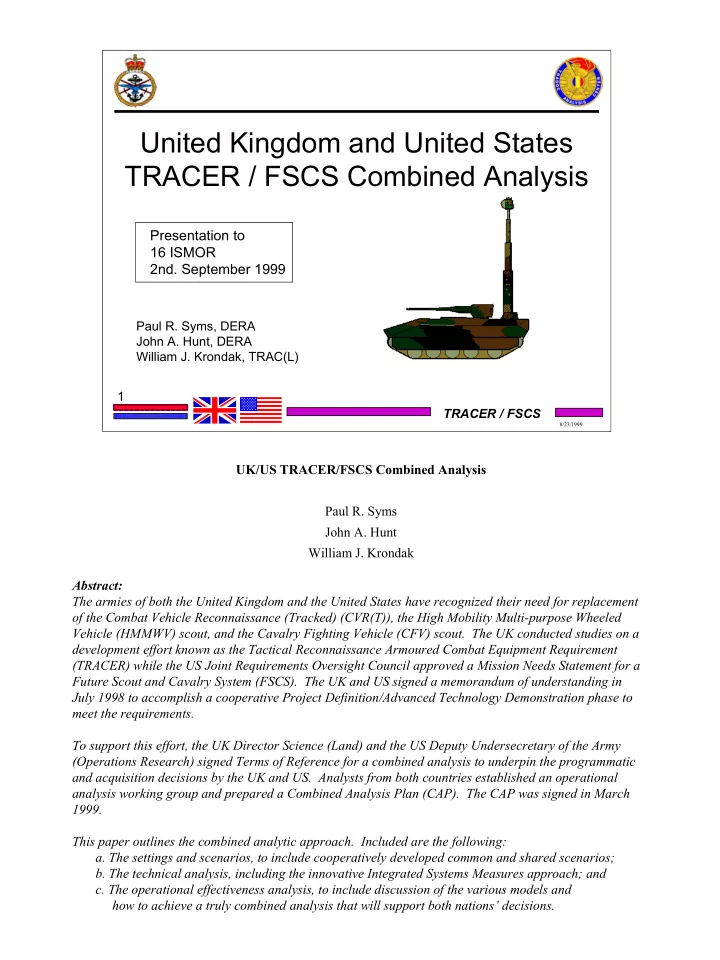
United Kingdom and United States TRACER / FSCS Combined Analysis Presentation to 16 ISMOR 2nd. September 1999 Paul R. Syms, DERA John A. Hunt, DERA William J. Krondak, TRAC(L) 1 TRACER / FSCS 8/23/1999 UK/US TRACER/FSCS Combined Analysis


slide-1
SLIDE 1

8/23/1999

TRACER / FSCS 1

United Kingdom and United States TRACER / FSCS Combined Analysis

Presentation to 16 ISMOR

  • 2nd. September 1999

Paul R. Syms, DERA John A. Hunt, DERA William J. Krondak, TRAC(L) UK/US TRACER/FSCS Combined Analysis Paul R. Syms John A. Hunt William J. Krondak Abstract: The armies of both the United Kingdom and the United States have recognized their need for replacement

  • f the Combat Vehicle Reconnaissance (Tracked) (CVR(T)), the High Mobility Multi-purpose Wheeled

Vehicle (HMMWV) scout, and the Cavalry Fighting Vehicle (CFV) scout. The UK conducted studies on a development effort known as the Tactical Reconnaissance Armoured Combat Equipment Requirement (TRACER) while the US Joint Requirements Oversight Council approved a Mission Needs Statement for a Future Scout and Cavalry System (FSCS). The UK and US signed a memorandum of understanding in July 1998 to accomplish a cooperative Project Definition/Advanced Technology Demonstration phase to meet the requirements. To support this effort, the UK Director Science (Land) and the US Deputy Undersecretary of the Army (Operations Research) signed Terms of Reference for a combined analysis to underpin the programmatic and acquisition decisions by the UK and US. Analysts from both countries established an operational analysis working group and prepared a Combined Analysis Plan (CAP). The CAP was signed in March 1999. This paper outlines the combined analytic approach. Included are the following:

  • a. The settings and scenarios, to include cooperatively developed common and shared scenarios;
  • b. The technical analysis, including the innovative Integrated Systems Measures approach; and
  • c. The operational effectiveness analysis, to include discussion of the various models and

how to achieve a truly combined analysis that will support both nations’ decisions.

slide-2
SLIDE 2

8/23/1999

TRACER / FSCS 2

  • Pre 1997 - UK and US each conduct research on ground scout

technologies

  • Mar 97 - US and UK began Cooperative Program Exploratory Analysis
  • Apr 97 - US Joint Requirements Oversight Council (JROC) validated

Mission Needs Statement (MNS)

  • Nov 97 - Terms of Reference for Analysis drafted at Operational Analysis

Working Group meeting in UK. Signed by Mr. Hollis, DUSA(OR) for US and Mr. Larcombe (Director Science (Land)) for UK

  • Feb 98 - MOU signed by US
  • Jul 98 - MOU signed by UK following Strategic Defence Review
  • Jan 99 - Project Definition/Advanced Technology Demonstration

contracts signed by US and UK with two competing consortia

  • Mar 99 - Combined Analysis Plan signed by US and UK

Background

  • 1. Introduction. Many countries in the European and North Atlantic community recognize that

they must cooperate to develop and produce affordable and interoperable military systems for their future security needs. In the area of ground-based surveillance and reconnaissance, the United Kingdom (UK) and the United States (US) recently began a cooperative Project Definition (PD) and Advanced Technology Demonstration (ATD) phase to build a new manned ground scout vehicle. A combined UK and US government analysis effort will parallel the PD/ATD phase and inform the government leaders regarding the development decisions at the end of the phase.

  • 2. Background.

2.1. Both UK and US military leaders recognized that a ground scout provided certain capabilities that could not be met by aerial surveillance and reconnaissance platforms or by other intelligence

  • means. The existing systems, the UK’s Combat Vehicle Reconnaissance (Tracked) (CVR(T)) and

the US High-Mobility Multi-purpose Wheeled Vehicle (HMMWV) and Bradley Cavalry Fighting Vehicles (CFV) were effective but aging. They did not have the platforms to incorporate the new technology becoming available through research and development. Thus, both nations sought to develop a replacement for the existing systems. After extensive research, the countries investigated whether a cooperative development was feasible. The chart shown here illustrates the steps taken to create a cooperative development program as well as a combined analysis. Note that the combined analysis terms of reference were drawn up in anticipation of the signing of the Memorandum of Understanding for cooperative development and highlight the excellent working relationship between analysts in the UK and US.

slide-3
SLIDE 3

8/23/1999

TRACER / FSCS 3

Study Objective and Approach

The objective of this Combined Analysis is to determine the most cost effective ground scout system to replace the Bradley Cavalry Fighting Vehicle (CFV) and the High Mobility Multi-purpose Wheeled Vehicle (HMMWV) used by US forces, and the Combat Vehicle Reconnaissance Tracked (CVR(T)) used by UK forces.

CAP

PM FSCS AMSAA TRAC DERA USAARMC

PM TRACER

SPS DLW

Integration of analyses and study questions accomplished through CAP and its study modules. 2.2. The PD/ATD phase lasts 42 months. The two competing consortia are Team Lancer and SIKA

  • International. Team Lancer is GEC-Marconi and Alvis Vehicles of the UK teamed with Raytheon

and United Defense of the US. SIKA International includes British Aerospace and Vickers Defence Systems of the UK teamed with Lockheed Martin and General Dynamics of the US. Both teams will work to create what they believe to be the systems that best meet the requirements specified in the Combined Operational Requirements Document (CORD) developed by the UK and US user

  • communities. They will build and test an integrated demonstrator vehicle.
  • 3. Study objective. The government analysis conducted in the combined analysis program by UK and

US analysts will help to make national authorities “informed customers” regarding the proposals from the industry consortia. The specific study objective (shown in the chart above) is to determine the most cost effective ground scout system to replace the HMMWV, Bradley CFV and CVR(T).

  • 4. Study approach. The study approach was developed through creation of the Combined Analysis

Plan (CAP). The CAP included input from agencies shown on the chart above. They included the US Army Armor Center (USAARMC), Project Manager Future Scout and Cavalry System (PM FSCS), US Army Materiel Systems Analysis Activity (AMSAA), and US Army Training and Doctrine Command Analysis Center (TRAC). United Kingdom contributors included the Directorate of Land Warfare (DLW), Project Manager TRACER, Specialist Procurement Services (SPS) and the Defence Evaluation and Research Agency (DERA) which includes the Centre for Defense Analysis (CDA).

slide-4
SLIDE 4

8/23/1999

TRACER / FSCS 4

Study Management

Combined Studies Advisory Group

Operational Analysis Working Group General/Settings Technologies/Performance Operational Effectiveness Cost US Co-chair Walt Hollis UK Co-chair Ian Sharpe Study Directors US - Mike Bauman UK - Alan Dixon US Roy Willoughby UK Andy Lane

Paul Syms Bill Krondak Harvey Lee John Hunt Rod Eaton Paul Syms Bill White Julian Burridge

Joint Program Office GO Steering Comm 4.1. Study management. The chart above describes the combined study management structure. Note that the Joint Program Office and a General Officer Steering Committee provide input to the Combined Study Advisory Group. The co-study directors are Mr. Alan Dixon of the Directorate Science (Land) (DSc(L)) and Mr. Mike Bauman of TRAC. The operational analysis working group (OAWG) comprises four sub-groups working under the leadership of Mr. Andy Lane of DSc(L) and

  • Mr. Roy Willoughby of TRAC.

4.2 Study modules. The study approach used a hierarchical structure of questions derived from the study objective. The questions were then gathered into logical groupings related to General/Setting, Technologies/Performance, Operational Effectiveness, Cost and Integration. The analysis working group then created and assigned a series of study modules that would address the questions. As each module is completed, its output will be used as input to answer the hierarchical structure of

  • questions. The study modules are being addressed in a time schedule broken in segments. This

provides management a tool to help allocate resources and assess progress.

slide-5
SLIDE 5

8/23/1999

TRACER / FSCS 5

M-T.1.1 Sensor Capabilities M-T.1.2 Survivability Analysis M-T.1.3 C4I Capabilities M-T.2.2 Mobility M-T.2.1 Firepower M-T.2.3 System Reliability M-T.0 Integrated Systems Analysis M-O.2 Scenario Development M-O.3 Operational Effectiveness M-O.4 TRACER/FSCS C4I Interactions M-O.6 Ground Recce Tactics Analysis M-O.5 Interactions with RISTA Assets M-O.8 Operational Sustainability M-O.7 Force Design M-C.1 Life-Cycle Costs M-C.2 Training Impact M-C.3 Logistics Impact M-C.5 Cost of Technologies M-C.4 Manpower Requirements M-C.6 Generation of Vehicle Variants M-I.1 Integration

  • f Study Results

Cost, Usage and Maintaianance M-O.1 Mission Needs

M-T.n Technical Analysis M-O.n Operational Effectiveness M-C.n Cost Analysis M-I.n Study Integration

CAP Study Modules

4.3. Scope of the study modules. The Combined Analysis Plan (CAP) consists of 21 separate study modules which are divided into Technical, Operational Effectiveness, Cost and Integration. The relationships between them are indicated by the lines.

slide-6
SLIDE 6

8/23/1999

TRACER / FSCS 6

Critical Study Questions

Level One Question: What are the cost and effectiveness values of TRACER/FSCS options? Level Two Questions: General (G) What are the settings to be used? Technical (T) What are the integrated system performance, cost and risk estimates for each alternative? Operations (O) What is the operational effectiveness of each alternative? Cost (C) What is the cost of each alternative?

  • 5. Critical study questions. The chart above shows the top level question related to the study
  • bjective and the level two sub-questions. In the following sections, the level three questions

assigned to each sub-group will be shown and the analytic tools and methods highlighted.

slide-7
SLIDE 7

8/23/1999

TRACER / FSCS 7 Level Three Technical Questions: T-1. What are the performance and risk estimates for potential sub-system technologies, correlated to cost? T-2. What is the optimal mix of TRACER/FSCS technologies (e.g. sensors, weapons, and signature management)? T-3. What are the most risk-adjusted cost effective sub-systems technologies and system level concepts? T-4. What techniques are required for the operator to make most effective use of potential new TRACER/FSCS technical capabilities? T-5. What are the best technology solutions that should be integrated into the TRACER/FSCS vehicle?

Technical Analysis Questions

Module Approach: M-T.0. Integrated System Measures Analysis M-T.1.1. Integrated sensors capabilities M-T.1.2. Integrated survivability analysis M-T.1.3. Integrated C4I capabilities M-T.2.1. Firepower analysis M-T.2.2. Mobility Analysis M-T.2.3. System Reliability

  • 6. Technical Analysis.

6.1 Technical questions and modules. The questions for the technical analysis are shown in the chart above. The analysts then developed modules to address the questions. Because of the expected resource requirements associated with module fulfillment and because some of the questions had already been addressed extensively in the prior research and analysis, the OAWG prioritized the modules. Priority one modules are shown on the left. Priority two modules are shown on the right. Several unique issues arose and were addressed by the technical analysis working group. Among them was the issue of survivability. The question arose “What constitutes a scout kill?” The analysts agreed that more than the traditional mobility kill, firepower kill, or catastrophic kill assessments were needed. The reason was that the scout is supposed to provide information about the battlefield to its higher headquarters and adjacent units. Thus the analysts developed a scheme to include sensor kills and communications kills in scout survivability. A second unique issue was how to address logically the many system and subsystem capabilities that had to be examined to enable assessment of the existing and proposed future concepts. The UK proposed an approach called integrated systems measures (ISMs).

slide-8
SLIDE 8

8/23/1999

TRACER / FSCS 8

Technical Analysis

Functions

  • Acquire info and targets
  • Communicate information
  • Survive when acquired
  • “Service” targets

Technical Analysis & Integrated Systems Measures (ISM) Approach:

  • AMSAA/DERA effort
  • Provides item level performance analysis
  • Examines Scout functions in vignettes
  • ISMs are measure of integrated performance of the system
  • Links capabilities with functions to determine the most appropriate

system design and allows trade-offs to be made

  • Supports Cost as an Independent Variable (CAIV) analysis

Capabilities/behaviors

  • Sensors
  • Survivability packages
  • C4I Capabilities
  • Firepower
  • Mobility
  • Reliability-Sustainability

6.2. Technical analysis and integrated systems measures. AMSAA and DERA agreed to use an integrated technical analysis and integrated systems measures (ISM) approach for this analysis. The technical analysis feeds the operational effectiveness (OE) analysis with technical data, and the ISMs and cost analysis with cost-performance data. 6.2.1. The technical analysis provides item level analysis of the components of the new scout system. It will assess the relative capabilities of a variety of sensors, survivability suites, command, control, communications, and computer packages, armament, as well as mobility and reliability concepts. It will do this using a variety of engineering level models and high resolution combat models. The technical analysis and ISM will support use of cost as an independent variable (CAIV) analysis. 6.2.2. The ISMs are high level measures of the behavior or function of a system. ISM measures what a system is supposed to do to meet the mission requirements placed upon it by military commanders. It is not a demand on the form of the system or implementation of a solution. For example, survivability is a behavior, while armor capable of defeating a given threat is demand on the form

  • f the system and does not allow the government or industry to meet the survivability requirement

using an alternative technology or approach. Taking the integrated approach, survivability is dependent on a variety of things other than just armour; these include sensor range, mobility, vehicle profile, weapons, and sensor countermeasures. ISMs differentiate between measures, metrics, and the subsequent requirements: for example, “speed” is a measure, 30 km/h is a metric, and “vehicle speed shall be at least 30 km/h” is a requirement. ISM analysis will support modification of the requirements based on tradeoffs during the study.

slide-9
SLIDE 9

8/23/1999

TRACER / FSCS 9

Level Three General Questions: G-1. What mission needs as stated in the CORD and MNS need to be further defined and analyzed? G-2. What are the missions, threats, environmental conditions, and terrain assumptions? G-3. What are the interfacing systems at the platform, force and joint/combined levels?

General Setting Questions

Module Approach: M-O.1. Mission needs. Assess mission needs for scouts. M-O.2. Scenario development. Build common and shared scenarios. Develop environmental and threat conditions for scenarios to assess system capabilities and vulnerabilities. M-O.4. C4I interactions. Use scenario settings (forces and systems) and results of the C4I module to assess the interfacing systems.

  • 7. General Setting.

7.1. Setting questions and modules. What settings to use in the operational analysis composed the level two question for this group. The level three questions shown on the next chart are being addressed through appropriate modules that define the missions, scenarios and environmental conditions under which the alternatives are to be examined. The mission needs question is being addressed through a review of existing doctrine and scout requirements. The issues to be explored in the module include mobility requirements to assess the need for tracks or wheels, the survivability requirements, and the armament requirements. To satisfactorily answer the second question on threat, environment and terrain issues, the operational analysis working group (OAWG)concluded that a number of scenarios and combat simulations would have to be used. Some of the scenarios are common scenarios, that is, both the US and UK will use the same scenario in their own simulations. Other scenarios are shared. Shared scenarios will be used in a combat simulation by one of the nation’s analysts and then the results shared with the other nation’s analysts and used to fulfill the study module requirements and answer the critical study questions. The question on system interfaces will be addressed through evaluation of the scenarios that use a variety of units (formation reconnaissance, battlegroup scouts, armored cavalry regiments, division cavalry, etc.), as well as a variety of joint and combined environments that will bring to bear a wide variety of supporting and cooperating sensor and weapon systems. All these will have to be integrated through command and control systems to achieve the full joint and combined operations capability.

slide-10
SLIDE 10

8/23/1999

TRACER / FSCS 10

Scenario Spectrum

Notes: NRC - NATO Regional Conflict FR - Formation Reconnaissance OOTW - Operations Other Than War CR - Close Reconnaissance SWA - Southwest Asia CDS - Corps/division scenario NEA - Northeast Asia CE - Central Europe MTW - Major Theatre of War indicates combined war gaming of Coalition operations for common scenarios

Serial Name Engagement Setting Terrain

  • Tgt. array

FR/CR Gamed as 1 ACR advance cover Meeting engt. NRC Rolling, wooded Moving FR HRS 62 2 Div Cav guard Zone recon OOTW Hilly, wooded Static FR HRS 61 3 Early entry Defensive SWA Open, rolling Moving Both SWA CDS 4 Corps offensive Corps attack MTW Hilly, mixed Largely static Both NEA CDS 5 Desert defensive Brigade defence NRC Rolling, open Static Both Series 57A 6 Desert offensive Brigade offence NRC Rolling, open Moving Both Series 57B 7 Centre: deter Division defence CE Rolling, mixed Static Both Series 58A 8 Centre: restore Division attack CE Rolling, mixed Moving Both Series 58B 9 Restore enclave BG attack OOTW Hilly, wooded Static CR Series 57C

7.2. Scenario spectrum. The scenario spectrum proposed for use and currently under development includes a wide range of settings. It includes major regional conflicts as well as operations other than war. The terrains range from hilly, mixed terrain that is very restrictive for mobility and line of sight to open desert terrain. The missions range from attacks and defensive operations to zone reconnaissance operations in an operations other than war environment. One of the unique accomplishments of this study has been the development of common scenarios. The UK analysts and military gamers assisted the US in the development of a common scenario at TRAC White Sands Missile Range in 1998. The US assisted the UK in the development of a common scenario at DERA Fort Halstead in early 1999. 7.2.1. For certain scenarios, the weather and threat environments will be altered to conduct

  • excursions. For example, one scenario excursion will include falling snow to examine mobility

and sensor capabilities, and another excursion will include precipitation and heavy fog. Environmental conditions such as high winds and ‘hot and high’ atmospheres, both of which could limit the use of unmanned aerial vehicles (UAVs), will also be considered. 7.2.2. Threat excursions will include improved conventional weapons, the use of chemical weapons, and sensor counter-measures.

slide-11
SLIDE 11

8/23/1999

TRACER / FSCS 11

Operational Analysis Questions - 1

Level Three Operations Questions: O-1. What is the ability of each alternative to satisfy the commander’s critical information requirements? O-2. What is the operational effectiveness of each alternative from a system perspective and from a force-on-force perspective under varying battlefield conditions? O-3. What are the operational effectiveness levels achieved on the UK guided missile TRACER/FSCS alternative? Should this capability be integrated

  • n future TRACER/FSCS platforms in a medium force?

O-4. What is the effect of other C4ISR linkages and long range communications?

Module approach: M-O.3. Operational effectiveness M-O.4. TRACER/FSCS C4I interactions

  • 8. Operational effectiveness analysis.

8.1. Operational effectiveness questions and modules. The questions to be addressed by the

  • perational effectiveness analysis are shown on the chart above and continued on the next chart.

Four modules have been developed to address the questions. Two are shown on this chart. Note that the first question relates to how the scout system will satisfy the commander’s critical information requirements. When the commander and staff do a mission assessment for an upcoming operation, they determine what information they must gather to increase their chances for achieving success. Establishing a set of critical information requirements thus enables the intelligence staff and subordinate units to focus their reconnaissance and surveillance efforts. The second question will be addressed by combat simulations. The third question relates to the UK employment of specialist overwatch variants carrying long range guided weapons to engage targets identified by the scouts. The fourth question relates to how will the commander control and communicate with a scout if it is built with the capability to penetrate deep into enemy territory to gather information.

slide-12
SLIDE 12

8/23/1999

TRACER / FSCS 12

Operational Analysis Questions - 2

Level Three Operations Questions (continued): O-5. What is the effect of using long range standoff killers assisting ground scouts? O-6. What is the survivability of each alternative? O-7. What are the interactions of the TRACER/FSCS with other reconnaissance systems, such as UAVs and airborne radar systems, as well as other combat and combat support systems like the attack helicopter, artillery, engineer reconnaissance, fixed wing assets and electronic warfare? O-8. What is the preferred method of employment of the British TRACER/FSCS?

Module approach (continued): M-O.5. Interactions with recon, surveillance and target acquisition assets. M-O.6. Ground reconnaissance tactics.

8.2. This chart continues the discussion of the operational analysis questions and modules. 8.2.1. Standoff killers refers to artillery and missile systems as well as helicopters armed with guided weapons that can be used in a ‘fire and forget’ mode. 8.2.2. Note the question regarding survivability. The operational effectiveness analysis will take the data and assessments from the technical analysis and the ISM and evaluate the resulting concepts in both high resolution force-on-force simulations as well as corps-level and division-level combat models. 8.2.3. The question on interactions is to determine the optimum mix of manned ground reconnaissance and other tactical reconnaissance systems, particularly UAVs, to achieve the reconnaissance aims, and ultimately, to achieve a successful battle outcome. This is driven by both nations’ desires to procure a cost-effective and robust tactical reconnaissance capability. 8.2.4. The question on preferred methods of employment is aimed particularly at the GW overwatch vehicle, and its use to counter enemy reconnaissance. It will be addressed primarily using the Janus wargame, possibly in combination with less detailed (but also less costly) manual wargaming.

slide-13
SLIDE 13

8/23/1999

TRACER / FSCS 13

Operational Effectiveness

Segment 1 Develop MoEs and MoPs Develop Scenarios Enhance models & simulations Gather data Segment 2 Run combat models Analyze output Report analysis Segment 3 Update analysis Report updated analysis

Unit Mission Success Scout success Force level kills & losses Common scenarios: ACR Cover Bde/Battlegroup Defence Others: Div Cav Guard (OOTW) Series 57 and 58 scenarios Corps/Division SWA and NEA Janus, CASTFOREM, ATLAS, STAMGEN, CEWS, VIC, GLAM

Affordability Review PD/ATD milestone Review 8.3. Operational effectiveness analysis. The operational effectiveness (OE) analysis is divided into three segments. Each contributes to the following segment and builds on previous work. 8.3.1. Segment one. During segment one, measures of effectiveness (MoEs) and measures of performance (MoPs) will be developed. These will use input from the technical analysis, and scenario input regarding the unit mission and scout mission. The critical information requirements mentioned earlier will feed the development of MoE and MoP. It should be noted that the analysis has to respond to the subtleties of reconnaissance and scouting, and traditional attrition based MoEs, such as loss-exchange ratio, are inappropriate. The development of MoEs to measure battle outcome is one of the greatest technical challenges of the programme. The models will also be enhanced to enable them better to represent new technologies and reconnaissance tactics. They will construct the scenarios designated by the General Settings sub-group and get the implementations approved. They will gather data from the technical analysis and from intelligence sources to load the combat models with the best data available. The models being used include brigade and battlegroup level interactive tools like Janus, and also the US Combined Arms and Support Task Force Evaluation Model (CAST- FOREM), the UK Analysis Tool for Land Systems (ATLAS), and corps and division-level simulations like Vector-in-Commander (VIC) and the UK Generic Land Aggregation Model (GLAM). 8.3.2. Segment two. During segment two, the analysts will run the scenarios in the models, assess the various alternative concepts for the ground scout, share the output with their counterparts, and develop reports and briefings to support a general officer Affordability Review in early 2001.

slide-14
SLIDE 14

8/23/1999

TRACER / FSCS 14

Cost Analysis Questions

Level Three Cost Questions: C-1. What is the estimated cost of each potential technology? C-2. What are the training, logistics and manpower requirements impacts for each alternative? C-2. What is the Life Cycle Cost (LCC) of each alternative? C-4. What are the potential development costs of building TRACER/FSCS variants for a medium force? Module Approach: M-C.1. Life cycle costs. M-C.2. Logistics impact. M-C.3. Training impact. M-C.4. Manpower requirements. M-C.5. Potential technology costs. M-C.6. TRACER/FSCS variants.

8.3.3. Segment three. Segment three will address any unanswered questions, update the analysis based on the emerging contractor proposals and provide the necessary information to inform the decision to move to the next phase in the development program. That decision will take place in mid-2002.

  • 9. Cost analysis questions and approach. The chart above shows the cost questions and cost

module approach. The costing method will include building a full life cycle cost estimate to include research, development, test, and evaluation (RDT&E), procurement, and operation and sustainability (O&S) cost for each alternative. In addition, the modules will include a training impact assessment, a logistics impact assessment, manpower requirements, and evaluation of the technology costs associated with the promising new technologies that may be applied to the scout system. The cost analysis will also include a module that assesses the costs of developing variants of the scout, particularly the UK guided weapon carrying variant.

slide-15
SLIDE 15

8/23/1999

TRACER / FSCS 15

Summary

The Combined Analysis Program contains many challenges: Analytical: Integrated System Measures Cost as an Independent Variable Common and Shared Scenarios Innovative Measures of Effectiveness Integration of Results Management: National differences in acquisition analytical support Analysis of classified technologies Highly demanding schedule

  • 10. Summary. The TRACER/FSCS combined analysis is an ambitious study but certainly one with

high-level management and oversight. Several new or innovative methods are being used or

  • explored. They include the integrated systems measures approach, the cost as an independent

variable method, the common and shared scenarios, the development of non-traditional measures of effectiveness and performance, and finally the challenging integration of the results to meet the decision needs of the leaders in two independent nations. The challenge is great. We hope to be able to report out the results of this work to a future ISMOR.

slide-16
SLIDE 16

8/23/1999

TRACER / FSCS 16

Any questions?

Paul R. Syms, CDA(L/A), DERA: prsyms@dera.gov.uk John A. Hunt, Land Systems, DERA: jahunt@dera.gov.uk William J. Krondak, TRAC Fort Leavenworth: krondakw@trac.army.mil

  • Dr. Paul R. Syms is a principal scientist in the Land/Air Studies Department of the Centre for

Defence Analysis, which is part of the UK Defence Evaluation and Research Agency (DERA). He received a Bachelor of Science degree in Applied Biology from Brunel University, and a doctorate in entomology from the University of London’s Queen Mary College. He has worked in military

  • perational analysis for ten years. He can be contacted on (1959) 514362, fax. (1959) 516027,
  • r by e-mail at prsyms@dera.gov.uk.
  • Mr. John A. Hunt is the DERA Technical Manager for the TRACER Programme. He graduated from

the University of London’s Imperial College with a Bachelor of Science degree in Mechanical Engineering and has a Master of Science degree in Military Vehicle Technology from RMCS. He is a Chartered Mechanical Engineer who has been working on the UK TRACER programme since the early 1990s and is contactable on e-mail at jahunt@dera.gov.uk.

  • Mr. William J. Krondak serves as the Director of Joint and Combined Operations analysis for

TRADOC Analysis Center, Fort Leavenworth, Kansas. He received a Bachelor of Science degree in Mathematics from the University of Nebraska and a Masters degree from the University of

  • Oklahoma. He graduated from the Armed Forces Staff College in Norfolk, Virginia, and the U.S.

Army War College at Carlisle Barracks, Pennsylvania. He can be reached at (913) 684-9209,

  • fax. (913) 684-9191, or e-mail at krondakw@trac.army.mil.