UNIT V BUBBLING WELL ROAD I HAVE A DREAM VIGNANA BHARATHI - - PowerPoint PPT Presentation

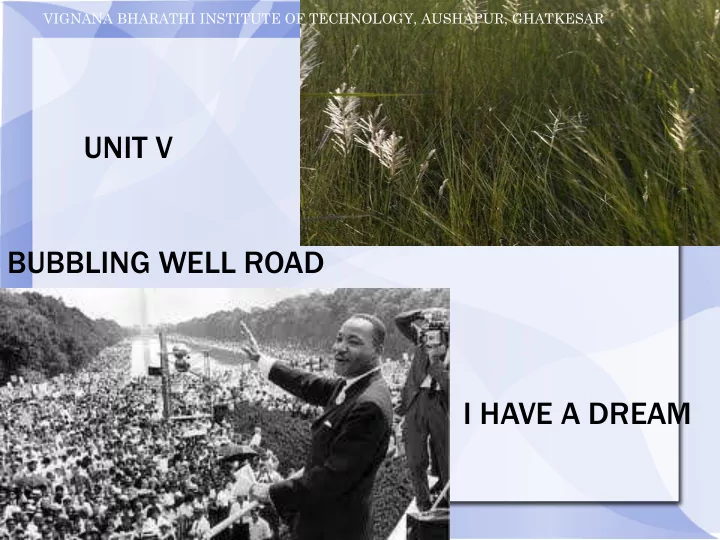
unit v bubbling well road i have a dream
SMART_READER_LITE
LIVE PREVIEW

UNIT V BUBBLING WELL ROAD I HAVE A DREAM VIGNANA BHARATHI - - PowerPoint PPT Presentation

VIGNANA BHARATHI INSTITUTE OF TECHNOLOGY, AUSHAPUR, GHATKESAR UNIT V BUBBLING WELL ROAD I HAVE A DREAM VIGNANA BHARATHI INSTITUTE OF TECHNOLOGY, AUSHAPUR, GHATKESAR Rudyard Kipling Rudyard Kipling (1865-1936), English writer and Nobel

slide-1
SLIDE 1

UNIT V BUBBLING WELL ROAD I HAVE A DREAM

VIGNANA BHARATHI INSTITUTE OF TECHNOLOGY, AUSHAPUR, GHATKESAR

slide-2
SLIDE 2

Rudyard Kipling

Rudyard Kipling (1865-1936), English writer and Nobel laureate, wrote novels, poems, and short stories, most of them set in India and Myanmar (Burma) during the time of British rule.

VIGNANA BHARATHI INSTITUTE OF TECHNOLOGY, AUSHAPUR, GHATKESAR

slide-3
SLIDE 3

Rudyard Kipling

Kim, a picaresque tale of Indian life that is generally regarded as his masterpiece, was published in 1901 “The Jungle Book” (1894) and “The Second Jungle Book” (1895), two collections of animal stories, which many consider his finest writing were very successful and popular

VIGNANA BHARATHI INSTITUTE OF TECHNOLOGY, AUSHAPUR, GHATKESAR

slide-4
SLIDE 4

THE JUNGLE BOOK

Mowgli, a boy raised by wolves & Baloo, the bear have become household names

VIGNANA BHARATHI INSTITUTE OF TECHNOLOGY, AUSHAPUR, GHATKESAR

slide-5
SLIDE 5

This is a humorous short story The humour in the story arises mainly from the difference between how the narrator poses himself to be at the beginning of the story and what he turns out to be by the end of his ‘misadventure’ into the Arti-goth patch of ten to twenty feet tall jungle grass

The Bubbling Well Road

VIGNANA BHARATHI INSTITUTE OF TECHNOLOGY, AUSHAPUR, GHATKESAR

slide-6
SLIDE 6

The Bubbling Well Road

The narrator is told by the villagers that a sounder of pigs, one of them with foot-long tushes, entered the grass patch. The narrator is immediately tempted and goes into the patch to hunt it though he does not know much about hunting pigs.

VIGNANA BHARATHI INSTITUTE OF TECHNOLOGY, AUSHAPUR, GHATKESAR

slide-7
SLIDE 7

He carries a gun and is accompanied by his dog, Mr. Wardle

The Bubbling Well Road

VIGNANA BHARATHI INSTITUTE OF TECHNOLOGY, AUSHAPUR, GHATKESAR

slide-8
SLIDE 8

The dog easily slips in and out of the grass clumps But the narrator finds it hard to move through the thick grass. He feels as if he is lost in the heart of Central African deep forest. He starts sweating profusely as the grass stems are as hot as boiler tubes

The Bubbling Well Road

VIGNANA BHARATHI INSTITUTE OF TECHNOLOGY, AUSHAPUR, GHATKESAR

slide-9
SLIDE 9

Soon, the dog goes missing and he starts calling out for his dog To his horror, he finds his own words are echoed from under his feet The narrator moves slowly and cautiously and finds a deep, black hole in the ground right in front of him

The Bubbling Well Road

VIGNANA BHARATHI INSTITUTE OF TECHNOLOGY, AUSHAPUR, GHATKESAR

slide-10
SLIDE 10

It turns out to be a very dark and deep well and he hears strange sounds and feels some black things moving in circles in it With some effort, he observes that a little spring of water falling into the well with a splutter is creating the sound of laughter

The Bubbling Well Road

VIGNANA BHARATHI INSTITUTE OF TECHNOLOGY, AUSHAPUR, GHATKESAR

slide-11
SLIDE 11

The narrator after getting scared by what he sees and hears in the patch of the grass and in the well, at last reaches the priest’s hut with a great difficulty. The priest is scared on seeing the narrator who is carrying a rifle and accompanied by a dog

The Bubbling Well Road

VIGNANA BHARATHI INSTITUTE OF TECHNOLOGY, AUSHAPUR, GHATKESAR

slide-12
SLIDE 12

After resting there for a while, he finally reaches the village with the old priest’s help The writer realizes that the fears of the villagers about the old man and the devils and ghost under his control are only baseless Before leaving, the narrator tries to set the grass patch alight but is not successful as it was too green He decides to come back the next summer with a bundle of newspapers and a match-box and put an end to the mystery of the Bubbling Well Road

The Bubbling Well Road

VIGNANA BHARATHI INSTITUTE OF TECHNOLOGY, AUSHAPUR, GHATKESAR

slide-13
SLIDE 13

Martin Luther King Jr.

(January 15, 1929 – April 4, 1968)

was an American Clergyman, activist and prominent leader in the African-American civil rights movement. His major achievement was to secure progress in the civil rights movement in the United States, he became an icon in the black movement.

VIGNANA BHARATHI INSTITUTE OF TECHNOLOGY, AUSHAPUR, GHATKESAR

slide-14
SLIDE 14

Slavery in America

slide-15
SLIDE 15

Two Great Books dealing with the theme of slavery in America

slide-16
SLIDE 16

THE MONTGOMERY BUS BOYCOTT

In 1955 King, who had just received his Ph.D. degree, was asked to lead a bus boycott in Montgomery. The city's black leaders had organized the boycott to protest against enforced racial segregation in public transport after the arrest of Rosa Parks, a black woman who had refused to give up her seat to a white passenger.

VIGNANA BHARATHI INSTITUTE OF TECHNOLOGY, AUSHAPUR, GHATKESAR

slide-17
SLIDE 17

THE MONTGOMERY BUS BOYCOTT

In the course of the 381-day action King was arrested and jailed, his home was bombed, and many threats were made against his life. The boycott ended in 1956 with a mandate from the Supreme Court outlawing all segregated public transport in the city. The Montgomery boycott was a clear victory for non-violent protest, and King emerged as a highly respected leader.

VIGNANA BHARATHI INSTITUTE OF TECHNOLOGY, AUSHAPUR, GHATKESAR

slide-18
SLIDE 18

Rosa Parks

THE MONTGOMERY BUS BOYCOTT

VIGNANA BHARATHI INSTITUTE OF TECHNOLOGY, AUSHAPUR, GHATKESAR

slide-19
SLIDE 19

Martin Luther King’s I HAVE A DREAM

King’s efforts led to the 1963 March in Washington, where he delivered his ‘I Have a Dream’ speech. His speech on August 28, 1963, from the steps of the Lincoln Memorial during the March in Washington for jobs and freedom, was a defining movement of the American Civil Rights Movement. There, he raised public consciousness

  • f the civil rights movement and established himself

as one of the greatest orators in US history

VIGNANA BHARATHI INSTITUTE OF TECHNOLOGY, AUSHAPUR, GHATKESAR

slide-20
SLIDE 20

Martin Luther King’s I HAVE A DREAM

MLK was a prominent advocate of non-violent resistance to racial oppression. On a visit to India in 1959 King was able to work out his understanding of Satyagraha, Gandhi's principle of non-violent persuasion, which King used as his main instrument of social protest.

VIGNANA BHARATHI INSTITUTE OF TECHNOLOGY, AUSHAPUR, GHATKESAR

slide-21
SLIDE 21

Martin Luther mentions that in 1863, a great man (Abraham Lincoln) proclaimed that blacks were free and paved the way for them to be recruited into the American Army. But one hundred years later, the Negro still is not free. They are still oppressed, segregated in the corners of American society. One hundred years later, the Negro lives on the lonely island

  • f poverty in the midst of a vast ocean of

material prosperity.

Martin Luther King’s I HAVE A DREAM

VIGNANA BHARATHI INSTITUTE OF TECHNOLOGY, AUSHAPUR, GHATKESAR

slide-22
SLIDE 22

Martin Luther says that they have come to their nation’s capital to cash a check. It is clear today that the citizens of colour are unable to cash this check. Both the Constitution and the Declaration

  • f

Independence failed to keep the promise

Martin Luther King’s I HAVE A DREAM

VIGNANA BHARATHI INSTITUTE OF TECHNOLOGY, AUSHAPUR, GHATKESAR

slide-23
SLIDE 23

He serves a warning that Nineteen sixty-three is not an end, but a beginning. If the nation pays a deaf ear to these desperate cries, it would only experience a rude awakening in the coming days. There will be neither rest nor tranquility in America until the Negro is granted his citizenship rights.

Martin Luther King’s I HAVE A DREAM

VIGNANA BHARATHI INSTITUTE OF TECHNOLOGY, AUSHAPUR, GHATKESAR

slide-24
SLIDE 24

Martin Luther echoes Gandhian principle of non-violence throughout his speech and says that they must not be guilty of wrongful deeds. They must forever conduct their struggle on the high plane of dignity and discipline. Physical violence must be strictly avoided.

Martin Luther King’s I HAVE A DREAM

VIGNANA BHARATHI INSTITUTE OF TECHNOLOGY, AUSHAPUR, GHATKESAR

slide-25
SLIDE 25

He appeals to the gathering that they should adopt an inclusive policy and that their destiny is tied up with the destiny of the whites and their freedom is inseparably bound to their freedom.

Martin Luther King’s I HAVE A DREAM

VIGNANA BHARATHI INSTITUTE OF TECHNOLOGY, AUSHAPUR, GHATKESAR

slide-26
SLIDE 26

Martin Luther King makes a passionate appeal to the Negroes to come out of their despair and continue to work with the faith that selfless suffering would only result in redemption. He asks the Negroes to march ahead and never even look back. They should not be satisfied until they could enter motels and move from smaller ghettos to larger

  • nes like others. They should not rest until they are

allowed to vote for a better future and get righteous treatment.

Martin Luther King’s I HAVE A DREAM

VIGNANA BHARATHI INSTITUTE OF TECHNOLOGY, AUSHAPUR, GHATKESAR

slide-27
SLIDE 27

Martin Luther tells the huge gathering that he has a dream for the country and for his fellow black people and same breath makes it clear that his dream is part of a larger American dream. The dream that one day

Ø

America will rise up and live out the true meaning of its creed: that all men are created equal.

Ø

  • n the red hills of Georgia the sons of former slaves and the sons of

former masters will be able to dine together like brothers.

Ø

even the state of Mississippi, a state blacks were most cruelly treated, will be transformed into an oasis of freedom and justice.

Martin Luther King’s I HAVE A DREAM

VIGNANA BHARATHI INSTITUTE OF TECHNOLOGY, AUSHAPUR, GHATKESAR

slide-28
SLIDE 28

The dream

Ø that their children will one day live in a nation where they will

not be judged by the colour of their skin but by the content of their character

Ø where all the little white boys and white girls will walk together

as sisters and brothers

Ø that one day all inequalities will disappear and all people,

irrespective of their colour, will get equal treatment and

  • pportunities

Ø that the glory of the Lord shall be revealed, and all people will

see it together

Martin Luther King’s I HAVE A DREAM

VIGNANA BHARATHI INSTITUTE OF TECHNOLOGY, AUSHAPUR, GHATKESAR

slide-29
SLIDE 29

King was shot and killed in Memphis, Tennessee on April 4th 1968. Some 100,000 people attended his funeral in Atlanta. A white escaped convict, James Earl Ray, was arrested for the murder; he pleaded guilty and in March 1969 was sentenced to 99 years in prison. In 1983 the third Monday in January was designated a national holiday in honour of Martin Luther King, Jr.'s birthday; his Atlanta birthplace and gravesite were made a national historic site.