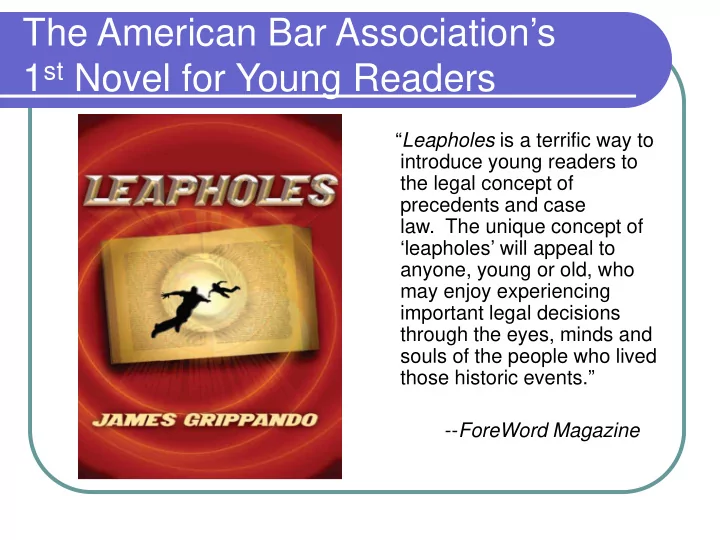
SLIDE 1 The American Bar Association’s 1st Novel for Young Readers
“Leapholes is a terrific way to introduce young readers to the legal concept of precedents and case
- law. The unique concept of
‘leapholes’ will appeal to anyone, young or old, who may enjoy experiencing important legal decisions through the eyes, minds and souls of the people who lived those historic events.”
SLIDE 2
Was Rosa Parks a real Person?
Her arrest in 1955
started a bus boycott in Montgomery, Alabama led by Dr. Martin Luther King, Jr.
Battles like hers
eventually ended up in the U.S. Supreme Court.
SLIDE 3 “Can We Go There?”
To Montgomery Alabama? To the U.S. Supreme Court in Washington D.C.?
SLIDE 4
“No, I want to Go to 1955.”
SLIDE 5
Why not? What if loopholes were…
SLIDE 6
Leapholes: The Cases
Every case mentioned in Leapholes is a
real case that involved real people who had real problems
For some, those cases were a matter of
life and death.
SLIDE 7
Legal Precedent
What is “legal precedent?”
How are legal precedents created?
Should something that happened to real people a long time ago have any impact on how we decide what is right or wrong in today’s society? Why or why not?
SLIDE 8 United States v. Holmes (1842)
Hit iceberg in 1841
and sank in North Atlantic Ocean
Lifeboats overloaded Crew threw 12 men
and 2 women
All would have died
if load had not been lightened
SLIDE 9
Holmes Decision
Judge said “sortition
should be adopted."
The word is derived
from the Latin and means “to cast or draw lots.”
Holmes was
convicted of manslaughter
SLIDE 10
Holmes: Good or Bad Precedent?
Was the judge right in condemning the sailor’s actions?
Should the passengers have cast lots to determine who should live and who should die?
What would you have done if you had been on that sinking lifeboat?
SLIDE 11
Leapholes & “Legal Evil”
Every suspense novel has “good vs. evil” In Leapholes, “Legal Evil” lives in the
worst cases (legal precedents) ever decided by the U.S. Supreme Court
One of those decisions was . . .
SLIDE 12 Dred Scott v. Sandford (1857)
Dred Scott, a slave in
Missouri, was taken by his owner in 1836 to Illinois & a free portion of the Louisiana Territory.
When his owner died,
Scott sued for freedom saying that when he was taken to places that
become free.
SLIDE 13 Dred Scott – Original Petition for Freedom (1846)
How do you think Dred Scott
must have felt asking a court to decide that another man did not “own” him?
How do you think people in
Missouri felt about this lawsuit?
How much courage do you
think it took for Dred Scott to sign his name with an “X” on this document?
How dangerous do you think
it was for a white lawyer to represent Dred Scott as the country was moving toward Civil War?
SLIDE 14 Dred Scott: “Legal Realism”
The Decision:
- - Slaves and their descendants
are not citizens & have no right to sue
- - Congress has no power to
- utlaw slavery in territories
(Missouri Compromise void)
Chief Justice Roger Taney, who wrote the court’s opinion, once
- wned slaves. Five of the nine
justices were from slave states.
Did Dred Scott have any real hope of winning?
SLIDE 15 Prigg v. Pennsylvania (1842)
In Leapholes, Legal Evil lives “where the brood follows
the dam.” That doctrine was created in ancient times to determine ownership rights over animals such as horses or cattle. If someone owned the mother (the “dam”), they also owned her offspring (the “brood”).
In 1842, the U.S. Supreme Court extended that doctrine to human beings. The Court decided that any child born to a slave was also a slave, even if the child was born in a state where slavery was illegal.
Was this a proper use of legal precedent? Why or
why not?
SLIDE 16
Leapholes and Equal Rights
In Leapholes, Ryan’s lawyer warns that “Legal Evil” is alive and well today.
Can you think of any modern-day examples of Legal Evil at work?
Why do you think the U.S. Constitution provides “equal protection” under law?
Does everyone in today’s society have equal rights under the law?
SLIDE 17 Leapholes & Confession/self-incrimination
In Leapholes, Ryan’s father is in prison because he pleaded guilty to a crime. He tells Ryan, however, that he is innocent.
Can you think of any reasons why a person might plead guilty to a crime that he did not commit? Have you ever confessed to something you did not do in
- rder to protect someone else?
Can people be forced into a confession? What makes a confession reliable? How can we decide if a confession is reliable?
Why do you think the U.S. Constitution protects the right to remain silent?