Unit2: Probabilityanddistributions 2. Bayes theorem and Bayesian - - PowerPoint PPT Presentation

unit 2 probability and distributions 2 bayes theorem and
SMART_READER_LITE
LIVE PREVIEW

Unit2: Probabilityanddistributions 2. Bayes theorem and Bayesian - - PowerPoint PPT Presentation

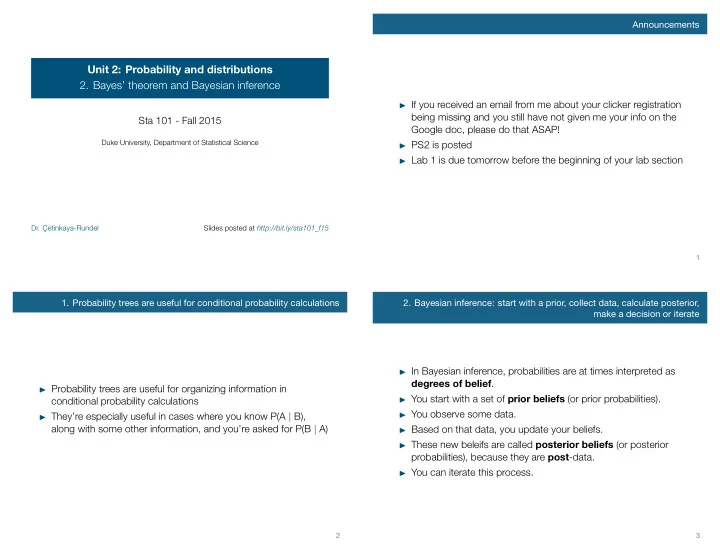
Announcements Unit2: Probabilityanddistributions 2. Bayes theorem and Bayesian inference If you received an email from me about your clicker registration being missing and you still have not given me your info on the Sta 101 - Fall


slide-1
SLIDE 1

Unit 2: Probability and distributions

  • 2. Bayes’ theorem and Bayesian inference

Sta 101 - Fall 2015

Duke University, Department of Statistical Science

  • Dr. Çetinkaya-Rundel

Slides posted at http://bit.ly/sta101_f15

Announcements ▶ If you received an email from me about your clicker registration

being missing and you still have not given me your info on the Google doc, please do that ASAP!

▶ PS2 is posted ▶ Lab 1 is due tomorrow before the beginning of your lab section

1

  • 1. Probability trees are useful for conditional probability calculations

▶ Probability trees are useful for organizing information in

conditional probability calculations

▶ They’re especially useful in cases where you know P(A | B),

along with some other information, and you’re asked for P(B | A)

2

  • 2. Bayesian inference: start with a prior, collect data, calculate posterior,

make a decision or iterate ▶ In Bayesian inference, probabilities are at times interpreted as

degrees of belief.

▶ You start with a set of prior beliefs (or prior probabilities). ▶ You observe some data. ▶ Based on that data, you update your beliefs. ▶ These new beleifs are called posterior beliefs (or posterior

probabilities), because they are post-data.

▶ You can iterate this process.

3

slide-2
SLIDE 2

Dice game

We’ll play a game to demonstrate this approach:

▶ Two dice: 6-sided and 12-sided

– I keep one die on the left and one die on the right

▶ The “good die” is the 12-sided die. ▶ Ultimate goal: come to a class consensus about whether the die

  • n the left or the die on the right is the “good die”

▶ We will start with priors, collect data, and calculate posteriors,

and make a decision or iterate until we’re ready to make a decision

4

Prior probabilities ▶ At each roll I tell you whether you won or not (win = ≥ 4)

– P(win | 6-sided die) = 0.5 → bad die – P(win | 12-sided die) = 0.75 → good die

▶ The two competing claims are

H1: Good die is on left H2: Good die is on right

▶ Since initially you have no idea which is true, you can assign

equal prior probabilities to the hypotheses

P(H1 is true) = 0.5 P(H2 is true) = 0.5

5

Rules of the game ▶ You won’t know which die I’m holding in which hand, left (L) or

right (R). left = YOUR left

▶ You pick die (L or R), I roll it, and I tell you if you win or not,

where winning is getting a number ≥ 4. If you win, you get a piece of candy. If you lose, I get to keep the candy.

▶ We’ll play this multiple times with different contestants. ▶ I will not swap the sides the dice are on at any point. ▶ You get to pick how long you want play, but there are costs

associated with playing longer.

6

Hypotheses and decisions

Truth Decision

L good, R bad

L bad, R good Pick L You get candy! You lose all the candy :( Pick R You lose all the candy :( You get candy! Sampling isn’t free! At each trial you risk losing pieces of candy if you lose (the die comes up < 4). Too many trials means you won’t have much candy left. And if we spend too much class time and we may not get through all the material.

7

slide-3
SLIDE 3

Data and decision making

Choice (L or R) Result (win or loss) Roll 1 Roll 2 Roll 3 Roll 4 Roll 5 Roll 6 Roll 7 ... What is your decision? How did you make this decision?

8

Posterior probability ▶ Posterior probability is the probability of the hypothesis given the

  • bserved data: P(hypothesis | data)

▶ Using Bayes’ theorem

P(hypothesis | data) = P(hypothesis and data) P(data) = P(data | hypothesis) × P(hypothesis) P(data)

9

Calculate the posterior probability for the hypothesis chosen in the first roll, and discuss how this might influence your decision for the next roll.

10

  • 3. Posterior probability and p-value do not mean the same thing

▶ p-value : P(observed or more extreme outcome | null hypothesis

is true)

– This is more like P(data | hyp) than P(hyp | data).

▶ posterior : P(hypothesis | data) ▶ Bayesian approach avoids the counter-intuitive Frequentist

p-value for decision making, and more advanced Bayesian techniques offer flexibility not present in Frequentist models

▶ Watch out!

– Bayes: A good prior helps, a bad prior hurts, but the prior matters less the more data you have. – p-value: It is really easy to mess up p-values: Goodman, 2008

11

slide-4
SLIDE 4

Application exercise: 2.2 Bayesian inference for drug testing

See the course website for instructions.

12

Summary of main ideas

  • 1. Probability trees are useful for conditional probability calculations
  • 2. Bayesian inference: start with a prior, collect data, calculate

posterior, make a decision or iterate

  • 3. Posterior probability and p-value do not mean the same thing

13