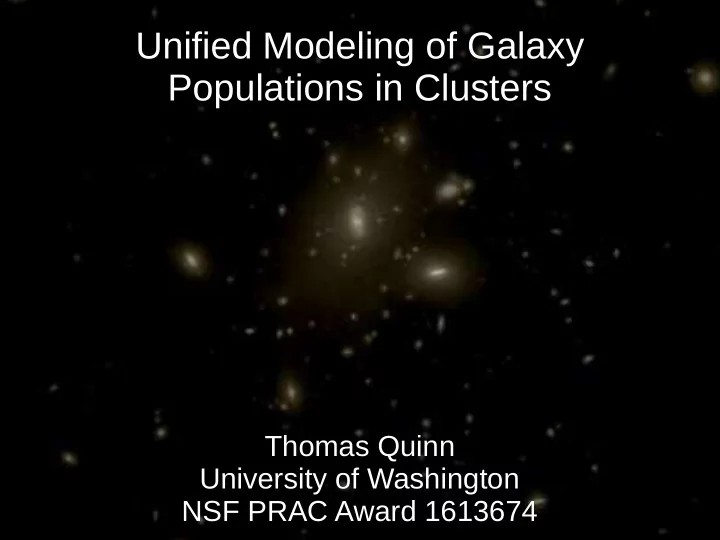
SLIDE 1
Unified Modeling of Galaxy Populations in Clusters
Thomas Quinn University of Washington NSF PRAC Award 1613674
SLIDE 2
Michael Tremmel Arif Babul Fabio Governato Lauren Anderson Ferah Munshi Joachim Stadel James Wadsley Greg Stinson
Laxmikant Kale Filippo Gioachin Pritish Jetley Celso Mendes Amit Sharma Lukasz Wesolowski Gengbin Zheng Edgar Solomonik Harshitha Menon Orion Lawlor
SLIDE 3 Outline
- Scientific background (Why it matters)
- Need for high resolution (Why Blue Waters)
- Previous Results (Accomplishments)
- The Cluster Clustering Problem (Key
Challenges)
- Charm++ and ChaNGa (Key Challenges)
- Recent results (Accomplishments)
SLIDE 4
Galaxies: can we form one of these?
SLIDE 5 Gas Stars Dark Matter
SLIDE 6 Modeling Star Formation: it's hard
- Gravitational Instabilities
- Magnetic Fields
- Radiative Transfer
- Molecular/Dust Chemistry
- Driven at large scales: differential rotation
- Driven at small scales: Supernovea and Stellar
Winds
- Scales unresolvable in cosmological simulations
SLIDE 7 Narayan et al 2008
SLIDE 8 Resolution and Subgrid Models
- Maximize Simulation Resolution
– Capture tidal torques/accretion history (20+ Mpc) – Adapt resolution to galaxy (sub-Kpc, 105 Msun)
- Capture Star Formation in a sub-grid model
– Stars form in high density environments – Supernovea/stellar winds/radiation regulate star
formation
– Mitigate issues with poor resolution (overcooling) – Tune to match present day stellar populations
SLIDE 9 Previous PRAC: good morphologies
Danielle Skinner
SLIDE 10
Good morphologies across a population
z = 0.5 z = 0.75 z = 1.2 z = 2 z = 3
SLIDE 11 Black hole/AGN feedback
- Supernova feedback doesn't suppress star
formation in massive galaxies
– Modeling of more energetic feedback required
- Components of AGN modeling:
– Seed (1e6 Msun) BH form in dense, low metallicity
gas
– BH grow from accreting gas, and release energy
into the surrounding gas (Active Galactic Nuclei)
– BH in merging galaxies sink to the center and
merge (LIGO, eLISA)
SLIDE 12 Michael Tremmel et al, 2017
SLIDE 13 Tremmel et al 2017
SLIDE 14 Milky Way DM Distribution Function
Erik Lentz
SLIDE 15
Consequences for DM Searches
SLIDE 16 Clusters: the science
in the Universe
entire Universe
- Baryonic content is
- bservable
- “Closed box” for
galactic evolution
SLIDE 17 Clusters: the challenge
- Good models of stellar feedback
- Good models of AGN (black hole) feedback
- Hydrodynamic instabilities require good
algorithms
- Resolution: 105 Msun particles in 1015 Msun
- bject
- Highly “clustered” computation
SLIDE 18 Charm Nbody GrAvity solver
- Massively parallel SPH
- SNe feedback creating
realistic outfmows
- SF linked to shielded gas
- SMBHs
- Optimized SF
parameters
Menon+ 2014, Governato+ 2014
SLIDE 19 Charm++
- C++-based parallel runtime system
– Composed of a set of globally-visible parallel objects
that interact
– The objects interact by asynchronously invoking
methods on each other
– Manages the parallel objects and (re)maps them to
processes
– Provides scheduling, load balancing, and a host of
- ther features, requiring little user intervention
SLIDE 20 06/06/18 Parallel Programming Laboratory @ UIUC 20
Scaling to .5M cores
SLIDE 21
SLIDE 22 06/06/18 Parallel Programming Laboratory @ UIUC 22
Clustered/Multistepping Challenges
- Computation is concentrated in a small fraction
- f the domain
- Load/particle imbalance
- Communication imbalance
- Fixed costs:
– Domain Decomposition – Load balancing – Tree build
SLIDE 23
Load distribution
SLIDE 24 Results: A cluster at unprecedented resolution
- Structure of the brightest cluster galaxy
- Other galaxies in the cluster environment
- The state of the intracluster medium
SLIDE 25
The highest resolution cosmological hydro simulation of a cluster to date
I n t r
u c i n g R
u l u s C
R e s
u t i
: 2 5 p c , 2 e 5 M
s u n
Zoom-In Simulation M200(z=0) = 1.5e14 Msun Gas Density HI Density Metal Density Stars
Marinacci+ 17, Dubois+ 14, Bocquet+ 16, Armitage+ 18, Schaye+ 14, Shirasaki+ 18
SLIDE 26
Outflows in the BCG
SLIDE 27
Winds are ubiquitous through time
5 . 1 8 G y r 6 . 1 5 G y r 7 . 4 G y r 8 . 6 G y r 8 . 4 7 G y r 9 . 6 G y r 9 . 7 1 G y r 7 . 4 4 G y r
SLIDE 28
Outflows and Quenching
SLIDE 29
Stellar Mass
SLIDE 30
Morphology of BCG
SLIDE 31
Quenching in the cluster
SLIDE 32
Quenching with radius
SLIDE 33
IntraCluster Medium
SLIDE 34 Take Aways
- Galaxy Clusters are hard:
– Scale is set by galactic (i.e. star formation) physics – Orders of magnitude larger than galaxies – Computational effort is spatially concentrated. – (Probably should include MHD/cosmic rays: see Iryna
Butsky's talk)
- But now clusters are doable
– Capability machines – Advanced load balancing techniques – First “holistic” simulations of galaxy clusters
More info: astro-ph 1806.01282
SLIDE 35 Acknowledgments
- NSF ITR
- NSF Astronomy
- NSF SSI
- NSF XSEDE program for computing
- BlueWaters Petascale Computing
- Blue Waters PAID Program
- NASA HST
- NASA Advanced Supercomputing
SLIDE 36
Zoomed Cluster simulation
SLIDE 37 Gravity Gas Communication SMP load sharing
29.4 seconds
LB by particle count
SLIDE 38 15.8 seconds
LB by Compute time
Star Formation
SLIDE 39 Luminosity Function
Anderson, et al 2016
SLIDE 40 Faint galaxies reionize the Universe
Anderson et al 2016
SLIDE 41 Faint galaxies reionize the Universe
Anderson et al 2016
SLIDE 42 PAID: ChaNGa GPU Scaling
- ChaNGa has a prelimary GPU implementation
- Goals of PAID:
– Tesla → Kepler optimization – SMP optimization – Multistep Optimization – Load balancing
– Simon Garcia de Gonzalo, NCSA – Michael Robson, Harshitha Menon, PPL UIUC – Peng Wang, Tom Gibbs (NVIDIA)
SLIDE 43
SLIDE 44 PAID GPU Progress
- 2X speed up of main gravity kernel; 1.4X
speedup of 2nd gravity kernel
– Interwarp communication – Caching of multipole data – Higher GPU occupancy – Overall speedup of 60%
- SMP queuing of GPU requests
– Reduced memory use, allowing more host threads – GPU memory management still an issue
SLIDE 45 Broader Impacts: Pre-Majors and Supercomputing
- UW Pre-Major in Astronomy Program:
– Engage underrepresented populations in research
early
– Establish a cohort – Plug major leak in the STEM education pipeline
- Simulation data analysis is ideal for this
research
– Science and images are compelling – Similarity to Astronomical data reduction
SLIDE 46 Simulated Galaxy Catalogs
Zoe Deford Joshua Smith (UW Freshman)