Understanding Fire Alarm Understanding Fire Alarm Requirements - - PowerPoint PPT Presentation

understanding fire alarm understanding fire alarm
SMART_READER_LITE
LIVE PREVIEW

Understanding Fire Alarm Understanding Fire Alarm Requirements - - PowerPoint PPT Presentation

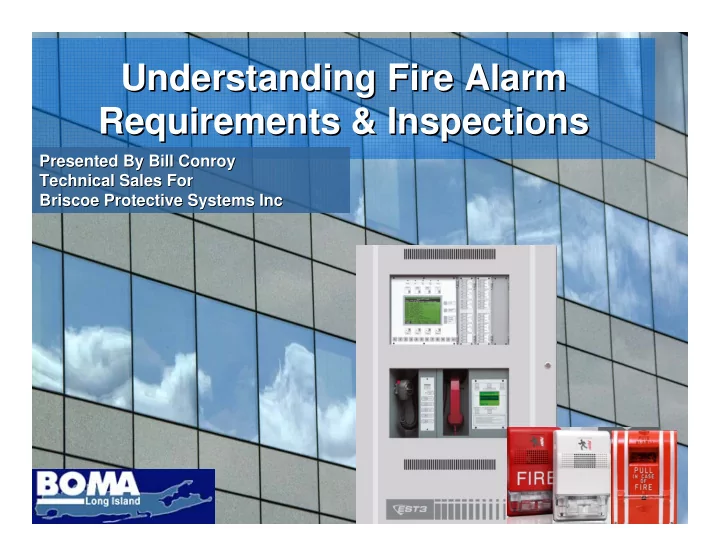
Understanding Fire Alarm Understanding Fire Alarm Requirements & Inspections Requirements & Inspections Presented By Bill Conroy Presented By Bill Conroy Technical Sales For Technical Sales For Briscoe Protective Systems Inc Briscoe


slide-1
SLIDE 1

Understanding Fire Alarm Understanding Fire Alarm Requirements & Inspections Requirements & Inspections

Presented By Bill Conroy Presented By Bill Conroy Technical Sales For Technical Sales For Briscoe Protective Systems Inc Briscoe Protective Systems Inc

slide-2
SLIDE 2

Fire Alarm Requirements are Fire Alarm Requirements are structured through a system of structured through a system of

  • codes. Codes provide guidance
  • codes. Codes provide guidance

and uniformity. They ensure Life and uniformity. They ensure Life Safety and protection of property by Safety and protection of property by regulating Fire Alarm System regulating Fire Alarm System

  • standards. The main standard for
  • standards. The main standard for

codes in the Fire Safety Industry is codes in the Fire Safety Industry is the NFPA. the NFPA.

Introduction Introduction

slide-3
SLIDE 3

  The National Fire The National Fire Protection Agency. Protection Agency.   Originated in1896 by a Originated in1896 by a group of insurance firms to group of insurance firms to standardize fire sprinkler standardize fire sprinkler systems. systems.   Today they minimize risk & Today they minimize risk & effect of fire by setting a effect of fire by setting a standard criteria of standard criteria of regulations. regulations.

What Is NFPA? What Is NFPA?

slide-4
SLIDE 4

Code Requirements Code Requirements

NYS & LI Municipalities have NYS & LI Municipalities have adopted NFPA 72 as their adopted NFPA 72 as their Guideline for Fire Code Guideline for Fire Code

  • Regulation. However, there are
  • Regulation. However, there are
  • ccasions whereby a Municipality
  • ccasions whereby a Municipality

will differ from NFPA 72 on will differ from NFPA 72 on specific code regulation. specific code regulation.

An Example would be Full Area Smoke An Example would be Full Area Smoke Detection. Detection.

slide-5
SLIDE 5

CODES CODES

Code can be driven by technology changes and the Code can be driven by technology changes and the constant flurry of changes in technology and terminology constant flurry of changes in technology and terminology can make it confusing to keep up with. can make it confusing to keep up with. It is important to have a basic understanding of some of It is important to have a basic understanding of some of these changes. We will start by taking a look at Central these changes. We will start by taking a look at Central Station Monitoring codes. Station Monitoring codes. Here is a short list of some of the terminology being used Here is a short list of some of the terminology being used today. today. POTS POTS-

  • Plain Old Telephone Service

Plain Old Telephone Service VOIP_ Voice Over Internet Provider VOIP_ Voice Over Internet Provider MFVN MFVN – – Managed Facilities Based Voice Network Managed Facilities Based Voice Network PSTN PSTN-

  • Public Switched Telephone Network

Public Switched Telephone Network

slide-6
SLIDE 6

NFPA and local AHJ NFPA and local AHJ’ ’s (Authorities having s (Authorities having jurisdiction) recognized that new technologies jurisdiction) recognized that new technologies such as VOIP, are increasingly being used to such as VOIP, are increasingly being used to connect to Fire Alarms. Some of their concerns connect to Fire Alarms. Some of their concerns were reliability of the voice service and were reliability of the voice service and continuing operation during power outages. continuing operation during power outages. Performance requirements for voice Performance requirements for voice communications technology and providers are communications technology and providers are the main concern and not so much the specific the main concern and not so much the specific voice communication technology. voice communication technology.

Central Station Monitoring Central Station Monitoring

slide-7
SLIDE 7

Central Station Monitoring Central Station Monitoring -

  • What is MFVN?

A Managed Facilities A Managed Facilities– –Based Based Voice Network is a physical Voice Network is a physical network owned and operated network owned and operated by a service provider that by a service provider that delivers traditional telephone delivers traditional telephone service via a loop start analog service via a loop start analog telephone interface. They are telephone interface. They are interconnected with public interconnected with public switched telephone network switched telephone network (PSTN) and provide dialtone to (PSTN) and provide dialtone to end users. end users. MFVN providers include cable MFVN providers include cable

  • perators and telephone
  • perators and telephone

companies, but do not include companies, but do not include internet based providers such internet based providers such as Vonage and Magic Jack. as Vonage and Magic Jack.

slide-8
SLIDE 8

Central Station Monitoring Central Station Monitoring -

  • Division of Fire Prevention Policy

Division of Fire Prevention Policy Memorandum Dated February 3, 2012 Memorandum Dated February 3, 2012 A Managed Facilities A Managed Facilities-

  • Based Voice Network

Based Voice Network (ie. Cablevision Systems) is, as of this (ie. Cablevision Systems) is, as of this date, an acceptable means of fire alarm date, an acceptable means of fire alarm signal transmission by fire alarm systems signal transmission by fire alarm systems located within the Town of located within the Town of Brookhaven Brookhaven

Town of Brookhaven ( other LI jurisdictions are following similar requirements). NOTE: NOTE: Reference to NFPA 72.2010 Edition,

Reference to NFPA 72.2010 Edition, is specific and limited to Annex A.3.3.141 for is specific and limited to Annex A.3.3.141 for the purpose of MFVN equivalence the purpose of MFVN equivalence

  • requirements. NFPA 72, 2007 Edition is the
  • requirements. NFPA 72, 2007 Edition is the

reference standard for the 2010 Fire Code of reference standard for the 2010 Fire Code of NYS and the 2010 Building Code of NYS. NYS and the 2010 Building Code of NYS.

slide-9
SLIDE 9

Central Station Monitoring Central Station Monitoring – –

continued continued A change to an MFVN signal transmission path or A change to an MFVN signal transmission path or request submitted with a permit for application to install, request submitted with a permit for application to install, requires the submission of documentation on the MFVN requires the submission of documentation on the MFVN providers letterhead attesting that: providers letterhead attesting that:   The signal transmission path utilizes an approved The signal transmission path utilizes an approved method that is listed and tested in accordance with method that is listed and tested in accordance with UL864 for fire alarm signal transmissions. UL864 for fire alarm signal transmissions.   The MFVN communications equipment installation at the The MFVN communications equipment installation at the premises is compliant with all of the functionality premises is compliant with all of the functionality equivalence requirements set forth in Annex A.3.3.141 of equivalence requirements set forth in Annex A.3.3.141 of NFPA 72 2010 Edition. NFPA 72 2010 Edition.   A manufacturer A manufacturer’ ’s cut sheet for the MFVN s cut sheet for the MFVN communications equipment installed must also be communications equipment installed must also be submitted. submitted. New And Existing Approved Fire Alarm Systems New And Existing Approved Fire Alarm Systems

slide-10
SLIDE 10

  All Plans and drawings must be prepared by a NY State All Plans and drawings must be prepared by a NY State licensed PE. licensed PE.   Permits must be obtained prior to the start of work. Permits must be obtained prior to the start of work.   Plans must be filed with a licensed Installer/Contractor on Plans must be filed with a licensed Installer/Contractor on Record. Record. Contractor information and Equipment specified is Contractor information and Equipment specified is regarded differently in the various jurisdictions regarded differently in the various jurisdictions. .

For Example in Nassau County, For Example in Nassau County, changes require resubmission changes require resubmission

  • f plans.
  • f plans.

In most Suffolk County Towns, In most Suffolk County Towns, comparable can be substituted comparable can be substituted. .

Filing Process Filing Process
slide-11
SLIDE 11

Key Points For Building Owners Key Points For Building Owners

  Approved plans must be obtained first Approved plans must be obtained first before installing, modifying, altering, before installing, modifying, altering, replacing renovating or remodeling any replacing renovating or remodeling any fire alarm system. fire alarm system.   It is unlawful to operate or maintain It is unlawful to operate or maintain any fire alarm system without first any fire alarm system without first

  • btaining a fire alarm system permit.
  • btaining a fire alarm system permit.

  New plans are needed if a change of New plans are needed if a change of

  • ccupancy use for a building occurs
  • ccupancy use for a building occurs

and this requires a manual or and this requires a manual or automatic fire alarm system. automatic fire alarm system.

slide-12
SLIDE 12

  A reconstruction project in a building which A reconstruction project in a building which would require a manual or automatic fire would require a manual or automatic fire alarm system. A reconstruction project is one alarm system. A reconstruction project is one where the reconfiguration of space, as where the reconfiguration of space, as indicated on the construction documents, is indicated on the construction documents, is such that it adversely impacts the means of such that it adversely impacts the means of egress shared with spaces outside the work egress shared with spaces outside the work area; affects the entire occupancy; or totals area; affects the entire occupancy; or totals more than two thirds of the building area. more than two thirds of the building area. This value shall not include the cost of the This value shall not include the cost of the land and shall relate to the structure only. land and shall relate to the structure only.

When Plans are needed

Key Points For Building Owners Key Points For Building Owners

slide-13
SLIDE 13

  Any fire alarm or fire & smoke detection system is Any fire alarm or fire & smoke detection system is installed, modified, altered, replaced, renovated or installed, modified, altered, replaced, renovated or remodeled. remodeled.

When Plans are Needed

Key Points For Building Owners Key Points For Building Owners

slide-14
SLIDE 14

The most important factor in The most important factor in performing this service is to ensure performing this service is to ensure the equipment performs as the equipment performs as

  • required. This guarantees Life
  • required. This guarantees Life

Safety. Safety. Also, to ensure the installation of Also, to ensure the installation of the system meets all of the code the system meets all of the code requirements and the requirements and the manufacturer manufacturer’ ’s instructions. s instructions.

Fire Alarm System Testing & Fire Alarm System Testing & Inspection Procedures Inspection Procedures

Why Do We Inspect and Test Fire Alarm Systems? Why Do We Inspect and Test Fire Alarm Systems?

slide-15
SLIDE 15

It is important for building owners and It is important for building owners and property managers to know what to expect property managers to know what to expect from their service providers inspection from their service providers inspection process, so that they can ensure the process, so that they can ensure the inspections are being performed properly. inspections are being performed properly. Ultimately the building owner is responsible Ultimately the building owner is responsible for the fire alarm system functioning for the fire alarm system functioning properly and meeting code requirements. properly and meeting code requirements. Failure to do so can result in Violations, Failure to do so can result in Violations, Summonses and Fines. Summonses and Fines.

Fire Alarm System Testing & Fire Alarm System Testing & Inspection Procedures Inspection Procedures continued

continued Responsibility Of Fire Alarm System Responsibility Of Fire Alarm System

slide-16
SLIDE 16

  Inspections should be scheduled according Inspections should be scheduled according to the frequencies listed by NFPA and to the frequencies listed by NFPA and municipal requirements. municipal requirements.   Inspections require the testing of the Fire Inspections require the testing of the Fire Alarm System and its devices. Alarm System and its devices.   Appropriate notification to Building Occupants Appropriate notification to Building Occupants including Tenant Spaces, Security etc. including Tenant Spaces, Security etc.

Fire Alarm System Testing & Fire Alarm System Testing & Inspection Procedures Inspection Procedures continued

continued

Preparing For Inspections And Tests Preparing For Inspections And Tests

Friday February 24, 2012

slide-17
SLIDE 17

Fire Alarm System Testing & Fire Alarm System Testing & Inspection Procedures Inspection Procedures continued

continued

Preparing For Inspections And Tests Preparing For Inspections And Tests cont.

cont.

are open and accessible including are open and accessible including protected areas such as Sprinkler protected areas such as Sprinkler Room, Boiler Room, Electrical Room Room, Boiler Room, Electrical Room etc. etc.   Verify that all areas to be inspected Verify that all areas to be inspected called so the system can be taken called so the system can be taken

  • ffline. Verify the account #, name, and
  • ffline. Verify the account #, name, and
  • address. Note the operators ID and be
  • address. Note the operators ID and be

sure to note it in the Fire Log Book. sure to note it in the Fire Log Book.   The Monitoring Central Station must The Monitoring Central Station must

slide-18
SLIDE 18

The Fire Alarm Service Provider will check The Fire Alarm Service Provider will check the FACP and Devices. the FACP and Devices. The FACP is checked for: The FACP is checked for:   Physical Damage Physical Damage   AC & Battery Power AC & Battery Power   Lamps and LEDS are working Lamps and LEDS are working   Trouble Conditions Visual and Audible Trouble Conditions Visual and Audible   Supervisory and Supply Circuits Supervisory and Supply Circuits   Wire terminations are secure Wire terminations are secure

Fire Alarm System Testing & Fire Alarm System Testing & Inspection Procedures Inspection Procedures continued

continued

Actual Fire Inspection Actual Fire Inspection

slide-19
SLIDE 19

  All Remote Annunciators are checked. All Remote Annunciators are checked.   Look at Devices and Circuits for proper Look at Devices and Circuits for proper and secured mounting. and secured mounting.   Check for painted over, substance Check for painted over, substance damage, tampering and abuse. damage, tampering and abuse.   Clean Smoke Detectors, replace when Clean Smoke Detectors, replace when necessary and make sure there are no necessary and make sure there are no

  • bstructions.
  • bstructions.

Fire Alarm System Testing & Fire Alarm System Testing & Inspection Procedures Inspection Procedures continued

continued

Actual Fire Inspection Actual Fire Inspection

slide-20
SLIDE 20

  Test Automatic Evacuation Test Automatic Evacuation Signal. Signal.   Ensure sounding devices are Ensure sounding devices are audible and can be heard audible and can be heard throughout the location. throughout the location.   Ensure visual devices can be Ensure visual devices can be easily seen. easily seen.

Fire Alarm System Testing & Fire Alarm System Testing & Inspection Procedures Inspection Procedures continued

continued

Actual Fire Inspection Actual Fire Inspection

slide-21
SLIDE 21

  Visually inspect Manual Pull Stations so Visually inspect Manual Pull Stations so they can be clearly seen by occupants they can be clearly seen by occupants and test at appropriate intervals. and test at appropriate intervals.   Check fixed extinguishing systems Check fixed extinguishing systems connected to the alarm. connected to the alarm.   Automatic Door Releases are tested Automatic Door Releases are tested   Fan Shut Down Circuits are tested Fan Shut Down Circuits are tested   Water Flow And Tamper Switches are Water Flow And Tamper Switches are tested. tested.   Gas shut offs are tested. Gas shut offs are tested.

Fire Alarm System Testing & Fire Alarm System Testing & Inspection Procedures Inspection Procedures continued

continued

Actual Fire Inspection Actual Fire Inspection

slide-22
SLIDE 22

NFPA recommends that a log book be kept noting all tests, inspections and

  • maintenance. It must remain in the

building for the Fire Departments

  • review. Records shall be retained until

the next test and for 1 year thereafter.

Fire Alarm System Testing & Fire Alarm System Testing & Inspection Procedures Inspection Procedures continued

continued

Preparing For Inspections And Tests Preparing For Inspections And Tests

slide-23
SLIDE 23

There are significant benefits to having staff There are significant benefits to having staff members educated as to how a Fire Alarm members educated as to how a Fire Alarm System Works. System Works. It will ensure life safety of building occupants It will ensure life safety of building occupants and save money, by knowing what services and save money, by knowing what services should be completed by vendors and to help should be completed by vendors and to help remain compliant with municipal codes to remain compliant with municipal codes to avoid fines. avoid fines. In our efforts to give back to the In our efforts to give back to the community, Briscoe Protective Systems community, Briscoe Protective Systems

  • ffers a Free basic class on Fire Alarm
  • ffers a Free basic class on Fire Alarm

Systems to help train your staff. Systems to help train your staff. Contact us to set up an appointment. Contact us to set up an appointment. 631 631-

  • 864

864-

  • 8666 Ext 214

8666 Ext 214

Education Education

Educating Staff Educating Staff

slide-24
SLIDE 24

Briscoe Protective Systems Inc. Briscoe Protective Systems Inc.

Fire Alarm Services Fire Alarm Services

Presented By Bill Conroy Presented By Bill Conroy Technical Sales Technical Sales 631 631-

  • 864

864-

  • 8666 Ext 203

8666 Ext 203 williamc@briscoeprotective.com williamc@briscoeprotective.com NYS License # 12000032751