Understanding Federal Circuit Scrutiny To Date THURSDAY, MARCH 30, - - PowerPoint PPT Presentation

understanding federal circuit scrutiny to date
SMART_READER_LITE
LIVE PREVIEW

Understanding Federal Circuit Scrutiny To Date THURSDAY, MARCH 30, - - PowerPoint PPT Presentation

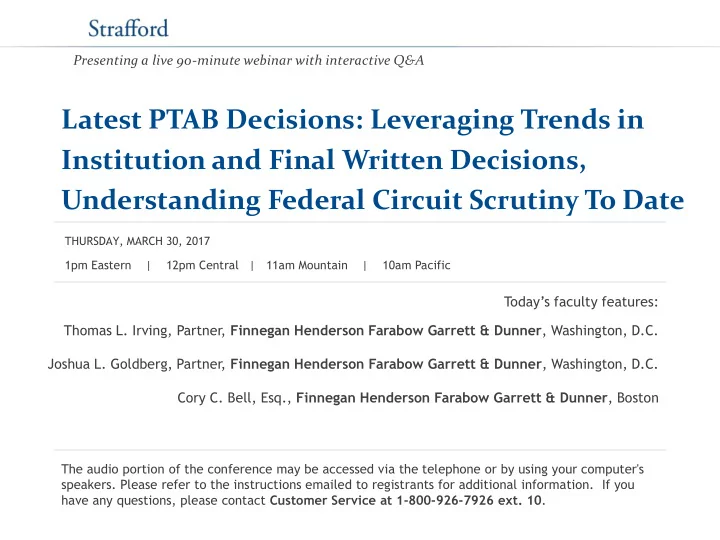
Presenting a live 90-minute webinar with interactive Q&A Latest PTAB Decisions: Leveraging Trends in Institution and Final Written Decisions, Understanding Federal Circuit Scrutiny To Date THURSDAY, MARCH 30, 2017 1pm Eastern | 12pm


slide-1
SLIDE 1

Latest PTAB Decisions: Leveraging Trends in Institution and Final Written Decisions, Understanding Federal Circuit Scrutiny To Date

Today’s faculty features:

1pm Eastern | 12pm Central | 11am Mountain | 10am Pacific

The audio portion of the conference may be accessed via the telephone or by using your computer's

  • speakers. Please refer to the instructions emailed to registrants for additional information. If you

have any questions, please contact Customer Service at 1-800-926-7926 ext. 10.

THURSDAY, MARCH 30, 2017

Presenting a live 90-minute webinar with interactive Q&A Thomas L. Irving, Partner, Finnegan Henderson Farabow Garrett & Dunner, Washington, D.C. Joshua L. Goldberg, Partner, Finnegan Henderson Farabow Garrett & Dunner, Washington, D.C. Cory C. Bell, Esq., Finnegan Henderson Farabow Garrett & Dunner, Boston

slide-2
SLIDE 2

Tips for Optimal Quality

Sound Quality If you are listening via your computer speakers, please note that the quality

  • f your sound will vary depending on the speed and quality of your internet

connection. If the sound quality is not satisfactory, you may listen via the phone: dial 1-866-819-0113 and enter your PIN when prompted. Otherwise, please send us a chat or e-mail sound@straffordpub.com immediately so we can address the problem. If you dialed in and have any difficulties during the call, press *0 for assistance. Viewing Quality To maximize your screen, press the F11 key on your keyboard. To exit full screen, press the F11 key again.

FOR LIVE EVENT ONLY

slide-3
SLIDE 3

Continuing Education Credits

In order for us to process your continuing education credit, you must confirm your participation in this webinar by completing and submitting the Attendance Affirmation/Evaluation after the webinar. A link to the Attendance Affirmation/Evaluation will be in the thank you email that you will receive immediately following the program. For additional information about continuing education, call us at 1-800-926-7926

  • ext. 35.

FOR LIVE EVENT ONLY

slide-4
SLIDE 4

4

Disclaimer

  • These materials have been prepared solely for educational and entertainment

purposes to contribute to the understanding of U.S. intellectual property law. These materials reflect only the personal views of the authors and are not individualized legal advice. It is understood that each case is fact specific, and that the appropriate solution in any case will vary. Therefore, these materials may or may not be relevant to any particular situation. Thus, the authors and Finnegan, Henderson, Farabow, Garrett & Dunner, LLP (including Finnegan Europe LLP, and Fei Han Foreign Legal Affairs Law Firm), cannot be bound either philosophically or as representatives of their various present and future clients to the comments expressed in these materials. The presentation of these materials does not establish any form of attorney-client relationship with these authors. While every attempt was made to ensure that these materials are accurate, errors or omissions may be contained therein, for which any liability is disclaimed.

slide-5
SLIDE 5

5

Trends We See

  • Maintaining the “no appeal of institution decision” for any reason.
  • Trying to keep the PTAB within the bounds of the statute, case law, and

not letting it run unchecked, though affirmance rate remains very high.

  • Increased application of the APA to protect both patent owners and

petitioners.

CAFC

  • Consistent in its approach to granting proposed amendments and

granting rehearings (hardly ever).

  • Pretty consistent in its handling of anticipation and obviousness in IPRs.
  • Institution rate and claim cancellation rate declining somewhat.
  • Higher standards for proving NPL constitutes prior art.

PTAB

  • Continuing to push to determine limits of AIA post-grant proceeding

estoppel provisions

  • Continuing to explore strategy balance between AIA post-grant

proceedings and litigation

  • Patent owners using AIA post-grant proceedings against other patent
  • wners.

Patent Bar

slide-6
SLIDE 6

6

As of Jan. 31, 2017 https://www.uspto.gov/sites/default/files/documents/aia_statistics_january2017.pdf

Petitions By Technology

The overall institution rate across all technologies is 70% (3169/4526).

slide-7
SLIDE 7

7

If IPR Instituted, Cancellation Rate Is High!

As of Feb. 1, 2017. Source: http://www.aiablog.com/claim-and-case-disposition/ “Mixed outcome”: at least one instituted claims survived and at least one instituted claim was canceled.

slide-8
SLIDE 8

8

FWDs and Claim Survival Rate: Finnegan Stats

As of Feb. 1, 2017 http://www.aiablog.com/technology-breakdown/

slide-9
SLIDE 9

9

NOTABLE PTAB DECISIONS OVER THE LAST 12 MONTHS

slide-10
SLIDE 10

10

On-Sale Bar

  • Dr. Reddy’s Laboratories, Ltd. v. Helsinn Healthcare S.A.,

PGR2016-00008, Paper 11 (P.T.A.B. Aug. 17, 2016)

– Patent Owner laid the groundwork for defending against the §102 and §112 attacks during prosecution. – PTAB:

  • “The AIA enlarged the scope of prior art under § 102 with respect to territory, and

also added the clause ‘otherwise available to the public.’ …As an AIA first-inventor- to-file patent, the ’942 patent is subject to AIA § 102(a)(1).”

  • “The [distrct] court in Helsinn Healthcare…concluded ‘that §102(a)(1) requires a

public sale or offer for sale of the claimed invention’ and ‘[t]he new requirement that the on-sale bar apply to public sales comports with the plain language meaning

  • f the amended section, the USPTO’s interpretation of the amendment, and the

legislative history of the AIA.” Id. at *45.” (issue in Teva v. Helsinn appeal, argued October 4, 2016).

AIA law applied

slide-11
SLIDE 11

11

  • DRL v. Helsinn, PGR2016-00008 (con’t)

– PTAB (con’t):

  • “Moreover, the court emphasized that ‘the post-AIA on-sale bar inquiry is

not focused on the public disclosure of the sale or offer for sale; rather, the ‘sale’ prong of the on-sale bar requires that the sale make the claimed invention available to the public one year prior to its critical date.’ Id. at *52.”

  • “Petitioner has established that MGI’s Form 8-K SEC filings and Helsinn’s

press releases made public the existence of the Supply and Licensing Agreements, but Petitioner has not shown that the heavily redacted SEC filings or the press releases, devoid of detail, made the claimed invention available to the public. Thus, we determine that the Supply and Licensing Agreements did not make the claimed invention available to the public one year prior to the critical date at issue here. Accordingly, we determine that Petitioner has failed to show that it is more likely than not that claims 1–19 are in violation of the on-sale bar under 35 U.S.C. § 102(a)(1).”

On-Sale Bar

AIA law applied

slide-12
SLIDE 12

12

PTAB Applies “Public Accessibility” Test to Pre-AIA §102 Also

  • Actavis, Inc. v. Research Corporation Technologies, Inc.,

IPR2014-01126, Paper 21 (P.T.A.B. Jan. 9, 2015)(university thesis)

  • Oxford Nanopore Tech. Ltd. v. Univ. of Washington, IPR2014-

00512, Paper 12 (P.T.A.B. Sept. 15, 2014)(grant applications)

  • HTC Corp., v. Cellular Comm’ns Equip. LLC., IPR2016-01503,

Paper No. 7 (Feb. 13, 2017)(standards documents)

slide-13
SLIDE 13

13

Successful Motion To Amend

  • Global Tel*link Corp. v. Securus Technologies, Inc., IPR2015-

01225, Paper 44 (P.T.A.B. Dec. 14, 2016)

– PTAB FWD: 7 instituted claims unpatentable, 1 survived. – Paper 45 (P.T.A.B. Dec. 14, 2016) Contingent Motion to Amend to Substitute Claims granted except with respect to two proposed claims.

  • Patent Owner provided:

– detailed analysis and liberal citations to the original disclosure and prior art, – expert declaration – explanation how the original disclosure purportedly supports the proposed substitute claims – proposed a level of ordinary skill in the art for the substitute claims – proposed claim constructions for some terms in the substitute claims. – provided detailed analysis regarding how each substitute claim purportedly is patentable over the prior art; – identified the known closest art.

slide-14
SLIDE 14

14

Successful Motion To Amend

  • IPR2015-01225 (con’t)

– Contingent Motion to Amend to Substitute Claims granted except with respect to two proposed claims.

  • Patent Owner narrowed the scope of original claims.
  • Patent Owner showed written description support for the

amended claims in the original disclosure.

  • Patent Owner showed patentability of substitute claims over prior

art.

  • Denied two proposed substitute claims because Patent Owner did

not show proposed substitute claim 15 is patentable over the prior art or that proposed substitute claim 16 does not contain new matter.

slide-15
SLIDE 15

15

Granted Proposed Amended Claims Still Rare

As of Feb. 1, 2017. Source: Finnegan research, http://www.aiablog.com/claim-and-case-disposition/

slide-16
SLIDE 16

16

Other Designated Representative PTAB Decisions Relating To Motions To Amend

http://www.uspto.gov/patents-application-process/appealing-patent-decisions/decisions-and-

  • pinions/representative-orders#heading-4
  • Idle Free Systems, Inc. v Bergstrom, Inc., IPR2012-00027, Paper

26 (P.T.A.B. June 11, 2013)(informative)

– Panel of 6 – Early days (June 11, 2013) – Patent Owner filed Motion to Amend without having conferred with the Board first – violation of 37 C.F.R. § 42.121(a – Panel dismissed, but provided discussion of several important requirements for motions to amend and provided patent owner another opportunity to file a motion to amend claims. – Eventually all instituted claims held unpatentable or conceded. Renewed motion to amend denied.

  • Nichia Corp. v. Emcore Corp., IPR2012-00005, Paper 27 (P.T.A.B.

June 3, 2013)

– Order after telephone conference. – Discusses requirement for written description in original patent application.

slide-17
SLIDE 17

17

Other Designated Representative PTAB Decisions Relating To Motions To Amend

  • Int'l Flavors & Fragrances Inc. v. The United States of America,

IPR2013-00124, Paper 12 (P.T.A.B. May 20, 2014)(informative) – First motion to amend granted (as to all but one proposed substitute claim).

  • No broadening of scope, written description support,

patentability over prior art shown.

  • Corning Optical Communications RF, LLC v. PPC Broadband, Inc.,

IPR2014-00441, Paper 19 (P.T.A.B. October 30, 2014)

– Order subsequent to telephone conference to satisfy the “to confer” requirement of 37 C.F.R. §42.121(a) with regard to the filing of a motion to amend claims. – “additional guidance regarding the requirements of a motion to amend is provided”

slide-18
SLIDE 18

18

Other Designated Representative PTAB Decisions Relating To Motions To Amend

  • MasterImage 3D, Inc. v. RealD Inc., IPR2015-00040, Paper 42 (PTAB July 15,

2015)

  • 1. “prior art of record” means:

a) any material art in the prosecution history of the patent; b) any material art of record in the current proceeding, including art asserted in grounds

  • n which the Board did not institute review; and

c) any material art of record in any other proceeding before the Office involving the patent.

  • 2. “prior art known to the patent owner” means “no more than the material prior

art that Patent Owner makes of record in the current proceeding pursuant to its duty of candor and good faith to the Office under 37 C.F.R. § 42.11, in light of a Motion to Amend.

  • “initial emphasis on each added limitation”
  • 3. “once Patent Owner has set forth a prima facie case of patentability of narrower

substitute claims over the prior art of record, the burden of production shifts to Petitioner…[but] the ultimate burden of persuasion remains with Patent Owner, the movant, to demonstrate the patentability of the amended claims.”

slide-19
SLIDE 19

19

Guidance on Motions to Amend Coming?

  • In re Aqua Products, Inc., 833 F.3d 1335 (Fed. Cir.

August 12, 2016), reh’g en banc granted

– In re Aqua Products, Inc., 823 F.3d 1369 (Fed. Cir. 2016) vacated. – Pending petition for rehearing en banc in Prolitec, Inc., v. ScentAir Technologies, Inc., 807 F.3d 1353 (Fed. Cir. 2015), stayed. – Questions to be briefed:

a) When the patent owner moves to amend its claims under 35 U.S.C. § 316(d), may the PTO require the patent owner to bear the burden of persuasion, or a burden of production, regarding patentability of the amended claims as a condition of allowing them? Which burdens are permitted under 35 U.S.C. § 316(e)? b) When the petitioner does not challenge the patentability of a proposed amended claim, or the Board thinks the challenge is inadequate, may the Board sua sponte raise patentability challenges to such a claim? If so, where would the burden of persuasion, or a burden of production, lie?

slide-20
SLIDE 20

20

PTAB OUTCOMES IN CBM, IPR, AND PGR: AT INSTITUTION, FINAL DISPOSITION

slide-21
SLIDE 21

21

30%* of the PTAB’s Bio/Pharm Institution Decisions Have Been Denials, and Institution Decisions are Non-Appealable (35 U.S.C. § 314(d))

Denial is Patent Owner’s first objective

*As of Jan. 31, 2017 https://www.uspto.gov/sites/default/files/documents/aia_statistics_january2017.pdf

slide-22
SLIDE 22

22

Bases Of IPR Petition Denials

  • Threshold issues

– Failure to name real-party-in-interest as required by 35 U.S.C. §312(a)(2). – Barred under 35 U.S.C. §315(a) or time-barred under 35 U.S.C. §315(b). – Estopped under 35 U.S.C. §315(e). – Same or substantially the same prior art/arguments under 35 U.S.C. §325(d).

  • “Same or substantially the same prior art or arguments” during prosecution
  • “Same or substantially the same prior art or arguments” in another IPR

petition

– Reference is not prior art/priority claim.

slide-23
SLIDE 23

23

Bases Of IPR Petition Denials

  • Substantive arguments (failure of Petitioner to meet threshold

for institution under 35 U.S.C. §314(a))

– Claim construction. – Unsupported assertions. – Patent Owner persuaded the PTAB that claim limitation not present or suggested in the asserted references. – Patent Owner persuaded the PTAB that Petitioner failed to provide reasonable basis for POSITA to combine/modify the asserted references. – Objective evidence of nonobviousness.

slide-24
SLIDE 24

24

Basis For Petition Denial In Pharma IPRs

312(a)(3), 1, 1% Time bar, 9, 4% RPI, 3, 1% 325d, 22, 10% Estopped, 1, 1% Reference not prior art, 22, 10% Limitation not present, 64, 30% Insufficient motivation, 89, 41% Objective evidence, 4, 2% No reasonable expectation

  • f success,

1, 0%

Source: Finnegan research; 159 pharma petition denials as of Feb. 28, 2017.

27% denied on threshold issues

slide-25
SLIDE 25

25

  • If Petitioner, attack priority claim of challenged claims.

– ButamaxTM Advanced Biofuels LLC v. Gevo, Inc., IPR2013- 00539, Paper 33 (PTAB March 3, 2015)

  • If Patent Owner, attack priority date of reference.

– Globus Medical, Inc. v. Depuy Synthes Products, LLC, IPR2015-00099, Paper 15 (P.T.A.B. May 1, 2015) – Baxter Healthcare Corp. v. Millenium Biologix, LLC, IPR2013-00591, Paper 8 (P.T.A.B. March 21, 2014) and IPR2013-00583, Paper 9 (P.T.A.B. March 21, 2014)

Attacking Priority Claim

slide-26
SLIDE 26

26

PTAB Looking For More Than Conclusory Statements

  • Benitec Biopharma Ltd. v. Cold Spring Harbor Laboratory,

IPR2016-00015, Paper 7 (P.T.A.B. March 23, 2016)

– Petition Ground 1: anticipation by Zamore under 35 U.S.C. §102(e). – Patent Owner in POPR: Zamore does not qualify as prior art under §102(e) because none of the issued claims of the Zamore patent are supported by US ‘185 provisional application. – PTAB: Petition denied.

  • The effective filing date of the ʼ599 patent is January 22, 2002.
  • Zamore issued from a non-provisional application filed on July 12, 2002, and claiming

benefit of the ’185 provisional application, filed on July 12, 2001.

  • Petitioner failed to show that Zamore entitled to provisional filing date.

– No expert opinion as to what a POSITA would understand from disclosure.

slide-27
SLIDE 27

27

PTAB Comment On Priority Attack

  • SAP v. Lakshmi, IPR2014-00414, Paper 24 (P.T.A.B. Aug. 17, 2015)

– Petitioner attacked priority claimed by patent. – Patent Owner objected to § 112 issue in an IPR. – PTAB:

  • We note the difference between compliance with the requirements of 35 U.S.
  • C. § 112 and assessing the earliest priority date for a claim. …the issue is not

whether there is a sufficient written description in the ’894 Patent, but whether the written description in the earlier applications supports Patent Owner’s claim to priority. . . .A review of the disclosure for purposes of identifying the priority date for the claimed subject matter is appropriate and within the scope of inter partes review. Nissan N. Am., Inc. v. Bd. of Regents,

  • Univ. of Tex. Sys., IPR2012-00037, Paper 24, at 14–16 (PTAB March 19, 2013).
slide-28
SLIDE 28

28

Federal Circuit Agrees Burden On Petitioner To Show Prior Art Entitled To Date Asserted

  • Dynamic Drinkware, LLC v. National Graphics, Inc., 2015 WL

5166366 (Fed. Cir. Sept. 4, 2015)

– Claims survived IPR. – Petitioner appealed. – FC: Affirmed PTAB.

  • Petitioner had burden to prove that prior art patent was entitled to filing

date of its provisional application;

  • Substantial evidence supported PTAB's determination that prior art

patent did not relate back to its provisional application.

– “A provisional application's effectiveness as prior art depends on its written description support for the claims of the issued patent of which it was a provisional. Dynamic did not make that showing.”

slide-29
SLIDE 29

29

Objective Evidence In Record Successfully Used By Patent Owner To Get Petition Denied

  • Omron Oilfield & Marine, Inc. v. Md/Totco, A Division Of Varco, L.P.,

IPR2013-00265, Paper 11 (P.T.A.B. Oct. 31, 2013)

  • Patent Owner able to rely on evidence in the record in a reexamination of the

patent of commercial success.

  • PTAB: Petition denied.

– “We find that the ’142 Patent had significant commercial success, which, here,

  • vercomes the prima facie case of obviousness.”

– Lower Drug Prices for Consumers, LLC v. Forest Labs. Holdings Ltd., IPR2016-00379, Paper 14 (P.T.A.B. July 1, 2016)

  • Expert declaration submitted during prosecution to support unexpected results

argument.

  • PTAB: Petition denied under §325(d).

– Petition did not address the deficiencies in the examiner’s position with respect to the evidence of unexpected results.

  • See also, Praxair Distribution, Inc. v. Mallinckrodt Hospital Products, IPR2016-00777,

IPR2016-00778, IPR2016-00779, IPR2016-00780, Paper 10 (P.T.A.B. Sept. 22, 2016)

slide-30
SLIDE 30

30

Even if Instituted, Objective Evidence May Be Sufficiently Persuasive for Unpatentability Determination

  • Intri–Plex Technologies, Inc. v. Saint–Gobain Performance Plastics Rencol Ltd.,

IPR2014–00309, Paper 83 (P.T.A.B. March 23, 2014)

– Patent Owner submitted objective evidence of nonobviousness via a declaration (prepared for the IPR) supporting the Patent Owner Response. – PTAB: Final Written Decision that Intri-Plex did not meet its burden of showing challenged claims unpatentable.

  • “we determine that the first three Graham factors favor a determination that the

challenged claims are obvious. However, a proper obviousness determination requires a consideration of all factors, and we determine that Saint-Gobain’s case for nonobviousness based on secondary considerations is particularly strong, and

  • utweighs the other three factors. In particular, we are persuaded that our finding of

commercial success is particularly strong, …. Indeed, we determine that commercial success alone sufficiently outweighs the other three factors, and that our finding of copying merely strengthens further our finding that secondary considerations weigh in favor of Saint-Gobain.”

slide-31
SLIDE 31

31

Even if Instituted, Objective Evidence May Be Sufficiently Persuasive for Unpatentability Determination

  • Coalition for Affordable Drugs VII LLC v. Pozen, Inc., IPR2015-01718, Paper 40

(P.T.A.B. Feb. 21, 2017)

– Institution decision: IPR instituted on all challenged claims and on both asserted grounds

  • f obviousness.

– PTAB FWD: Claims not shown to be unpatentable.

  • Petitioner showed a POSITA would have been motivated to modify the references, but

that “do[es] not end our obviousness analysis.”

  • Patent Owner submitted expert declaration in support of unexpected results argument.
  • Examiner concluded results would have been unexpected over one of the presently

asserted references and the unexpected results were commensurate in scope with the claim.

  • Petitioner’s argument that the three asserted references render the final wherein clause
  • bvious was conclusory and unsupported.

– Rules do not allow arguments made in supporting documents to be incorporated by reference into a petition (37 C.F.R. 42.6(a)(3)). – Warned Petitioner of this flaw in Institution Decision.

  • “We find that this surprising result—the opposite of what the ordinary artisan would

have expected—represents a difference in kind, rather than degree.”

slide-32
SLIDE 32

32

Showing Sufficient Nexus Has Been Stumbling Block For Many Patent Owners

  • Sufficient nexus shown: Innopharma Licensing, Inc. v. Senju

Pharmaceutical Co., Ltd., IPR2015-00902 and IPR2015-00903 – Patent Owner submitted evidence of unexpected results, commercial success, and industry acclaim in POR. – PTAB FWD: Not unpatentable

  • “persuaded by [Patent Owner’s expert’s] testimony that those results would

have been ‘entirely unexpected’ to one of ordinary skill in the art at the time of the invention.”

  • Evidence of unexpected results was commensurate in scope with the claims.
  • Petitioner’s opinion testimony was “undercut by the best objective evidence
  • n point.”
slide-33
SLIDE 33

33

ADDITIONAL ISSUES FOR PGRs

slide-34
SLIDE 34

34

Foot-faulted Into AIA

  • US Endodontics, LLC v. Gold Standard Instruments, LLC, PGR2015-00019
  • Patent at issue granted on application filed Jan. 29, 2014; claimed priority back to June 8,

2004 provisional application.

  • Petitioner: neither the patent nor any of the earlier applications provides an enabling

disclosure, therefore the patent claims’ effective filing date is the actual filing date.

  • PTAB: Instituted PGR.
  • Initial burden on petitioner: “as part of showing that it is entitled to the requested relief of post-

grant review, the petitioner has the burden to show that the patent is subject to the first- inventor-to-file provisions of the AIA.

  • Claims eligible for PGR
  • “a patent that issues from an application filed after March 16 [15 sic], 2013, that claims priority to an

application filed before March 16, 2013, is available for post-grant review ‘if the patent contains . . . at least one claim that was not disclosed in compliance with the written description and enablement requirements of § 112(a) in the earlier application for which the benefit of an earlier filing date prior to March 16, 2013 was sought, Inguran, LLC v. Premium Genetics (UK) Ltd., Case PGR2015-00017, slip op. 11 (PTAB Dec. 22, 2015) (Paper 8).”

AIA law applied

slide-35
SLIDE 35

35

PGR Petition Denied Because Claims Not Eligible For PGR

  • Front Row Tech., LLC v. MLB Advanced Media, L.P., 2015-00023, Paper 8

(P.T.A.B. Feb. 22, 2016)

– Filing date Jan. 29, 2010; no claim for priority or benefit. – Petitioner said PGR-eligible because of amendments submitted Sept. 23, 2013. – PTAB: Claims not eligible for PGR.

  • “Nowhere does the statute contemplate that the effective filing date might

depend on the date of a later-filed amendment to a claim.”

  • “as a matter of law, if a claim in the application is not entitled to an earlier

filing date, then the effective filing date is the actual filing date of the application (per subparagraph (A)), regardless of whether a later-filed amendment to a claim finds sufficient support in the application.”

slide-36
SLIDE 36

36

PGR Petition Denied Because Claims Not Eligible For PGR

  • Mylan Pharms. Inc. v. Yeda Research & Development Co. Ltd.,

2016-00010, Paper 9 (P.T.A.B. Aug. 16, 2016)

– Petitioner: claims PGR-eligible because not entitled to benefit of priority claim to August 20, 2009 (priority applications do not provide written description support for all claim limitations); effective filing date is actual filing date of May 22, 2015. – PTAB: Claims not eligible for PGR.

  • Examiner specifically addressed that pre-AIA applied to claims.
  • Examiner found claims supported by priority document.
  • Petitioner did not show break in priority chain; “Petitioner has not

demonstrated that it is more likely than not that the ’776 patent has at least one claim having an effective filing date on or after March 16, 2013.”

slide-37
SLIDE 37

37

PGR Petition Denied Because Claims Not Eligible For PGR

  • David O.B.A. Adepbimpe v. Johns Hopkins Univ., 2016-00020,

Paper 14 (P.T.A.B. July 25, 2016)

– Parties filed briefs on PGR eligibility prior to Patent Owner filing POPR. – Priority claims to Oct. 4, 2012 and Feb. 25, 2013. – Amended claims filed March 17, 2015. – PTAB: Claims not eligible for PGR.

  • “Section 100(i)(1) does not make any provision for the effective filing date to

be later than the actual filing date of the application in question, even when the application is amended later, and even when the later amendment introduces claims that lack written-description support in the original specification.

slide-38
SLIDE 38

38

PGR Petition Granted Because Claims Eligible For PGR

  • Inguran, LLC d/b/a/ Sexing Tech. v. Premium Genetics (UK)

Ltd., PGR2015-00017, Paper 8 (P.T.A.B. Dec. 22, 2015)

– Actual filing date of claims at issue, Jan. 31, 2014. – Priority benefit claimed to application filed March 6, 2012. – PTAB agreed with Petitioner that “claim 2 is not disclosed in ’969 Application in the manner required by 35 U.S.C. § 112(a), and, therefore, we are persuaded the ’395 Patent is not entitled to an effective filing date before March 16, 2013. Accordingly, for purposes

  • f this decision, Petitioner demonstrates the ’395 Patent is available

for post-grant review, and has set forth sufficient grounds for standing.”

slide-39
SLIDE 39

39

FEDERAL CIRCUIT APPELLATE DECISIONS OF PTAB RULINGS

slide-40
SLIDE 40

40

CAFC Review Of PTAB FWD’s

As of Mar. 1, 2017, http://www.aiablog.com/ Note, this is an appeal affirmance rate only; it is not a patent owner or petitioner win rate on appeal.

slide-41
SLIDE 41

41

Source: https://www.law360.com/articles/894919/fed-circ-taking-harder-look-at-ptab- appeals, (Mar. 1, 2017).

Comparison of Affirmance Rate of PTAB FWD’s and District Court Decisions

slide-42
SLIDE 42

42

Heavy Reliance on Rule 36

Source: https://www.law360.com/articles/894024/fed-circ-issuing-more-hidden- decisions-amid-case-influx, (Mar. 1, 2017).

60% (807/1348)

slide-43
SLIDE 43

43

CAFC/USSC Affirmed PTAB’S Approach

  • In re Cuozzo Speed Technologies, LLC, 793 F.3d 1268 (Fed. Cir. 2015)

– No jurisdiction to review PTAB’s IPR institution decision (See 35 U.S.C. § 314(d)). – Affirm PTAB’s Final Written Decision in full (all instituted claims unpatentable as obvious)

  • No error in PTAB’s application of BRI claim construction standard;
  • No error in obviousness determination; and
  • No error in denial of Cuozzo’s motion to amend.

– Lack of written description support; – Improper broadening

  • Cuozzo Speed Techs., LLC v. Lee, 136 S.Ct. 2131 (U.S., June 20, 2016).
  • Affirmed Federal Circuit decision not allowing attack of the decision to institute.

– In this case, §314(d) bars judicial review of whether PTAB wrongly instituted an IPR on grounds not specifically mentioned in a third party’s review request.

  • Affirmed Federal Circuit decision (unanimous), as to the BRI standard.

– USPTO has authority under §316(a)(4) to enact 37 CFR §42.100(b) (BRI is the claim construction standard in IPRs).

slide-44
SLIDE 44

44

USSC Cuozzo (con’t)

  • No attack on decision to institute allowed.

– “We doubt that Congress would have granted the Patent Office this authority, including, for example, the ability to continue proceedings even after the original petitioner settles and drops

  • ut, §317(a), if it had thought that the agency’s final decision

could be unwound under some minor statutory technicality related to its preliminary decision to institute inter partes review.” – “The text of the ‘No Appeal’ provision, along with its place in the overall statutory scheme, its role alongside the Administrative Procedure Act, the prior interpretation of similar patent statutes, and Congress’ purpose in crafting inter partes review, all point in favor of precluding review of the Patent Office’s institution decisions.”

slide-45
SLIDE 45

45

USSC Cuozzo: Wiggle Room?

  • No attack on decision to institute allowed.

– “Nevertheless, in light of §314(d)’s own text and the

presumption favoring review, we emphasize that our interpretation applies where the grounds for attacking the decision to institute inter partes review consist of questions that are closely tied to the application and interpretation of statutes related to the Patent Office’s decision to initiate inter partes review.”

slide-46
SLIDE 46

46

USSC Cuozzo: Wiggle Room?

  • No attack on decision to institute allowed.

– “This means that we need not, and do not, decide the precise effect of §314(d) on appeals that implicate constitutional questions, that depend on

  • ther less closely related statutes, or that present other questions of

interpretation that reach, in terms of scope and impact, well beyond ‘this section.’ Thus, contrary to the dissent’s suggestion, we do not categorically preclude review of a final decision where a petition fails to give “sufficient notice” such that there is a due process problem with the entire proceeding, nor does our interpretation enable the agency to act outside its statutory limits by, for example, canceling a patent claim for ‘indefiniteness under §112’ in inter partes review.” – “Such ‘shenanigans’ may be properly reviewable in the context of §319 and under the Administrative Procedure Act, which enables reviewing courts to ‘set aside agency action’ that is ‘contrary to constitutional right,’ ‘in excess of statutory jurisdiction,’ or ‘arbitrary [and] capricious.’”

slide-47
SLIDE 47

47

Of Note In USSC Cuozzo

  • USSC Majority opinion seemed to be very explicit that this

decision, at least with respect to the non-appealability part, is

  • n the facts presented in Cuozzo.
  • So, still open: constitutional questions, “less closely related

statutes,” “other questions of interpretation” beyond this section, “due process problem,” agency acting “outside its statutory limits,” “shenanigans,” and ““in excess of statutory jurisdiction,” or “arbitrary [and] capricious.” (at p. 11-12).

  • Supreme Court did not agree with argument that IPR

proceedings are like a trial proceeding.

– The IPR process is "less like a judicial proceeding and more like a specialized agency proceeding.“ (USSC majority, p. 15)

slide-48
SLIDE 48

48

Testing Cuozzo

  • Wi-Fi One, LLC v. Broadcom Corp., 837 F.3d 1329 (Fed. Cir. 2016), reh’g en banc

granted, opinion vacated (Fed. Cir. Jan. 4, 2017)

– In POPR and POR, Wi-Fi argued that Broadcom was in privity with certain entities that were involved in parallel district court litigation and those entities would be time-barred from seeking IPR of the ‘215 patent under 35 U.S.C. § 315(b). – PTAB: FWD – all instituted claims unpatentable. – Wi-Fi One continued to press time bar argument on appeal. – In Achates Reference Publishing, Inc. v. Apple Inc., 803 F.3d 652, 658 (Fed. Cir. 2015): 314(d) “prohibits this court from reviewing the Board's determination to initiate IPR proceedings based on its assessment of the time-bar of § 315(b), even if such assessment is reconsidered during the merits phase of proceedings and restated as part of the Board's final written decision.” – FC: Cuozzo did not “implicitly overrule” Achates. – En banc rehearing granted; question to be briefed:

  • Should this court overrule Achates Reference Publishing, Inc. v. Apple Inc., 803 F.3d 652 (Fed. Cir. 2015) and hold that

judicial review is available for a patent owner to challenge the PTO’s determination that the petitioner satisfied the timeliness requirement of 35 U.S.C. § 315(b) governing the filing of petitions for inter partes review?

slide-49
SLIDE 49

49

Testing Cuozzo

  • Judge Reyna, concurring in initial decision: Agreed that Wi-Fi One did not

show Broadcom to be a RPI or in privity in the litigation, but believes the time-bar is not a mere technicality.

– “this Court has jurisdiction to address the time bar question despite the statutory requirement that the Board's institution decisions ‘shall be final and nonappealable.’ 35 U.S.C. § 314(d). I believe that the legal distinction that exists between an ‘institution’ decision and a final decision compels that the decision in this case is a final decision, not an institution decision. A final decision concerning the time bar set forth by 35 U.S.C. § 315(b) should be subject to review. Our opinion in Achates Reference Publishing v. Apple, Inc., 803 F.3d 652 (Fed. Cir. 2015), …should be reconsidered by the en banc court…. Cuozzo explicitly notes that its holding does not ‘enable the agency to act

  • utside its statutory limits’ and that such ‘shenanigans’ are properly
  • reviewable. 136 S. Ct. at 2141-42. That admonition compels us to review

allegations that the Board has ignored, or erred in the application of, the statutory time bar.”

slide-50
SLIDE 50

50

CAFC Noted That BRI Has Limits

  • Microsoft Corp. V. Proxyconn, Inc., 789 F.3d 1292 (Fed. Cir.

2015)

  • Yes, claim construction standard at PTAB is BRI, but:
  • “That is not to say, however, that the Board may construe claims during IPR so

broadly that its constructions are unreasonable under general claim construction principles. …Even under the broadest reasonable interpretation, the Board's construction ‘cannot be divorced from the specification and the record evidence,’ …and ‘must be consistent with the one that those skilled in the art would reach,’ …. A construction that is ‘unreasonably broad’ and which does not ‘reasonably reflect the plain language and disclosure’ will not pass muster.”

  • Vacated PTAB’s claim construction on certain claims because it was

“based on an unreasonably broad construction” and remanded.

  • On remand, IPR2012-00026, IPR2013-00109 (Dec. 9, 2015), PTAB again

held claims unpatentable.

slide-51
SLIDE 51

51

CAFC Sending Back To PTAB When Finds PTAB’s Claim Con “Unreasonable”

  • La Biomedical Research Institute v. Eli Lilly and Co., --F.3d__ (Fed. Cir. Feb. 28, 2017)

– FC: Vacate and remand.

  • “The Board's construction is therefore not the broadest reasonable interpretation of the disputed

claim language; rather, it is overly broad.”

  • In re Varma, 816 F.3d 1352 (Fed. Cir. 2016)

– FC: Vacate and remand.

  • “We conclude that the Board relied on unreasonable interpretations of claim language in claims 22,

23, 25, and 29–31. The proper remedy, we also hold, is to vacate the Board's rejections of those claims for reconsideration of anticipation and obviousness under the correct claim construction.”

  • D’Agostino v. MasterCard International Inc., 844 F.3d 945 (Fed. Cir. 2016)

– FC: Vacate and remand.

  • “the Board's chain-store construction and/or finding for purposes of meeting the single-merchant

claim limitation, for both anticipation and obviousness purposes, must be set aside. Because the decisive aspect of the Board's reasoning is contrary to the claim as reasonably construed, we need not and do not discuss other statements made by the Board en route to its conclusion…”

slide-52
SLIDE 52

52

Note: Due Process To Be Maintained In BRI

  • SAS Institute, Inc., v. Complementsoft, LLC, 825 F.3d 1341 (Fed. Cir. 2016)

– FC: Remand and re-decide after SAS responds to new construction.

  • § 554(b)(3): Agency may not change theories midstream without giving respondents

reasonable notice of change and an opportunity to present arguments under the new theory.

  • Okay that the PTAB adopted a new construction in its FWD, but changed its theory

midstream, and SAS focused its argument on the PTAB’s institution claim construction.

  • Violation of §554(b)(3) because SAS did not have a meaningful opportunity to

respond.

  • Both petitioner and patent owner entitled to benefits of §554(b)(3).

See also, Dell Inc. v. Acceleron, LLC, 818 F.3d 1293118 (Fed. Cir. 2016), vacating claim cancellation and remanding because “the Board denied Acceleron its procedural rights by relying in its decision on a factual assertion introduced into the proceeding only at oral argument, after Acceleron could meaningfully respond.”

slide-53
SLIDE 53

53

PTAB Does Not Have To Decide Every Asserted Ground

  • In re Schott Gemtron Corp., 617 Fed.Appx. 994 (Fed. Cir. Aug. 11,

2015)

– IPR instituted on two of the nine grounds asserted. – IPR FWD – all instituted claims survived. – Federal Circuit – affirmed IPR FWD. – Petitioner filed petition for writ of mandamus that would direct the PTAB to grant IPR on two of the seven denied grounds. – Federal Circuit: denied.

  • PTAB does not have to consider every unpatentability argument raised by a

petitioner in an America Invents Act review.

  • “…the denial of a petition cannot be reviewed under any circumstances,” the

panel said. ‘This case is no different.’”

slide-54
SLIDE 54

54

CAFC: Final Written Decision Need Not Address Every Claim Raised in Petition; No Backdoor Appeal of PTAB’S Institution Decision

  • Synopsys, Inc. v. Mentor Graphics Corp., 814 F.3d 1309 (Fed. Cir.

2016)

– Petition challenged claims 1–15 and 20–33 on grounds of anticipation and

  • bviousness.

– Trial instituted on a subset of those claims on anticipation and the FWD addressed only anticipation of those claims.

– 35 U.S.C. §318(a): if IPR instituted, the PTAB “shall issue a FWD with respect to the patentability of any patent claim challenged by petitioner.” – FC:

  • Text makes clear that the claims addressed in FWD are different than claims

raised in petition.

  • “if IPR instituted” strongly suggests “challenged” claims are only those

instituted and challenged after institution.

slide-55
SLIDE 55

55

Synopsys (con’t)

  • Different language in 35 U.S.C. §314(a) means Congress

intended two different meanings: no IPR unless there is a reasonable likelihood petitioner would prevail on “at least 1 of the claims challenged in the petition.”

– §314(a) authorizes claim by claim institution. – If claim not instituted, incomplete record for a FWD.

  • Rule making authority (37 C.F.R. §42.108 allows review of “ all
  • r some of the challenged claims”)—PTO can promulgate

rules “setting forth the standards for the showing of sufficient grounds to institute” (§ 316(a)).

slide-56
SLIDE 56

56

No Appellate Review Of Any Part Of Institution Decision

  • Harmonic Inc. v. Avid Technology, Inc., 815 F.3d 1356

(Fed. Cir. 2016)

– PTAB instituted IPR on fewer than all asserted grounds, and then held instituted claims not unpatentable. – FC: Affirmed patentability decision and refusal to revisit grounds characterized as “redundant.”

  • No jurisdiction to review any part of institution decision.
  • “The Board's decision to institute on one prior art ground or another

does not raise fundamental questions about the scope of its statutory authority to deem patents unpatentable; it is simply the Board's exercise of its institution authority in a given case. Section 314(d) prohibits our review of such a decision.”

slide-57
SLIDE 57

57

Institution Decision And FWD By Same Panel Okay

  • Ethicon Endo-Surgery, Inc. v. Covidien LP, 812

F.3d 1023 (Fed. Cir. 2016), reh’g denied, (June 22, 2016), cert. denied, (Jan. 9, 2017)

  • A different Johnson & Johnson unit, LifeScan

Scotland Ltd., asked the Supreme Court to review the same petition in a different case in

  • October. The justices also denied that petition.
slide-58
SLIDE 58

58

But No Automatic Appellate Standing For Petitioners

  • Phigenix Inc. v. ImmunoGen Inc., 845 F.3d 1168 (Fed.
  • Cir. 2017)

– Phigenix lost IPR challenging ImmunoGen‘s patent and filed an appeal to the Federal Circuit. – Federal Circuit dismissed for lack of Article III standing.

  • Party seeking judicial review bears burden of establishing standing.

– Suffered injury in fact; (Phigenix did not show) – traceable to challenged conduct; and – likely redressed by favorable judicial decision.

  • Anyone can file an IPR petition, and every petitioner has right to appeal, but

not everyone has Article III standing.

slide-59
SLIDE 59

59

  • Phigenix (con’t)

– Burden of production: same as plaintiff moving for SJ. – Evidence to meet burden: arguments, affidavits,

  • ther evidence

– When must produce: “at first appropriate time, whether in response to a motion to dismiss or in the opening brief.”

Establish Legal Standard For Demonstrating Standing For Judicial Review Of Agency Action

slide-60
SLIDE 60

60

  • Phigenix (con’t)

– FC: “Phigenix does not contend that it faces risk of infringing the ’856 patent, that it is an actual or prospective licensee of the patent, or that it otherwise plans to take any action that would implicate the patent. …Instead, Phigenix asserts that it has suffered an actual economic injury because the ’856 patent increases competition between itself and ImmunoGen… and “‘[i]ncreased competition represents a cognizable Article III injury,’” – Phigenix supported argument with declarations that are unsupported by facts.

Phigenix Did Not Meet Burden

slide-61
SLIDE 61

61

  • Phigenix (con’t)

– FC: No injury in fact based on 35 U.S.C. § 141(c).

  • “Phigenix cannot base its injury in fact upon a violation
  • f § 141(c) because it has been permitted to file its

appeal, and the exercise of its right to appeal does not necessarily establish that it possesses Article III standing.”

– FC: No injury in fact based on 35 U.S.C. § 315(e).

  • “appellant “is not engaged in any activity that would

give rise to a possible infringement suit.”

Phigenix Did Not Meet Burden

slide-62
SLIDE 62

62

Estopped Under 35 U.S.C. §315(e)

(e) ESTOPPEL.— (1) PROCEEDINGS BEFORE THE OFFICE.—The petitioner in an inter partes review of a claim in a patent under this chapter that results in a final written decision under section 318(a), or the real party in interest or privy of the petitioner, may not request or maintain a proceeding before the Office with respect to that claim on any ground that the petitioner raised or reasonably could have raised during that inter partes review. (2) CIVIL ACTIONS AND OTHER PROCEEDINGS.—The petitioner in an inter partes review of a claim in a patent under this chapter that results in a final written decision under section 318(a), or the real party in interest or privy of the petitioner, may not assert either in a civil action … or in a proceeding before the International Trade Commission …that the claim is invalid on any ground that the petitioner raised or reasonably could have raised during that inter partes review.

slide-63
SLIDE 63

63

Scope Of Petitioner Estoppel?

  • At PTAB, claim-by-claim: Dell Inc. v. Elecs. and Tele Telecomms

Research, Inst, IPR2015-00549, Paper No 10 (P.T.A.B. March 26 2015)

– New IPR petition on claims 1-9, references M and H after FWD of not unpatentable on claims 1-3 and 5-8 based on H reference (though M and H both asserted in first petition). – Petitioner estopped with respect to M and H challenge of claims 1-3 and 5-8 because both references cited in the earlier IPR.

  • Did not matter that reference asserted for anticipation in one petition and
  • bviousness in the other.

– “the differences in how the references have been asserted in these proceedings [has] no weight on our determination of whether the grounds raised in the instant Petition could have been raised in the [earlier proceeding].”

slide-64
SLIDE 64

64

Scope Of Petitioner Estoppel?

  • Apotex Inc v Wyeth LLC, IPR2015-00873, Paper No 8 (P.T.A.B.
  • Sept. 16 2015)

– Petitioner attempted to file a second IPR petition after a FWD upholding claims. – Ground 1 in the second IPR petition was the same as in first petition, but PTAB had not instituted on that ground, finding it “redundant.” – Ground 2 asserted references that were cited in the first IPR petition, but not asserted as a ground of unpatentability. – PTAB:

  • Estoppel did not apply to ground 1 because since ground 1 was not

instituted upon, it wasn’t actually “raised” and could not have been reasonably raised in first IPR proceeding because of redundancy finding.

  • Estopped from asserting ground 2 because the petitioner was aware of the

prior art when it filed the first IPR and chose not to assert it.

slide-65
SLIDE 65

65

Estoppel Remains “Hot” Issue

  • Shaw Indus. Group, Inc. v. Automated Creel Sys., Inc.,

817 F.3d 1293 (Fed. Cir. 2016)

– Shaw petitioned for IPR of all patent claims (21) on 15 grounds. – PTAB: Instituted on all claims but one on 2 grounds.

  • “Payne-based ground was ‘denied as redundant’” without

substantive analysis.

  • Also granted second petition on less than all asserted grounds,

denying the remaining as “redundant.”

– PTAB: FWD some instituted claims unpatentable.

slide-66
SLIDE 66

66

Estoppel Remains “Hot” Issue

  • Shaw (con’t)

– FC: Affirm-in-part, vacate-in-part, remand.

  • “We have no authority, however, to review the Board’s decision to

institute IPR on some but not all grounds….We thus lack jurisdiction to review the Board’s decision not to institute IPR on the Payne-based ground, which includes its decision not to consider the Payne-based ground in its final written decision.”

  • “315(e) would not estop Shaw from bringing its Payne-based

arguments in either the PTO or the district courts….The IPR does not begin until it is instituted….Thus, Shaw did not raise – nor could it have reasonably raised – the Payne-based ground during the IPR.” (emphasis in original)

  • Petition for cert. denied, (U.S. Oct. 31, 2016)
slide-67
SLIDE 67

67

Estoppel Remains “Hot” Issue

  • Shaw (con’t)

– Judge Reyna, concurring

  • “The Board’s improper, conclusory statement s declining to

implement inter partes review (‘IPR’) of grounds it found to be ‘redundant’ leave me deeply concerned about the broader impact that the Redundancy Doctrine may have on the integrity of the patent system. In particular, other tribunals will be tasked with deciding whether estoppel applies based on cryptic statements the U.S.[PTO] makes under the guise of its presumed ‘complete discretion’ over IPR institution.”

  • “The PTO’s claim to unchecked discretionary authority is

unprecedented…. regardless of whether the Board’s institution decisions can be appealed, the Board cannot create a black box decision making process.”

slide-68
SLIDE 68

68

Application of Shaw

  • IV v. Toshiba, Civ. No. 13-453 (D. Del. Dec. 19, 2016)

(Robinson)

– Toshiba was petitioner in IPR where PTAB issued FWD of unpatentability of several instituted claims. – IV argued Toshiba’s litigation obviousness argument on reference not in IPR could have been raised in IPR (publicly available patents and printed publications) and Toshiba should therefore be estopped. – DC: Toshiba not estopped.

  • “the Court determined in Shaw that, because the PTAB rejected a certain invalidity ground

proposed by the IPR petitioner, no IPR was instituted on that ground and, therefore, petitioner "did not raise - nor could it have reasonably raised - the [rejected] ground during the IPR." … Although extending the above logic to prior art references that were never presented to the PTAB at all (despite their public nature) confounds the very purpose of this parallel administrative proceeding, the court cannot divine a reasoned way around the Federal Circuit's interpretation in Shaw.

slide-69
SLIDE 69

69

Application of Shaw

  • IV v. Toshiba, Civ. No. 13-453 (D. Del. Jan. 11, 2017)(Robinson)

– Denying reconsideration:

  • “estoppel applies to grounds for invalidity upon which the Board

instituted review in the IPR proceeding, whether or not the Board addresses those grounds in its final decision (‘instituted grounds’).”

  • “estoppel does not apply to invalidity grounds that were raised by

a petitioner in an IPR, but rejected by the Board as instituted grounds (i.e., ‘noninstituted grounds’).”

  • In this case, “the invalidity ground at issue (the Fuse combination)

was never raised in the IPR, but reasonably could have been raised during the IPR (‘litigation ground’).”

– “Toshiba is not estopped from presenting the Fuse combination at trial.”

slide-70
SLIDE 70

70

  • Depomed, Inc. v. Purdue Pharma L.P., Civ. No.

13-571 (D. N.J. Nov. 4, 2016)

– IPR petitions were denied. – DC: “Purdue is not estopped from pursuing its § 102(b) on-sale bar defense, § 102(g) defense or Defense 1.”

  • “the Court finds that the estoppel provisions of 35

U.S.C. § 315(e)(2) do not apply to Purdue’s on-sale bar

  • r § 102(g) defenses.”
  • “where the PTAB chooses not to consider the merits of

a defense raised in an IPR, that defense remains viable in litigation”

Scope Of Petitioner Estoppel

slide-71
SLIDE 71

71

Estoppel Applies Even If Joined To Another IPR

  • IBM filed IPR petition and motion for joinder to an instituted

IPR (instituted on different grounds than in IBM’s petition).

  • Parallel Networks Licensing, LLC v. IBM, 13-2072 (D. Del. Feb.

22, 2017) – IBM estopped from raising those grounds in litigation.

  • “Allowing IBM to raise arguments here that it elected not to raise

during the IPR would give it a second bite at the apple and allow it to reap the benefits of the IPR without the downside of meaningful estoppel. To prevent that unfair result, I conclude that IBM is estopped from asserting prior art references and combinations that it reasonably could have raised before the PTAB.”

  • Should have to live with consequences of strategy decisions.
slide-72
SLIDE 72

72

File DJ After Winning IPR And Note Estoppel

  • Kite Pharma, Inc. v. Sloan Kettering Institute For Cancer

Research, IPR2015-01719, Paper 72 (P.T.A.B. Dec. 16, 2016) FWD – all instituted claims survived.

– Appeal filed with CAFC Feb. 2017.

  • On Dec. 19, filed action for declaratory judgment of patent
  • infringement. (Juno Therapeutics, Inc. v. Kite Pharma, Inc., D.

Del., No. 1:16-cv-01243, 12/19/16).

– Noted in complaint that “Because the IPR resulted in a Final Written Decision finding the claims not unpatentable, Kite is estopped from asserting that the claims are invalid ‘on any ground that the petitioner raised or reasonably could have raised during the inter partes review.’ 35 U.S.C.315(e).”

slide-73
SLIDE 73

73

  • Nike, Inc. v. Adidas AG, 812 F.3d 1326 (Fed. Cir.

2016)

– PTAB: denied Nike’s motion to amend proposing substitute claims because Nike failed to establish patentability of substitute claims.

  • Cited PTAB representative decision, Idle Free, IPR2012-00027, that

Patent Owner needs to show patentability over “prior art not of record but known to the patent owner.”

  • Nike’s statement that the proposed claims were patentable over prior

art not of record but known to Nike was insufficient.

Federal Circuit Opinion Relating To Motions To Amend

slide-74
SLIDE 74

74

  • Nike (con’t)

– CAFC:

  • Affirmed that the burden of establishing patentability of proposed

substitute claims is on patent owner (as held in Microsoft v. Proxyconn).

  • But, PTAB’s denial of Nike’s motion to amend for failure to show

patentable distinction over “prior art not of record but known to the patent owner” was not adequate basis for affirmance.

– MasterImage “clarified” Idle Free.

» Question is “whether the patent owner submitted the necessary information to comply with its duty of candor to the office.”

– In this case, the PTAB applied Idle Free “too aggressively.” – “After MasterImage’s explanation of Idle Free, we cannot see how the statement used by Nike would be inadequate, absent an allegation of conduct violating the duty of candor. We therefore conclude that this was an improper ground on which to deny Nike’s motion to amend.”

Federal Circuit Opinion Relating To Motions To Amend

slide-75
SLIDE 75

75

  • Nike (con’t)

– CAFC (con’t):

  • Vacate obviousness holding and remand for PTAB to consider Nike’s
  • bjective evidence;
  • Vacate grouping of proposed substitute claims together and remand

for determination of treatment consistent with Idle Free and rules applying to “reasonable number” of patentably distinct substitute claims;

  • Affirmed PTAB BRI claim construction.

Federal Circuit Opinion Relating To Motions To Amend

See also, In re Aqua Prods. at slide 19.

slide-76
SLIDE 76

76

DISPOSITION OF CASES BY THE PTAB ON REMAND FROM THE CAFC Note: no statute or rules deal with remand. So far, has been worked out on case-by-case basis between parties and PTAB.

slide-77
SLIDE 77

77

On Remand

  • So far, PTAB allowed limited additional briefing.
  • New evidence likely will not be allowed.
  • Time has averaged about 7 ½ months from CAFC

decision to PTAB remand decision.

Maintained

  • riginal

decision on patentability, 4, 50% Changed

  • riginal

decision on patentability, 3, 37% Mixed, 1, 13%

Remand decisions

Source: Jon E. Wright and Pauline M. Pelletier, “What Happens on Remand? How the PTAB Is Handling Post-Grant Proceedings Remanded to It by the Federal Circuit after a Successful Appeal”

slide-78
SLIDE 78

78

CAFC Remanding if Finds PTAB Determination Insufficiently Supported

  • Personal Web Techs., LLC v. Apple, Inc., No. 2016-1174, --F.3d__

(Fed. Cir. Feb. 14, 2017)

– Appeal of IPR2013-00596 PTAB FWD holding all instituted claims unpatentable for obviousness. – FC: Affirmed PTAB’s claim construction, but vacated obviousness determination and remanded.

  • Criticized PTAB’s inadequate explanation of why claimed method was invalid

for obviousness.

– Insufficient explanation that references disclosed all of the recited claim elements; – Insufficient explantation why a POSITA would have be motivated to combine as in claimed method with a reasonable expectation of success.

  • Judicial review only effective if reasoning accompanies decision.

– “At least in this case,…a clear, evidence-supported account of the contemplated workings

  • f the combination is a prerequisite to adequately explaining and supporting a

conclusion that a relevant skilled artisan would have been motivated to make the combination and reasonably expect success in doing so.”

  • Explicitly notes remand is not just to explain PTAB’s decision, but “to

reconsider the merits of the obviousness challenge…”

slide-79
SLIDE 79

79

Decision on Remand

  • Microsoft Corp. v. Proxyconn, Inc., IPR2012-00026,

IPR2013-00109, Paper 80 (P.T.A.B. Dec. 9, 2015)

– First FWD: 11 instituted claims unpatentable, 1 instituted claim survived. – FC: affirmed claim patentable and 3 claims unpatentable and denial of motion to amend; vacated unpatentability determination of 8 other claims, and remanded.

slide-80
SLIDE 80

80

Decision on Remand

  • Microsoft on remand (con’t)

– Parties did not reach agreement on post-remand procedures, so the PTAB ordered briefs filed on the effect

  • f the CAFC decision on the FWD.
  • Filed simultaneously
  • 15-page limit
  • No new references or other evidence allowed.
  • Any reply would require authorization from the PTAB.

– Second FWD again held the 8 claims unpatentable.

slide-81
SLIDE 81

81

Decision on Remand

  • Microsoft on remand (con’t)

– PTAB noted:

  • CAFC did not order decision reversed.
  • 18-month time period no longer applies.
  • Due process because there were no new arguments.

– Construed claims again, “consistent with the Federal Circuit’s guidance,” and held Microsoft demonstrated that the claims were unpatentable.

slide-82
SLIDE 82

82

Best practices for Handling AIA Post-grant Proceedings Before the PTAB

slide-83
SLIDE 83

83

Patent Owner Needs To “Front- load” To Maximize Chance Of Denial

  • Institution decision is a substantive one.
  • Don’t wait with arguments, particularly insufficiency of evidence, RPI,

315(b), 325(d), and claim construction arguments:

– Actavis, Inc. v. Research Corporation Technologies, Inc., IPR2014-01126, Paper 21 (PTAB Jan. 9, 2015):

  • “Therefore, based on the record before us, we determine that Petitioner has not

provided competent evidence to qualify the LeGall thesis as a “printed publication” under § 102(b). Petitioner may have recognized this deficiency. Indeed, in a footnote, Petitioner states that it “reserves the right to supplement this Petition with additional evidence that the LeGall thesis was accessible to a POSA well before” the critical date. Pet. 36 n. 3. But a party may only submit supplemental information after a trial has been instituted (37 C.F.R. § 42.123) while we must decide whether to institute a trial based on “the information presented in the petition” (35 U.S.C. § 314(a)). Because the Petition and the accompanying evidence are insufficient to qualify the LeGall thesis as a § 102(b) prior art, we deny the Petition regarding this ground. (emphasis added)

slide-84
SLIDE 84

84

Patent Owner Needs To “Front-load” To Avoid Institution On Petitioner’s Terms

  • Galderma SA v. Allergan, Inc., IPR2015-01119,

Paper 9 (P.T.A.B. Oct. 20, 2015)

– Patent Owner did not file a POPR. – PTAB: Instituted IPR on all asserted grounds on all challenged claims and adopted Petitioner’s proposed claim construction:

  • “Absent evidence or argument to the contrary, on the

current record, we adopt Petitioner’s proposed meaning as the broadest reasonable interpretation of this term.”

slide-85
SLIDE 85

85

Use The POPR To Tell PTAB Why Petition Should Be Denied

  • Do not make PTAB figure it out.
  • PTAB looking for the concise, compelling argument.
  • Support arguments with declarations from

prosecution.

slide-86
SLIDE 86

86

May Submit Declaration With POPR

  • § 42.107 Preliminary response to petition.
  • (a) The patent owner may file a preliminary response to the petition. The

response is limited to setting forth the reasons why no inter partes review should be instituted under 35 U.S.C. 314 and can include supporting evidence.

  • § 42.108 Institution of inter partes review.
  • (c) Sufficient grounds. Inter partes review shall not be instituted for a ground
  • f unpatentability unless the Board decides that the petition supporting the

ground would demonstrate that there is a reasonable likelihood that at least

  • ne of the claims challenged in the petition is unpatentable. The Board’s

decision will take into account a patent owner preliminary response where such a response is filed, including any testimonial evidence, but a genuine issue of material fact created by such testimonial evidence will be viewed in the light most favorable to the petitioner solely for purposes of deciding whether to institute an inter partes review. A petitioner may seek leave to file a reply to the preliminary response in accordance with §§ 42.23 and 42.24(c). Any such request must make a showing of good cause.

slide-87
SLIDE 87

87

Lay A Strong Foundation For Desired Claim Construction During Drafting And Prosecution

  • Claims and Specification

– Define terms judiciously, considering dual objectives of patentability and proving infringement. – Once defined, use terms consistently. – Lay basis for Patent Owner’s desired claim construction, both at PTAB and in district court litigation. – Probably want range of claims from broad to narrow, but consider what limits you want on broad claims so that the broadest reasonable interpretation (BRI) is not unreasonable.

  • Such a specification can be your best friend for contradicting

Petitioner’s proposed claim construction!

slide-88
SLIDE 88

88

Consider Alternative Use Of “Patent Profanity”?

  • PTAB and PTO ex parte: broadest reasonable claim

construction and interpretation (BRI).

– Profanity could put limits on BRI and could be advantageous to the patent owner for some claims. – See, e.g., Conopco, Inc. v. Procter & Gamble Co., IPR2013-00510, where Petitioner argued “no evidence in the '155 patent or its file history of the criticality of the recited ranges in the compositions as claimed[.]”

slide-89
SLIDE 89

89

Drafting Claims And Specification To Withstand Challenges In District Court Litigation And PTAB Proceedings

  • Profanity for some embodiments
  • Narrow claim scope
  • Keep out of IPR/PGR
  • No profanity for other embodiments
  • Broad (fully-supported) claim scope
  • Catch design-arounds
  • The real trick is if you can get claims broad enough to be

infringed but narrow enough in IPR to be patentable!!

slide-90
SLIDE 90

90

  • Consider including several claims with varying claim

scope.

  • Increase likelihood that one or more claims will survive.
  • Strong for infringement purposes/strong for patentability may

be at cross purposes.

  • Minimize necessity of amendment.

Drafting Claims And Specification To Withstand Challenges In District Court Litigation And PTAB Proceedings

slide-91
SLIDE 91

91

Objective Evidence

  • If, as a Patent Owner, you are fortunate to have good
  • bjective evidence of nonobviousness, then it is worth the

effort in the POPR and/or POR to present that evidence and explain the nexus between that evidence and the merits of the claimed invention to PTAB in detail.

– More than a sentence or two about the nexus being “presumed.”

  • In establishing the prima facie nexus, Patent Owners should

provide detailed explanation and analysis on the nexus issue; why leave such an important point in doubt?

slide-92
SLIDE 92

92

Consider Pursuing Several Patents From One Application

  • Keeping a family member alive may help a patent owner facing IPR.

– If PTAB does not allow the patent owner to enter a particular proposed substitute claim, if the subject matter of the proposed substitute claim is patentably distinct from any canceled claims, such subject matter can still be pursued in a pending family member. – Perhaps avoid the need to amend claims in an IPR against potential novelty and obviousness attacks based on patents and printed publications. – Divisionals all protected from ODP attacks in litigation and could lead to several patents each having numerous claims of varying scope that a petitioner will have to challenge. – Additionally, evidence and arguments submitted in the prosecution history of other applications could be referenced in a POPR or Patent Owner Response (POR) for the patent at issue in the IPR.

  • Caution on keeping a pending application: Study cases discussing “unreasonable

and unexplained delay.”

– Tafas v. Doll, 559 F.3d 1345 (Fed. Cir. 2009) – In re Bogese, 303 F.3d 1362 (Fed. Cir. 2002) – Symbol Tech., Inc. v. Lemelson Medical, Educ. & Research Foundation, 422 F.3d 1378 (Fed. Cir. 2005)

slide-93
SLIDE 93

93

Consider Keeping Continuation Application Pending (con’t)

  • Estoppel impact on a patent owner receiving an adverse

written decision and how it would likely preclude seeking patentability of a claim in the continuation that is not patentably distinct from the claim determined to be unpatentable in the written decision.

– 37 C.F.R. §42.73(d)(3): “(3) Patent applicant or owner. A patent applicant or owner is precluded from taking action inconsistent with the adverse judgment, including obtaining in any patent:

  • (i) A claim that is not patentably distinct from a finally refused
  • r canceled claim; or
  • (ii) An amendment of a specification or of a drawing that was

denied during the trial proceeding, but this provision does not apply to an application or patent that has a different written description.

slide-94
SLIDE 94

94

What Trends Are Anticipated for 2017? How Will This Change PTAB Practice?

  • Likely settling into a more “steady state” in AIA post-grant proceedings, though still

some question whether PGRs will take off like IPRs did.

  • More court guidance on estoppel.

– Dampen IPR enthusiasm?

  • CAFC will continue heavy use of Rule 36.

– Though watch constitutional challenge of this, e.g., Pui-Kwong Chan et al. v. Baizhen Yang, Case No. 2016-1214; Leak Surveys Inc. v. FLIR Systems Inc., Case No. 16-1299.

  • USSC may weigh in again.
  • Pressure for at least USPTO rules for remand will grow.
  • Balancing post-grant proceedings and litigation will remain a primary concern.
  • It will continue to become more difficult for parties to raise arguments/evidence

late in proceedings as a result of the Dell line of APA cases at the CAFC.

slide-95
SLIDE 95

95

Thank You!

Contact Information: Tom Irving tom.irving@finnegan.com 202.408.4082 Joshua Goldberg joshua.goldberg@finnegan.com 202.408.6092 Cory Bell cory.bell@finnegan.com 617.646.1641