Next step: Industrialization 2 Blaaster - October 2013 Hva er nytt - - PowerPoint PPT Presentation

next step industrialization 2 blaaster october 2013
SMART_READER_LITE
LIVE PREVIEW

Next step: Industrialization 2 Blaaster - October 2013 Hva er nytt - - PowerPoint PPT Presentation

INDUSTRY MEETS SCIENCE BLAASTER WIND TECHNOLOGIES AS New product of Norway! Next step: Industrialization 2 Blaaster - October 2013 Hva er nytt under solen? 3 Blaaster - October 2013 Adressa 27. oktober 2013: Gigantmulighet for Midt- Norge,


slide-1
SLIDE 1

INDUSTRY MEETS SCIENCE

BLAASTER WIND TECHNOLOGIES AS

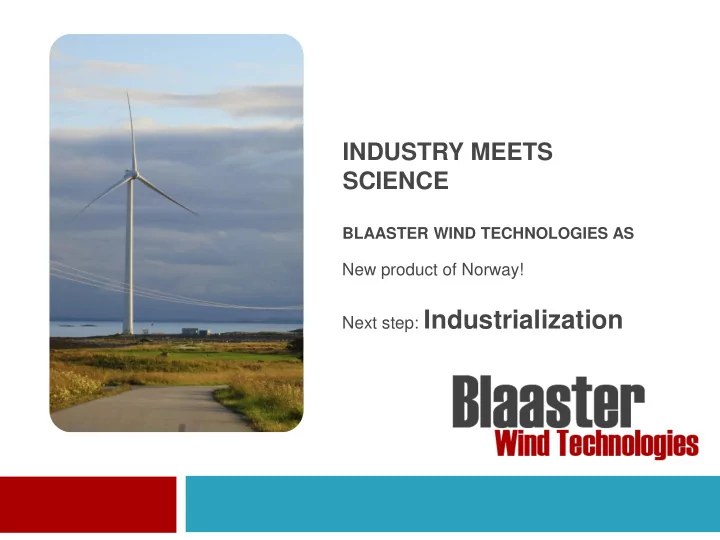
New product of Norway! Next step: Industrialization

slide-2
SLIDE 2

2 Blaaster - October 2013

slide-3
SLIDE 3

Developing the next generation wind turbines

Hva er nytt under solen?

3 Blaaster - October 2013

Adressa 27. oktober 2013:

Gigantmulighet for Midt- Norge, om bare…

Kronikk av Anne Strømmen Lycke, Styreleder i Sarepta.

For hvem, spør vi?

slide-4
SLIDE 4

Developing the next generation wind turbines 4 Blaaster - October 2013

Introduction

Blaaster Wind Technologies (Blaaster) is a Norwegian wind turbine manufacturing start- up company with a deep knowledge in R&D, design, manufacturing and marketing of large wind turbines

Blaaster has developed a brand new technology platform for large direct drive wind turbines 3 MW ++

Blaaster installed in summer 2012 the largest wind turbine in Norway – Blaaster DL101 – at the company’s test site after 3 years of R&D and prototype manufacturing

Blaaster is now searching for relevant partners for the further development of Blaaster Wind Technologies

slide-5
SLIDE 5

Developing the next generation wind turbines 5 Blaaster - October 2013

It is still possible to lower the cost considerably for electricity from wind power with more effective turbine designs and maintenance solutions

  • Direct-drive concept reducing the number of moving components
  • Lower risk for damage
  • Significant reduction in the nacelle weight and cost
  • Reducing maintenance cost by ~50% compared to regular geared wind

turbines

  • World’s first road transportable direct-drive concept for very large wind turbine

(size: 3MW to 10MW) due to segmentation of generator

  • State-of-the-art power electronics moved from nacelle down to ground level
  • Allows for easy access and maintenance
  • Flexible turbine layout
  • Can easily be adjusted to various markets, wind classes and power size
  • Adaptable value chain

Technology advantages through a direct drive concept increasing availability and energy production

  • 30 years experience from the wind turbine business, whereof 13 years experience

with large direct-drive wind turbines

  • Developed the technology and start up strategy behind ScanWind, now the

technology basis for General Electric’s offshore wind strategy on large turbines

Extensive experience and proof of concept counts Rapid build up with extensive network of partners and suppliers

  • Large network within the field of wind turbine science and technology
  • Strong relations to suppliers of core parts such as engineering, electro-technical

partners and manufacturing

  • Scalable business model based on regional companies and delivery consortiums
  • Increased size of wind turbines gives lower costs for produced electricity
  • Conventional technology holds considerable risk when sizing up
  • New electrical solutions lower the need for maintenance on the turbine itself

Proof of last concept in place

  • One year successful operation of Blaaster DL101 at test center, Mid-Norway

Business opportunities in wind energy – globally

slide-6
SLIDE 6

Developing the next generation wind turbines

Blaaster Wind Technologies (BWT) is a Norwegian wind turbine manufacturing company with a deep knowledge in R&D, design, manufacturing and marketing of large wind turbines BWT has developed a new technology platform for large direct drive wind turbines In 2012 BWT installed the largest wind turbine in Norway at Valsneset site after 3 years of R&D and prototype manufacturing Large business opportunities identified after successful testing BWT is now building the industrial platform for sales and manufacturing of wind turbines in both Norway and Sweden as a first step towards the global market

Blaaster Wind Technologies AS – large wind turbines – proven technology

Technology highlights

  • Directly driven generators used in a wind turbine are now

broadly accepted as the best technical solution for building large wind turbines with high reliability

  • Challenges connected to direct drive have up to now been

characterized by: – Too heavy constructions giving too high price – Complicated to transport – Difficult to manufacture in series

  • BWT has solved these challenges:

– By integration of the complete driveline – By specially designed segmented medium voltage PM generator – By placing all power converters down to ground level – By modular assembly of the main components at site – By having individual blade installation for easy installation – By an innovative foundation solution

  • With focus on life cycle cost, condition based maintenance

and the turbine architecture itself Blaaster turbines have maintenance costs less than ½ compared with similar turbines.

  • For a 3 MW wind turbine the NPV of lower maintenance

costs for a direct drive compared to a geared drive over lifetime is estimated at EUR 1 400 000, or approximately 35% of investment cost for the whole wind turbine

6 Blaaster - October 2013

slide-7
SLIDE 7

Blaaster Valsneset AS – wind park with consistent high energy production – technology edge in Norway

Blaaster Valsneset AS was established in 2009 with the objective of conducting long-term testing of products developed by Blaaster Wind Technologies AS under real life operating conditions The company has so far built and operates the first prototype of Blaaster Wind Technologies` DDPM wind turbine at Valsneset with success and good eranings The plan is further to build another two wind turbines at the same site, as well as facilitate testing

  • f a new grid compliant

medium converter system Blaaster Valsneset AS is today an electricity producer, selling electricity to the spot market through TrønderEnergi Kraft AS.

Prototype provided valuable documentation - green light for further investments

  • The successful completion of the prototype in summer 2012

confirmed the design and provided the necessary documentation of concept and technology platform

  • The prototype has been in stable el production for several

months with almost 100 % availability

  • Turbine concept developed by Blaaster Wind Technologies

AS functioned as predicted and will help to reduce the

  • verall costs associated with wind power in the future

7

Valsneset – the best wind park in the world?

  • With location on a peninsula on the coast of Mid-Norway

– 2 hours drive from Trondheim – Valsneset offers an

  • ptimal combination of wind conditions and locality
  • Valsneset provides “offshore conditions onshore”
  • Cooperation with NTNU, SefAS and IFE

Blaaster - October 2013

slide-8
SLIDE 8

Blaaster Valsneset AS – status prototype

8

  • Prototype installed summer 2012
  • Commissioning started September 2012
  • After a test and commissioning phase, the turbine was put into normal energy

production in April 2013

  • Turbine is now operating with an availability of +98%
  • Turbine is under continuous monitoring from the main office in Trondheim to

ensure the best performance and continuous high energy production

  • After the turbine was put into normal operation it has provided high consistent

energy production – as expected

  • The wind turbine is today the most-producing wind turbine in Norway

Blaaster - October 2013

slide-9
SLIDE 9

Developing the next generation wind turbines

Key numbers – Blaaster DL101

Blaaster - October 2013

Operating data Rated power 3MW Cut-in wind speed 3 m/s Rated wind speed 13 m/s Cut-out wind speed 25 m/s Wind Class IEC 1A/B Rotor Rotor diameter 100.6m Swept Area 7948 m2 Nominal revolutions 15 rpm Range of rotations 9-18 rpm Rotor brakes Individual redundant feathering on each blade Rotor lock Automatic rotor lock system Electrical Frequency 50/60 Hz Generator Direct-drive permanent magnet System voltage 3.3 kV Power electronics Full scale converter with LVRT functionality. All power electronics to be placed in central park hub Tower Type Tubular steel tower Hub height 92 m Blade dimensions Length 48.8 m

  • Max. Chord

3.85m Energy production Annual Mean Hub wind speed magnitude [m/s] Annual energy yield [GWh] 6 5438.2 6.5 6596.5 7 7752.5 7.5 8880.5 8 9960.8 8.5 10978.6 9 11922.1 9.5 12782.7 10 13554.1

Assumptions: Blaaster calculated electrical and mechanical losses Air density: 1.225 kg/m3 100% Park efficiency 100% Availability Wind shape factor: 2

500 1000 1500 2000 2500 3000 3500 5 10 15 20 25 Power output (kW)

Wind speed (m/s)

9

slide-10
SLIDE 10
slide-11
SLIDE 11

Developing the next generation wind turbines

Dagens tema

11 Blaaster - October 2013  Det er gitt konsesjon for utbygging av 1.7 GW vindkraft i Midt-Norge

tilsvarende ca. 19 mrd. kr. i investeringer

 Hvordan får vi til et teknologisk og industrielt taktskifte i Trøndelag

med de mulighetene som nå åpner seg?

 Mitt tema:

 Erfaring fra etablering av norsk vindturbinproduksjon

slide-12
SLIDE 12

Developing the next generation wind turbines 12 Blaaster - October 2013 12

Market potential?– Ja, det er på plass dersom det blir utbygging

Region/Country 2011 2016 %- growth

Nordic Region (Norway +Sweden) 3 226 9 537 196 % Central Europe 60 330 76 720 27 % UK 5 050 8 772 74 % NL & Poland 3 729 8 800 136 % Total Americas 56 563 125 763 122 % Total Asia 79 282 188 732 138 % Total others 1 343 2 557 90 %

Sum 209 523 420 881 101 % Example of selected markets with substantial growth (MW)

* Offshore-installations represented only 1,8% of the total market

Today, there is approximately 238 GW of installed wind power globally

The market has the past years increased with 27% annually

The annual wind turbine market is approximately 58 GEUR

Each year, approximately 13.500 wind turbines of Blaaster’s size is installed

Needless to say; only obtaining a small part of the market has a huge economic potential

Norway and Sweden can be considered home market for Blaaster. In this region there is today no local

  • actors. The wind turbine market potential is in this

region up to 2020 in the magnitude of 12 GEUR

In Norway, Blaaster has just one competitor on 3 MW direct drive wind turbines in Wind class I

Blaaster can already to day document lower COE than all its comparable competitors

The market in short

slide-13
SLIDE 13

Developing the next generation wind turbines

Market Norway & Sweden

13 Blaaster - October 2013

Common el-certificate market in Norway and Sweden until 2020

Market and permissions in place – ca. 20 TWh to be built within 2020

Industrial turnover ca. 80 GNOK

No other wind turbine manufacturers in Norway an Sweden

Markets close to already established manufacturing facilities

Common industrial interest and culture

Volume large enough to build full size manufacturing capacities in both Norway and Sweden

Large interest in the Norwegian Export Credit on Blaaster´s wind turbines

slide-14
SLIDE 14

Marked utenfor stuedøra – realitet eller bare tull?

14 Blaaster - October 2013

Sørmarkfjellet – 150MW Roan – 300MW Kvenndalsfjellet – 100MW Storheia – 220MW Remmafjellet – 130MW Svarthammaren – 150MW Frøya – 60MW Hitra 2 – 75MW Valsneset – 6MW Geitfjellet – 170MW

Blaaster Workshop

Blaaster

Bessakerfjellet 2 – 10MW

Ytre Vikna 2 – 210MW

slide-15
SLIDE 15

Developing the next generation wind turbines

Viktig med riktig mål og fokus av virkemidlene og innsatsfaktorene

15 Blaaster - October 2013

Roads 4 % Internal grid 2 % Grid connection 2 % Foundation 5 % Complete installed wind turbine 87 %

Wind park cost

Vindkraftindustri = Vindturbiner

Det er vindturbinene og nettet det knyttes spesialkompetanse til Dette er sakens kjerne som bør ha fokus i et høykostland!

slide-16
SLIDE 16

Developing the next generation wind turbines

Er koblingen mellom lokale utbyggere og industri gjort feil?

16 Blaaster - October 2013

Hva er hjemmemarkedet egentlig?

Utbyggerne klarer ikke å overbevise leverandørene om utbyggingen kommer til å skje, og når den kommer til å skje – til tross for innføringen av el-sertifikatene i 2012

14 års erfaring viser at norske vindkraftutbyggere ikke engasjerer seg i å få frem en norsk vindturbinindustri – dette er den store utfordringen

ScanWind var et unntak, men benyttes nå av enkelte utbyggere som selve beviset på at dette skal vi ikke holde på med i Norge

Slike holdninger hos utbyggerne virker voldsomt negativt inn på investeringsapparatet en vindturbinleverandør er avhengig av

Dette står også i skarp kontrast til at både ScanWind og Blaaster står for grensesprengende teknologi som resten av verden nå kopierer

Det er stor oppmerksomhet i utlandet mot “Blaaster´s approach”

Det har heller ikke vært mulig å oppnå en forståelse hos utbyggere med konsesjon for at man i alle fall kunne gjort etableringen enklere for en leverandør ved at man hadde stilt noen få oppstillingsplasser til disposisjon for industriutvikling på vanlige leiebetingelser

Det virkelig positive med Norge er at vi har et ok virkemiddelapparat som fortsatt tror på

  • ss
slide-17
SLIDE 17

Developing the next generation wind turbines

Surr med definisjonen av roller, type markeder og vekstbegreper

17 Blaaster - October 2013

Det settes likhetstegn mellom utbygginger og industri, og dermed utbyggere og industriaktører

Det settes likhetstegn mellom industriprodukter, salg av ingeniørtimer og servicetjenester

Det surres med hva som er mulige norske industrileveranser

Det settes likhetstegn mellom høykompetanse og lavkompetanse aktivitet

Lokalt er det mange som tror at utbyggingen på Fosen vil medføre stor industrivekst, hvilket er vanskelig å skjønne dersom det utelukkende satses på det som ligger utenfor selve vindturbinen

Men om det er en god del norske turbinleveranser kan det medføre stor

  • msetningsvekst i Midt- Norge, hvilket sikrer en global industri ledet fra Norge

Eneste som sikrer stor varig aktivitet i Norge på vindkraft er om man klarer å holde en høy global posisjon på vindkraft kjernekompetanse demonstrert gjennom demonstrasjonsparker onshore og offshore i Norge

Tiden er inne for å rydde opp i hvem som drar og hvem som blir dratt!

slide-18
SLIDE 18

Developing the next generation wind turbines

Må forbedre norsk konkurransedyktighet

18 Blaaster - October 2013

Blaasters erfaringer er at skal man bli konkurransedyktig på underleveranser av vindturbiner fra Norge for bruk i Norge og Sverige, må det skje betydelige endringer i spesialiseringen inn mot vindkraft hos underleverandørene

Man må fokusere på å levere høykompetanse produkter, og ikke komponenter med høyt norsk timeinnhold og lavt teknologi innhold

Prisen på underleveranser av enkeltkomponenter fra Norge er per i dag stort sett 2 til 3 ganger høyere enn leveranser fra andre høykostland i Europa

Skal man levere slike produkter fra Norge kreves det koordinert innsats fra:

Teknologi kunnskapsbedrifter

Lokale produksjonsbedrifter

Det offentlige virkemiddelapparatet for hjelp til investeringer i industri infrastruktur

De utbyggerne som ser nytteverdien i å ha egen norsk industri

Villige turbinleverandører som ser seg tjent med å få dette til i Norge

slide-19
SLIDE 19

Developing the next generation wind turbines

Hvordan få til taktskifte?

19 Blaaster - October 2013  Slik Norge har organisert seg i dag blir det ingen vindkraftindustri av

betydning i Norge

 Alle land Blaaster konkurrerer med opptrer proteksjonistisk overfor

sin industri på en eller annen måte

 Norge har ingen industripolitikk på vindkraft  Blaaster anbefaler at det utpekes en arbeidsgruppe av noen få

handlekraftige personer med sammenfallende industri interesser som får i oppgave å klargjøre sammen med virkemiddelapparatet hva som skal til av koordinerte rammebetingelser for å støtte

  • ppbyggingen av en norsk vindkraftindustri, alternativt….
slide-20
SLIDE 20

Developing the next generation wind turbines

Alternativt…

20 Blaaster - October 2013  Utbyggerne med konsesjon skifter holdning til norsk vindkraft

industrioppbygging og deltar på et forsøk på å bygge opp en konkurransedyktig norsk vindkraftindustri

 Det er enklere og mer samfunnsgagnlig enn vi holder på i dag!  Slik har alle andre land det er naturlig å sammenligne seg med gjort

det