
SLIDE 1
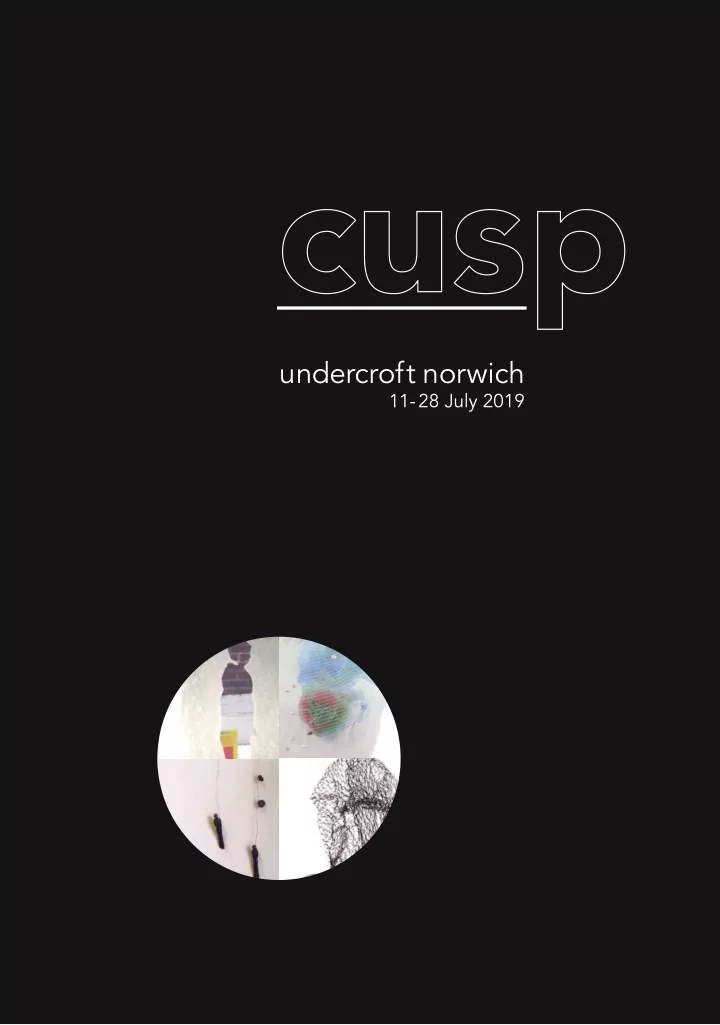
undercroft norwich 11-28 July 2019 Alison Esther Dunhill Boehm - - PDF document
undercroft norwich 11-28 July 2019 Alison Esther Dunhill Boehm Lines of glittered crystals strewn over Being a bit of a nomad, I have always worked Wondermesh. Stars in the night sky (constellations in and with whatever materials the
Lines of glittered crystals strewn over
Wondermesh clouds, plaster and textile clouds, hanging and light-filled, sometimes moving in space, their transparency stopped by small bits of solid consumer waste. Blue clouds, black cloud, made in netting or mesh, with threads stretched, draped and coiled and with flowers and leaves
pierced plaster, hung as a flock of flying wall
copper pipe studded, glass bead- embedded (volcanic craters in symmetry). Miniature Doric columns with ribbon-tied, tiny scrolls on top (temple of Segesta). My columns encasing secrets in their scrolls, those ancient writing surfaces. Each scroll a small unit in a growing multiple. White pillars, gold pillars, wild, flying, multi- textile-topped green pillars. Clouds formed by pouring plaster onto sand piles, then gouging, paint-streaking and embedding the plaster form with glass, textile and metal offcuts. Working fast before the plaster
lorries, in a rusty pile of the disused useful. Dull aluminium, verdigrised copper, dull brass, matt zinc, cheap tin glinting like silver, all sewn onto the huge, lit, white cloud. Subterranean ‘Undercroft River’, its flow emitting froth pools. www.alisondunhill.com
Alison
Being a bit of a nomad, I have always worked in and with whatever materials the environment I lived in allowed. Sometimes larger sculptural works were possible but other times it was only small drawings. With every move, the conditions, and hence work, changed. Just before moving to England, I found a damp and decaying but beautiful piece of wood in the Palatinate Forest in Germany. This was the beginning of a new body of work involving small figure ‘impressions’ made of raku fired clay. Exploring the context
reaction allowing me to explore new ideas. I love the ambiguity of meaning that can arise; an
For this exhibition I was able to experiment and expand on ideas that would have been impossible without the vast dimensions and aesthetic constraints of the Undercroft Gallery. It was a wonderful opportunity for me to work on a large scale and through a space. The Tower, made of plaster blocks and incorporating raku fired figures echoes the solidity
The large figures, standing as Sentinels, are modelled with Ciment Fondu, a first for me. The material allows a similar restricted working time as with the small raku figures which I found exciting. The eleven large pillar figures were inspired by a drawing done in 2016. The objects are connected and flow through the gallery allowing visitors to walk through them. www.estherboehm.com
Esther
cusp is underground in the Undercroft. Inspired by the site, Helen’s creations stem from dark subterranean environments. Worms wriggled into her thoughts, devils delved into her subconscious. Anatomical studies became ‘spirits’ in jars - sculpted forms influenced by forays through hospital vaults. The darkness of caves, with the flash of gold seams and smooth white of skulls. Drawing is a mainstay and there are examples
imaginings, pastel and charcoal sketches. In printmaking, Helen relishes the freedom granted by the unpredictability of the medium. Her prints are intensely dark but with a luminous energy. Expanding on her drawing work Helen explores
parallel, along with wax ‘spirits’ and chicken-wire creations. There is a distinctive anthropomorphic quality to Helen’s works, dead artists dressed in their canvas paintings, faces and bones. Setting the fragile and delicate alongside physical and emotional weight. Saved from underground landfill, much of Helen’s display material is rescued from tips, cleaned and repurposed with practical flair. Her work may be disconcerting and somewhat dark, but always has an element of humour. Like Bourgeois and Rego, there are traces
addressing the emotional theme of loss. Helen’s artwork communicates emotions and concerns that can be recognised by everyone. The result is at once humble and real, imperfect, yet emotionally spiky, unsettling but honest. www.helenbreach.com
Helen
The human figure plays an important role in all my work and this is reflected in the pieces on
gradually evolved into the larger free-standing positive and negative wooden figures. Working alongside the sculptor Tom Sharp I was able to work with new materials and realise these pieces. The paper installations were screenprinted with mixed media and found objects. The Undercroft itself was an inspiration for some of this work particularly the floor and metal grill becoming part of the negative space. I also had the
artist/blacksmith. Working three-dimensionally with paper and cardboard I made a suspended figure drawn from life but wanted something more permanent and substantial and this began my interest in metal sculpture. I have collected rusted objects washed up on the beaches near where I live and like the natural way the pieces fit into the landscape. This metal figure has changed my perspective on what is possible and Cusp has had a profound effect upon my thinking and future practice. Wiebe Siem became an influence after visiting her exhibition at the Henry Moore institute in Leeds. The imaginary shapes freed my imagination and enabled me to simplify my drawing practice. The Undercroft itself was a powerful influence on how I might create a visual conversation with my fellow artists using the space imaginatively without boundaries without walls – a big change from the churches and intimate white spaces I am familiar with. www.lydiahaines.com
Lydia
assisted by Thanks go out to: Roger, Zana, Rob, Richard, Harry, Toby, Tom, Stina, Thelma, Hazel, Pam, Anita, Phyllis, Zandra and Claire Alison, Helen, Lydia and Esther