Unable to Tolerate an Effective Dose of Statin Erik Stroes 1 , David - - PowerPoint PPT Presentation

unable to tolerate an effective dose of statin
SMART_READER_LITE
LIVE PREVIEW

Unable to Tolerate an Effective Dose of Statin Erik Stroes 1 , David - - PowerPoint PPT Presentation

A Phase 3 Double-blind, Randomized Study to Assess Safety and Efficacy of Evolocumab (AMG 145) in Hypercholesterolemic Subjects Unable to Tolerate an Effective Dose of Statin Erik Stroes 1 , David Colquhoun 2 , David Sullivan 3 , Fernando Civeira


slide-1
SLIDE 1

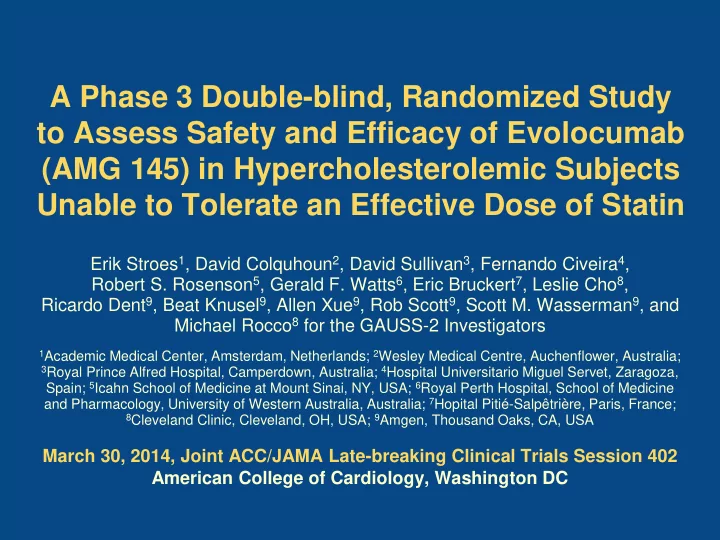
A Phase 3 Double-blind, Randomized Study to Assess Safety and Efficacy of Evolocumab (AMG 145) in Hypercholesterolemic Subjects Unable to Tolerate an Effective Dose of Statin

Erik Stroes1, David Colquhoun2, David Sullivan3, Fernando Civeira4, Robert S. Rosenson5, Gerald F. Watts6, Eric Bruckert7, Leslie Cho8, Ricardo Dent9, Beat Knusel9, Allen Xue9, Rob Scott9, Scott M. Wasserman9, and Michael Rocco8 for the GAUSS-2 Investigators

1Academic Medical Center, Amsterdam, Netherlands; 2Wesley Medical Centre, Auchenflower, Australia; 3Royal Prince Alfred Hospital, Camperdown, Australia; 4Hospital Universitario Miguel Servet, Zaragoza,

Spain; 5Icahn School of Medicine at Mount Sinai, NY, USA; 6Royal Perth Hospital, School of Medicine and Pharmacology, University of Western Australia, Australia; 7Hopital Pitié-Salpêtrière, Paris, France;

8Cleveland Clinic, Cleveland, OH, USA; 9Amgen, Thousand Oaks, CA, USA

March 30, 2014, Joint ACC/JAMA Late-breaking Clinical Trials Session 402 American College of Cardiology, Washington DC

slide-2
SLIDE 2

Background and Rationale

  • LDL-C lowering with statins reduces CV risk
  • ~ 22% CV and ~10% mortality risk reduction for every 39 mg/dL LDL-C

decrease1

  • Statin side effects leading to partial/complete statin intolerance may

be present in 10% – 20% of patients in a real-life setting.2,3

  • Statin discontinuation and low adherence have been shown to

impact survival in both primary and secondary prevention.4-6

  • Evolocumab, a fully human monoclonal antibody against PCSK9,

is a novel therapeutic option for lowering LDL-C.

  • In a phase II study, evolocumab reduced LDL-C in patients

intolerant to at least one statin.7

2

  • 1. Lancet 2010;376(9753):1670-1681.
  • 2. Can J Cardiol 2011;27:635-62.
  • 3. Ann Intern Med 2013;158:526.
  • 4. JAMA 2007;297:177.
  • 5. Eur Heart J 2013;34:2940-8.
  • 6. Eur J Clin Pharm 2009;65:1013.
  • 7. JAMA 2012;308:2497-2506.
slide-3
SLIDE 3

The GAUSS-2 Study

  • Goal Achievement after Utilizing an anti-PCSK9 antibody

in Statin Intolerant Subjects (NCT01763905)

  • Design

A 12-week randomized, double-blind, placebo- and ezetimibe-controlled multicenter phase 3 study1

  • Objective

To evaluate the efficacy and safety of evolocumab in statin-intolerant hypercholesterolemic patients

3

  • 1. Clin Cardiol 2014. In Press.
slide-4
SLIDE 4

GAUSS-2 Study Design

4

*Phone call for AEs, SAEs. AEs, adverse events; EOS, end of study; LDL-C, low-density lipoprotein cholesterol; SAEs, serious adverse events; SC, subcutaneous; PO, oral; Q2W, every 2 weeks (biweekly); QM, monthly

End of Study Randomization 2:2:1:1 Evolocumab 140 mg SC Q2W + Placebo PO QD N = 103 Evolocumab 420 mg SC QM + Placebo PO QD N = 102 Placebo SC Q2W + Ezetimibe 10 mg PO QD N = 51 Placebo SC QM + Ezetimibe 10 mg PO QD N = 51

Maximum 6 weeks Day 1 Week 2 Week 4 Week 6 Week 8 Week 10 Week 12 Week 14 Time point Evolocumab or Placebo SC Q2W Evolocumab or Placebo SC QM

Screening period Fasting LDL-C 5–10 days before randomization Subcutaneous injection of placebo

Q2W EOS* QM EOS

slide-5
SLIDE 5

GAUSS-2: Endpoints

  • Co-primary endpoints

Percent change from baseline in LDL-C at mean of weeks 10 and 12 and at week 12

  • Secondary endpoints

At mean of weeks 10 and 12 and at week 12:

  • Percent change from baseline in ApoB, ApoA-I, lipoprotein(a),

TG, and HDL-C

  • Achievement of LDL-C < 70 mg/dL
  • Key safety endpoints
  • Treatment-emergent and serious adverse events
  • Muscle and hepatic enzyme elevations
  • Anti-evolocumab antibodies

5

slide-6
SLIDE 6

6

GAUSS-2: Baseline Characteristics

Biweekly Monthly

PBO Q2W + EZE QD (N = 51)

Evolocumab

140 mg Q2W + PBO QD (N = 103) PBO QM + EZE QD (N = 51)

Evolocumab

420 mg QM + PBO QD (N = 102)

Age (years), mean (SD) 62 (10) 61 (10) 60 (9) 63 (10) Female, % 53 45 43 45 Race, white, % 96 91 90 96 NCEP risk categories*, % High 63 50 63 57 Moderately high 10 16 16 16 Moderate 18 19 16 16 Lower 10 16 6 12

*Risk category definitions: high, diagnosed CHD or risk equivalent; moderately high, 2 or more risk factors and Framingham risk score 10%–20%; moderate, 2 or more risk factors and Framingham risk score < 10%; lower, 0 or 1 risk factor. EZE, ezetimibe; PBO, placebo; Q2W, biweekly; QM, monthly; QD, daily

slide-7
SLIDE 7

7

GAUSS-2: Baseline Characteristics II

Biweekly Monthly

PBO Q2W + EZE QD (N = 51)

Evolocumab

140 mg Q2W + PBO QD (N = 103) PBO QM + EZE QD (N = 51)

Evolocumab

420 mg QM + PBO QD (N = 102)

Number of intolerable statins, % ≥ 2 100 100 100 100 ≥ 3 51 55 67 51 ≥ 4 26 19 24 20 Worst muscle-related side effect*, % Myalgia 78 78 88 79 Myositis 22 19 8 19 Rhabdomyolysis 2 4 2 Lipid lowering therapy, % 29 33 31 36 Statin use, % 18 18 20 17

*Data missing for one patient in the evolocumab Q2W arm EZE, ezetimibe; PBO, placebo; Q2W, biweekly; QM, monthly; QD, daily

slide-8
SLIDE 8

8

GAUSS-2: Baseline Lipids

Biweekly Monthly

PBO Q2W EZE QD (N = 51)

Evolocumab

140 mg Q2W + PBO QD (N = 103) PBO QM + EZE QD (N = 51)

Evolocumab

420 mg QM + PBO QD (N = 102)

LDL-C*, mg/dL,

mean (SD)

195 (64) 192 (57) 195 (52) 192 (61) ApoB, mg/dL,

mean (SD)

140 (37) 140 (32) 140 (31) 133 (32) Lp(a), nmol/L,

median (Q1,Q3)

57 (22, 205) 39 (10, 101) 26 (7, 181) 31 (9, 80) TG, mg/dL,

median (Q1,Q3)

170 (120, 243) 165 (123, 224) 168 (124, 240) 139 (103, 190)

*Determined by the Friedewald formula with reflexive testing via preparative ultracentrifugation when calculated LDL-C was <40 mg/dL or triglyceride levels were >400 mg/dL EZE, ezetimibe; PBO, placebo; Q2W, biweekly; QM, monthly; QD, daily; TG, triglycerides

slide-9
SLIDE 9

GAUSS-2: Evolocumab

Primary Endpoint Biweekly Dose

9

BL Week 2 Week 4 Week 6 Week 8 Week 10 Week 12

  • 80

Study drug administration Biweekly SC

  • 60
  • 40
  • 20

Day 1 Mean Percent Change in LDL-C from Baseline

–18% –56%

1: Ezetimibe (N = 51) 2: Evolocumab 140 mg Q2W (N = 103) Study Week

BL, baseline. Vertical lines represent the standard error around the mean. Plot is based on observed data with no imputation for missing values. P value is multiplicity adjusted.

slide-10
SLIDE 10

GAUSS-2: Evolocumab

Primary Endpoint Monthly Dose

10

Study Week 1: Ezetimibe (N = 51) 2: Evolocumab 420 mg QM (N = 102) Study drug administration Monthly SC Mean Percent Change in LDL-C from Baseline

  • 60
  • 40
  • 20

BL Week 2 Week 4 Week 6 Week 8 Week 10 Week 12 Day 1

–15% –53%

BL, baseline. Vertical lines represent the standard error around the mean. Plot is based on observed data with no imputation for missing values. P value is multiplicity adjusted.

  • 80
slide-11
SLIDE 11

GAUSS-2: LDL-C lowering efficacy

Clinically equivalent between dosing groups

11

Evolocumab Biweekly Treatment Difference vs Ezetimibe Average at weeks 10 and 12 –37% P < 0.001 At week 12 –38% Evolocumab Monthly Treatment Difference vs Ezetimibe Average at weeks 10 and 12 –39% P < 0.001 At week 12 –38%

slide-12
SLIDE 12

GAUSS-2: Secondary Endpoints at Week 12

12

ApoB* Lp(a)* HDL-C ApoA-I Triglycerides Evolocumab 140 mg Q2W vs ezetimibe Evolocumab 420 mg QM vs ezetimibe

Treatment difference vs ezetimibe: *P < 0.001; P value adjusted for multiplicity.

  • 25%
  • 28%
  • 40
  • 35
  • 30
  • 25
  • 20
  • 15
  • 10
  • 5

Treatment Difference, % Mean (SE)

4% 2%

1 2 3 4 5 6 7 Treatment Difference, % Mean (SE)

  • 33%
  • 33%
  • 40
  • 35
  • 30
  • 25
  • 20
  • 15
  • 10
  • 5

Treatment Difference, %, Mean (SE)

4% 5%

1 2 3 4 5 6 7 8 Treatment Difference, % Mean (SE)

2%

  • 5%
  • 12
  • 9
  • 6
  • 3

3 6 9 Treatment Difference, % Mean (SE)

No notable difference in results for average at weeks 10 and 12 and week 12

slide-13
SLIDE 13

GAUSS-2: LDL-C Goal Achievement

at Week 12

13

*Combination of NCEP ATP III moderate and moderately-high risk categories Rate based on subjects with observed values at Week 12 and LDL-C above target goal at baseline

12

(92%)

28

(80%)

29

(91%)

3

(20%)

7

(70%)

2

(7%) 1 (4%)

36

(77%) 40 (76%) 0.0 10.0 20.0 Lower Risk < 160 mg/dL High Risk < 100 mg/dL Moderately High Risk* < 130 mg/dL 30.0 40.0 50.0 60.0 70.0 80.0 90.0 100.0

Ezetimibe QD + PBO Q2W Ezetimibe QD + PBO QM Evolocumab 140 mg Q2W + PBO QD Evolocumab 420 mg QM + PBO QD

Proportion of Patients Achieving LDL-C Target Goal at Week 12, n (%) (0%) (0%)

1

(8%)

slide-14
SLIDE 14

14

GAUSS-2: Safety and Tolerability

Adverse Events (AEs), n(%) Ezetimibe (N = 102) Evolocumab (N = 205) Treatment-emergent AEs 74 (73) 135 (66) Common treatment-emergent AEs (≥5% of patients in either treatment arm) Headache Myalgia Extremity pain Muscle spasms Fatigue Nausea Diarrhea Paresthesia 9 (9) 18 (18) 1 (1) 4 (4) 10 (10) 7 (7) 7 (7) 5 (5) 16 (8) 16 (8) 14 (7) 13 (6) 9 (4) 9 (4) 5 (2) 2 (1) Serious AEs 4 (4) 6 (3) AEs leading to study drug discontinuation 13 (13) 17 (8) Deaths Potential injection site reactions* 8 (8) 6 (3) Muscle-related SMQ† 23 (23) 25 (12) Neurocognitive AEs†† Anti-evolocumab antibodies‡

  • *Reported using high-level term grouping, including IS - rash, inflammation, pruritus, reaction, urticaria. †Standard MedDRA Queries.

††Searched HLGT terms: Deliria (incl confusion); Cognitive and attention disorders and disturbances; dementia and amnestic

conditions; disturbances in thinking and perception; mental impairment disorders. ‡Binding or neutralizing; data missing for one patient.

slide-15
SLIDE 15

GAUSS-2: Conclusions

  • Evolocumab, administered biweekly (140 mg) or monthly (420 mg),

yields a potent reduction in LDL-C after 12 weeks in patients with statin intolerance to at least 2 statins.

  • LDL-C reductions are clinically equivalent with biweekly and

monthly dosing regimens.

  • Evolocumab biweekly (140 mg) or monthly (420 mg) is superior to

ezetimibe in lowering LDL-C, ApoB, and Lp(a).

  • Evolocumab is well tolerated with low rates of muscle symptoms in

this 12-week study in patients intolerant to ≥ 2 statins due to muscle- related side effects.

  • The LDL-C lowering efficacy combined with good tolerability make

evolocumab a promising option to address the unmet clinical need in high-risk hypercholesterolemic patients with statin intolerance.

15

slide-16
SLIDE 16

JACC 2014: online first. Available online at http://content.onlinejacc.org/

Thank you to our investigators and coordinators, data safety committee members, clinical endpoint committee members, core laboratories, operational teams, monitors, and sponsor

Anti-PCSK9 Antibody Effectively Lowers Cholesterol in Patients with Statin Intolerance: The GAUSS-2 Randomized, Placebo-controlled Phase 3 Clinical Trial of Evolocumab

Erik Stroes, MD, PhD, David Colquhoun, MD, David Sullivan, MD, Fernando Civeira, MD, Robert S. Rosenson, MD, Gerald F. Watts, DSc, PhD, DM, Eric Bruckert, MD, Leslie Cho, MD, Ricardo Dent, MD, Beat Knusel, PhD, Allen Xue, PhD, Rob Scott, MD, Scott M. Wasserman, MD, Michael Rocco, MD for the GAUSS-2 Investigators