UMBC A B M A L T F O U M B C I M Y O R T 1 - - PowerPoint PPT Presentation

umbc
SMART_READER_LITE
LIVE PREVIEW

UMBC A B M A L T F O U M B C I M Y O R T 1 - - PowerPoint PPT Presentation

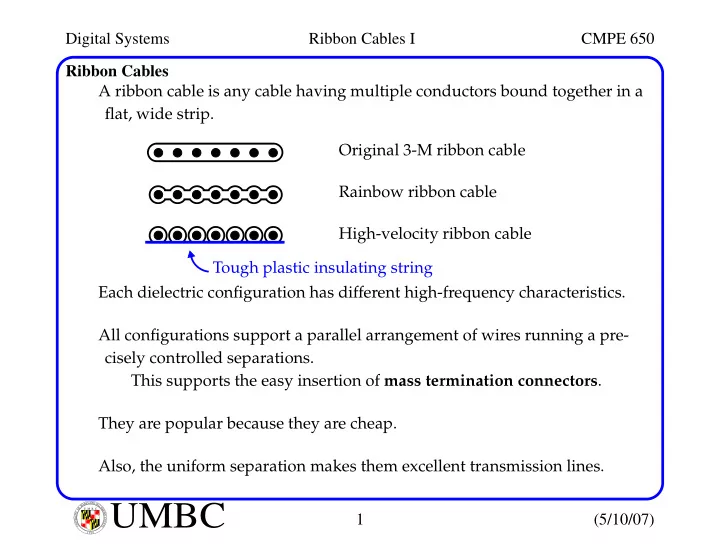
Digital Systems Ribbon Cables I CMPE 650 Ribbon Cables A ribbon cable is any cable having multiple conductors bound together in a flat, wide strip. Original 3-M ribbon cable Rainbow ribbon cable High-velocity ribbon cable Tough plastic


slide-1
SLIDE 1

Digital Systems Ribbon Cables I CMPE 650 1 (5/10/07)

UMBC

U M B C U N I V E R S I T Y O F M A R Y L A N D B A L T I M O R E C O U N T Y 1 9 6 6

Ribbon Cables A ribbon cable is any cable having multiple conductors bound together in a flat, wide strip. Each dielectric configuration has different high-frequency characteristics. All configurations support a parallel arrangement of wires running a pre- cisely controlled separations. This supports the easy insertion of mass termination connectors. They are popular because they are cheap. Also, the uniform separation makes them excellent transmission lines. Original 3-M ribbon cable Rainbow ribbon cable High-velocity ribbon cable Tough plastic insulating string

slide-2
SLIDE 2

Digital Systems Ribbon Cables I CMPE 650 2 (5/10/07)

UMBC

U M B C U N I V E R S I T Y O F M A R Y L A N D B A L T I M O R E C O U N T Y 1 9 6 6

Ribbon Cable Signal Propagation The rise time of a ribbon cable varies with the square of its length. K = constant dependent on cable, ft2-GHz L = length, ft Reducing the length by 1/2, reduces rise time by 1/4, etc... This is also true for coax and twisted pair. This is true because the frequency response for any cable is determined by the cable’s inductance, capacitance and resistance/length. All cable types share the same basic frequency response shape. Only K differs for different cable types. T10-90 3L2 K

  • =

H f ( ) e

0.546 L2 f [ ] K

  • 1 2

=

slide-3
SLIDE 3

Digital Systems Ribbon Cables I CMPE 650 3 (5/10/07)

UMBC

U M B C U N I V E R S I T Y O F M A R Y L A N D B A L T I M O R E C O U N T Y 1 9 6 6

Ribbon Cable Signal Propagation Shape invariance means, if K changes, you can compensate by modifying L. In other words, you can get the same response using a long piece of coax

  • r a short piece of ribbon cable.

Ribbon cable work very well at short distances. The response depends on the ground connection arrangement. This arrangement yields a characteristic impedance between 80 and 100 Ω. G-S-G arrangement 105 107 109 Freq response magnitude (dB)

  • 1
  • 2
  • 3
  • 4

Cable length 10 ft 25 ft 100 ft

slide-4
SLIDE 4

Digital Systems Ribbon Cables I CMPE 650 4 (5/10/07)

UMBC

U M B C U N I V E R S I T Y O F M A R Y L A N D B A L T I M O R E C O U N T Y 1 9 6 6

Ribbon Cable Frequency Response From the figure, a 10’ section produces an attenuation of less then 3.3 dB up to about 500 MHz. The effective bandwidth varies with the inverse square of distance. For ribbon cables less than 10 ft., the performance is very good. At 100 ft., the 3.3-dB attenuation point occurs at 5 MHz, yielding a rise time of 100 ns. Note the shape of the curves doesn’t change, they are only shifted. The bumps occur because the cable terminations in the simulations were not complex (a resistor was used), and some mismatch occurred. Also, resistive terminations cause cable resistance to introduce a DC attenuation, e.g., 100-ft response has a 1.5 dB attenuation at DC. The cables dielectric impacts performance in two ways. It controls signal propagation velocity and attenuation.

slide-5
SLIDE 5

Digital Systems Ribbon Cables I CMPE 650 5 (5/10/07)

UMBC

U M B C U N I V E R S I T Y O F M A R Y L A N D B A L T I M O R E C O U N T Y 1 9 6 6

Ribbon Cable Frequency Response Propagation velocity, in ft/ns, is inversely proportional to the square root of electric permittivity. Cables with a dielectric surrounding the wires exhibit lower speed while cables on a thin, flat plastic sheet are high speed (air carries their field). Attenuation depends on the ratio of series resistance to cable impedance. At high frequencies, skin effect causes series resistance to rise with the square root of frequency, and so follows attenuation. Also, the dielectric influences attenuation by changing the cable’s character- istic impedance. Cables completely surrounded in a dielectric material exhibit higher effective permittivity, and more attenuation.

slide-6
SLIDE 6

Digital Systems Ribbon Cables I CMPE 650 6 (5/10/07)

UMBC

U M B C U N I V E R S I T Y O F M A R Y L A N D B A L T I M O R E C O U N T Y 1 9 6 6

Ribbon Cable Rise Time Rise time of 4 lengths of ribbon cables. Rise time is proportional to the square of the length. There is also a DC, resistive, attentuation. To compute rise time given one value of attenuation, length and frequency. 2 ns/div 10 25 50 100 Offset horizontally 30 AWG, 0.05-in. wire pitch K L0

2F0 22.5

( ) A0

2

  • =

Previous equation solved for K. A0 = attenuation, dB

slide-7
SLIDE 7

Digital Systems Ribbon Cables I CMPE 650 7 (5/10/07)

UMBC

U M B C U N I V E R S I T Y O F M A R Y L A N D B A L T I M O R E C O U N T Y 1 9 6 6

Ribbon Cable Rise Time Once K is known, then Crosstalk Crosstalk in ribbon cables varies with the placement of grounds among the signal conductors. Here, both inductive and capacitive crosstalk are present and are nearly equal. This causes a large reverse coupling coefficient, but almost no forward coupling. T10-90 3 L2 ( ) K

  • =