UMBC A B M A L T F O U M B C I M Y O R T 1 - - PowerPoint PPT Presentation

umbc
SMART_READER_LITE
LIVE PREVIEW

UMBC A B M A L T F O U M B C I M Y O R T 1 - - PowerPoint PPT Presentation

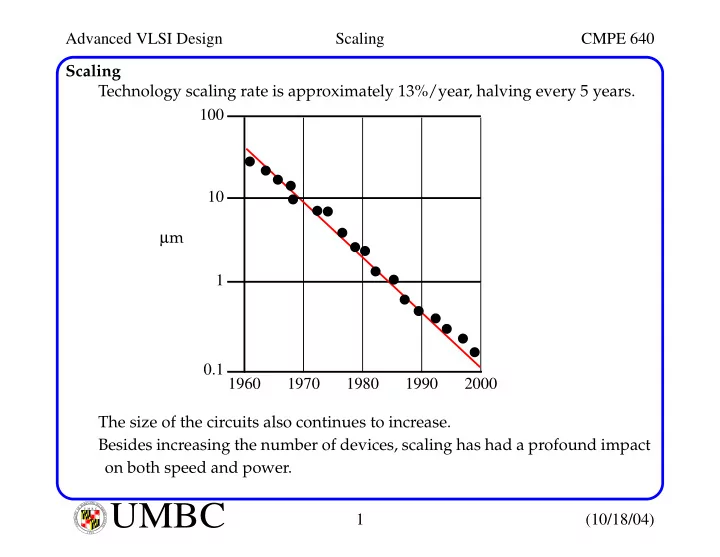
Advanced VLSI Design Scaling CMPE 640 Scaling Technology scaling rate is approximately 13%/year, halving every 5 years. 100 10 m 1 0.1 1960 1970 1980 1990 2000 The size of the circuits also continues to increase. Besides increasing


slide-1
SLIDE 1

Advanced VLSI Design Scaling CMPE 640 1 (10/18/04)

UMBC

U M B C U N I V E R S I T Y O F M A R Y L A N D B A L T I M O R E C O U N T Y 1 9 6 6

Scaling Technology scaling rate is approximately 13%/year, halving every 5 years. The size of the circuits also continues to increase. Besides increasing the number of devices, scaling has had a profound impact

  • n both speed and power.

1 0.1 1960 1970 1980 2000 1990 10 100 µm

slide-2
SLIDE 2

Advanced VLSI Design Scaling CMPE 640 2 (10/18/04)

UMBC

U M B C U N I V E R S I T Y O F M A R Y L A N D B A L T I M O R E C O U N T Y 1 9 6 6

Full Scaling (Constant Electrical Field Scaling) In the ideal model, all the dimensions of the MOS devices, e.g., the voltage supply level and depletion widths are scaled by the same factor S. Keeping the electric field patterns constant avoids breakdown and other sec-

  • ndary effects.

This leads to greater device density, higher speed and reduced power con- sumption. Ron remains constant -- performance is improved because of the reduced capacitance. Circuit speed increases linearly while the power scales down quadratically! Both clearly indicate the benefits of scaling.

slide-3
SLIDE 3

Advanced VLSI Design Scaling CMPE 640 3 (10/18/04)

UMBC

U M B C U N I V E R S I T Y O F M A R Y L A N D B A L T I M O R E C O U N T Y 1 9 6 6

Scaling See text for assumption used to derive this table. Dimensions are scaled by S while voltages are scaled by U. Parameter Relation Full Scaling General Scaling Fixed-V Scaling

W, L, tox 1/S 1/S 1/S VDD, VT 1/S 1/U 1 NSUB V/Wdepl

2

S S2/U S2 Area/Device WL

1/S2

1/S2 1/S2 Cox 1/tox S S S Cgate CoxWL

1/S

1/S 1/S kn, kp CoxW/L S S S Isat CoxWV 1/S 1/U

1

Current density Isat/Area S S2/U S2 Ron V/Isat

1

1

1

Intrinsic Delay RonCgate

1/S

1/S

1/S

P IsatV 1/S2 1/U2

1

Power density P/Area

1

S2/U2 S2

slide-4
SLIDE 4

Advanced VLSI Design Scaling CMPE 640 4 (10/18/04)

UMBC

U M B C U N I V E R S I T Y O F M A R Y L A N D B A L T I M O R E C O U N T Y 1 9 6 6

Fixed Voltage Scaling Full scaling is not a feasible option. For example, to keep new chips compatible with existing chips, voltages cannot be scaled arbitrarily. Providing multiple voltage supplies is expensive. 5V was used up through the early 90s. Voltages of 3.3 and 2.5 used since the introduction of 0.5 µm. The change from a fixed-voltage scaling model to the general scaling model used today can be justified by reviewing the rightmost column. In velocity saturated device, keeping the voltage constant while scaling the device dimensions:

  • Does not provide a performance advantage over full scaling model (1/S vs.

1/S)

  • But has a major power penalty associated with it (1/S2 vs 1).
slide-5
SLIDE 5

Advanced VLSI Design Scaling CMPE 640 5 (10/18/04)

UMBC

U M B C U N I V E R S I T Y O F M A R Y L A N D B A L T I M O R E C O U N T Y 1 9 6 6

Fixed Voltage Scaling Note the gain of increased current level is offset by the higher voltage swing, which only hurts power dissipation. Also note that this is very different from the situation when transistors were

  • perating in the long-channel mode.

Here, current was a quadratic function of the voltage. In this scenario, keeping voltage constant gave a performance advantage (net reduction in "on" resistance" Other reasons for scaling the supply voltage include hot-carrier effect and

  • xide breakdown.

These latter reasons played a significant role in the trend we see today. Bear in mind that this is a first order analysis -- in reality, there is a (small) per- formance benefit with fixed voltage due to, e.g., channel length modulation.

slide-6
SLIDE 6

Advanced VLSI Design Scaling CMPE 640 6 (10/18/04)

UMBC

U M B C U N I V E R S I T Y O F M A R Y L A N D B A L T I M O R E C O U N T Y 1 9 6 6

General Scaling Supply voltage is now being scaled, but at a slower rate than feature size. For example, from 0.5 µm to 0.1 µm, supply voltage reduced from 5 V to 1.5V. Then why not stick with full scaling model if there is no benefit to keeping the supply voltage higher.

  • Some device voltages, e.g., silicon bandgap and built-in junction potential, are

material parameters and cannot be scaled.

  • VT scaling is limited since making it too low makes it difficult to turn off the

devices completely. This is aggravated by large process variations. A more general scaling model is needed, where dimensions and voltages are scaled independently using S and U respectively. Under fi xed voltage scaling, U = 1 as shown in the last column of the table.

slide-7
SLIDE 7

Advanced VLSI Design Scaling CMPE 640 7 (10/18/04)

UMBC

U M B C U N I V E R S I T Y O F M A R Y L A N D B A L T I M O R E C O U N T Y 1 9 6 6

General Scaling Under general scaling model, performance scenario is identical (1/S) to other models but power dissipation lies between the two models, S > U > 1. Recent CMOS technologies and projections of the future. Year intro -> 2001 2003 2005 2007 Drawn channel L (nm) 90 65 45 35 Physical channel L (nm) 65 45 32 25 Gate oxide (nm) 2.3 2.0 1.9 1.4 VDD (V) 1.2 1.0 0.9 0.7 NMOS IDsat (µA/µm) 900 900 900 900 NMOS Ileak (µA/µm) 0.01 0.07 0.3 1