UMBC A B M A L T F O U M B C I M Y O R T 1 - - PowerPoint PPT Presentation

umbc
SMART_READER_LITE
LIVE PREVIEW

UMBC A B M A L T F O U M B C I M Y O R T 1 - - PowerPoint PPT Presentation

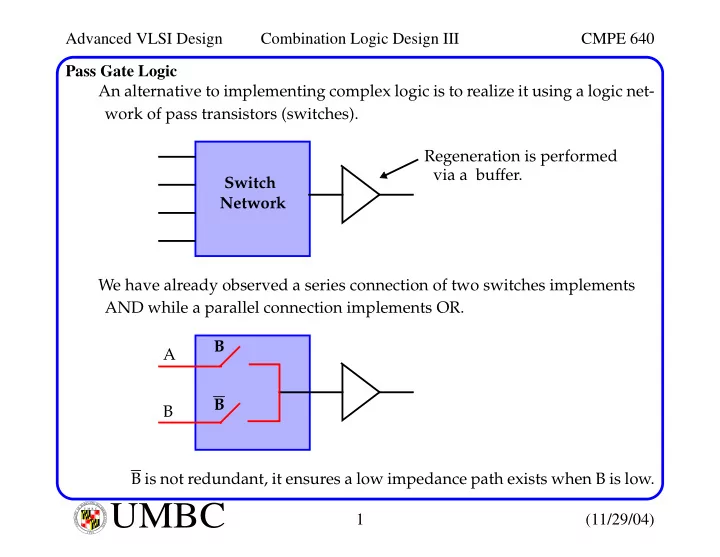
Advanced VLSI Design Combination Logic Design III CMPE 640 Pass Gate Logic An alternative to implementing complex logic is to realize it using a logic net- work of pass transistors (switches). Regeneration is performed via a buffer. Switch


slide-1
SLIDE 1

Advanced VLSI Design Combination Logic Design III CMPE 640 1 (11/29/04)

UMBC

U M B C U N I V E R S I T Y O F M A R Y L A N D B A L T I M O R E C O U N T Y 1 9 6 6

Pass Gate Logic An alternative to implementing complex logic is to realize it using a logic net- work of pass transistors (switches). We have already observed a series connection of two switches implements AND while a parallel connection implements OR. B is not redundant, it ensures a low impedance path exists when B is low. Switch Network Regeneration is performed via a buffer. A B B B

slide-2
SLIDE 2

Advanced VLSI Design Combination Logic Design III CMPE 640 2 (11/29/04)

UMBC

U M B C U N I V E R S I T Y O F M A R Y L A N D B A L T I M O R E C O U N T Y 1 9 6 6

Pass Gate Logic Advantage: fast and simple. Complex gates can be implemented using minimum number of transis- tors, which also reduces parasitics. Static and dynamic performance depends on a switch with low parasitic resistance and capacitance. Therefore, pass gate networks are often constructed from bi-directional transmission gates. A C C B A B C C Transmission gate

slide-3
SLIDE 3

Advanced VLSI Design Combination Logic Design III CMPE 640 3 (11/29/04)

UMBC

U M B C U N I V E R S I T Y O F M A R Y L A N D B A L T I M O R E C O U N T Y 1 9 6 6

Pass Gate Logic Both transistors are important: Here, Mn turns off when VB reaches (5 - VTn) or approximately 3.5V! Note, the VTn is increased due to the body effect. This reduces the noise margin and increases static power dissipation. Also, the resistance of the switch increases dramatically when the out- put voltage reaches Vin -VTn (linear mode). The combination of both an PMOS and NMOS avoids this problem but requires that the control and its complement be available. C=5V A=5V B CL Mn M1 M2

slide-4
SLIDE 4

Advanced VLSI Design Combination Logic Design III CMPE 640 4 (11/29/04)

UMBC

U M B C U N I V E R S I T Y O F M A R Y L A N D B A L T I M O R E C O U N T Y 1 9 6 6

Pass Gate Logic Transmission gates can implement complex gates very efficiently Design Issues:

  • Resistance.

S S S A B 2-to-1 MUX requires 6 transistors F = (A*S + B*S) A B B B B A XOR XOR requires 6 transistors A=5 C=0 C=5 B CL Parallel connection of resistances Rn and Rp Rn = (VDD - Vout)/In Rp = (VDD - Vout)/Ip Currents are dependent on Vout and operation region

slide-5
SLIDE 5

Advanced VLSI Design Combination Logic Design III CMPE 640 5 (11/29/04)

UMBC

U M B C U N I V E R S I T Y O F M A R Y L A N D B A L T I M O R E C O U N T Y 1 9 6 6

Pass Gate Logic Design Issues

  • Resistance (cont).

During the low-to-high transition, the pass transistors pass through sev- eral operation modes. As VGS is always equal to VDS, the NMOS is either in saturation or off. The VGS of the PMOS is VDD, and the device changes from saturation to linear.

  • Vout < |VTn|: NMOS and PMOS saturated.
  • |VTp| < Vout < VDD - VTn: NMOS saturated, PMOS linear.
  • VDD -VTn < Vout: NMOS cutoff, PMOS linear.

It is important to incorporate the body effect when computing Ip and In. The expression for the resistance of a pass gate without the body effect. Req 1 kn VDD VTn – ( ) kp VDD VTp – ( ) +

slide-6
SLIDE 6

Advanced VLSI Design Combination Logic Design III CMPE 640 6 (11/29/04)

UMBC

U M B C U N I V E R S I T Y O F M A R Y L A N D B A L T I M O R E C O U N T Y 1 9 6 6

Pass Gate Logic Design Issues

  • Resistance (cont).

Simulated values of : Req is relatively constant at 10 kΩ so a constant resistance switch model is reasonable. Req Rp Rn || = R (kΩ) 10 20 30 1 2 3 4 5 Rn Rp 5V 0V 5V Vout Req

slide-7
SLIDE 7

Advanced VLSI Design Combination Logic Design III CMPE 640 7 (11/29/04)

UMBC

U M B C U N I V E R S I T Y O F M A R Y L A N D B A L T I M O R E C O U N T Y 1 9 6 6

Pass Gate Logic Design Issues

  • Delay

In order to analyze the response, let’s replace the pass gates with Reqs. Delay is found by solving a set of differential equations of the form: 5 5 5 5 V1 Vi-1 Vi Vi+1 Vn-1 Vn C C C V1 Vi-1 Vi Vi+1 Vn-1 Vn C C C Req Req Req Req C C C t ∂ ∂Vi 1 ReqC

  • Vi

1 +

Vi

1 –

2Vi – + ( ) =

slide-8
SLIDE 8

Advanced VLSI Design Combination Logic Design III CMPE 640 8 (11/29/04)

UMBC

U M B C U N I V E R S I T Y O F M A R Y L A N D B A L T I M O R E C O U N T Y 1 9 6 6

Pass Gate Logic Design Issues

  • Delay (cont).

An estimate of the dominant time constant at the output of n pass gates: Propagation delay is proportional to n2! For large n, it is better to break the chain every m switches and insert buffers: Total delay assuming buffer delay is tbuf is: τ Vn ( ) CReqk

k = n

CReq n n 1 + ( ) 2

  • =

= Vn C C C Req Req C C C m m tp 0.69 n m

  • CReq

m m 1 + ( ) 2

  • n

m

  • 1

–     tbuf + 0.69 CReq n m 1 + ( ) 2

  • n

m

  • 1

–     tbuf + = =

slide-9
SLIDE 9

Advanced VLSI Design Combination Logic Design III CMPE 640 9 (11/29/04)

UMBC

U M B C U N I V E R S I T Y O F M A R Y L A N D B A L T I M O R E C O U N T Y 1 9 6 6

Pass Gate Logic Design Issues

  • Delay (cont).

Here, delay exhibits only a linear dependence on the # of switches n. The optimal number of switches, mopt, between buffers is found: As tbuf increases, the number of switches grows. In current technologies, mopt is typically 3 or 4. For example, assume Req = 10kΩ, C = 10fF, and tpbuf = 500ps. This yields an optimal value of m equal to 3.8. Therefore, a buffer every 4 transmission gates is suggested. m ∂ ∂tp = mopt 1.7 tpbuf CReq

  • =
slide-10
SLIDE 10

Advanced VLSI Design Combination Logic Design III CMPE 640 10 (11/29/04)

UMBC

U M B C U N I V E R S I T Y O F M A R Y L A N D B A L T I M O R E C O U N T Y 1 9 6 6

Pass Gate Logic Design Issues

  • Transistor sizing

Pass gate logic family is a member of the ratioless logic class. The dc characteristics are not affected by the sizes. Performance, to the first order, is not impacted by changing the W/L. Increasing the size reduces the resistance, but this is offset by the increase in diffusion capacitance. Therefore, minimum sized devices should ALWAYS be used, unless the chain drives a significant external load capacitance. In this case, ordering transistors from largest to smallest in the pass gate chain will help reduce delay. This is analogous to the argument given earlier for logic gate transis- tors close to the output.

slide-11
SLIDE 11

Advanced VLSI Design Combination Logic Design III CMPE 640 11 (11/29/04)

UMBC

U M B C U N I V E R S I T Y O F M A R Y L A N D B A L T I M O R E C O U N T Y 1 9 6 6

NMOS-Only Transmission Gate Disadvantages of pass gate:

  • Requires both NMOS and PMOS, in different wells.
  • Both true and complemented polarities of the control signal needed.
  • Parallel connection of both transistors increases node capacitance.

Therefore, an NMOS-only version is advantageous. Problems:

  • Reduced noise margins due to the threshold voltage drop.
  • Static power consumption.

C=5V A=5V B CL Mn M1 M2

slide-12
SLIDE 12

Advanced VLSI Design Combination Logic Design III CMPE 640 12 (11/29/04)

UMBC

U M B C U N I V E R S I T Y O F M A R Y L A N D B A L T I M O R E C O U N T Y 1 9 6 6

NMOS-Only Transmission Gate One solution is to add a PMOS device, called a level restorer. The output of the inverter is "feedback" as a control signal. It turns on when the inverter output goes low (Vout < VDD - |Vtp|) and restores node X to VDD. This eliminates the static power consumed. However, the size of the PMOS transistor is important, since a conflict is cre- ated during switching. For example, assume node A=0, storage node X=VDD and B=0->1. A conducting path exists from VDD-Mr-Mn-M3-GND. B A X Mn M1 M2 Mr Level restorer M3 M4 5V

slide-13
SLIDE 13

Advanced VLSI Design Combination Logic Design III CMPE 640 13 (11/29/04)

UMBC

U M B C U N I V E R S I T Y O F M A R Y L A N D B A L T I M O R E C O U N T Y 1 9 6 6

NMOS-Only Transmission Gate Let Rr, Rn and R3 represent the resistances of transistors Mr, Mn and M3. If Rr is too small, it will be impossible to bring node X below VM. This is called the writability problem, used in reference to feedback cir- cuits. Let’s simplify the analysis of finding the switching point by grounding Mr’s input (open the feedback loop). Assume Mr is in linear mode, Mn is in saturation and VA is close to GND. I is set by (3), which allows VA to be found via (1) and then VB as a func- tion of the k-parameters (the objective). I k3 VDD VTn – ( )V A = (linear) I kn 2

  • VB

V A VTn – – ( )2 = I kr VDD VTp – ( ) VDD VM – ( ) VDD VM – ( )2 2

= (for VX = VM) (1) (2) (3)

slide-14
SLIDE 14

Advanced VLSI Design Combination Logic Design III CMPE 640 14 (11/29/04)

UMBC

U M B C U N I V E R S I T Y O F M A R Y L A N D B A L T I M O R E C O U N T Y 1 9 6 6

NMOS-Only Transmission Gate Let’s set the condition that VB < VDD -- in other words, some value of VB less than VDD will set VX < VM (which allows the inverter to switch). Assume the sizes of M3 and Mn are identical and VDD=5V, VTn=|VTp|=0.75V and VM=2.5V: The boundry condition for this constraint to be valid is m = kn/kp > 1.55. Smaller values do not allow the inverter to switch. Using a value of 3 is reasonable, which amounts to making the NMOS pass gate transistor equal to PMOS restoring device. What about performance? Adding the level restorer increases the capacitance at VX. Also, the rise time of the inverter is slowed due to the fight. VB 3.87 kr kn

  • 1.76

kr kn

  • 0.75

5V ≤ + + =

slide-15
SLIDE 15

Advanced VLSI Design Combination Logic Design III CMPE 640 15 (11/29/04)

UMBC

U M B C U N I V E R S I T Y O F M A R Y L A N D B A L T I M O R E C O U N T Y 1 9 6 6

NMOS-Only Transmission Gate However, the fall time is improved slightly. A second method of implementing NMOS-only pass gate networks is to change VT (if your manufacturer supports it). A zero VT transistor for Mn (a natural device) is one possibility. This logic style is called Complementary Pass-Transistor Logic (CPL).

  • 1.0

1.0 3.0 5.0 2 4 6 t (nsec) Vout (V)

  • 1.0

1.0 3.0 5.0 2 4 6 t (nsec) Vout (V) Without With VB Without With

slide-16
SLIDE 16

Advanced VLSI Design Combination Logic Design III CMPE 640 16 (11/29/04)

UMBC

U M B C U N I V E R S I T Y O F M A R Y L A N D B A L T I M O R E C O U N T Y 1 9 6 6

CPL Examples: Properties:

  • They are differential circuits.

Eliminates inverters and allows minimal implementations, e.g., XOR.

  • CPL is static (low impedance connection to VDD and GND).
  • VT (including body effect) is reduced to below |VTp|, eliminating static

power in successor gates.

  • The design is modular -- all gates use exactly the same topology.

F=AB A B A B B B G=AB F=A+B A B A B B B G=A+B F=A+B A A A A B B G=A+B

slide-17
SLIDE 17

Advanced VLSI Design Combination Logic Design III CMPE 640 17 (11/29/04)

UMBC

U M B C U N I V E R S I T Y O F M A R Y L A N D B A L T I M O R E C O U N T Y 1 9 6 6

CPL The main disadvantages is that turning off a zero-VT device is hard (plus it has a reduced noise margin). Note that a 4-input NAND requires three 2-input NANDs + buffer for 14 transistors, which is > 8 for the full complementary version! The applicability of CPL is strongly dependent on the logic function to be implemented, e.g. 2-transistor XOR good for multipliers and adders. CPL is extremely fast and efficient. Routing overhead is significant however. 0V 5V 0V 5V