ULI Public/Private Partnerships Workshop Tuesday, May 7, 2019 - - PowerPoint PPT Presentation

uli public private partnerships workshop
SMART_READER_LITE
LIVE PREVIEW

ULI Public/Private Partnerships Workshop Tuesday, May 7, 2019 - - PowerPoint PPT Presentation

ULI Public/Private Partnerships Workshop Tuesday, May 7, 2019 8:30 am 3:30 pm HCDA 1 st Floor Community Room 547 Queen Street, Honolulu Public Private Partnerships: Tools for TOD, Affordable Housing, Revitalization Charles A. Long


slide-1
SLIDE 1

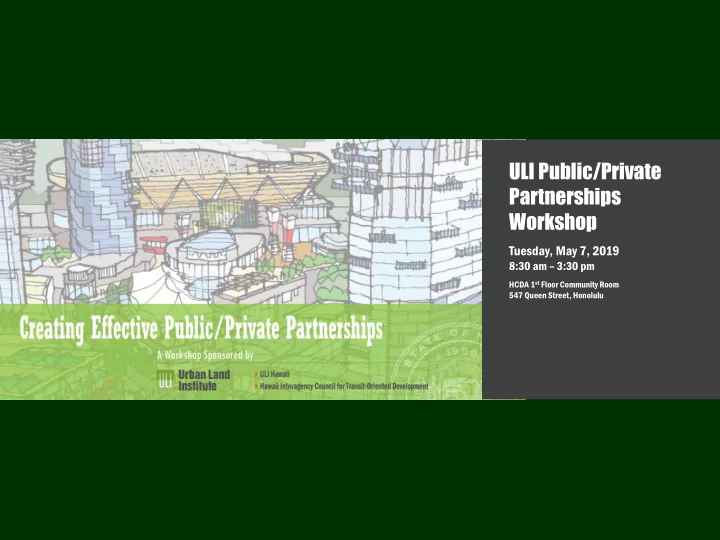
ULI Public/Private Partnerships Workshop

Tuesday, May 7, 2019

8:30 am – 3:30 pm

HCDA 1st Floor Community Room 547 Queen Street, Honolulu
slide-2
SLIDE 2

Urban Land Institute PPP Workshop

Public Private Partnerships: Tools for TOD, Affordable Housing, Revitalization

Honolulu, HI May 7, 2019

Charles A. Long Junction Properties, LLC

slide-3
SLIDE 3

Outline for today

I. Introductions / Objectives II. The development process and real estate finance III. Public Private Partnerships: why are they now a critical tool for community vitality? IV. The tools of public private partnerships V. Doing a deal!

Urban Land Institute PPP Workshop

slide-4
SLIDE 4

Charles A. Long Junction Properties, LLC 775-742-9166 Charles@Junctionprops.com

  • Developer specializing mixed use development in California
  • Consultant on redevelopment, capital finance and economic

development

  • Instructor for ULI Real Estate School on development process,

public-private partnerships and sustainable development

  • Former city manager of Fairfield and interim manager in

Mammoth Lakes, Hercules and Pinole, CA

  • Author of “Finance for Real Estate Development “ published

April 2011. Winner of 2012 Silver Award, NAREE

  • Served on 18 ULI advisory panels, chairing panels in Salem

OR, Boise, ID, Dallas, TX, Buffalo, NY, Pasco County, FL, San Bernardino, CA

  • Masters in Public Policy, UC Berkeley; platoon sergeant, US

Army

Urban Land Institute PPP Workshop

slide-5
SLIDE 5

Under construction-Two Uptown Oakland Projects

Urban Land Institute PPP Workshop

slide-6
SLIDE 6

Finance for Real Estate Development

published by ULI April 2011 Winner NAREE Silver Award 2012

Urban Land Institute PPP Workshop

slide-7
SLIDE 7

Panel

PPP in Hawaii:

Opportunities & Challenges

Jon

  • n W

Wal allenstrom

Principal Alaka‘i Development

Chris K s Kinimaka ka

Public Works Manager State Dept of Accounting & General Services

Stanf anfor

  • rd Carr

President Stanford Carr Development LLC

Harri rriso son Rue

Community Building & TOD Administrator City Dept of Planning & Permitting

slide-8
SLIDE 8

The Challenges to successful Public Private Partnerships

Urban Land Institute PPP Workshop

slide-9
SLIDE 9

Public Private Partnerships pending on Oahu

Mayor Wright Homes Redevelopment Aloha Stadium Redevelopment HART: 21 Transit Stations East Kapolei Master Development Plan

Urban Land Institute PPP Workshop

slide-10
SLIDE 10
  • 1. Connection to transit
  • 2. Financing and delivery
  • 3. Housing Renewal
  • 4. Affordable Housing
  • 5. Placemaking
  • 6. Anti-Displacement
  • 7. Community acceptance

Key Issues

10

Urban Land Institute PPP Workshop

slide-11
SLIDE 11
  • 1. The basics of real estate finance to be able to

conduct an open and transparent negotiation process.

  • 2. The work flow to successful partnerships.
  • 3. Who you need to have on your team.
  • 4. The 8 tools of public private partnerships and the

resources needed to effectively deploy these tools.

  • 5. How to craft a fair and validated deal that is

supported by the community.

Learning Objectives: For you to understand:

11

Urban Land Institute PPP Workshop

slide-12
SLIDE 12

Introductions

  • Your objectives from this course

Urban Land Institute PPP Workshop

slide-13
SLIDE 13

13

  • II. The Development Process and

Real Estate Finance

Urban Land Institute PPP Workshop

slide-14
SLIDE 14

Development is…

a separate self financing enterprise that goes from small to large.

  • 14

Urban Land Institute PPP Workshop

slide-15
SLIDE 15

The Development Process has three phases

Urban Land Institute PPP Workshop

slide-16
SLIDE 16

Six areas of focus

Urban Land Institute PPP Workshop

Site acquisition, conditions and cost Construction cost and management Market Dynamics Design and Configuration

Community (Entitlement, time, costs, stakeholders)

Financing/ Capital Stack

Success in PPP requires work in these six dimensions

slide-17
SLIDE 17

80% to 90% of project value is created in the pre-development phase

17

Acquisition, design, entitlement, financing, risk management

Project Value

Urban Land Institute PPP Workshop

slide-18
SLIDE 18

Pre-development Risk

18

Funding for pre-development comes primarily from developer capital. Entitlement—Site Assembly—Cleanup Developers avoid opportunities with high pre- development risk and cost.

Urban Land Institute PPP Workshop

slide-19
SLIDE 19

Questions

  • 1. Why do developers have the highest risk of

losing money before construction starts?

  • 2. What implications does this risk profile have for

the public sector for creating a public private partnership?

  • 3. What are the six areas of focus to effectively

manage a real estate project?

Urban Land Institute PPP Workshop

slide-20
SLIDE 20

Real Estate Investment is based on an adequate return.

Value - Costs = Return

How much return is needed for a project to be financially viable?

Urban Land Institute PPP Workshop

slide-21
SLIDE 21

A viable project has a value sufficient to:

1. attract debt and equity to fund all project costs (including cost of capital) and 2. compensate the developer for skill and time

Urban Land Institute PPP Workshop

slide-22
SLIDE 22

Value – Cost =Return

which pays:

  • Cost of debt: interest on a construction loan

(variable rate 4% to 6.5%)

  • Return on equity: return to investors (15% to

20%)

  • Developer profit: based on project

performance after paying costs of capital.

Urban Land Institute PPP Workshop

slide-23
SLIDE 23

Return depends on:

  • Market conditions
  • Pricing of existing product
  • Rents, cycle, etc.
  • Investor underwriting criteria
  • Distribution of costs over the project
  • Time to start and to construct
  • Leverage—debt costs less than equity

Urban Land Institute PPP Workshop

slide-24
SLIDE 24

THE REAL ESTATE ___________

Political / Physical / Economic Opportunities & Constraints

CAPITAL THE MARKET ___________ USERS DEBT SOURCE: Lenders EQUITY SOURCE: Owners and Investors PUBLIC SECTOR AGENCIES DEVELOPER __________ OPERATOR FUNDS FUNDS

Basic Financing Structure Involving Debt and Equity

PUBLIC PARTICIPATION

COMMODITY AND/OR VALUE SALE, LEASE, OR OCCUPANCY $

ENTITLEMENT TAXES AND FEES

DEBT SERVICE RETURN RETURN VISION, SKILLS PRE-DEVELOPMENT, REQUIRED CO- INVESTMENT CONSTRUCTION AND PERMANENT DEBT FINANCING PRE-DEVELOPMENT AND PERMANENT EQUITY FINANCING

  • 24

Urban Land Institute PPP Workshop

slide-25
SLIDE 25

Capital funding categories Debt

Equity

  • Return from project performance
  • Paid in tiers (the waterfall)
  • Much higher return than debt
  • Funds before debt
  • The value-add play
  • Return from interest rate and from

performance

  • Pays an interest rate
  • Costs less than equity
  • Secured by a lien on the property
  • Amount based on LTV, LTC or DCR
  • Lender can foreclose if not paid
  • Construction and permanent loans

Mezzanine or performing debt

Urban Land Institute PPP Workshop

slide-26
SLIDE 26

Real Estate Development is Capital Intensive

Cost of Capital 10% to 35% Land 5% to 15% Construction and Fees 60% to 80% Equity 30% to 40%

Debt 60% to 70%

Example

  • Apartment project takes 24 months to

complete

  • 60% leverage—debt at 5%, equity at 20%
  • Cost of capital = 20% of other projects

costs

Urban Land Institute PPP Workshop

slide-27
SLIDE 27

80% leverage on a project that costs $10 million and produces $12 million in valuation after 2 year construction

Urban Land Institute PPP Workshop

Debt $8.0 million Equity $2.0 million Repay bank loan plus interest: $8,560,000 2 year construction effective loan period 1 year

Investor/developer Distribution $3,440,000

31.1%

Leveraged rate of return

Costs

Sales or Value

80% Leverage

Unleveraged rate of return=9.5%

Higher % Debt (higher leverage) reduces cost of capital and increases return to Equity.

slide-28
SLIDE 28

60% leverage on a project that costs $10 million and produces $12 million in valuation after 2 year construction

Urban Land Institute PPP Workshop

Debt $6.0 million Equity $4.0 million

Repay bank loan plus interest: $6,420,000 2 year construction effective loan period 1 year Investor/developer Distribution $5,580,000

18.11%

Leveraged rate of return

Costs

Sales or Value

60% Leverage

Unleveraged rate of return=9.54%

slide-29
SLIDE 29
  • Pre-tax Internal Rate of

Return(IRR)

– Leveraged – Unleveraged

  • Net Present Value

– Present Value of cash flow (if equal to investment=IRR)

Project return is expressed many different ways

  • 29

Use Return on Cost for project feasibility evaluation.

  • Net operating

income/Total cash cost (the “Development Cap”)

  • Return on Cost

Urban Land Institute PPP Workshop

slide-30
SLIDE 30

The return on cost measures whether a project is viable

First, what is the blended cost of capital?

Example Cost of equity: 20% per year (30% of costs) = 6% Cost of debt: 5% per year (70% of costs) = 3.5% TOTAL ANNUAL COST OF CAPITAL = 9.5% If a project takes 2 years to construct, the cost of capital is: 9.5% per year or a total of about 20%.

Urban Land Institute PPP Workshop

slide-31
SLIDE 31

The minimum required cash-on-cash return is the “hurdle rate” based on blended cost

  • f capital and duration of development

period

1-year: about 10% 2-years: about 20% 3-years: about 30%

Urban Land Institute PPP Workshop

slide-32
SLIDE 32

Income projects (retail, office, apartments, etc.) Net Operating Income divided by a “cap rate”

Valuing a real estate project

32

For Sale Project (primarily residential) Net Sales

Urban Land Institute PPP Workshop

slide-33
SLIDE 33

FINANCING DEVELOPMENT COSTS

Legal

Developers Fee

Construction Cost Land/Infrastructure

  • .

A&E Construct Interest. Equity Private Debt Gap

  • =
  • OPERATIONS

OPERATING EXPENSES

NET OPERATING INCOME (NOI)

DEBT SERVICE

OPERATING CASH FLOW (OPCF)

= (Maintenance, Management, Taxes, Insurance) + Utilities + Replacement Reserves

= Rent +Other Income

  • Vacancy

Private debt based on Debt Service Coverage Ratio OR Loan-to-Value OR Loan-to-Cost Ratio

= Periodic Return to Investors

Economics of Income Property Development and Ownership

GROSS INCOME

  • 33

Urban Land Institute PPP Workshop

slide-34
SLIDE 34

Value of an “income” project.

  • e. g. apartments, offices, retail stores, industrial

buildings, hotels, business parks…; i.e. real estate with a Net Operating Income.

  • 34

Project Value = NOI Capitalization Rate Project Value OR: NOI Capitalization Rate=

Urban Land Institute PPP Workshop

slide-35
SLIDE 35

Value an income stream based on two parameters:

  • Net Operating Income (NOI): The stabilized annual

income resulting from Gross Rental income and maintenance charges (Gross Operating Income) less maintenance, taxes and insurance.

  • Capitalization Rate or Cap Rate: A real estate “term
  • f art”, expressed as a percentage, indicating current

market conditions for valuing a project.

35

Urban Land Institute PPP Workshop

slide-36
SLIDE 36

The cap rate indicates how the market values a stream of income (NOI)

  • 36

Or, the same NOI with a different

  • property condition
  • sector
  • Regional and local market
  • capital market conditions

has a different value, and that difference is reflected by the “all in” market indicator called a “cap rate”.

Urban Land Institute PPP Workshop

slide-37
SLIDE 37

Oahu: wide variation in cap rates

Urban Land Institute PPP Workshop

Source: Apartment Loan Store, April 29, 2019

slide-38
SLIDE 38

What is the project value?

NOI Cap Rate

$3,000,000 5% $3,000,000 6% $2,000,000 4% $2,000,000 5%

How is the difference in value reflected in the percentage increase between the low and high cap rate?

  • 38

Urban Land Institute PPP Workshop

slide-39
SLIDE 39

Cap rate P/E Ratio 2% 50 3% 33 4% 25 5% 20 6% 16.7 And, is the same type of market indicator—i.e. an indicator of investor preferences.

Cap rate is the inverse of the P/E ratio used in the stock market

  • 39

Urban Land Institute PPP Workshop

slide-40
SLIDE 40

S&P 500 PE ratio is up from its historical average of 15.67

  • 40

Source: multpl web site

Urban Land Institute PPP Workshop

slide-41
SLIDE 41

General Electric 15.87 Microsoft 22.42 Starbucks 26.70 Amazon 273.99

Other stock P/E ratios

  • 41

What does a high P/E (or low cap rate) signal about investor expectations on income?

Source: NASDAQ web site

Urban Land Institute PPP Workshop

slide-42
SLIDE 42

$61 billion market value $7 billion annual sales P/E Ratio: current (47.05) Projected 2019 79.59 Cap rate of 1.26% $57.4 billion market value $166 billion annual sales P/E Ratio: 6.39 Cap rate of 15.65%

Tesla General Motors

Urban Land Institute PPP Workshop

slide-43
SLIDE 43

Web sites where you can track cap rates by region, sector and investor type

  • CBRE https://www.cbre.com/research-

and-reports

  • Real Estate Research Council

www.rerc.com

  • Real Capital Analytics

http://global.rcanalytics.com/

  • National Council of Real Estate

Investment Fiduciaries (NCREIF) http://www.ncreif.com

  • Reis: http://www.reis.com/index.cfm

Urban Land Institute PPP Workshop

slide-44
SLIDE 44

“Hurdle rate” can be used to determine the “Feasible Project Costs ”

Feasible Project Costs = Project Value 1 + hurdle rate

  • 44

Urban Land Institute PPP Workshop

slide-45
SLIDE 45

Pop quiz What is the Feasible Project Cost?

Project Value Hurdle Rate

$36,000,000 20% $39,000,000 30% $50,000,000 25% $60,000,000 25%

  • 45

Urban Land Institute PPP Workshop

slide-46
SLIDE 46

Residual Land Value is:

The price that the project can afford. THE DEVELOPMENT VALUE. BASED ON: A realistic cost pro-forma and project valuation.

46

How much is land is worth? What you can use it for.

Urban Land Institute PPP Workshop

slide-47
SLIDE 47

Residual land value is the land component of feasible project costs.

MINUS Costs without land =Residual land value

Project Value

1 + hurdle rate

Feasible Project Costs

47

Urban Land Institute PPP Workshop

slide-48
SLIDE 48

A realistic pro-forma includes:

  • 1. A realistic estimate of PROJECT VALUE
  • 2. A realistic estimate of PROJECT COSTS

a) Land (at what the project can afford) b) Hard costs c) Fees and Allowances d) Architecture and Design e) Other “soft costs”

f) Contingency: (10-15% in early stages)

Return below the “hurdle” is the “funding gap”

Urban Land Institute PPP Workshop

slide-49
SLIDE 49

The Simple Pro-Forma

Urban Land Institute PPP Workshop

slide-50
SLIDE 50

Urban Land Institute PPP Workshop

slide-51
SLIDE 51

Urban Land Institute PPP Workshop

slide-52
SLIDE 52

If Feasible Project Costs are less than Actual Costs, there is a gap.

Feasible Project Costs

The gap is the deficit between actual costs and the Feasible Project Cost

Urban Land Institute PPP Workshop

Actual Costs

minus

<

slide-53
SLIDE 53

The GAP

Soft Costs Land Construction and Fees

Land

Urban Land Institute PPP Workshop

Feasible Project Cost

Construction and Fees

No Gap

Project Financeable with private capital Soft Costs

slide-54
SLIDE 54

Closing the “Gap” How Much?

Project value=$120 million Feasible Project Cost=$100 million Total Development Costs= $110 million The “Gap”=$10 million

Assistance from:

  • Tax increment financing
  • Tax credits
  • Land “write-down”
  • Lower city requirements for

infrastructure or fees

City “Upside”:

  • Profit Sharing, “net” revenue
  • Often difficult to monitor
slide-55
SLIDE 55

Questions

1. How is the value of a project estimated? 2. How does the value of the project determine the “feasible project costs”? 3. What is the difference between actual costs and feasible project costs called?

Urban Land Institute PPP Workshop

slide-56
SLIDE 56
  • II. Why are Public Private

Partnerships so critical for community vitality

Urban Land Institute PPP Workshop

slide-57
SLIDE 57

Public Private Partnerships are critical for contemporary development. But they are hard to do.

Dead shopping malls Airport redevelopment Community revitalization Transit Oriented Development

Urban Land Institute PPP Workshop

slide-58
SLIDE 58

Stapleton Airport Redevelopment Denver, CO

  • 12,000 Homes and Apartments
  • 10 Million SF Office
  • 3 Million SF Retail
  • Over 1,100 acres of regional

parks and open space

  • $620 million of infrastructure financed

with PPP

  • New Airport Approved 1988 and
  • pened in 1995.
  • Stapleton Redevelopment

Foundation formed 1990 funded by $3M philanthropic contributions

  • Planning 1989-1995: 5 Principles
  • Environmental Responsibility
  • Social Equity
  • Economic Opportunity
  • Physical Design
  • Implementation

Urban Land Institute PPP Workshop

slide-59
SLIDE 59

Silver Spring Town Center “I will revitalize Silver Springs or die trying”

County Manager, Montgomery County, MD

Silver Spring, MD

1. Catalyzing Value Creation

  • American Film Institute
  • Discovery Channel

2. Costs

  • Parking
  • Re-do of streets/utilities

3. Site Assembly

  • Acquisition w threat of

condemnation 4. Entitlement

  • Streamlined approval

based on specific plan

Urban Land Institute PPP Workshop

slide-60
SLIDE 60

Del Mar Station, Pasadena, CA

  • Joint project of Urban Partners,

Archstone, and LA Metro

  • 1,200 space underground

parking for all uses.

  • Restoration of historic train

depot.

  • 11,000 sf of retail
  • 347 units residential
  • Construction of all components

took place simultaneously.

Urban Land Institute PPP Workshop

slide-61
SLIDE 61

Cost

  • $240 million private

Size

  • 163,000 sf office
  • 231,000 sf retail
  • 205 residential units
  • 2,000 parking spaces

Public participation enhanced value and “closed the gap”

  • $8.9 million in infrastructure
  • $8.0 million in greenway/land acquisition
  • $17 million from property tax rebates

Metropolitan (Charlotte, NC)

Mixed use redevelopment Pappas Properties

Urban Land Institute PPP Workshop

An old Rouse Shopping Mall revitalized

slide-62
SLIDE 62

Mission Bay, San Francisco, CA

  • 303 Acres-old rail yard
  • 11,000 new residents
  • 31,000 new jobs
  • Biotech research labs
  • Public transit links and open space
  • Site cleanup and $400 million of infrastructure

(Financed with “land secured” and TIF bonds) UCSF campus land donation required by Mayor Willie Brown

slide-63
SLIDE 63

Catalyzing value

Urban Land Institute PPP Workshop

63

Uptown, Oakland, CA

  • 665 rental units; 25

percent affordable

  • New, one half acre park
  • $160 million private

cost

  • $50 million public

investment

Part of Jerry Brown’s 10,000 initiative Fundamental change in Downtown Oakland

slide-64
SLIDE 64

Nashville Metro Development and Housing Authority

Urban Land Institute PPP Workshop

slide-65
SLIDE 65

Seattle Housing Authority

Replaced 561 units of affordable housing with:

  • 5,000 residential units
  • 1,800 affordable
  • 65,000 sf for neighborhood

services

  • 1.8 acre park
  • Green street loop
  • Community garden
  • 88,000 sf of retail
  • 900,000 sf of retail
  • 5,100 parking spaces.

Urban Land Institute PPP Workshop

slide-66
SLIDE 66

It takes time and community support

  • 1983 Specific Plan, 1984 Redevelopment Plan
  • Six day planning charrette in

2001—project started construction in 2004

  • Lease of BART surface parking to developer

for 100 years. Revenues estimated at up to $1 billion: 75% to County, 25% to BART.

  • Redevelopment financing for parking

replacement ($45 million), parks, plazas and streets ($12 million)

  • $125 million of housing revenue bonds

Pleasant Hill BART station

Urban Land Institute PPP Workshop

slide-67
SLIDE 67

Entitlement process frequently delays investment

  • More public involvement
  • More review steps
  • Skepticism about density.
  • Development impacts must be

funded

  • Pre-development risk results in

missed opportunities.

Alameda NAS, Alameda, CA

After 20, years “We took a different approach. We were able to streamline the public, community process.” Jennifer Ott, Chief Operating Officer, Alameda Point

Three developers dropped out!

Urban Land Institute PPP Workshop

slide-68
SLIDE 68

Lack of stakeholder consensus

San Francisco Business Times, May 26, 2017

Urban Land Institute PPP Workshop

slide-69
SLIDE 69

Streamline the entitlement process.

Urban Land Institute PPP Workshop

  • Incorporate the vision into the

regulatory framework

  • Comprehensive plan
  • Zoning
  • Development conditions
  • Environmental review
  • Eliminate the project-by-project

gauntlet—projects that meet the standards proceed to design and permit.

  • Base the plan on the market
  • Imbed flexibility (e. g. form

based code) Walnut Creek, CA downtown plan

Livermore, CA downtown specific plan

slide-70
SLIDE 70

Examples:

– Transit – Theater – Golf course – Park – Interchanges – Streetscape – Stadiums – Trails

Co-investment creates development value for public and private sectors

Urban Land Institute PPP Workshop

Union City, CA

  • Intermodal TOD site
  • Community Theater
  • Brownfield site cleaned up

by redevelopment agency Atlanta, GA 45 mile beltline trail on old transit r.o.w. links 45 neighborhoods

slide-71
SLIDE 71

Rancho Solano and Paradise Valley Golf Courses, Fairfield, CA

  • Developer donates land

to the city (180 acres for each golf course)

  • City uses lease revenue

financing for building golf courses

  • Developer captures

increased value of homes build around course.

Urban Land Institute PPP Workshop

slide-72
SLIDE 72

Converting Northland Shopping Mall into a Town Center Plan

Urban Land Institute PPP Workshop

City is still working on market analysis, gap funding estimates and developer selection

Northland Shopping Mall, built 1954 Closed 2015 The Master Plan

slide-73
SLIDE 73

–4 property owners: concerned about to distribute cleanup costs and the connection of costs to value. –Cleanup will increase land value by up to $130 million –Agency to use TIF and land secured bonds to equalize costs and fund infrastructure for access and circulation. Newark, CA 150 acres Industrial site conversion to TOD

Urban Land Institute PPP Workshop

slide-74
SLIDE 74
  • Lower project risks
  • Increase project value
  • Lower the cost of capital
  • Reduce project costs—Fund the gap

Economic Assistance based on evaluating the Risk Profile and Project Economics

Urban Land Institute PPP Workshop

  • Important layer in the capital stack
  • Private capital sources rely on public to meet

underwriting criteria

  • MAKE A FAIR DEAL
slide-75
SLIDE 75

Avoid using the Old Paradigm CLOROX Distribution facility

University Park, Illinois

  • Pure pay-as-you go (90% of

property tax increment)

  • Client has ready access to

capital

  • Self-financed
  • Old structure works and is

the best fit for this Fortune 100 client Courtesy of Richard Klawiter, DLA Piper, Chicago

Urban Land Institute PPP Workshop

slide-76
SLIDE 76

Old Paradigm rarely evaluated whether the incentives made sense economically

– Naked pledge of tax-based, usually incremental, revenue source – Limited "valuing" of the revenue stream by underwriters. – Justified as an “inducement” for private investment. – Public agency doesn’t share in the upside.

Old Paradigm undermines public trust

Urban Land Institute PPP Workshop

slide-77
SLIDE 77

Source: New York Times, Bryce Covert 2/14/19

Urban Land Institute PPP Workshop

slide-78
SLIDE 78

Source: New York Times, Cecilia Kang 2/15/19

Urban Land Institute PPP Workshop

slide-79
SLIDE 79

Source: New York Times, Matthew Haag 3/09/19

Urban Land Institute PPP Workshop

slide-80
SLIDE 80

The New Paradigm of Pubic Private Partnerships

Lakeside Steel Plant site conversion, Chicago, IL

  • 35 million square feet
  • Dwelling units maximum 13,575
  • Commercial Area approximately

17.5 million square feet

Source: Jeffrey Owen, DLA Piper, Chicago

  • Total capitalization $400 million
  • 25% from municipal bonds

Urban Land Institute PPP Workshop

slide-81
SLIDE 81

The New Paradigm

  • 1. Public financing achieves FINANCIAL VIABILITY

using multiple revenue sources where the private sector cannot do so alone.

  • 2. Public sector assembles and cleans up the site with

reconveyance at “residual land value” (FINANCING THE GAP)

  • 3. Public investment receives a FAIR RETURN if overall

returns exceed benchmarks needed for private investment.

  • 4. Public benefits go beyond beating other jurisdictions—

they achieve a COMMUNITY VISION

Urban Land Institute PPP Workshop

slide-82
SLIDE 82

Public Private Partnerships are about achieving Community Benefits

  • Revitalization
  • Jobs/Economic Vitality
  • Anti-Displacement
  • Affordable Housing
  • Placemaking
  • Parks/Open Space
  • Transit Oriented Development
  • Creative Arts Activities Preservation

What benefits are you trying to achieve through PPP?

Urban Land Institute PPP Workshop

slide-83
SLIDE 83
  • Public:

– Weak understanding of the private real estate process and economics – Unrealistic, irresponsible or constraint-driven deal making – Inconsistent and unreliable performance on commitments.

  • Private sector:

– Uncertain about how to craft a partnership with a public entity. – Frustration with process and constraints – Failure to capture opportunities

And yet, neither sector fully understands the other

  • 83

Urban Land Institute PPP Workshop

slide-84
SLIDE 84

Key elements of successful PPP

  • Need an entity to provide leadership for creating the

community-based vision.

  • Streamline the entitlement
  • Foster cooperation and coordination among all

stakeholders.

  • Enhance value through co-investment.
  • Look for catalytic opportunities.
  • Create housing renewal and mixed income
  • pportunities.

Build trust and transparency with the public and your partners

Urban Land Institute PPP Workshop

slide-85
SLIDE 85

MOST IMPORTANT: Be Trustworthy

  • A relationship-based business.
  • Be Value Driven
  • Seek valid information as basis of deciding.
  • Do what you say you will do.
  • Change your mind if the information changes.
  • Explain why.

Urban Land Institute PPP Workshop

slide-86
SLIDE 86

PPP Knowledge and Skills

  • Negotiation
  • Building Trust
  • Real Estate Finance and market dynamics
  • Legal
  • Political
  • Community participation

Urban Land Institute PPP Workshop

slide-87
SLIDE 87

Questions

1. Why are the key parameters of success for a PPP? 2. What challenges do you face in your community for achieving good partnerships? 3. What skills do you want to achieve to be effective?

Urban Land Institute PPP Workshop

slide-88
SLIDE 88

Panel

PPP in Hawaii:

Opportunities & Challenges

Jon

  • n W

Wal allenstrom

Principal Alaka‘i Development

Chris K s Kinimaka ka

Public Works Manager State Dept of Accounting & General Services

Stanf anfor

  • rd Carr

President Stanford Carr Development LLC

Harri rriso son Rue

Community Building & TOD Administrator City Dept of Planning & Permitting

slide-89
SLIDE 89

Halekauwila

slide-90
SLIDE 90

Keauhou Lane

slide-91
SLIDE 91

Keauhou Lane

slide-92
SLIDE 92

Keauhou Lane

slide-93
SLIDE 93

Hale Kewalo

slide-94
SLIDE 94

Panel

PPP in Hawaii:

Opportunities & Challenges

Jon

  • n W

Wal allenstrom

Principal Alaka‘i Development

Chris K s Kinimaka ka

Public Works Manager State Dept of Accounting & General Services

Stanf anfor

  • rd Carr

President Stanford Carr Development LLC

Harri rriso son Rue

Community Building & TOD Administrator City Dept of Planning & Permitting

slide-95
SLIDE 95
  • IV. The tools of

public private partnerships

Urban Land Institute PPP Workshop

slide-96
SLIDE 96
  • Tax Increment bonds
  • Land secured bonds
  • Business

improvement districts

  • Lease revenue bonds
  • GO bonds
  • Tax abatements
  • Sales tax sharing
  • PILOTS
  • Tax credits
  • EB-5
  • Federal and state

grants

Numerous tools—Lots to learn

Urban Land Institute PPP Workshop

slide-97
SLIDE 97

Resources

1. Proactive Predevelopment 2. Create a shared vision 3. Assemble a Development Team 4. Be clear on the risks and rewards for all parties 5. Document a clear and rational decision-making process 6. All parties must do their homework 7. Secure consistent and coordinated leadership 8. Communicate early and often 9. Negotiate a fair deal structure

  • 10. Build trust as a core value

Urban Land Institute PPP Workshop

slide-98
SLIDE 98

Resources

Urban Land Institute PPP Workshop

slide-99
SLIDE 99

The Development Team

▪ Architects ▪ Urban Designers ▪ Engineers ▪ Land Planners ▪ Landscape Architects ▪ Attorneys ▪ Development Advisors ▪ Market Researchers ▪ Finance feasibility consultant ▪ Contractors ▪ Environmental Consultants ▪ Transportation Consultants

  • Designers
  • Expertise/Support

99

slide-100
SLIDE 100

The Lead Entity?

10

  • Leadership
  • Memorandum of Agreement

for alignment.

  • Authority to act
  • Financial capacity
slide-101
SLIDE 101

The flow

Urban Land Institute PPP Workshop

Designate the Lead Entity and Assemble the Team

Create the Vision and Conduct a Market Valuation Select a development partner Evaluate gap financing needs Entitle the project Implement and monitor Negotiate and validate the deal

12 to 18 months—simultaneous tasks 6 to 12 months—simultaneous tasks 6 months

Involve the Community—make the process open and transparent

slide-102
SLIDE 102

The toolkit checklist

1. Lower project risk 2. Increase project value 3. Lower the cost of capital 4. Reduce project costs-Fund the gap

Urban Land Institute PPP Workshop

5. Negotiate and monitor within an environment of trust 6. Select the developer based on qualifications 7. Create alignment 8. Create a Fair, Validated Deal

slide-103
SLIDE 103

#1 Lower Project Risks

Before the developer is involved (if possible):

– Entitlement based on a community vision.

  • Market Analysis

– Assembly and cleanup

  • Land / Eminent

Domain

– Relocation – Demolition

Bellevue, WA

Bellevue was named number 1 in CNN Money's list of the best places to live and launch businesses. It has a top- down and highly integrated land use and transportation planning process.

Urban Land Institute PPP Workshop

slide-104
SLIDE 104

Make the plan real!

  • Is it focused on public

benefits?

  • Does it reflect a

community consensus?

  • Is it connected to a valid

means for accomplishment?

  • Does it recognize market

realities?

Urban Land Institute PPP Workshop

“The reason that everybody likes planning is that nobody has to do anything.” Governor Jerry Brown

slide-105
SLIDE 105

Chapter 201H process streamlines entitlement for affordable housing projects

105

At least 51% affordable—with additional mixed uses allowed. Program instituted through HFDC and recently adopted by City and County of Honolulu. Requires processing of application and public hearing.

Urban Land Institute PPP Workshop

slide-106
SLIDE 106

#2 Increase Project Value

  • Zoning Bonus

– Community Facilities – Transit – Plaza – Affordable Housing

  • On Site
  • Off Site
  • Co-investment
  • Value catalyzation
  • Tax Abatements

Urban Land Institute PPP Workshop

slide-107
SLIDE 107

Zoning Bonuses

Urban Land Institute PPP Workshop

slide-108
SLIDE 108

Tax Abatements—Be careful!

Urban Land Institute Value from Real Estate Development 108

– …(tax) abatement practices go largely unmonitored …and …municipal governments have little incentive to comprehensively assess whether an abatement is necessary to attract development, whether the type of development is needed in the first place or whether the abatement ultimately achieves its desired economic development goals. (New Jersey State Controller)

slide-109
SLIDE 109

#3 Lowering cost of capital

  • 1. Municipal bonds

a) Land secured bonds b) Tax increment bonds c) GO, lease revenue bonds

  • 2. Backup guarantee from

public agency

  • 3. Tax Credits

Urban Land Institute PPP Workshop

slide-110
SLIDE 110

Municipal Bonds

  • A municipal security the interest on which

is excluded from:

– gross income for federal income tax purposes. – state income for tax purposes and

Current rate of 4% for 40 year muni bond financing compared to 5.5% Prime Rate for 20 year term

Urban Land Institute PPP Workshop

slide-111
SLIDE 111

Tax exempt financing lowers cost and increases leverage

Urban Land Institute PPP Workshop

  • Public financing takes many forms
  • Land secured financing for

infrastructure/cleanup

  • Housing revenue bonds
  • Lease revenue financing for facilities
  • Revenue and general obligation

bonds

  • Tax Increment Financing
  • Federal regulations limit use to public

purpose and require compliance with IRS regulations for use of funds.

  • 111

Berkeley Reparatory Theater Lease revenue bond with the Berkeley General Fund as guarantor of debt service.

slide-112
SLIDE 112

Land Secured Bonds: assessment bonds are the primary means of financing infrastructure and cleanup

  • Financing provided by tax exempt bonds

with lower interest rate and longer amortization period.

  • Assessment or annual tax levy repays the

bonds and is passed on to users

  • Delinquencies result in tax lien and

foreclosure

  • BE CAREFUL! ESTABLISH

FINANCING STANDARDS.

  • Private financing subordinates to

public financing.

  • 112

Mission Bay Hunters Point

Urban Land Institute PPP Workshop

slide-113
SLIDE 113

Tax Credits provide equity in return for tax benefits to the tax credit purchaser

Low-Income Tax Credits

  • Affordable rent-

restricted housing

  • $9 billion annual market

– awarded at the state level to specific projects

  • Rigorous compliance

requirements New Market Tax Credits

  • Low-income

communities

  • $3 billion to $4 billion

annually awarded by Treasury Dept.

  • Rigorous compliance

requirements Courtesy of Leslie Eckstein, Wells Fargo Bank Historic Tax Credits

  • Historic preservation
  • Administered by U.S.

Park Service and state preservation

  • ffices
  • Rigorous compliance

requirements

Urban Land Institute PPP Workshop

slide-114
SLIDE 114

Tax Credit Examples

Urban Land Institute PPP Workshop

Market Creek Plaza-San Diego 77,482 sf retail shopping center New Market Tax Credits Argonaut Hotel, San Francisco Rent income supports historic ships Historic Tax Credits Museum of African American Art - Harlem, NY 3 story museum and 20 story residential $19 million of Historic Tax Credits

slide-115
SLIDE 115

#4. Reduce Project Costs (Closing the “Gap”)

“Gap” - The shortfall between actual project cost and it Feasible Project Cost. (the “but for”) Because of:

– Market conditions – Density limits – Project costs:

  • Site acquisition/preparation/conditions
  • Required infrastructure

Urban Land Institute PPP Workshop

slide-116
SLIDE 116

Gap Funding options

– Tax Increment subsidies – Value capture PILOTS – Land write-down – Lower city infrastructure or fee requirements

Urban Land Institute PPP Workshop

slide-117
SLIDE 117

Base Assessed Value= Value of project area when formed

Incremental Assessed Value = Value created from new investment

Property Tax $ Tax Increment $

CITY/COUNTY

Redevelopment Agency Invest in project area w bond proceeds Provide Services

Urban Land Institute PPP Workshop

slide-118
SLIDE 118

Value Capture on Tax Exempt properties

– Payments in lieu of taxes (PILOTS) levied

  • n tax exempt properties.

– Negotiated as part of the project financial analysis with tax exempt landowners. – Subject to annual appropriates process.

Urban Land Institute PPP Workshop

slide-119
SLIDE 119

Land Writedown Buy at appraised value (usually high) Sell at development value (usually lower)

Land Assembly would enhance the development program

Possible 45 Acre site including OCCC

Urban Land Institute PPP Workshop

But: Assembly costs may increase the funding gap

slide-120
SLIDE 120

City credits on fees or infrastructure

Bayfront project Hercules, CA Ferry terminal, train and bus station (Intermodal Transit Center-ITC) City granted a reduction in development impact fees to acquire site of

  • ITC. Only for

development within first 5 years. Project “gap” was $22 million in 2012 Developer owned site of ITC. Normally would have been required to dedicate site.

  • http://www.herculesbayfront.com/

Site is old munitions factory.

Urban Land Institute PPP Workshop

slide-121
SLIDE 121

#5 Negotiate and Monitor the deal

 Negotiate a fair disposition and development agreement  Terms: sale or lease price  Performance  Amount of assistance  Profit-sharing  Doomsday scenarios  Present a public third party analysis evaluating the fairness of the deal.  Monitor performance responsibilities and financial results

Pinole Valley Shopping Center Renovation of a 70,000 square foot neighborhood shopping center built in the 1960’s.

Urban Land Institute PPP Workshop

slide-122
SLIDE 122

Pinole Valley Shopping Center

Pinole, CA

  • Agency purchased site from foreclosure along with two gas stations for $7.3 million

in 2004.

  • Ground leased site to developer for 80% of net cash flow (NOI after debt service)
  • Developer obtained financing to renovate the center based on the Agency land value

serving as the equity.

  • With sale, Agency receives 80% of net proceeds ($10 million) in

2012 after paying off permanent loan. Monitoring the deal was essential!

Renovation of a 70,000 square foot neighborhood shopping center built in the 1960’s.

Urban Land Institute PPP Workshop

slide-123
SLIDE 123
  • Don’t treat the process as a hard bargaining

situation

  • Know your project economics and don’t make

concessions you can’t afford.

  • Build the relationship of trust
  • Build community ownership

Negotiation is about problem-solving

Urban Land Institute PPP Workshop

slide-124
SLIDE 124
  • Understand the local public information laws.
  • Disclose to an outside 3d party consultant
  • Recognize that the final deal must meet the
  • pen book requirement.
  • Don’t be ashamed about return requirements

Sharing Proprietary information

Urban Land Institute PPP Workshop

slide-125
SLIDE 125

#6: Developer Selection

 Select the developer with RFQ not RFP-

  • nce selected execute an Exclusive

Negotiating Agreement (ENA)  “Who” you partner with is just as important as the development plan.  Build trust during the negotiation process.  Provide for joint decision-making to insure alignment of interest.  The Developer must co-invest in the project

Urban Land Institute PPP Workshop

slide-126
SLIDE 126

Developer Selection Process

Urban Land Institute PPP Workshop

slide-127
SLIDE 127

Urban Land Institute PPP Workshop

Sharp Wrinkly Wide Ropy Tubular Flappy

#7: Alignment

slide-128
SLIDE 128

Who?

  • 1. City Departments—Economic development, Planning,

Public Works, Building, Fire

  • 2. Community groups.
  • 3. Adjacent cities/ the County
  • 4. State housing
  • 5. State transportation department.
  • 6. State toxic substance department
  • 7. Federal transportation/transit

Urban Land Institute PPP Workshop

slide-129
SLIDE 129

#8: Make a Fair Deal

  • 1. Public Sector must analyze the “Cost
  • f Public Incentives” and compare to

the ”Benefit value of the project”

  • 2. VALIDATE the deal publicly with an
  • utside 3d party.
  • 3. Public agency must SHARE IN

RETURN in excess of that needed to attract private capital.

  • 4. It’s not about beating other

jurisdictions—it’s about achieving COMMUNITY VISION

Urban Land Institute PPP Workshop

slide-130
SLIDE 130

Ultimately, this is about governance

  • Have a shared vision for the future---build a community

consensus.

  • Set clear, predictable and high development standards.
  • Develop the competence to understand constraints and
  • pportunities in real estate economics.
  • Build partnerships with the private sector based on

fiduciary principles that protect the public interest.

  • Have strong leaders and committed citizens

Urban Land Institute PPP Workshop

slide-131
SLIDE 131
  • 1. Make deals based on the real estate, not wishful

thinking: Validate the deal based on the real estate economics and on

what the markets will actually support.

  • 2. Build trust and ownership: Who is involved in the

partnership is as critical as what the project is. Developers and communities need to take the time to use the “open book” and to develop relationships of consistency and trust.

  • 3. Do the hard work competently: Public private partnerships

are complicated and require resilience and persistence to accomplish. They require a competent team on both sides of the table who take the time and effort to craft complex deals.

Public Private Partnerships require:

Urban Land Institute PPP Workshop

slide-132
SLIDE 132

Questions

1. What are the leadership challenges for PPP in Hawaii? 2. What public benefits are critical for PPP in Hawaii?

Urban Land Institute PPP Workshop

slide-133
SLIDE 133
  • V. Preparation: OCCC-a catalyst to

renewal in Kalihi

Urban Land Institute PPP Workshop

16 Acres

slide-134
SLIDE 134

In 2017, the State Office of Planning planning process resulting in the “21st Century Kalihi Transformation Initiative”

Urban Land Institute PPP Workshop

  • “economic development and housing for the support and betterment of

Kalihi’s current and future generations. The Initiative supports innovation and capacity building and takes a balanced approach in creating jobs and providing housing so the people who live in the area can continue to live and work in Kalihi and enhance the quality of life for future generations. Mixed-income and mixed-housing types would be provided including affordable, workforce, low income and kupuna housing as well as market rate and larger 2-3 bedroom units to support families and multiple generations.

slide-135
SLIDE 135

All market Rate

Urban Land Institute PPP Workshop

slide-136
SLIDE 136

Return-All Market Rate

Urban Land Institute PPP Workshop

slide-137
SLIDE 137

20% Affordable Rate

Urban Land Institute PPP Workshop

slide-138
SLIDE 138

Questions

Urban Land Institute PPP Workshop

1. How should the State work with the community to determine a viable development program? What factors should determine which agency should lead the planning and development process? 2. How should a developer be engaged to partner with and address the final design, risks and financial issues in the project? 3. What are the risks that this development opportunity presents and how can the community mitigate those risks? 4. What options exist for increasing project value to the State and developer? 5. What options could lower the cost of capital and address the gap funding required for the mixed income project requiring higher levels of affordable housing? 6. How should the size of the gap be validated and sources explored that could be used to fund it? 7. How should the community be involved in addressing these questions?

slide-139
SLIDE 139

Summing up

  • 1. What have you found useful about today’s

discussion in terms of how you approach fostering high quality development?

  • 2. What approaches to PPP do you think

Oahu should consider?

  • 3. What would you suggest ULI do to

enhance the ability of jurisdictions to do PPP?

Urban Land Institute PPP Workshop

slide-140
SLIDE 140

Mahalo

from the TOD Council!

Wit With sp special th thanks nks to ULI LI H Hawai awaii for th r their s r supp pport